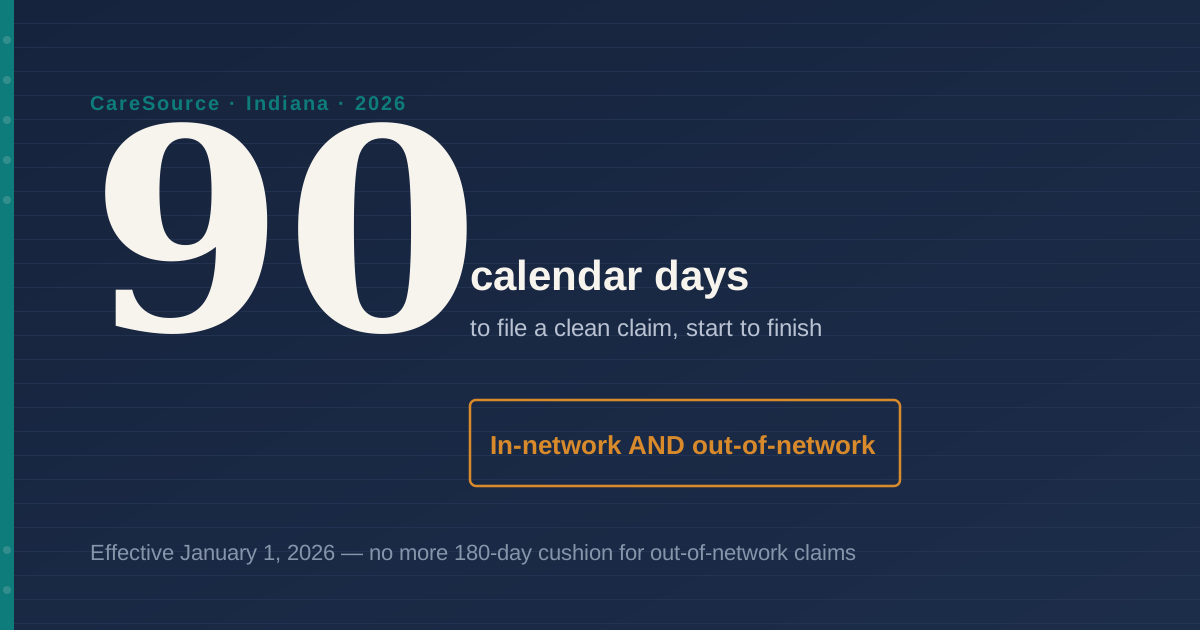
If you bill CareSource in Indiana, one number should be sitting at the top of your payer grid right now: 90 calendar days. That’s the CareSource Indiana timely filing limit for every claim filed on or after January 1, 2026 and, for the first time, it applies whether your practice is in-network or completely outside CareSource’s contracted network. The old 180-day cushion for out-of-network claims is gone.
That single change has already produced a wave of CO-29 denials across Indiana billing teams that were still working off last year’s numbers. This guide lays out every CareSource Indiana deadline in one place initial claims, corrected claims, coordination of benefits, disputes, and appeals along with the documentation that actually gets a wrongly denied claim reprocessed, and the workflow changes that keep a 90-day window from ever becoming a write-off.
The Short Answer: CareSource Indiana Timely Filing at a Glance
| Claim Action | Deadline | Clock Starts |
|---|---|---|
| Initial claim, in-network (HHW/HIP Medicaid) | 90 calendar days | Date of service or discharge |
| Initial claim, out-of-network (Medicaid) | 90 calendar days (reduced from 180, effective 1/1/2026) | Date of service or discharge |
| Initial claim, Marketplace | 90 calendar days | Date of service |
| Corrected claim after a denial | 90 calendar days | Original date of service (clock does not reset) |
| Corrected claim after an incorrect payment | 60 calendar days | Receipt of the Explanation of Payment (EOP) |
| Secondary/COB claim | 90 calendar days | Primary payer’s EOP date |
| Claim dispute (HHW/HIP) | 60 calendar days | Receipt of the EOP or written determination |
| Claim dispute (Marketplace) | 90 calendar days | Receipt of the EOP |
| Claim appeal | 60 calendar days | Resolution of the dispute (dispute must be completed first) |
| External review | 120 calendar days | Appeal determination |
Keep this table on the wall next to your aging report. A single “CareSource = 90 days” line in a payer grid isn’t enough anymore there are effectively six different clocks hiding under one payer name, and each one starts on a different event.
What Actually Changed on January 1, 2026
Before this year, out-of-network providers in Indiana had roughly twice as long to file as in-network providers 180 days versus 90. CareSource closed that gap through network notification IN-MED-P-5700252, issued July 21, 2026 and approved by Indiana’s Office of Medicaid Policy and Planning (OMPP) on July 15, 2026 — but made retroactive to January 1, 2026. The stated reason is compliance with the Medicaid state plan requirement at 42 CFR § 447.45(d)(4), which sets the federal ceiling for timely filing across state Medicaid programs.
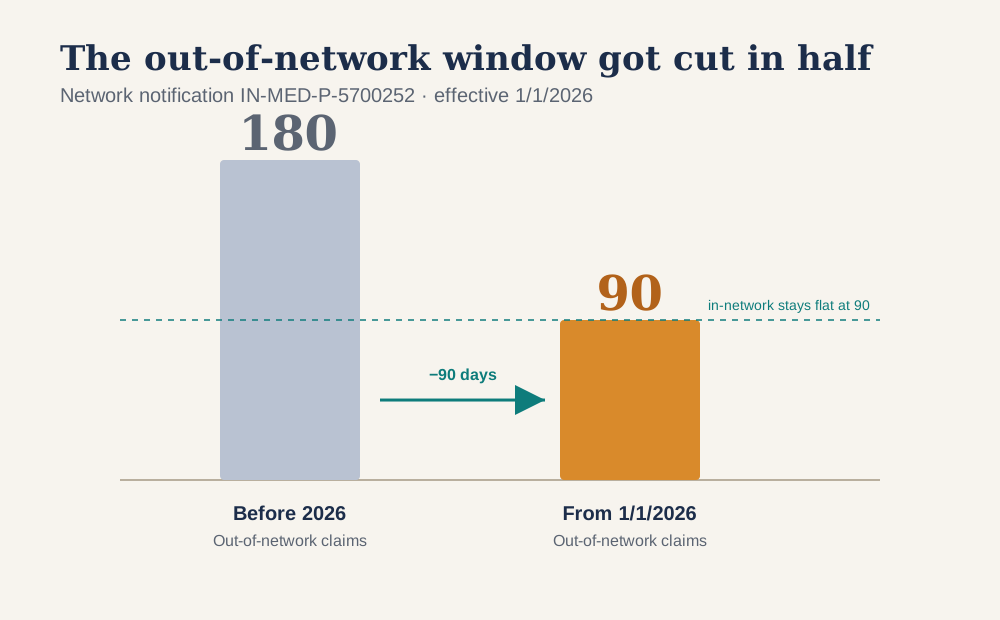
Two practical consequences follow directly from that notice:
- Any group billing CareSource without a signed contract is now exposed on a 90-day clock, not 180. Hospital-based anesthesia, pathology, radiology, and emergency medicine groups that routinely see CareSource patients at facilities where they aren’t personally credentialed are the most exposed, because their filing window just got cut in half without any change to their internal process.
- Timely filing is explicitly waived when member eligibility is updated retroactively. This is the strongest exception CareSource has published, and it’s frequently missed a retroactive eligibility correction that arrives after a claim has already been written off as untimely is grounds to refile, not a reason to leave the balance on the books.
Because the notice took months to publish after its effective date, you’ll still find 180 days referenced in older CareSource provider manual language and in some third-party payer directories. Where a network notification conflicts with older manual text, the notification governs claims for the date-of-service range it covers. When in doubt, confirm the current figure directly on CareSource’s Indiana provider updates and announcements page before you calendar a deadline off a document that may predate this change.
Why “90 Days” Isn’t the Same 90 Days for Every Claim
Indiana runs CareSource Medicaid covering Hoosier Healthwise (HHW) and the Healthy Indiana Plan (HIP) — and CareSource Marketplace as two separate contracts with separate provider manuals, separate dispute timelines, and separate update histories. Both currently land on 90 days for an initial claim, but they diverge the moment you move past the first submission:
- Marketplace disputes get 90 calendar days from the EOP.
- HHW/HIP disputes get only 60 calendar days.
- Marketplace appeals are sometimes quoted at 365 days in CareSource’s multi-state materials that figure does not apply in Indiana. The Indiana Medicaid appeal window is 60 days from dispute resolution, full stop.
If your payer grid has one row labeled “CareSource IN,” you’re one plan mix-up away from a preventable denial. Split it into at least two rows Medicaid and Marketplace with separate columns for initial, corrected, dispute, and appeal deadlines.
Medicaid Managed Care vs. Fee-for-Service: Don’t Mix Up the Windows
A second, unrelated source of confusion: Indiana Medicaid fee-for-service (billed directly through the state’s IHCP system) runs on a 180-calendar-day filing limit, per IHCP Bulletin BT201829. CareSource is a managed care entity operating under its own contract, not fee-for-service, and its 90-day window controls whenever a member is actually enrolled with CareSource. Run eligibility at every visit not just at intake since Indiana reassigned a large volume of members to remaining managed care plans after MD wise exited the state’s Medicaid program on January 1, 2026. A patient who was fee-for-service or on a different plan last year may now be CareSource, and billing them on the wrong plan’s timeline is an easy way to lose a claim that was otherwise clean.
When Does the Clock Actually Start?
This is where a lot of otherwise careful billing teams lose days without realizing it.
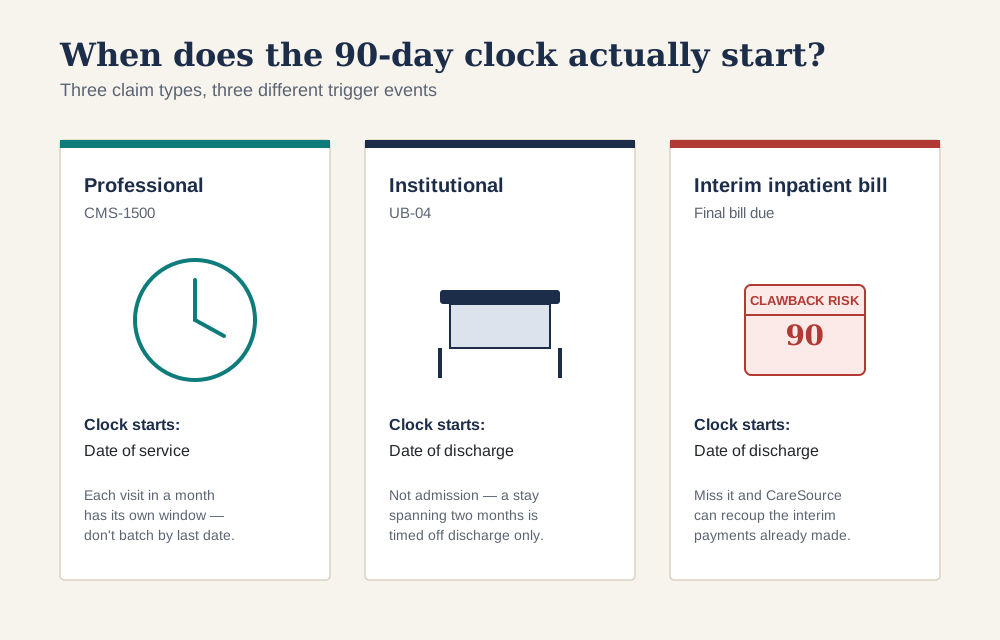
- Professional claims (CMS-1500) run from the individual date of service. A month of recurring visits does not share one clock each date of service starts its own 90-day window, so batching a month of encounters and filing them all against the last visit date will let the earliest ones expire unnoticed.
- Institutional claims (UB-04) run from the date of discharge, not admission. A stay that begins in one month and ends in the next is timed entirely off the discharge date.
- Interim inpatient bills are a special case: the final, complete bill still has to reach CareSource within 90 calendar days of discharge, or CareSource can deny the final claim and recoup the interim payments already made turning a filing miss into a clawback on money you were already paid.
- Secondary claims, where CareSource pays after another carrier, don’t run from the date of service at all once the original window has lapsed. They run from the primary payer’s EOP date — covered in detail below.
Corrected Claims: Two Different Deadlines Depending on What Went Wrong
CareSource treats a corrected claim differently depending on why the original claim needs fixing, and mixing these up is one of the more expensive mistakes a billing team can make.
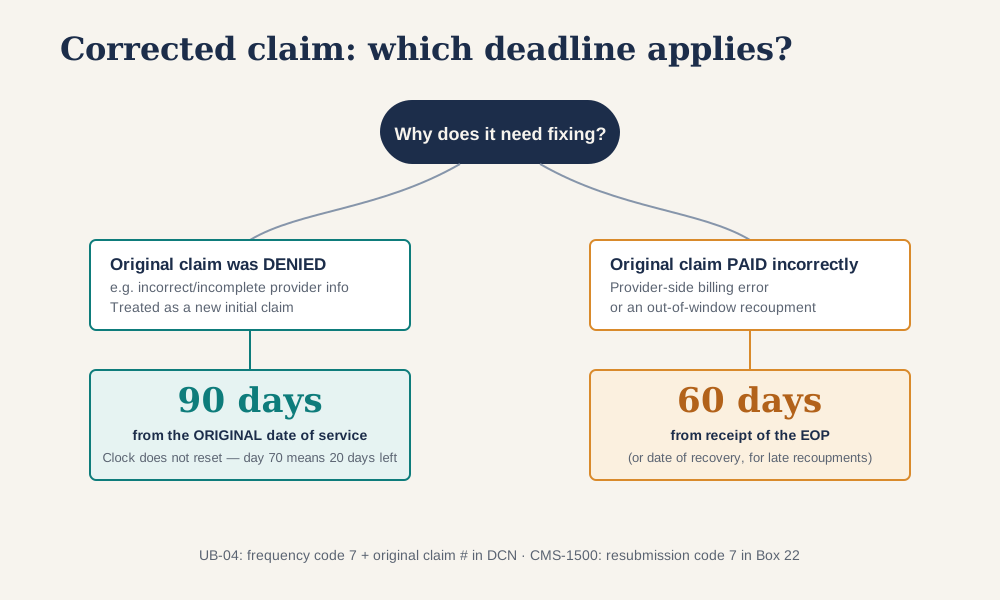
If the original claim was denied — for example, for incorrect or incomplete provider information the resubmission is treated as an initial claim for adjudication purposes. That means it’s still bound by the full 90-day window measured from the original date of service. Correcting the claim does not restart the clock. If the original claim denied on day 70, you have 20 days left, not a fresh 90.
If the original claim paid, but paid incorrectly because of a provider-side error, CareSource gives you 60 calendar days from receipt of the EOP to submit a corrected claim. A related scenario a recoupment that happens outside the original filing window also carries a 60-day corrected-claim deadline, measured from the date of the recovery.
Formatting matters here too. On the UB-04, use frequency code 7 in the Type of Bill field, with the original claim number entered as the Document Control Number. On the CMS-1500, enter resubmission code 7 in Box 22, with the original claim number on the same line. Submit a correction without that information and CareSource will process it as a brand-new original claim — which can trigger a duplicate-claim denial instead of a correction.
Coordination of Benefits: The Deadline That Runs on Someone Else’s Timeline
When another carrier is primary and CareSource pays second, the standard 90-day-from-date-of-service clock stops being the relevant number.
- If you’re still inside the original filing window when you learn about the other coverage, submit the secondary claim within whatever time remains on that original window.
- If the original window has already elapsed, CareSource allows 90 calendar days from the primary payer’s EOP date but the claim has to arrive with the primary’s EOP or EOB attached. A secondary claim submitted without that documentation is not considered a clean claim, and CareSource can deny it for timely filing exactly as if it had never been submitted.
If the primary carrier is slow to respond or goes silent, that delay is not, by itself, a timely filing exception. Document your follow-up attempts and submit before your window closes rather than waiting on a determination that may not come in time.
Submitting the Claim: Payer ID, Portal, and Paper
Electronic submission through your clearinghouse is the faster route and, just as importantly, it’s the route that generates the acknowledgment records you’ll need if a claim is ever wrongly denied for timely filing.
- CareSource’s Indiana payer ID is INCS1, used for both Medicaid and Marketplace claims, supporting 837P (professional) and 837I (institutional) transactions.
- Paper claims for Indiana Medicaid go to: CareSource, Attn: Claims Department, PO Box 3607, Dayton, OH 45401-3607. This address is specific to Indiana CareSource operates in multiple states with different addresses, so a multi-state billing operation needs the correct address built into its workflow rather than assumed.
- The CareSource Indiana provider portal (providerportal.caresource.com) handles eligibility, claim status, disputes, and appeals in one place, and Provider Services can be reached at 1-844-607-2831, Monday through Friday.
A note for groups also enrolling with other payers in the state or region: getting the enrollment paperwork right the first time avoids exactly this kind of filing exposure. If you’re working through provider enrollment elsewhere, our Wisconsin Medicaid provider enrollment guide to the ForwardHealth portal and our complete Ambetter provider enrollment and credentialing guide walk through the same kind of application, effective-date, and network-status details that determine which filing clock applies to a given claim.
A Submitted Claim Is Not the Same as a Filed Claim
This distinction is where a genuinely on-time claim can still end up denied for timely filing.
CareSource and Indiana’s IHCP training materials are consistent on this point: a rejected or voided claim does not protect your filing date. If a claim leaves your clearinghouse on day 40 and bounces back with a rejection on day 45, but nobody opens the rejection report until day 95, CareSource has no record of that claim ever arriving. As far as the timely filing rule is concerned, it was never filed a screenshot of the rejection doesn’t change that.
Two acknowledgment types get confused with each other constantly:
- A 999 confirms only that your electronic batch was syntactically valid. It says nothing about whether the payer accepted the claim.
- A 277CA confirms the payer actually accepted the claim into adjudication. This is the document that proves filing.
Save both, with timestamps, as a matter of routine not just when a denial shows up. If your team only opens rejection reports weekly instead of daily, that gap is usually the real root cause behind a cluster of CO-29 denials, more often than any single biller’s mistake.
CO-29 Denials: What Counts as Proof, and What Doesn’t
CO-29 is the claim adjustment reason code for “the time limit for filing has expired.” You may also see Indiana EOB code 7565 on the accompanying remittance, which reads essentially the same way. The code covers two very different situations, and only one of them is worth appealing:
- The claim genuinely went out after the window closed.
- The claim was filed on time, but CareSource has no record of receiving it.
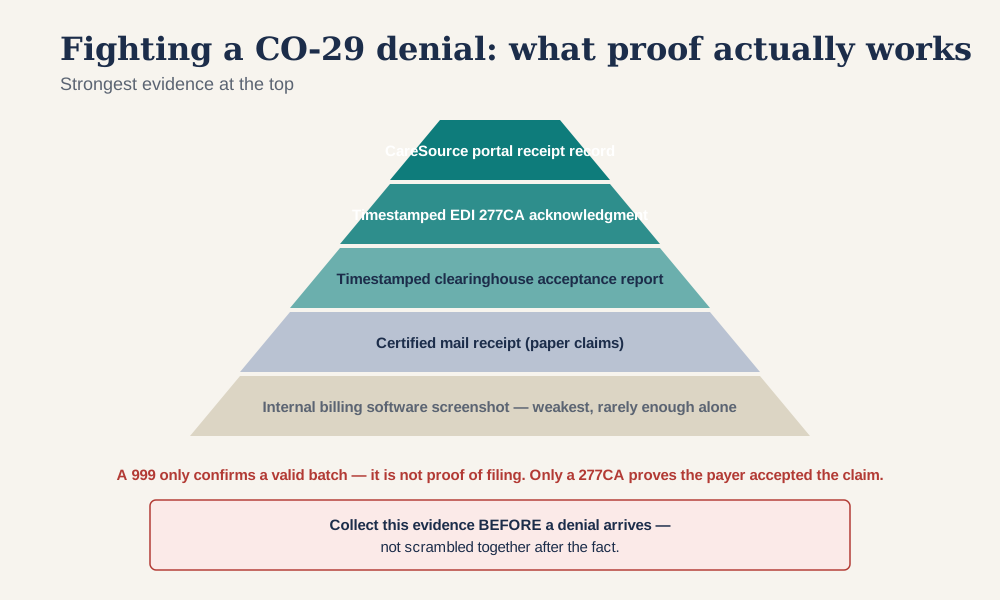
Only the second is recoverable, and it’s recoverable more often than most billing teams assume but only with documentation collected before the denial arrives, not scrambled together after. In order of strength, the evidence that gets a claim reprocessed is: a CareSource portal record showing receipt, a timestamped EDI 277CA acknowledgment, a timestamped clearinghouse acceptance report, a certified mail receipt for paper claims, and weakest of all, and rarely sufficient alone an internal billing software screenshot. CareSource specifically requires proof of original receipt by fax or EDI for a timely filing appeal, so a rejected-claim screenshot will not satisfy the requirement no matter how it’s framed.
Can the patient be billed instead? In most cases, no. Participating provider agreements bar shifting a provider-side timely filing denial onto the member, and Medicaid members carry additional protection against being billed for administrative errors that weren’t theirs. The write-off stays with the practice, which is exactly why prevention is worth more here than recovery.
Disputes and Appeals: Indiana’s Sequential Ladder
Unlike some commercial payers, CareSource Indiana requires disputes and appeals to be filed in a strict order filing an appeal before completing the dispute process gets it rejected outright, while the appeal clock keeps running in the background.
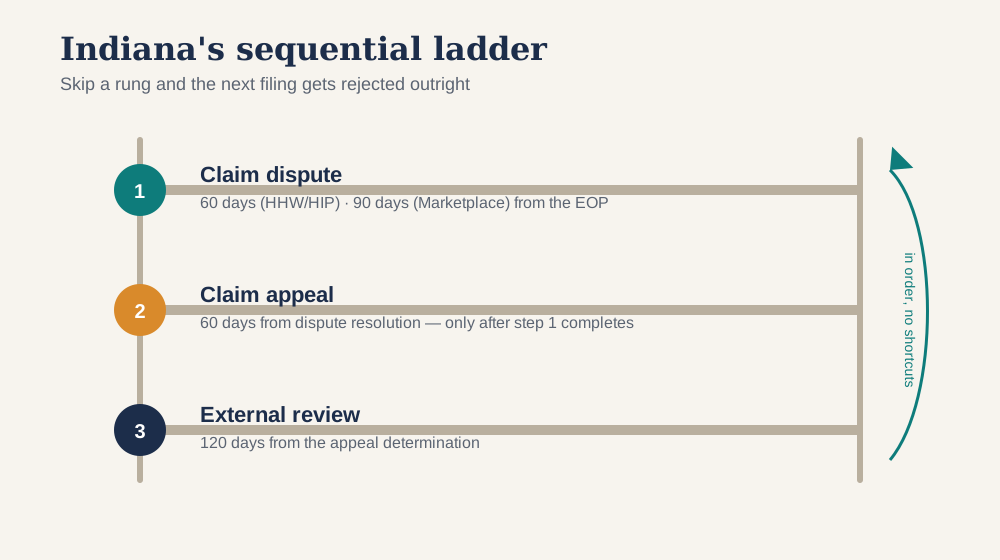
- Claim dispute — within 60 calendar days of the written determination (HHW/HIP) or 90 days (Marketplace)
- Claim appeal — within 60 calendar days of the dispute’s resolution, and only after the dispute is complete
- External review — within 120 calendar days of the appeal determination
Medical necessity denials are handled separately from this ladder as clinical appeals, which run 60 calendar days from the date on the action notice for both pre-service and post-service requests. A peer-to-peer review can be requested, but requesting one does not pause the appeal deadline — file within the window regardless of whether the call has happened.
Facility and Long-Term Care Claims Carry Their Own Traps
Institutional billing for skilled nursing and long-term care adds a layer most outpatient-focused billing teams aren’t used to tracking: place-of-service coding, per-diem billing cycles, and interim bill sequencing all interact with the same 90-day discharge clock described above. Getting the underlying coding wrong compounds the filing risk, since a claim that gets kicked back for a coding correction still has to clear the same window. If your practice bills nursing facility visits, our breakdown of nursing facility CPT codes 99304–99316, POS 31 vs. 32, and the denial patterns tied to them is worth reviewing alongside this guide, since the two issues frequently show up on the same denied claim.
Building a Payer Grid That Actually Catches These Deadlines
A generic “CareSource = 90 days” entry is not a functioning control. A payer grid that holds up needs, at minimum, separate rows for Medicaid in-network, Medicaid out-of-network, Marketplace, and secondary/COB claims each with its own initial window, the specific event that starts the clock, its corrected-claim window, its dispute window, and a “last verified” date. That last column is the one teams skip most often, and it’s the one that keeps the grid honest the next time CareSource issues a notification that changes a number without much fanfare.
A few habits close most of the gap between a 90-day rule on paper and a 90-day rule that actually holds in practice:
- Set an internal deadline well inside the real one. Targeting day 60 instead of day 90 on a CareSource claim leaves 30 days of room to catch and fix a rejection before the real window closes.
- Work rejection reports daily, not weekly. A claim rejected on day 45 and caught on day 46 is a two-minute fix. Caught on day 90, it’s a write-off.
- Age claims by date of service, not date entered, and flag anything crossing 50% and 75% of its filing window automatically rather than relying on someone remembering to check.
- Confirm acceptance in the CareSource portal before considering any claim closed out of your workflow a submission is not a filing until the payer’s system shows it.
How Credexa Solutions Keeps CareSource Claims Inside the Window
Tracking six different CareSource clocks initial, corrected, COB, dispute, appeal, and external review across every patient’s plan type is a full-time discipline, and it’s exactly the kind of work that quietly slips when a billing team is also juggling coding, eligibility checks, and a dozen other payers at once.
At Credexa Solutions, this is the daily job, not an occasional task. We build payer-specific grids for CareSource and every other plan a practice bills, work rejection queues every business day so a claim never sits unopened until its window closes, and maintain the documentation portal receipts, 277CA acknowledgments, EOP timestamps that makes a timely filing appeal winnable instead of a guessing game. When a CO-29 denial does land, we separate the recoverable cases from genuine misses and push the recoverable ones back through CareSource with the proof required to get them reprocessed, rather than writing off a claim that was actually filed on time.
If CareSource claims or claims from any other Indiana or out-of-state payer — are aging out on your books, a look at where they’re stalling in the cycle is worth a conversation. Reach out to Credexa Solutions for a review of your current CareSource claim aging and a walkthrough of how our billing and revenue cycle management process keeps deadlines like this one from ever becoming a write-off.
Frequently Asked Questions
What is the CareSource Indiana timely filing limit in 2026? Ninety calendar days from the date of service or discharge, for both in-network and out-of-network providers, effective January 1, 2026.
Did the out-of-network filing limit really change this year? Yes. It dropped from 180 calendar days to 90, per CareSource network notification IN-MED-P-5700252, issued July 21, 2026 and made effective retroactively to January 1, 2026.
How long do I have to submit a corrected claim to CareSource? It depends on why the original claim needs correcting. A claim denied for provider error and resubmitted is treated as an initial claim and stays on the 90-day window from the original date of service. A claim that paid incorrectly gets 60 calendar days from the EOP date instead.
What’s the CareSource appeal timely filing limit in Indiana? Sixty calendar days after a claim dispute resolves appeals cannot be filed until the dispute process is complete. This differs from figures CareSource publishes in some multi-state materials, which do not apply to Indiana Medicaid.
What is CareSource’s payer ID for Indiana? INCS1, for both Medicaid and Marketplace claims submitted through standard clearinghouses.
Can a patient be billed if a claim is denied for timely filing? In most cases, no. Provider agreements and Medicaid member protections generally bar shifting a provider-side filing error onto the patient.
This guide reflects CareSource Indiana network notifications and IHCP provider training materials current as of September 2026. Filing rules change through payer notifications that aren’t always reflected immediately across every published source verify against your current provider contract and CareSource’s provider portal before treating any deadline as final. For help keeping every payer’s filing clock on track, Credexa Solutions provides full-service medical billing and revenue cycle management built around exactly this kind of deadline discipline.