By the Credentialing Team at CredexaSolutions
Wellpoint provider enrollment is the process a physician, group, or facility goes through to become an in-network participant with a Wellpoint health plan. Two systems drive the whole process: the CAQH Provider Data Portal, which stores your credentialing data, and Availity Essentials, which is where the enrollment application itself gets submitted. Neither system talks to the other automatically, and the requirements shift depending on which state you’re enrolling in and what kind of provider you are.
If you’ve already tried to get started, you may have discovered the first trap on your own. Most practices fill out the “application request” form on Wellpoint’s website, submit it, and assume the credentialing clock has started. It hasn’t. That form is an expression of interest — nothing more. It tells a Provider Relations representative that you exist. It does not open a credentialing file, and it is not part of the formal application for network participation.
That single misunderstanding is responsible for more delayed start dates than any document error, licensing issue, or committee backlog combined.
Wellpoint currently operates provider networks across 12 states, and each state runs under its own legal entity, with its own payer ID and its own contract terms. A group that’s approved and active in Texas has no standing whatsoever in New Jersey — the credentialing standards Wellpoint applies are broadly consistent nationwide, but where you submit, who reviews the file, and what format the paperwork takes will differ from state to state.
This guide walks through the entire path: which channel to use to reach Wellpoint, what CAQH needs before a file can even be opened, the documents that most often stall an application, realistic timelines for each stage, and what to do when a submitted file goes quiet. Every figure cited below is sourced from a Wellpoint publication, a CAQH resource, or federal statute, and the source list appears at the end of this article.
Where to Actually Reach Wellpoint
There is no single Wellpoint provider portal. Enrollment runs through four different channels, and which one applies to you depends on your state and your provider type:
- The digital enrollment gateway at wellpoint.com/provider/enrollment.
- Availity Essentials, accessed through Payer Spaces.
- The CAQH Provider Data Portal at proview.caqh.org.
- State-specific credentialing mailboxes and fax lines
Below is a consolidated reference table. Bookmark it before you start an application, because searching for “Wellpoint provider phone number” tends to send people through a dozen different state landing pages before they land on the right one.
| Need | Channel |
| National enrollment gateway | wellpoint.com/provider/enrollment |
| Availity enrollment path | Payer Spaces → Wellpoint → Applications → Provider Enrollment |
| CAQH registration | proview.caqh.org |
| CAQH Provider help line | 888-599-1771 |
| Wellpoint credentialing team | wlpcred@wellpoint.com |
| Texas facility credentialing | TXCredentialing@wellpoint.com (W-9 required) |
| Tennessee LTSS CHOICES | tnltssprovidercontracting@wellpoint.com |
| Iowa facility/LTSS fax | 1-855-883-9043 |
| Availity Client Services | 800-282-4548 |
| EFT enrollment | enrollsafe.payeehub.org |
| EFT support | Support@payeehub.org |
| Vision network (EyeMed) | eyemedinfocus.com/join, or 1-888-581-3648 |
| Florida providers | Routed to Simply Healthcare Plans |
| Wellpoint Federal (Medicare) | NGSMedicare.com, during the current transition |
A practical pattern we see constantly: a provider submits the online interest form in January, hears nothing for six weeks, and assumes Wellpoint is simply slow. In reality, no file was ever opened, because Wellpoint was waiting on a CAQH profile it had no permission to view. Calling the state-specific credentialing contact tells you within minutes whether a file actually exists — waiting for a callback does not.
Wellpoint, Anthem, Amerigroup, and UniCare — Sorting Out the Brand History
The naming history behind Wellpoint confuses a lot of billing staff, and it’s worth untangling once so you’re not chasing the wrong entity.
Wellpoint is a brand operated by Elevance Health, which used to be called Anthem, Inc. Elevance rebranded its Amerigroup and UniCare plans under the Wellpoint name starting January 1, 2024. Importantly, existing contracts and credentialing files carried over — nobody who was already in-network with Amerigroup had to re-credential simply because the logo changed.
To go one layer deeper: WellPoint Inc. became Anthem Inc. in 2014. Anthem became Elevance Health in 2022. Elevance then revived the retired “Wellpoint” name for its state Medicaid, Medicare Advantage, and commercial lines of business. In other words, the corporate entity that used to be called WellPoint is not the same organization as the plan brand you’re credentialing with today — that’s Elevance, operating under a name it brought back from storage.
For billing purposes, what matters is one level below the consumer-facing brand: Wellpoint issues coverage through separate state legal entities — Wellpoint Texas, Inc.; Wellpoint Iowa, Inc.; Wellpoint New Jersey, Inc.; Wellpoint Tennessee, Inc.; Wellpoint Insurance Company, and others. Each entity has its own contract, and your payer ID is tied to the entity, not to the Wellpoint name on the member’s card.
Is Wellpoint the Same as Amerigroup?
Yes, functionally. Amerigroup plans in Arizona, Iowa, New Jersey, Tennessee, Texas, and Washington took on the Wellpoint name effective January 1, 2024. UniCare in West Virginia followed the same path. Wellpoint has stated that existing agreements stayed in force through the transition and that credentialing processes were unaffected.
What did change is where you go to find information. Provider-facing pages moved to provider.wellpoint.com and wellpoint.com, and the current state selector lists 12 jurisdictions: Arizona, Florida, Iowa, Maryland, New Jersey, New York, South Carolina, Tennessee, Texas, Washington, West Virginia, and Washington, D.C. If you have an old Amerigroup bookmark saved, it’s very likely pointing you somewhere stale.
All three lines of business — Medicaid, Medicare Advantage, and ACA Marketplace — now sit under the single Wellpoint brand, though the enrollment paperwork differs depending on which one you’re joining.
Credentialing, Contracting, and Loading Are Three Separate Steps
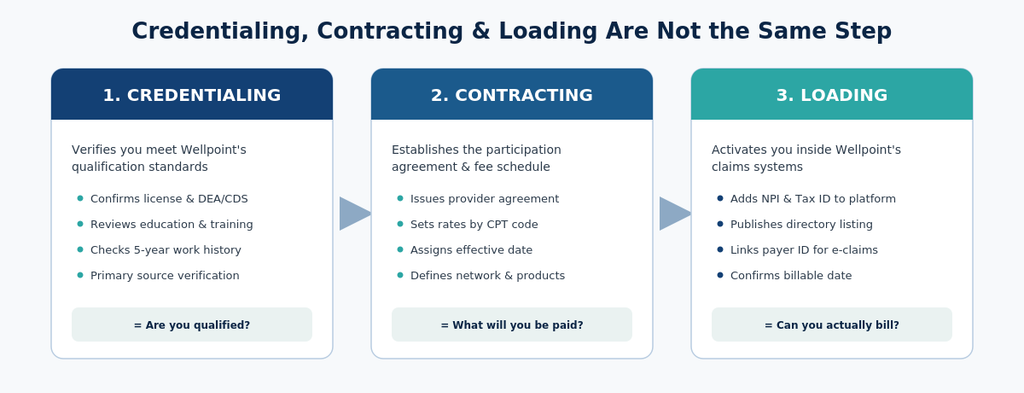
Providers tend to use “credentialing,” “contracting,” and “enrollment” interchangeably. Payers do not, and understanding the distinction saves you from calling the wrong department and asking the wrong question.
Credentialing verifies that you meet Wellpoint’s qualification standards. This stage:
- Confirms your active state license and, where applicable, DEA or CDS registration
- Reviews your education, training, and board certification
- Checks five years of work history and current malpractice coverage
- Requires primary source verification before any decision is made
Contracting establishes the terms under which you’ll actually get paid. This stage:
- Issues the participating provider agreement for signature
- Sets your reimbursement rates by CPT code
- Assigns a contract effective date
- Defines which specific network and product lines you’re joining
Loading is the technical step that activates you inside Wellpoint’s claims systems. This stage:
- Adds your NPI and Tax ID to the claims processing platform
- Publishes your listing in the public provider directory
- Links your payer ID so electronic claims can be submitted
- Confirms the actual date you’re allowed to bill as in-network
Primary source verification, mentioned above, means Wellpoint is contacting your medical school, your state licensing board, and your malpractice carrier directly — not simply accepting what you wrote on the application. Those third parties respond on their own timeline, which is a major reason the review stage runs longer than most providers expect.
Here’s the gap that catches people off guard: your credentialing decision can be fully approved while loading is still sitting in a queue. “We’re approved” and “we can bill” are two different sentences, and conflating them is how practices end up with a stack of unbillable claims for services rendered in good faith. Enrollment, in the fullest sense, isn’t complete until a live payer ID exists and your directory listing is published — not when a credentialing committee votes yes.
The Six-Step Wellpoint Enrollment Process.
Getting from zero to a live payer ID takes six sequential steps. Skip one, and the file stalls — often without any notification telling you which step was missed.
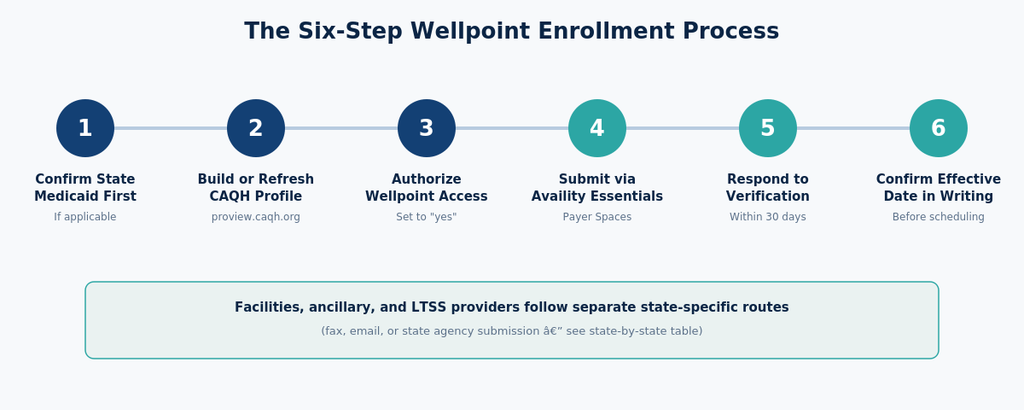
Step 1: Confirm state Medicaid enrollment first, if it applie
If you intend to see Medicaid members, enroll with the state Medicaid agency before you chase the Wellpoint contract itself. In several states, the state Medicaid ID is treated as a hard prerequisite rather than something you can run in parallel. Iowa is explicit about this: an active Iowa Medicaid ID is required before Wellpoint will bring you into the network.
Step 2: Build or refresh your CAQH profile
Register at proview.caqh.org if you don’t already have an active profile. Note that CAQH’s provider-facing platform, long known as CAQH ProView, now also operates under the name DataSpring, powered by CAQH — same login, same underlying data, same URL. If you get stuck, the CAQH Provider help line is 888-599-1771.
Step 3: Authorize Wellpoint to view your CAQH profile
CAQH profiles are private by default. Wellpoint cannot pull your data without explicit authorization, and an application will sit in limbo indefinitely if this step is skipped — with no notice from anyone telling you why. Set your authorization to “yes” for Wellpoint specifically, and double-check that your attestation date is current before moving forward.
Step 4: Submit through Availity Essentials
Log into Availity, select Payer Spaces, choose the Wellpoint entry for your state, and open Provider Enrollment. Because CAQH data auto-populates much of this application, skipping Step 2 or leaving it incomplete is the single most common reason this step fails. Not every provider type is supported through digital enrollment — some will return an outright error, which means you need the alternate route (covered in the state table below) rather than repeated attempts through the portal.
Step 5: Respond to verification requests quickly
This is where primary source verification actually happens. Wellpoint’s credentialing program documentation states that when information can’t be verified, or when a discrepancy turns up, the credentialing department will contact the practitioner within 30 calendar days. Answer inside that window without exception — a file waiting on you is a file that has stopped moving entirely.
Step 6: Get your effective date in writing before scheduling patients
This is the single step that prevents the most write-offs, and it costs you one email. Do not schedule patients under a Wellpoint plan until you have a written confirmation of your contract effective date.
Facilities, ancillary providers, and long-term services and supports (LTSS) providers generally do not follow this same six-step path. Iowa routes them by fax, Texas requires an emailed W-9, and Tennessee uses a joint state application — details on all three appear in the state-by-state section further down.
Documents Wellpoint Requires, and Where Applications Actually Fail
A complete Wellpoint credentialing application requires the following, at minimum:
| Requirement | Detail |
|---|---|
| Signature and date | Must appear on the application itself |
| CAQH status | “Initial Application Complete” or “Reattestation” |
| State license | Active in every state where you provide services |
| Education and training | Documentation supporting your requested specialty, or proof that training completes within 60 days |
| Hospital privileges | Current privilege information, where applicable |
| DEA or CDS certificate | Current, for each state where you provide services |
| Disclosure questions | Written explanations for any “yes” answers |
| Work history | Five years, formatted as month and year |
| Liability insurance | Current professional coverage |
| Site review | Access permitted within 30 days of request, if applicable |
Two specific issues cause more rejections than everything else on this list combined.
Name mismatches. Your name has to match, character for character including suffix, across your CAQH profile, your NPPES registration, and your state license. If a license reads “Robert” and CAQH reads “Bob,” the file gets flagged as a discrepancy before a human reviewer ever looks at the substance of the application.
Documents that expire mid-review. Never submit a certificate or license copy that will lapse before the review window closes. A reviewer looking at your file in week six will not accept documentation that expired in week five, even if it was valid the day you submitted it.
One additional wrinkle worth knowing: Wellpoint’s published “Program Summary” — the document that’s supposed to spell out exactly which provider types are and aren’t credentialed — has, at various points, simply not been posted on the national join-our-network page. Until it’s available, confirm your provider type directly with Provider Relations before you invest time building an application, since ancillary and facility types frequently get routed somewhere entirely different from the standard practitioner path.
Wellpoint also applies a specific rule around DEA registration: if you’ve applied for an additional DEA registration but haven’t received it yet, credentialing may proceed as long as another provider handles controlled-substance prescribing in the interim — but failing to supply the completed registration within 90 days results in termination from the network. Track that 90-day clock the same way you’d track a license renewal.
How Long Wellpoint Credentialing Actually Takes
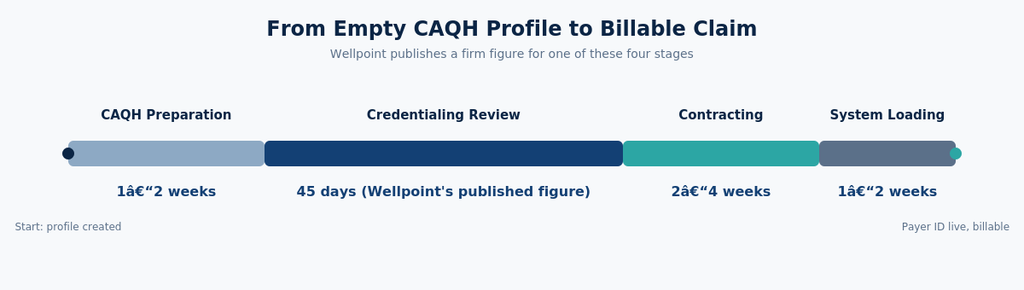
Wellpoint states publicly that credentialing typically takes 45 days from the point its credentialing department receives a complete CAQH-based application. Read that qualifier carefully — the clock starts once the file is complete, not once you click submit. Miss a single required document, and the 45-day window hasn’t started at all, and nobody sends a notice telling you so.
Full network participation runs through four stages, and Wellpoint only publishes a firm number for one of them:
| Stage | What happens | Typical window |
|---|---|---|
| CAQH preparation | Profile built, documents uploaded, attestation completed, Wellpoint authorized | 1–2 weeks |
| Credentialing review | Primary source verification, then a credentialing decision | 45 days (Wellpoint’s published figure) |
| Contracting | Participation agreement issued, signed, returned | 2–4 weeks |
| System loading | Payer ID activated, directory listing published | 1–2 weeks |
The committee cadence explains part of the delay. Wellpoint’s Credentials Committee meets at minimum once every 45 calendar days — a file that lands the week after a meeting has already missed its window and is now waiting for the next one, a timing quirk that’s out of your control and, frankly, out of the payer representative’s control too.
Treat 45 days as an optimistic floor for the review stage alone, not as a full-cycle estimate. Build your provider onboarding and hiring schedule around a longer runway. If your file clears faster, that’s simply a pleasant surprise.
The recurring pattern we see: a practice reads “45 days” on Wellpoint’s website, schedules a new provider’s patients for week seven, and spends month three writing off claims that were never actually billable in the first place. That’s a planning error, and it’s an expensive one, but it’s entirely avoidable if you confirm your effective date before you touch the schedule.
You also have the right to request status updates at any point during credentialing or recredentialing — if you need a status check, email the credentialing team directly rather than waiting for a letter that may never arrive.
State Medicaid Enrollment Is a Separate, Federally Required Step
Federal law requires that states ensure providers in a Medicaid managed care network are separately enrolled with the state Medicaid agency itself. That requirement lives at 42 U.S.C. § 1396u-2(d)(6)(A), and it is entirely separate from Wellpoint’s own network contracting process — in several states, it comes first, as a prerequisite.
The statute specifies the exact identifying data a state has to collect: name, specialty, date of birth, Social Security number, NPI, federal tax ID, and state license or certification number. That’s why your state’s Medicaid portal asks for those specific fields — federal law requires it.
One clarification that tends to relieve providers once they understand it: enrolling with the state Medicaid agency does not obligate you to treat fee-for-service Medicaid patients who aren’t enrolled with a managed care entity. You can complete state Medicaid enrollment, contract with Wellpoint, and still decline unassigned Medicaid patients if that’s your practice’s policy.
Sequencing is where practices lose the most calendar time. Iowa requires an active Iowa Medicaid ID before you can join the Wellpoint network at all. Washington requires you to become a state-approved provider through the Health Care Authority first. A practice that waits for Wellpoint’s approval before starting the state-level process ends up paying for both timelines back-to-back instead of running them concurrently.
The practical fix: run two tracks simultaneously. Track A is state Medicaid enrollment through your state’s own portal. Track B is Wellpoint credentialing and contracting. Start both in the same week, wherever your state’s rules allow it.
Wellpoint Enrollment by State and Provider Type
Routing varies meaningfully by state and by provider type. Most practitioners apply through Availity Essentials once their CAQH profile is authorized. Facilities, ancillary providers, and LTSS providers generally follow a different path — forms, direct email submission, or routing through a separate state agency. Florida is its own case entirely, routed through Simply Healthcare Plans.
| State | Practitioner route | Facility / ancillary / LTSS route |
|---|---|---|
| Texas | Availity digital enrollment | Request for Credentialing or Letter of Interest form, plus a W-9, to TXCredentialing@wellpoint.com. A third-party vendor performs primary source verification. |
| New Jersey | CAQH profile plus the online provider application request form, followed by Provider Relations outreach | Same request form, followed by Provider Relations contact |
| Iowa | CAQH-based application; an active Iowa Medicaid ID is required first | Provider application and W-9 by fax to 1-855-883-9043 |
| Washington | Availity → Payer Spaces → the Wellpoint Washington, Inc. entry | State-approved status through the Health Care Authority required first; vision routes through EyeMed |
| Tennessee | CAQH plus standard credentialing | CHOICES LTSS uses the Joint MCO Universal Application, emailed to tnltssprovidercontracting@wellpoint.com; ECF CHOICES routes through the state Department of Disability and Aging |
| Florida | Routed to the Simply Healthcare Plans signup page | Same routing |
| Maryland | CAQH plus Availity enrollment | Availity Essentials Provider Demographic Management handles post-approval updates |
| Federal (Medicare) | National Government Services now operates as Wellpoint Federal | Continue using NGSMedicare.com portals during the current transition |
Three cross-cutting notes worth flagging. First, a state Medicaid ID is a prerequisite in several states rather than a task you can run in parallel — confirm before assuming you can move on both fronts at once. Second, certain provider types return a “not currently supported by digital enrollment” error inside Availity; that error means you need the alternate route, not another attempt at the same form. Third, Wellpoint’s national commercial page sometimes lists a narrower state footprint than its full provider hub, so confirm which legal entity actually holds your contract before you file anything.
Coverage also shifts over time — Wellpoint exited the District of Columbia Medicaid managed care program during 2026, and claims that cross a plan-transition boundary tend to come back denied as “coverage terminated,” aging in accounts receivable until someone connects the denial to the underlying plan change.
Always verify your specific state’s current page before submitting anything — Wellpoint updates these routes without advance notice, and a route that was correct three months ago may not be correct today.
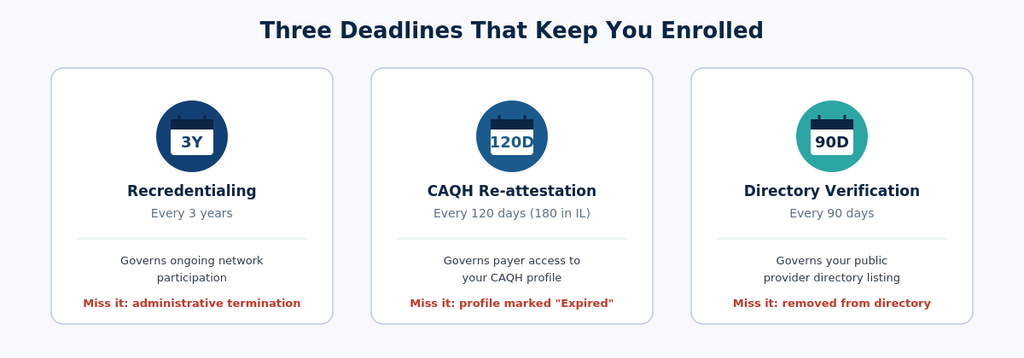
Three Deadlines That Keep Your Enrollment Active
Getting approved is not the finish line. Once you’re in-network, three separate deadlines run on three separate calendars, owned by three separate organizations, and missing any one of them interrupts either your participation or your payment.
| Deadline | Interval | Governs | Consequence of missing it |
|---|---|---|---|
| Wellpoint recredentialing | Every 3 years | Ongoing network participation | Administrative termination from the network |
| CAQH re-attestation | Every 120 days (180 for Illinois) | Payer access to your profile | Profile status changes to “Expired,” halting credentialing |
| Directory verification | Every 90 days | Your public directory listing | Removal from the online directory |
The recredentialing consequence is more severe than most providers assume. If you don’t update your CAQH profile or supply requested recredentialing information by the stated due date, Wellpoint treats the application as incomplete — which results in administrative termination, not a warning letter. Your status flips to out-of-network, and every claim submitted after that date denies.
CAQH’s own re-attestation requirement runs every 120 days (180 for Illinois providers). Many providers respond to CAQH’s quarterly reminder email and end up attesting roughly every 90 days in practice, but the actual requirement is 120. Miss it, and your profile status silently flips to “Expired” — cutting off payer access without any direct notification to you.
The typical failure mode isn’t complicated: a reminder email lands in the inbox of a former office manager who no longer works there, nobody redirects it, and a payer flags the stale data six weeks later, usually when a claim denies. Assign ownership of these three dates to one specific person or system, and start the recredentialing process 90 days ahead of the actual due date rather than on it.
When a Wellpoint Application Stalls or Gets Denied
Here’s something most providers don’t realize: an incomplete Wellpoint application usually doesn’t get denied outright. It simply stalls, silently, with no notification. Remember that the 45-day clock only starts once the credentialing department considers your file complete — an incomplete file just sits.
You do have specific rights here, and most providers never exercise them. You may review the information submitted in support of your own credentialing application, correct anything that’s erroneous, and request a status update at any time. The channel for all of this is wlpcred@wellpoint.com.
Files typically stall for one of a short list of reasons, none of which generate a formal rejection letter:
- A name mismatch between CAQH, NPPES, and the state license
- An expired CAQH attestation, cutting off payer access to the profile
- Authorization never granted, so Wellpoint literally cannot open the file
- A document that expires somewhere inside the review window
- A provider type that the digital enrollment tool doesn’t support
Silence is the common symptom across all five of these. That’s exactly why proactive follow-up beats passive waiting — a weekly check-in habit catches a problem in week two instead of discovering it in month three.
The revenue impact of a stalled file
Services delivered before your contract’s effective date are not automatically billable as in-network care. Some payers allow retroactive effective dates tied back to the original application date; many don’t, and it varies by payer, by state, and sometimes by the individual contract. Never assume retroactive billing will be honored — confirm your effective date in writing before you schedule a single patient under that plan.
While enrollment is still pending, Wellpoint maintains a bridge process for out-of-network care: a Non-Participating and Single Case Agreement registration, submitted through a NonPar Update Form (a process that has been transitioning toward Availity Essentials). This is the legitimate route for a patient who needs care before your contract is fully live.
Then there’s the accounts receivable nobody wants to open. Claims submitted during an enrollment gap deny, sit, and age past the point where anyone on staff remembers why. That’s a payer-routing problem, not a coding problem, and it’s fully recoverable — but only when someone works it systematically by payer and by aging bucket rather than by claim date. A file that hasn’t moved in more than 30 days needs a phone call, not another week of patience.
Setting Up EFT and ERA Once You’re Approved
Once Wellpoint approves your enrollment, two separate setup steps remain, and skipping either one costs you money quietly.
Electronic Funds Transfer (EFT) runs through EnrollSafe at enrollsafe.payeehub.org. Electronic Remittance Advice (ERA) runs through Availity, under My Providers → Enrollment Center → ERA Enrollment. If you work through a clearinghouse, register for ERA through them instead.
These are genuinely two separate enrollments, and practices frequently set up one and assume the other is automatically included — then spend the next quarter posting payments by hand because the 835 remittance file never arrives.
The EFT deposit itself carries a trace number that matches the corresponding 835 electronic remittance advice, which is what lets your practice management system reconcile a deposit against the specific claims it paid. Without that 835, someone in your office is matching deposits to claims manually, line by line.
The detail that costs money without anyone noticing: providers who are not enrolled in EFT may receive payment via virtual credit card instead of a paper check. VCCs process as credit card transactions, meaning your merchant processor takes a cut of every single payment. Finish your EFT enrollment before your first claim goes out the door, not after your first VCC payment lands and you realize what happened.
What Changed for Wellpoint Providers in 2026
A handful of confirmed structural changes affect enrollment this year, and each has already generated avoidable calls to payer services.
CAQH’s ownership structure changed. In January 2026, CAQH converted from a nonprofit structure to a for-profit company owned by a consortium of health plans — meaning the organization that governs your credentialing data is now owned in part by the plans that decide whether you remain enrolled.
CAQH’s platform was rebranded. Starting June 8, 2026, CAQH began operating under the name DataSpring, powered by CAQH. Same login, same underlying profile, same URL at proview.caqh.org — nothing about your data or your existing attestation schedule changed. This rebrand has already caused confusion among billing staff who assumed a new login screen meant a new account was required; it does not.
Out-of-network registration is moving to Availity. The Non-Participating and Single Case Agreement process is in the process of shifting from a downloadable form to full handling inside Availity Essentials.
Wellpoint exited D.C. Medicaid managed care. Claims that straddle this transition period are returning as “coverage terminated” and aging in AR until someone connects the denial pattern to the underlying plan exit.
Check for newer policy notices before relying on any information here — Wellpoint updates its provider-facing pages without advance notice, and the pace of change in 2026 has been noticeably higher than in prior years.
In-House or Outsourced: How to Decide
You can absolutely complete Wellpoint provider enrollment entirely in-house. The application itself costs nothing to submit. The real cost is staff time — building and attesting a CAQH profile, assembling documentation, submitting through Availity, and then calling the payer week after week until a decision actually lands. Practices almost always underestimate the follow-up burden, not the initial paperwork.
Be realistic about the time investment. A first-time CAQH build takes a solid working session. Document collection typically takes longer, since someone has to track down a malpractice certificate or a hospital privilege letter that isn’t sitting in a folder anywhere. Submission itself is fast. What nobody budgets for is the eight-to-twelve weeks of weekly follow-up calls that follow — each one 10 to 20 minutes on hold, repeated for every payer on your enrollment list.
In-house tends to make sense when: you have a single provider joining one or two panels, and an administrator with real bandwidth who has navigated payer portals before. That’s genuinely learnable, tedious work, and paying an outside firm to run two applications is hard to justify financially.
Outsourcing tends to make sense when: you’re enrolling multiple providers across multiple states or multiple payers simultaneously, a file has already stalled and nobody internally knows why, or — the most common scenario we see — the person who owns credentialing also runs the front desk, and credentialing loses that competition for attention every single week the waiting room is full.
At CredexaSolutions, our credentialing team manages the entire Wellpoint enrollment path end to end — CAQH setup and attestation, document assembly, Availity submission, weekly payer follow-up, and ongoing tracking of recredentialing deadlines so they don’t quietly lapse. If you’d like a straightforward cost comparison for your specific situation, reach out and we’ll walk through the numbers with you.
Frequently Asked Questions
How do I become a Wellpoint provider? Register with the CAQH Provider Data Portal, authorize Wellpoint to access your profile, then submit your enrollment application through Availity Essentials under Payer Spaces → Wellpoint → Applications → Provider Enrollment. Facilities, ancillary providers, and LTSS providers use state-specific forms instead, and several states require state Medicaid enrollment as a prerequisite.
How long does Wellpoint credentialing take? Wellpoint states that credentialing typically takes 45 days from the point its credentialing department receives a complete, CAQH-based application. That covers verification and the credentialing decision only — contracting and system loading happen afterward, and CAQH preparation happens beforehand, so full participation takes meaningfully longer than 45 days measured from your actual start date.
Is Wellpoint Medicaid or commercial insurance? Both. Wellpoint offers Medicaid and CHIP plans, Medicare Advantage plans, and individual/commercial plans, depending on the state. Its provider hub currently lists 12 states and territories. Credentialing standards stay largely consistent across lines of business, but the enrollment route itself differs.
Is Wellpoint the same as Amerigroup? Wellpoint is the rebranded identity for plans that previously operated as Amerigroup (and as UniCare in West Virginia). Elevance Health began this rebrand January 1, 2024. Existing agreements stayed in force, and the credentialing process didn’t change — providers already in-network with Amerigroup did not need to re-credential because of the name change alone.
Who owns Wellpoint? Elevance Health operates Wellpoint. Elevance was named Anthem, Inc. until 2022, and Anthem was named WellPoint Inc. until 2014. Elevance revived the retired “Wellpoint” name for its Medicaid, Medicare, and commercial lines. Coverage itself is issued through separate state legal entities, such as Wellpoint Texas, Inc. and Wellpoint New Jersey, Inc.
How often does Wellpoint recredential providers? Every three years. If your CAQH profile is current and complete at that point, little to no extra work may be required on your end. If it’s expired or incomplete, Wellpoint will reach out — and failing to supply the requested information by the stated due date results in administrative termination from the network.
Can I bill Wellpoint before credentialing is finished? You can see patients, but you cannot bill as an in-network provider before your official contract effective date. Retroactive effective dates exist at some payers and not at others — never assume it will apply to you. Confirm your effective date in writing before scheduling, and use a Single Case Agreement as the bridge if a patient needs care sooner.
What happens if my CAQH profile expires? CAQH changes your profile status to “Expired,” and payers lose access to your data entirely. Any credentialing or recredentialing application in progress stops moving, typically without a direct notice from the payer telling you what happened.
Does Wellpoint credential my specific provider type? Wellpoint’s Program Summary is meant to define exactly which provider types are credentialed directly and which are treated as ancillary — but this document has not always been consistently published. Confirm your provider type directly with Provider Relations before applying, since facility and ancillary types often require an entirely different credentialing path.
How much does Wellpoint credentialing cost? Wellpoint itself does not charge providers an application fee. Your actual cost is either internal staff time or an outsourcing fee if you choose to delegate the work.
Can a billing or credentialing company handle Wellpoint enrollment for my practice? Yes. Most of this work — document assembly, portal submission, and persistent follow-up — is fully delegable, since none of it requires clinical judgment. CredexaSolutions handles this process end to end for practices enrolling with Wellpoint and other major payers, including ongoing recredentialing tracking after your initial approval.
Sources
Facts and figures in this guide are drawn from Wellpoint’s published provider enrollment and credentialing pages (including its Join Our Network, Digital Enrollment, and state-specific join-our-network pages for Texas, New Jersey, Iowa, and Tennessee), Wellpoint’s Credentialing Program Summary, Wellpoint Provider News on electronic payments, CAQH’s Provider Data Portal and public resources documentation, and 42 U.S.C. § 1396u-2 as published by the Office of the Law Revision Counsel and the U.S. Government Publishing Office. Wellpoint updates its provider-facing pages without notice, so always confirm state-specific requirements against your own contracted entity before filing an application.
Have a Wellpoint file that’s stalled, or need to get several providers enrolled at once? The credentialing team at CredexaSolutions handles CAQH setup, application submission, and weekly payer follow-up so your applications keep moving instead of sitting in a queue. Reach out for a consultation