If you bill Anthem, one number controls how much of your revenue you keep: 90 days. That is the Anthem Blue Cross timely filing limit for most contracted commercial and Medicare Advantage professional claims, counted from the date of service. Medicaid and Medi-Cal plans give you more room, anywhere from 90 days to 15 months depending on the state, and corrected claims, secondary claims, and appeals each run on separate clocks.
The trouble is that billing teams rarely lose money because they don’t know the number. They lose it because they apply the wrong number to the wrong claim. A Medicaid deadline gets used on a commercial claim, Original Medicare’s one-year window gets used on a Medicare Advantage claim, or a rejected submission sits unread while the days run out.
This guide lays out every Anthem timely filing deadline for 2026, explains how Anthem counts the days, shows what proof wins a CO-29 dispute, and walks through the workflow that keeps claims inside the window. We also show how Credexa Solutions uses accurate coding and structured denial management to stop timely filing write-offs before they start.
Important: Your signed provider agreement outranks every default in this article. Anthem’s own policies say they may be superseded by provider, state, federal, or CMS contracts. Treat the numbers below as your starting point and confirm them against your contract.
Table of Contents
- Anthem timely filing limits at a glance
- Which Anthem is on the card?
- Commercial and Medicare Advantage: the 90-day rule
- Medicaid and Medi-Cal deadlines by state
- How Anthem counts the days
- Corrected and secondary claims
- Proof of timely filing Anthem accepts
- What to do after a CO-29 denial
- Why Anthem claims miss the window
- How Credexa Solutions protects your Anthem revenue
- FAQs
Anthem Timely Filing Limits at a Glance
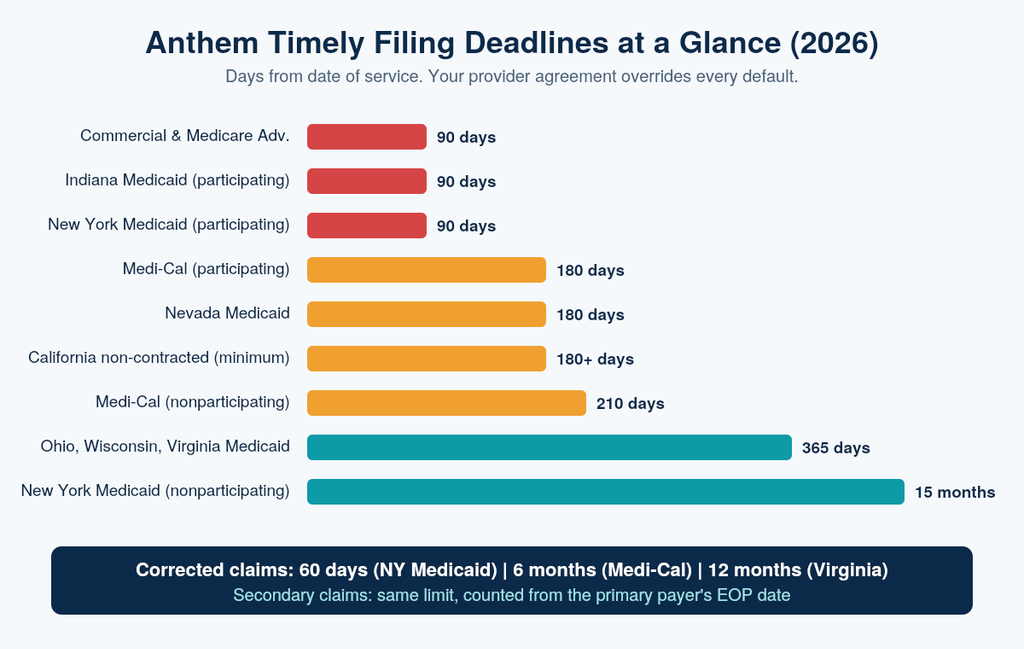
Anthem’s filing deadlines in 2026 range from 90 days to 15 months. Which one applies depends on three things: your network status, the line of business, and the state program. Use this table as your first-pass payer grid.
| Plan or claim type | Deadline | Clock starts | Where the rule comes from |
|---|---|---|---|
| Commercial, contracted, professional | 90 days | Date of service | 2019 provider agreement amendment |
| Medicare Advantage, contracted, professional | 90 days | Date of service | Same 2019 amendment |
| Non-contracted, Blue Cross of California | At least 180 days | Date of service | 28 CCR § 1300.71 |
| California Medi-Cal | 180 days participating, 210 days nonparticipating | Date of service (last day for consecutive services) | Anthem policy G-06050 |
| Medicaid: Ohio, Wisconsin, Virginia | 365 days | Date of service (Ohio inpatient from discharge) | G-06050; Anthem Virginia provider news |
| Medicaid: Indiana | 90 days participating, 180 days nonparticipating | Date of service | G-06050 |
| Medicaid: New York | 90 days participating, 15 months nonparticipating | Date of service | G-06050 |
| Medicaid: Nevada | 180 days; 365 days for out-of-state providers | Date of service | G-06050 |
| Secondary claims | Same limit as the original claim | Primary payer’s EOP date | G-06050 state versions |
| Corrected claims | 60 days (NY Medicaid), six months (Medi-Cal), 12 months (Virginia) | EOP or payment date | G-16001; Anthem Virginia provider news |
Print this table, then add one more column: your contract’s version of each number. That column is the one that protects you in a dispute.
Which Anthem Is on the Card?
Before you look up a deadline, work out which Anthem entity issued the member’s card. The name on the card changes the rulebook.
In California, Anthem Blue Cross is the trade name of Blue Cross of California. Anthem’s California provider site says so directly. Behind that brand sit three legal entities: Blue Cross of California (licensed by the Department of Managed Health Care), Anthem Blue Cross Life and Health Insurance Company (licensed by the California Department of Insurance), and Blue Cross of California Partnership Plan, Inc., which serves Medi-Cal members. The EOP footer tells you which one paid. Anthem Blue Cross is not Blue Shield of California, which publishes its own rules.
Outside California, Anthem operates as Anthem Blue Cross and Blue Shield in 13 more states: Colorado, Connecticut, Georgia, Indiana, Kentucky, Maine, Missouri, Nevada, New Hampshire, New York, Ohio, Virginia, and Wisconsin. Two footprints have carve-outs. Missouri excludes 30 counties around Kansas City, and Virginia excludes the City of Fairfax, the Town of Vienna, and the area east of State Route 123.
In New York, you will see both names. Since January 1, 2024, the former Empire BlueCross plan upstate carries the Anthem Blue Cross name, while downstate plans use Anthem Blue Cross and Blue Shield.
Related brands follow separate manuals. Elevance Health is the parent company, renamed from Anthem, Inc. in 2022, and the rename changed no deadlines. Wellpoint is the name Elevance gave its former Amerigroup plans in 2024, and those sit outside the Blue license. Carelon manages behavioral health for many Anthem members, so check the Carelon guide for your state before assuming therapy claims share Anthem’s deadline.
Commercial and Medicare Advantage: The 90-Day Rule
Where the 90 days came from
For contracted providers, the commercial and Medicare Advantage limit is a contract term, not a law. Anthem sent participating practices an amendment stating that professional claims submitted on or after October 1, 2019, must reach Anthem within 90 days of the date of service. According to the AAFP’s report on the change, practices that objected had a short window to push back in writing, and those that could not reach an agreement faced termination from the network.
In California, the California Medical Association reported that the previous window had been 365 days, and that plans in the state must give providers at least 45 days’ written notice before changing claim submission rules. If you stayed in network after 2019, you either accepted the 90 days or negotiated something different. Pull the executed amendment so you know which.
Who the rule binds
Because it is a contract term, the 90-day limit binds contracted providers. Anthem told the CMA that the change did not affect non-contracted physicians. California law also sets a floor: under 28 CCR § 1300.71, a plan cannot set a filing deadline shorter than 90 days for contracted providers or 180 days for non-contracted providers. The same regulation requires the plan to accept a late claim when the provider shows good cause through a dispute.
Two details trip up billers. First, the 2019 notices covered professional claims, so facility claims on a UB-04 follow the facility agreement. Second, a practice that left the network and kept using 90 days as a habit may be writing off claims that actually had at least 180 days in California.
Anthem Medicare Advantage vs. Original Medicare
Original Medicare gives you one calendar year from the date of service under 42 CFR 424.44. Anthem Medicare Advantage is different: it runs on your Anthem contract, and the 2019 amendment set 90 days for contracted providers.
Picture two 72-year-olds checking in at the same front desk. One shows a red-white-and-blue Medicare card and the claim has a year. The other shows an Anthem Medicare Advantage card and the claim has 90 days. If your front desk does not catch that difference during check-in, your billing team will find out when the remit says CO-29.
Medicaid and Medi-Cal Deadlines by State
Anthem’s Medicaid plans do not use the commercial amendment. Each state publishes its own version of Anthem’s Claims Timely Filing policy (G-06050), and the numbers vary widely.
| State | Program | Participating | Nonparticipating | Notes |
|---|---|---|---|---|
| California | Medi-Cal | 180 days | 210 days | Consecutive-day services count from the last day of service |
| Indiana | Hoosier Healthwise, Healthy Indiana Plan, Hoosier Care Connect | 90 days | 180 days | Policy effective December 27, 2022 |
| Nevada | Medicaid | 180 days | 180 days | Out-of-state providers get 365 days |
| New York | Medicaid | 90 days | 15 months | The 15 months applies only to nonparticipating providers |
| Ohio | Medicaid | 365 days | 365 days | Inpatient claims count from discharge |
| Virginia | HealthKeepers Plus | 365 days | 365 days | Corrected claims and reconsiderations get 12 months from the EOP |
| Wisconsin | BadgerCare Plus, Medicaid SSI | 365 days | 365 days | Counted from the date of service |
Medi-Cal in practice
Anthem’s California Medi-Cal policy gives participating providers 180 calendar days and nonparticipating providers 210. Weekends count. Suppose a participating clinic sees a Medi-Cal member on January 12, 2027. Anthem has to receive the claim by July 11, 2027. A nonparticipating provider seeing the same member would have until August 10, 2027. If another payer pays first, the count starts at that payer’s EOP date instead.
You will sometimes see 180 or 210 days quoted as “the” Anthem Blue Cross timely filing limit. Those figures belong to Medi-Cal. A contracted California practice billing a commercial Anthem plan still works inside the 90-day window.
Watch for outdated lists
Many online billing guides are stale. Two common errors are worth correcting. Indiana Medicaid is often listed at 365 days, but Anthem’s Indiana policy gives participating providers 90. Kentucky Medicaid is often listed at 365 days, but Anthem stopped serving Kentucky Medicaid on January 1, 2025, and the 365-day run-out only covered services through December 31, 2024. A current Kentucky Medicaid claim belongs with the member’s new plan.
Some states have no Anthem-branded Medicaid filing policy that we could locate, including Colorado, Connecticut, Georgia, Maine, Missouri, and New Hampshire. In several of them Medicaid runs through Wellpoint or another plan, so confirm who holds the member’s Medicaid contract before you choose a deadline.
Two clocks in Ohio
Ohio shows why one number per payer is not enough. A practice billing Ohio commercial claims has 90 days under the 2019 amendment, while its Ohio Medicaid claims get 365. Both dates need to live in your claim scrubber, tied to the member’s line of business.
How Anthem Counts the Days
Anthem subtracts the date of service from the date it receives and accepts the claim, using calendar days. Four rules decide where the count starts and stops:
- The count ends at receipt. A claim mailed or sent on day 89 that arrives on day 91 is late.
- Calendar days only. Anthem’s policies describe no weekend or holiday extension.
- Consecutive-day services count from the last day of service, and Ohio Medicaid inpatient claims count from discharge.
- Secondary claims start on the primary payer’s EOP date.
Anthem’s state policies do allow a temporary waiver after a documented natural disaster. If a hurricane or fire closed your office, keep the official notice in the claim file and cite it in your dispute.
Why a rejected claim does not stop the clock
Anthem treats a claim as filed when it is received and accepted within the limit. A claim your clearinghouse or Availity rejects never reached acceptance, so the clock kept running while it sat in a report.
Here is how that plays out. Your biller sends a claim on day 20 and the clearinghouse rejects it for a subscriber ID mismatch. Nobody opens the rejection report until day 95. On a 90-day contract, the claim is five days late even though your practice management system shows a send date well inside the window.
Your proof of timely filing is the clearinghouse-assigned receipt date on the acceptance report, not your system’s send date. Work rejections every business day and fix member IDs at check-in.
A simple date check
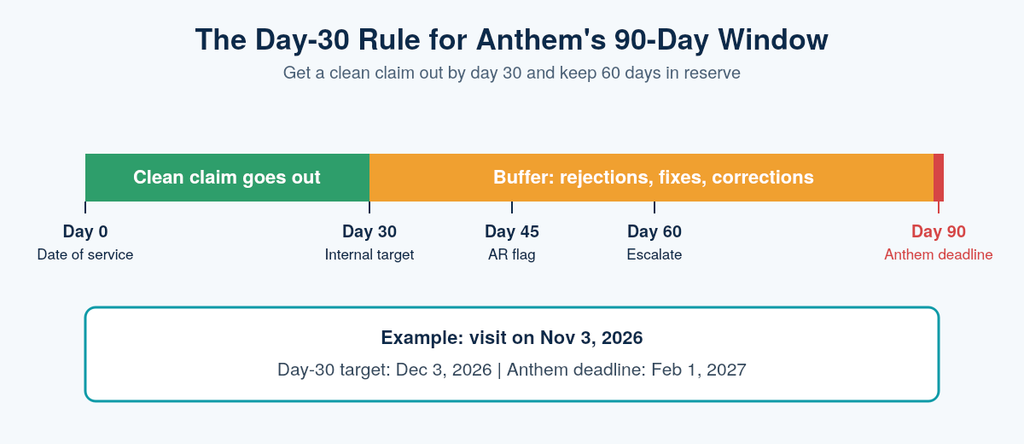
For a contracted commercial or Medicare Advantage claim, you are on time when Anthem’s receipt date minus the date of service is 90 or fewer. A visit on November 3, 2026, must reach Anthem by February 1, 2027. We recommend an internal target of day 30 (December 3, 2026 in that example), which leaves two months for rejections, coding questions, and eligibility fixes.
Corrected and Secondary Claims
Corrected claims
Anthem publishes corrected-claim windows by market in its Corrected Claims policy (G-16001):
| Market | Window | Starts from |
|---|---|---|
| New York Medicaid | 60 days | EOP date |
| California Medi-Cal | Six months (participating providers) | Date of payment |
| Virginia HealthKeepers Plus | 12 months | EOP date |
| Commercial and Medicare Advantage | Set by your agreement and state manual | Varies |
For commercial and Medicare Advantage, we did not find a published number in the documents we reviewed, so file each correction inside both the correction window and the original claim’s filing window, whichever closes first.
On electronic claims, Anthem requires frequency code 7 to replace a prior claim or 8 to void one. Paper claims need the words “Corrected Claim” marked on them. An unmarked correction can be denied as a duplicate, and that costs you days you cannot recover. Accurate claim-level coding matters here: a correction that changes a CPT code, modifier, or diagnosis pointer should be reviewed before it goes out, not after it is denied a second time.
Secondary claims
A secondary claim carries the same limit as the original, but the count starts on the other carrier’s remittance date. Anthem’s California coordination-of-benefits flyer recommends four steps: verify the primary carrier in Availity before the visit, submit the claim and attach the primary’s EOB through Availity’s Claims and Payments application, make sure the claim arrives within the limit counted from the primary’s remittance, and send the primary payer’s dated denial letter on letterhead if it denied the claim.
Coordination-of-benefits errors often show up as CO-22 alongside CO-29 on the same remit. Verifying benefits before the visit prevents both.
Proof of Timely Filing Anthem Accepts
If Anthem denies a claim as late but your records show it arrived in time, the dispute is won or lost on proof. Anthem’s proof-of-timely-filing policy (G-06133) is specific about what counts.
| Submission method | Accepted? | What to send |
|---|---|---|
| Electronic | Yes | Clearinghouse-assigned receipt date from reconciliation reports |
| Yes | Official return receipt or delivery confirmation, plus a claim log | |
| Fax | No | Anthem will not accept a fax transmission report |
| Hand delivery | No | Anthem will not accept a claim log with a signed receipt |
For mailed claims, build a claim log with one row per claim: claimant name, address, and phone; federal tax ID; addressee and designated address; date of mailing and delivery method; subscriber and member names; subscriber ID; dates of service; and total charge.
Fax confirmations stopped counting for Medi-Cal
Anthem’s Medi-Cal proof policy took effect June 15, 2026, and its revision history says Anthem no longer accepts proof of facsimile transmission. If your proof packet template was built from an older checklist, remove the fax line. Practices that still fax Medi-Cal claims should move them to electronic submission and keep the reconciliation report.
California commercial: nine forms of proof
For California commercial claims, Anthem’s acceptable-proof flyer lists nine forms, including a clearinghouse report showing submission to the Availity EDI gateway, an Availity Level 2 status report, Anthem’s own dated request for more information, an Anthem denial letter or remittance showing earlier submission, and another carrier’s dated denial letter or remittance advice. Submit them through Availity’s Claims & Payments, then Claim Status, using the Dispute button and Submit Attachments.
Good cause: when Anthem will reconsider a late claim
If the claim truly missed the window, G-06133 recognizes good cause in six situations: incorrect or incomplete information from official sources, retroactive enrollment the member learned about later, wrong payer information from the member, an unavoidable delay getting required documentation, unusual circumstances beyond your control, or destruction of your records not caused by your own willful act. In California, 28 CCR § 1300.71(b)(4) requires the plan to accept a late claim once you show good cause through a provider dispute. Attach the document that proves it, such as the retroactive eligibility notice.
What to Do After an Anthem CO-29 Denial
CO-29 is the claim adjustment reason code for “the time limit for filing has expired,” as defined in X12’s CARC list. It means Anthem’s receipt date fell outside the limit. Either the claim really was late, or Anthem has the wrong receipt date and you can prove it.
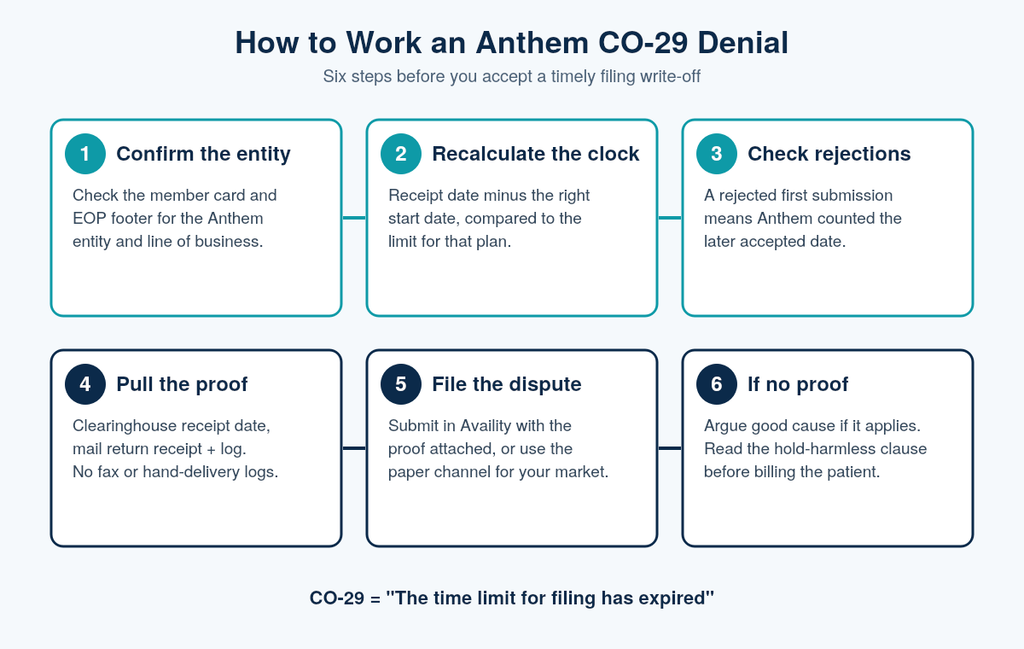
Work every CO-29 in this order:
- Confirm the Anthem entity and line of business from the card and the EOP footer.
- Recalculate the clock using Anthem’s receipt date, the right start date, and the right limit.
- Check the rejection history. If your first submission was rejected, Anthem counted the later accepted date.
- Pull proof that matches G-06133, or the nine-item flyer for California commercial.
- File the dispute in Availity with the proof attached, or use the paper channel your market allows.
- If you have no proof and no good cause, read the hold-harmless language in your Anthem agreement before anyone bills the member.
For paper Medi-Cal disputes, use Anthem’s Provider Dispute Resolution form. Member appeal forms belong to a separate grievance process. Also note that ERISA does not create a 12-month provider filing window: 29 CFR 2560.503-1 gives group health plan claimants at least 180 days to appeal an adverse benefit determination, but your contract still sets the claim filing deadline.
Appeal windows are a different clock
Do not confuse the claim filing limit with the time you have to dispute a denial.
| Market | First level | Second level |
|---|---|---|
| Indiana Medicaid | Reconsideration within 60 calendar days of the remittance advice | Appeal within 60 days of the decision letter |
| Virginia HealthKeepers Plus | Reconsideration within 12 months of the EOP | Appeal within 15 months of service or 180 days from the reconsideration decision |
| California Medi-Cal | Dispute within 365 days of the notice date | Not listed |
| DMHC-licensed Blue Cross of California plans | At least 365 days under 28 CCR § 1300.71.38 | Not set by the regulation |
| Other commercial and Medicare Advantage | Your state’s Anthem provider manual | Your state’s Anthem provider manual |
The 60-day figure that circulates as “Anthem’s appeal rule” comes from Indiana Medicaid. For a Medi-Cal denial, you have 365 days from the date on the notice.
Why Anthem Claims Miss the Window
When a claim ends up with CO-29, the cause is almost always one of six workflow gaps:
- Unworked rejections. A rejected claim has no receipt date, so the clock keeps running.
- Wrong payer ID or entity. The claim goes to the wrong system and the rejection eats filing days.
- Primary coverage discovered after the visit. The claim bounces between payers and burns time on both clocks.
- Credentialing gaps. Anthem denies dates of service before a provider’s effective date, and a slow enrollment can push the rebill past the window.
- Charges held for coding or documentation. Every day a chart waits for a signature or a code query comes off your 90.
- The wrong clock applied. Medicaid rules used on commercial claims, Original Medicare’s year used on Medicare Advantage, or the original date of service used on a secondary claim.
Number five is the one most practices underestimate. Coding is not just about getting paid correctly. It is also about getting paid in time. A chart that stalls because the coder is unsure about a specialty code, a modifier, or a medical necessity link is a claim losing filing days.
Specialty coding is where this shows up first. Our guides to ophthalmology CPT codes 2026, lithotripsy CPT codes 2026, and general surgery CPT codes 2026 cover the code and modifier details that commonly cause coding holds and payer edits.
A day-30 workflow
Build your Anthem process around a day-30 target so that 60 days remain for anything that goes wrong:
- Verify eligibility, coordination of benefits, and the Anthem entity at scheduling and again at check-in.
- Release charges within 48 hours of the visit.
- Submit electronically, and save the reconciliation report by claim number the same day.
- Work rejections every business day.
- Age AR by date of service, and flag Anthem 90-day claims at day 45 and day 60.
- Track secondary and corrected claims on their own clocks, and recheck Anthem’s policy pages every quarter.
Sort your queue by filing deadline, not by dollar value. A $140 Anthem commercial claim at day 70 has 20 days left. A $2,000 Medicaid claim at day 200 on a 365-day plan still has 165. The smaller claim is the urgent one.
How Credexa Solutions Protects Your Anthem Revenue
A short filing window punishes slow, error-prone billing. Credexa Solutions is a medical billing and credentialing company, and our approach to Anthem is built on one idea: a clean, accurately coded claim that goes out early is the best defense against both CO-29 and every other denial.
Accurate coding before the claim leaves
Credexa’s coding review checks CPT, ICD-10, and modifier combinations before submission. That prevents the coding-related denials that force corrected claims, and every corrected claim is a claim running on a second clock. Fewer corrections mean fewer claims drifting toward Anthem’s limit.
Denial management that fixes the cause
When an Anthem denial does arrive, Credexa does not just resubmit it. Our denial management team classifies each denial by reason code, works out whether the root cause was coding, eligibility, authorization, credentialing, or timing, and corrects the source so the same pattern does not repeat. For CO-29 specifically, we recalculate the clock, retrieve the clearinghouse receipt data, assemble the proof Anthem’s policy names, and file the dispute in the right channel with the right attachments.
Clock-based AR follow-up
Credexa works Anthem accounts receivable by filing deadline rather than by balance. Claims approaching day 45 and day 60 get escalated first, and secondary and corrected claims are tracked on their own clocks. That is how write-offs are caught while they are still recoverable.
Credentialing that prevents date-of-service denials
A provider who is not yet loaded at Anthem produces claims that cannot be paid, and the rebill often lands after the window has closed. Credexa’s credentialing and enrollment support submits applications early and follows them up, so providers are active before their first Anthem visit.
What to ask any billing partner
Whether you work with Credexa or someone else, ask these five questions before handing over your Anthem claims:
- Do you track Anthem deadlines by entity, line of business, and claim type?
- Can you show me the reconciliation report for any claim?
- How often do you work rejections?
- Is AR aged by date of service or by bill date?
- Who reviews coding before the claim is released?
If your remits keep showing CO-29 on the same Anthem product, you are probably looking at a workflow pattern rather than bad luck. Contact Credexa Solutions at credexasolution.com and send us a sample of recent Anthem remits. We will review them and show you where claims are slipping and which ones may still be recoverable.

Anthem Blue Cross Timely Filing Limit FAQs
How long do I have to submit a claim to Anthem Blue Cross?
For contracted commercial and Medicare Advantage professional claims, 90 days from the date of service. Medi-Cal allows 180 days in network and 210 out of network, and Anthem’s Medicaid plans run from 90 days to 15 months depending on the state. Your provider agreement has the final say.
What is the Anthem Blue Cross timely filing limit in California?
Contracted physicians have 90 days for commercial and Medicare Advantage claims. California law requires at least 180 days for non-contracted providers. Medi-Cal gives participating providers 180 days and nonparticipating providers 210.
Is the Anthem Medicare timely filing limit 90 days or 12 months?
For contracted providers, Anthem Medicare Advantage claims follow the 90-day contract term. Original Medicare’s one-year limit under 42 CFR 424.44 does not carry over to an Anthem Medicare Advantage contract.
What is the Anthem timely filing limit for corrected claims?
It depends on the market: 60 days from the EOP for New York Medicaid, six months from payment for Medi-Cal, and 12 months from the EOP for Virginia HealthKeepers Plus. Commercial plans follow your agreement. Use frequency code 7 or 8 so the claim is not denied as a duplicate.
What is the Anthem timely filing limit for secondary claims?
Secondary claims carry the same limit as the original claim, counted from the primary payer’s remittance or EOP date. Attach the primary EOB, or the primary payer’s dated denial letter on letterhead.
What is the Anthem appeal timely filing limit?
There is no single window. Indiana Medicaid allows 60 calendar days for reconsideration, Virginia HealthKeepers Plus allows 12 months from the EOP, and California Medi-Cal allows 365 days from the notice date.
What is the Anthem Ohio timely filing limit?
Ninety days for contracted commercial and Medicare Advantage professional claims, and 365 days for Medicaid. Ohio Medicaid inpatient claims count from the discharge date.
What does CO-29 mean on an Anthem remit?
CO-29 means the time limit for filing has expired. Before writing the claim off, check whether a rejected first submission pushed the accepted date past the limit and pull the clearinghouse receipt date. If the claim arrived in time, dispute it in Availity with that proof.
What other insurers have a 90-day filing limit?
Many commercial contracts do, including Cigna and UnitedHealthcare for participating providers in most cases. Always confirm against your own contract.
Does Anthem accept fax confirmation as proof of timely filing?
No. Anthem’s proof policy does not accept fax transmission reports or hand-delivery logs. For Medi-Cal, fax confirmations stopped counting on June 15, 2026. Electronic receipt reports and mailed return receipts with a claim log are the accepted routes.
Final Takeaway
Anthem’s filing clocks are short, but they are predictable once someone owns them. Identify the entity on the card, apply the right clock for the line of business, work rejections daily, keep proof in a format Anthem’s policy accepts, and treat coding accuracy as a filing-deadline issue rather than a back-office detail.
If you would rather not carry that workload yourself, Credexa Solutions can take on the coding review, denial management, AR follow-up, and credentialing behind your Anthem claims. Visit credexasolution.com to request a review of your Anthem denials.
Deadlines in this article were drawn from Anthem policy documents and public sources current as of October 2026. Policies change, so verify the figures against your provider agreement and Anthem’s current provider manual before relying on them.