
If you bill Kaiser Permanente, you have probably asked the question every biller asks sooner or later: how long do we actually have to file? The honest answer is frustrating. There is no single Kaiser deadline. The Kaiser Permanente timely filing limit can be 90 days, 120 days, 180 days, or 365 days, and which one applies depends on the region where the member’s coverage sits, the member’s product (commercial, Medicare, or self-funded), and whatever your own provider agreement says.
That patchwork is exactly why timely filing remains one of the most preventable causes of lost revenue. A clean, correctly coded claim that reaches the payer one day late is still a denied claim, and a CO-29 write-off is money you almost never get back.
This guide breaks down the Kaiser timely filing rules region by region, explains how corrected claims, secondary claims, and disputes each run on their own clocks, shows you how to build proof of timely filing, and walks through how a billing partner like Credexa Solutions helps practices manage denials with accurate codes so fewer claims ever reach the deadline in trouble.
Important: The limits below are drawn from Kaiser Permanente’s published provider manuals and claims pages as we reviewed them. Kaiser reissues its manuals regularly and your contract can override them. Always confirm the current edition and your own agreement before relying on any number.
The Short Answer: What Is the Kaiser Permanente Timely Filing Limit?
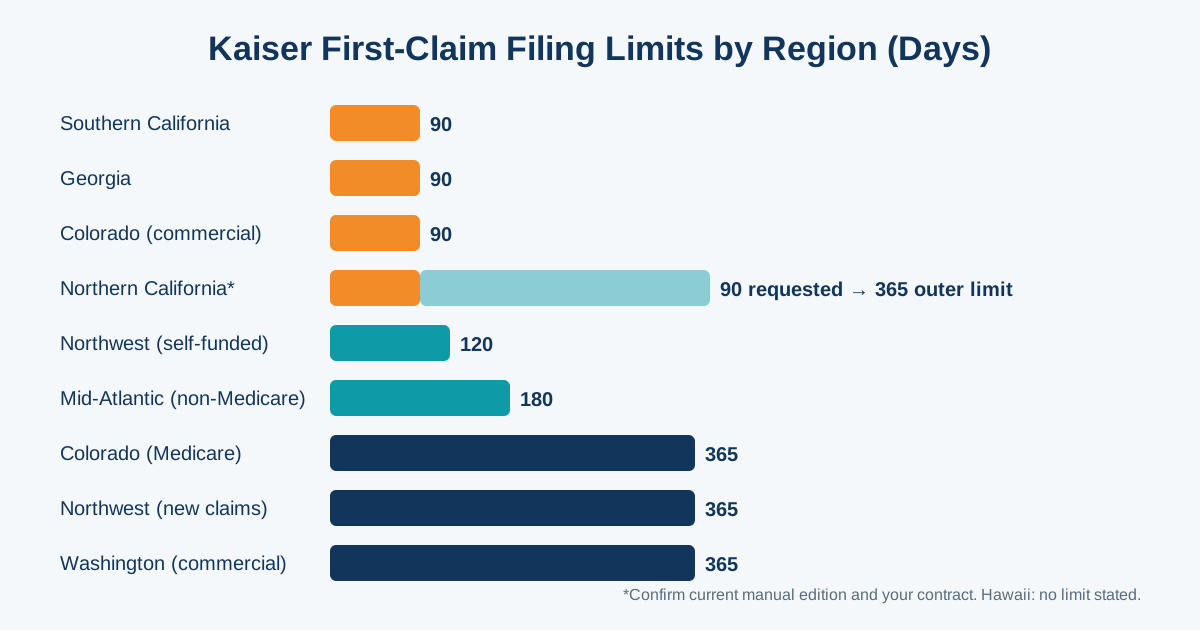
For most first-time claims, Kaiser’s published provider documents point to one of these windows:
- 90 days from the date of service in Southern California, Georgia, and for Colorado commercial members.
- 180 days for non-Medicare members in the Mid-Atlantic States region.
- 365 days for new claims in the Northwest, for commercial members in Washington, and for Colorado Medicare members.
- Northern California is a two-part rule: Kaiser requests claims within 90 days but sets 365 days as the outer limit in its 2025 manual.
Your contract can extend any of these. Some regions say so directly with wording such as “unless your agreement provides otherwise.” So the fastest, safest habit is simple: read your agreement first, then the regional manual, then file well before the earliest date that could apply.
Why Kaiser Timely Filing Is Harder Than Other Payers
Most large commercial payers publish one national number, or a short list of numbers by product. Kaiser Permanente is structured differently. It operates through separate regional organizations, and each region publishes its own provider manual, claims page, payer ID, mailing address, and dispute process.
Three things follow from that structure:
- The member’s region controls the rule, not your office’s location. A clinic in one state may treat members whose coverage is held in another Kaiser region. Claims are routed according to where the membership is held.
- Manual editions do not stay current. A payer chart you found two years ago may reflect an older manual. Northern California, for example, moved from a 180-day outer limit in earlier manuals to 365 days in its 2025 edition.
- State rules and federal rules add floors. California regulation sets minimum filing periods, and Original Medicare has its own one-year rule. These sit underneath whatever Kaiser publishes.
If you work with multiple payers, compare these rules with our guides on the Medicare timely filing limit, the UnitedHealthcare timely filing limit, and the Aetna timely filing limit.
Kaiser Permanente Timely Filing Limit by Region and Plan
The table below summarizes what Kaiser’s published documents state for first submissions. “Confirm before relying” means the source was older, undated, or silent on a detail.
| Region / Plan | Filing limit | Counted from | Confirm before relying |
|---|---|---|---|
| Northern California (HMO, contracted) | 90 days requested; 365 days outer limit | Date of service or discharge | Check the current-year manual |
| Northern California (KPIC self-funded) | 90 days preferred; 365 days outer limit | Date of service or discharge | Payor contracts can vary |
| Southern California (contracted) | 90 days unless your agreement gives longer | Date of service or discharge | Confirm current version |
| Colorado | 90 days commercial; 365 days Medicare | Date of service | Confirm current edition |
| Georgia | 90 days unless your contract says otherwise | Date of service | Confirm in the Georgia manual |
| Hawaii | No limit stated on the claims page | Not stated | Check your agreement and current manual |
| Mid-Atlantic States | 180 days non-Medicare; 12 months Medicare Advantage | Date of service | Confirm edition date |
| Northwest | 365 days new claims; 120 days self-funded | Date of service | Older file header; confirm edition |
| Washington (commercial) | 365 days | See Section 6.2.22 of the manual | Read the section for your member’s plan |
You can review the primary documents yourself on Kaiser’s provider pages, including the Northern California billing and payment manual, the Southern California institutional manual, the Colorado billing section, and the Mid-Atlantic Chapter 8.
Northern California: A Target and a Cutoff
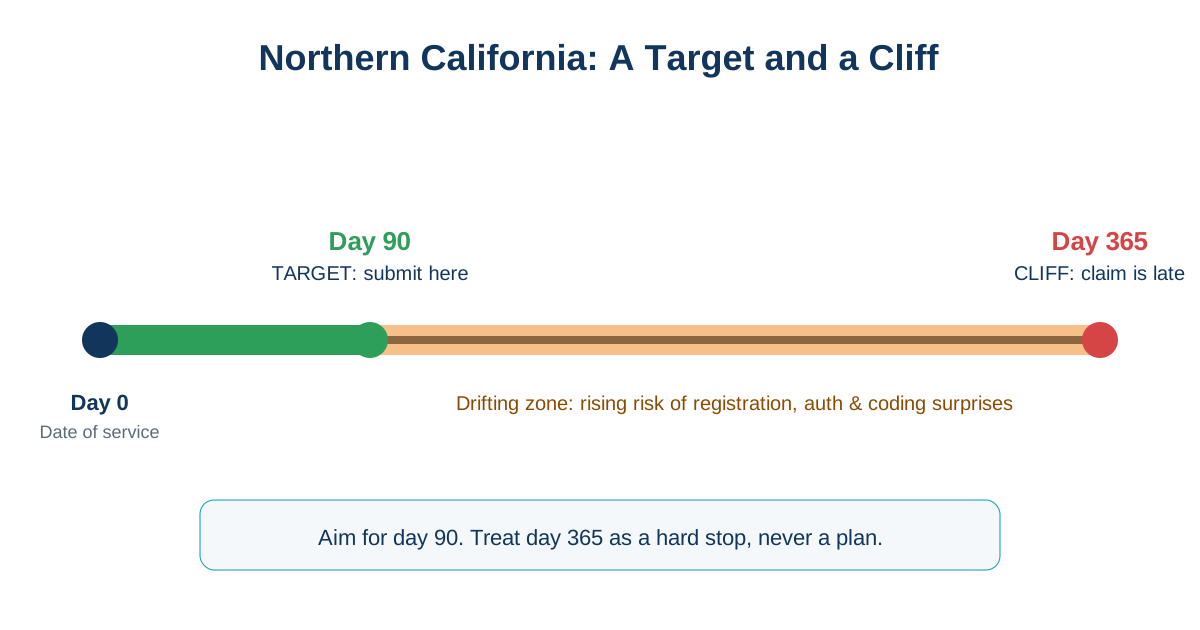
Northern California is the region that trips up the most billers. The manual asks providers to submit claims within 90 calendar days, but it treats 365 days as the point after which claims are considered late (or any longer period in your agreement or required by law). Think of 90 days as the goal and 365 as the cliff. Letting claims drift toward day 365 is a bad strategy: the longer a claim sits, the more likely it is that a registration, authorization, or coding problem will surface too late to fix.
Plan-Level Differences Inside a Region
Inside a single region the limit can change by product. A Colorado clinic that sees a commercial member and a Medicare member on the same day is working with two different deadlines for the same payer. In the Northwest, new claims and self-funded claims are not treated alike. This is why eligibility verification at the front desk is really a filing-deadline decision: the plan type you record determines which clock applies. Our insurance eligibility verification services are built around capturing exactly that detail before the visit.
Northwest vs. Washington
These are two separate Kaiser regions with separate manuals, addresses, and contacts. Billers often merge them mentally because of geography. Do not. Confirm which region holds the member’s coverage and read that region’s document.
Federal and State Rules That Sit Underneath Kaiser’s Limits
Kaiser’s numbers do not exist in a vacuum.
- California: Under 28 CCR 1300.71, a health plan cannot set a claim-filing deadline shorter than 90 days for contracted providers or 180 days for non-contracted providers. That is a floor, not Kaiser’s actual number.
- Original Medicare: Claims must be filed within one calendar year of the date of service under 42 CFR 424.44.
- Medicare Advantage reconsiderations: Non-contracted providers generally have 60 calendar days to request reconsideration of a decision under 42 CFR 422.582, often with a signed Waiver of Liability.
- Prior authorization: The CMS Interoperability and Prior Authorization Final Rule (CMS-0057-F) speeds up authorization decisions, but it does not change claim filing deadlines. A claim that is waiting on an authorization is still on the filing clock.
How the Clock Is Counted: A Worked Example
Deadlines are easy to miscalculate under pressure. Here is a simple method that works for any Kaiser clock:
- Identify the starting event (date of service, discharge date, primary payer’s payment, or original remittance).
- Add the number of days, treating the starting date as day zero.
- Treat the result as the last possible day, not the target.
- Log the date on the claim the moment it is created.
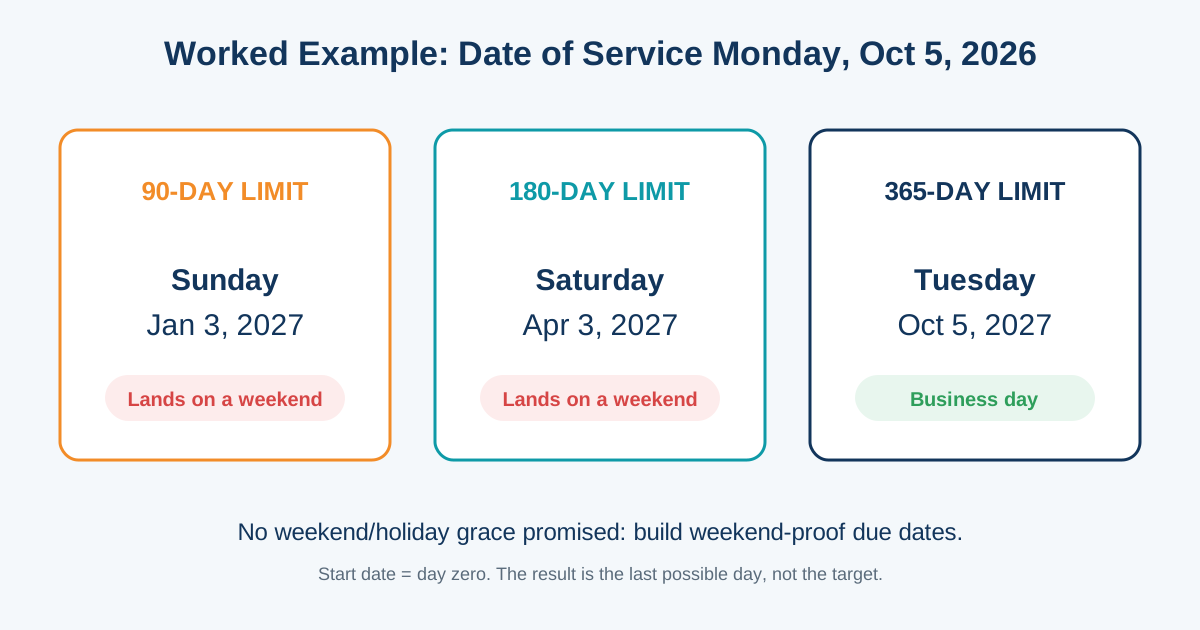
Kaiser’s manuals we reviewed do not promise extra time when the last day lands on a weekend or holiday, so plan as though there is none.
Example. A member is seen on Monday, October 5, 2026.
| Limit | Last filing day |
|---|---|
| 90 days | Sunday, January 3, 2027 |
| 180 days | Saturday, April 3, 2027 |
| 365 days | Tuesday, October 5, 2027 |
Notice that the 90-day and 180-day deadlines both land on a weekend. If your team treats “the deadline” as a business day, you could file a day late without realizing it. Build weekend-proof due dates into your workflow, not just the raw calculation.
Also note the verb the manual uses. Some Kaiser documents say claims must be “sent” by the deadline; others say “received.” When a document says received, do not wait for the final day.
Kaiser Corrected Claim Timely Filing: The Second Clock
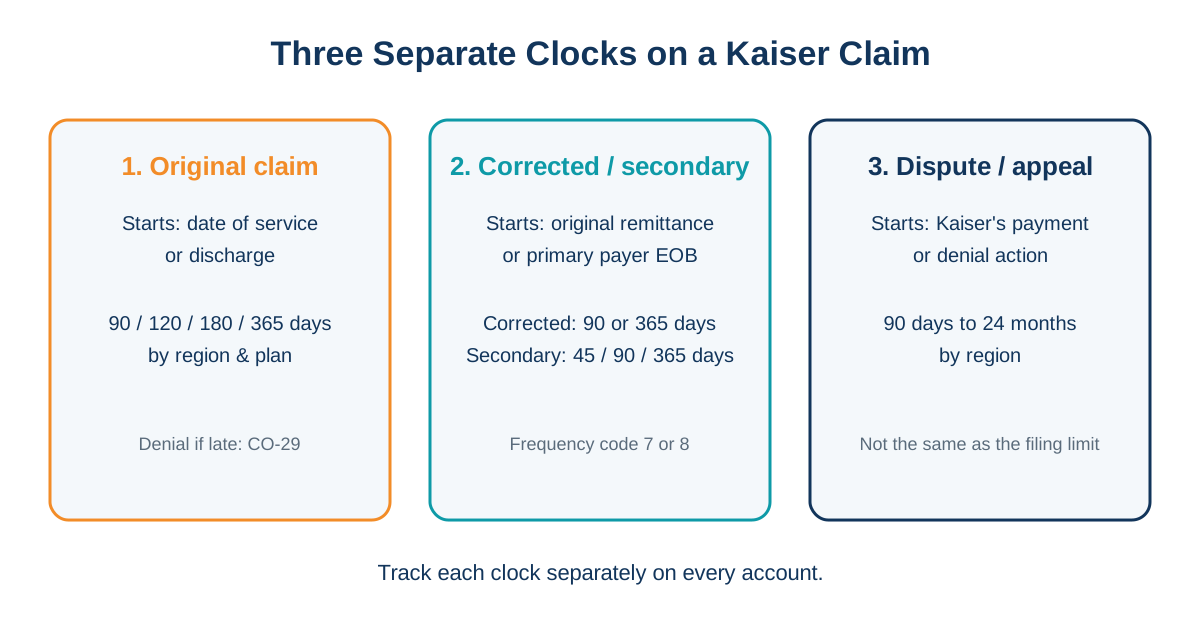
A corrected claim does not always inherit the original deadline. Kaiser’s institutional manual describes a separate correction period counted from the date of the original remittance advice, and the length varies by region. As reported in the 2026 institutional manual, corrected claims get 90 calendar days in Colorado and 365 calendar days in Georgia, Hawaii, the Mid-Atlantic States, and the Northwest, while California corrected claims stay tied to the original claim’s limit.
There is a wrinkle to watch: Colorado’s older 2024 manual describes 90 business days for corrected claims, which lands weeks later on the calendar than 90 calendar days. If two documents disagree, use the earlier date until Kaiser confirms in writing which one governs.
Practical rules for corrected claims:
- Use frequency code 7 for a replacement claim and frequency code 8 for a void.
- Include the original claim number so Kaiser can link the correction.
- Attach or supply the information Kaiser said was missing.
- Keep proof of the first submission with the correction. Northern California’s manual asks for it.
- Remember that Colorado also limits claim adjustments to 12 months from the date of the initial remittance advice.
Corrections are easier to prevent than to time. A first-pass claim with accurate codes, correct modifiers, and complete demographics never needs the second clock. That is one reason we pair claim scrubbing with coding review in our medical coding services.
Secondary Claims and Coordination of Benefits at Kaiser
When Kaiser is the secondary payer, the clock usually starts with the primary payer’s payment or explanation of benefits (EOB), not the date of service.
- Northern California: 90 days after the primary payer pays, or longer under your agreement or the law.
- Colorado: 45 days from the primary payer’s EOB for secondary claims, with separate, longer windows for responding to coordination-of-benefits information requests.
- Northwest: 365 days from the primary payer’s EOB.
- California floor: A plan that pays second cannot require filing sooner than 90 days after the primary payer’s payment, contest, denial, or notice.
Always send the primary payer’s remittance with the secondary claim. Without it, the claim is likely to deny for missing or inconsistent coordination-of-benefits information, commonly reported with CO-22. Our guide to CO-22 denials covers the fix.
How to Prove Timely Filing to Kaiser
When Kaiser denies a claim as late, the question is never “did you file on time?” It is “can you prove it?” Northern California’s manual is specific: system-generated reports showing the original submission date count, while handwritten or typed notes do not. Colorado and the Northwest describe similar evidence, such as EDI transmission reports and payer acknowledgments.
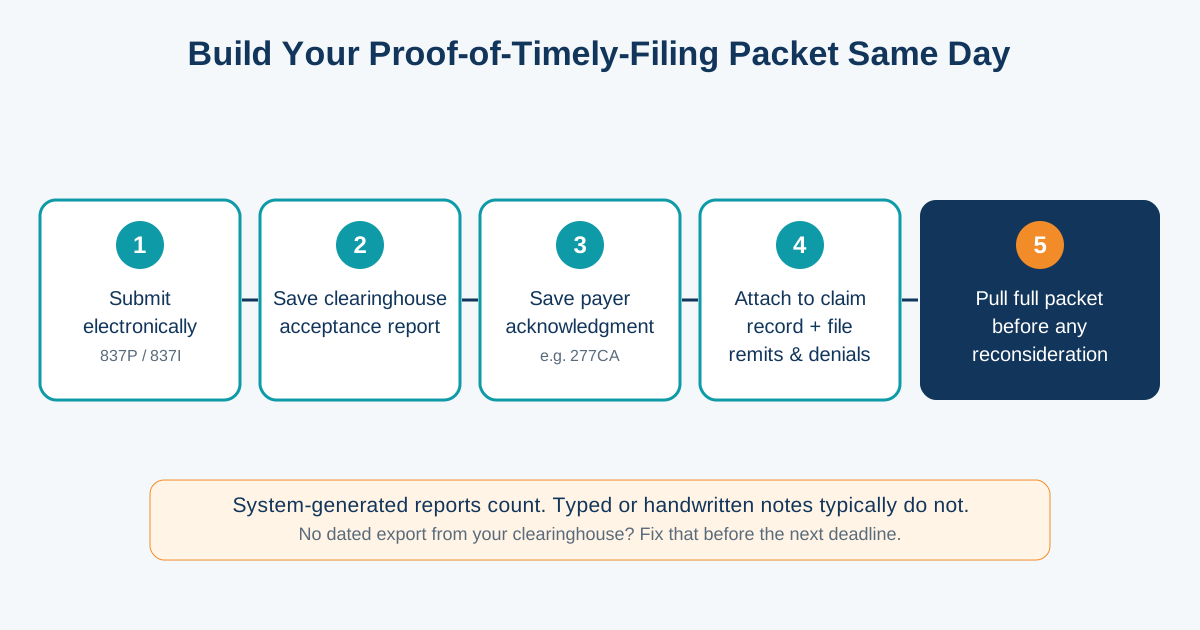
Build a proof-of-timely-filing packet the same day you submit every Kaiser claim:
- Submit electronically (837P or 837I) so a system creates the timestamp.
- Save the clearinghouse acceptance report and the payer acknowledgment (for example, a 277CA) on submission day.
- Store both on the claim record where anyone working the account can find them.
- File each remittance and denial notice with the claim as it arrives.
- Pull the complete packet before you file any reconsideration or dispute.
If your clearinghouse cannot export dated reports, that is a red flag worth fixing before the next deadline problem.
Understanding CO-29 and the Codes Behind Timely Filing Denials
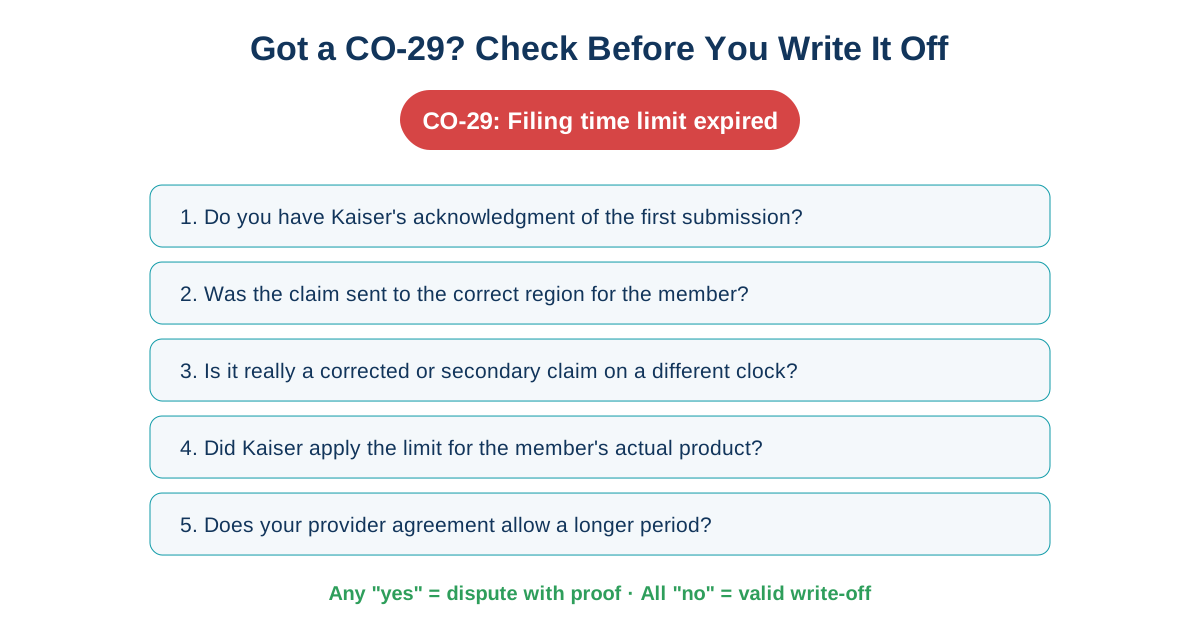
CO-29 is the claim adjustment reason code (CARC) for “the time limit for filing has expired.” The CO group code means contractual obligation, which means it is typically a provider write-off and not billable to the patient. You can browse the full list of CARCs on the X12 claim adjustment reason code page.
Before you accept a CO-29 as valid, run this checklist:
- Did Kaiser acknowledge the first submission, and do you have the report?
- Was the claim sent to the correct region for the member’s coverage?
- Is this actually a corrected or secondary claim running on a different clock?
- Did the payer apply the limit for the member’s actual product (commercial, Medicare, self-funded)?
- Does your agreement allow a longer period?
Many “timely filing” denials are really something else in disguise. A claim sent to the wrong region can come back as a routing problem (CO-109, claim not covered by this payer, send it to the correct payer). A claim that Kaiser never received shows up as a status mystery, not a denial. And a claim that was received but rejected at the front end for missing data may never have entered adjudication. Treating all of these as “filing problems” hides the real fix.
Accurate Codes Prevent Denials Before the Clock Even Matters
Timely filing is the denial that ends the conversation, but it is rarely the only risk on a Kaiser claim. Code-level errors are what push claims into rework, and rework is what eats the filing window. The most common code-driven denial categories include:
- CO-16: claim lacks information or has a submission or billing error.
- CO-4: procedure code inconsistent with the modifier used.
- CO-11: diagnosis inconsistent with the procedure.
- CO-18: exact duplicate claim or service.
- CO-97: benefit included in another service already adjudicated (bundling).
- CO-50: not deemed a medical necessity.
- CO-197: precertification or authorization absent.
Each one traces back to something you can control: CPT and HCPCS selection from the AMA CPT code set, ICD-10-CM diagnosis specificity per CMS ICD-10 guidance, modifier use, claim form standards from the NUCC, and authorization tracking. When those are right the first time, claims pay on the first pass and the timely filing limit never becomes a factor.
Kaiser Provider Disputes and Appeals: Windows by Region
Once Kaiser pays or denies a claim, a new clock starts for disputing the decision. Do not confuse it with the timely filing limit for the original claim.
| Region | Provider dispute window (as published) | Counted from |
|---|---|---|
| Northern California | 365 calendar days | Kaiser’s action |
| Southern California (contracted) | 365 days | Kaiser’s action |
| Colorado | 90 calendar days | Last plan determination |
| Mid-Atlantic States | 180 days | Denial or explanation of payment |
| Northwest | 365 days | Kaiser’s first processing or denial |
| Washington | 24 months (30 with coordination of benefits) for certain provider liability denials | Date of denial notice |
Georgia and Hawaii are not in the table because their current manuals were not accessible for our review. Take the window from your explanation of payment or ask Kaiser in writing.
Members have their own appeal rights and their own claim windows, and those are separate. Member pages for plans such as Flexible Choice, point-of-service, and Added Choice give members between 90 days and 12 months to submit their own claims. That number is not your provider deadline, even when it looks longer.
Regions use different forms and mailing addresses for disputes. Northern and Southern California, for instance, use a Provider Dispute Resolution Request form and also accept disputes through Kaiser’s Online Affiliate portal. Always pull the current form and address from the region’s claims page.
Emergency, Out-of-Network, and Non-Contracted Claims
Contract status changes your deadline. In California, non-contracted commercial claims have historically sat at the 180-day regulatory floor, and Kaiser announced temporary extensions during the 2024 Change Healthcare outage that lifted some deadlines to 365 days for affected providers. Those extensions carried no published end date in the FAQ we reviewed, so do not rely on them without written confirmation. Non-contracted Medicare Advantage providers should also plan on a Waiver of Liability with any appeal.
A single-case agreement or letter of agreement can set its own filing clause, so put the timely filing period in writing whenever you negotiate one.
Where to Send Kaiser Claims So the Clock Isn’t Wasted
A claim that sits at the wrong address or under the wrong payer ID keeps aging. Follow this routing process on every submission:
- Read the region and product off the member’s ID card.
- Submit an 837P (professional) or 837I (institutional) through your clearinghouse using that region’s payer ID.
- For paper, use an original red CMS-1500 or a UB-04 and mail it to the region’s claims address.
- Include the member’s medical record number and your NPI.
- Save the acceptance report the day it posts.
Kaiser’s regions each maintain a claims page with current addresses, payer IDs, and phone numbers, for example the pages for Northern California, Southern California, Colorado, and Georgia. Copy details from the source, not from a chart, because ZIP codes and payer IDs change and clearinghouses may use different IDs.
Kaiser’s Online Affiliate portal is the tool named on several regional pages for claim status, payments, and disputes. If a claim has not appeared after the processing window in your region’s manual, check status before resubmitting, because a blind resubmission can deny as a duplicate.
How Credexa Solutions Helps You Manage Denials With Accurate Codes
Knowing the rules is half the job. The other half is applying them consistently across hundreds or thousands of claims a month, across multiple payers, with staff who are also answering phones and checking patients in. That is where Credexa Solutions comes in.
Credexa Solutions supports practices with end-to-end revenue cycle work, with a particular emphasis on preventing denials at the source and resolving them quickly when they occur. Here is how that maps directly to the Kaiser challenges above.
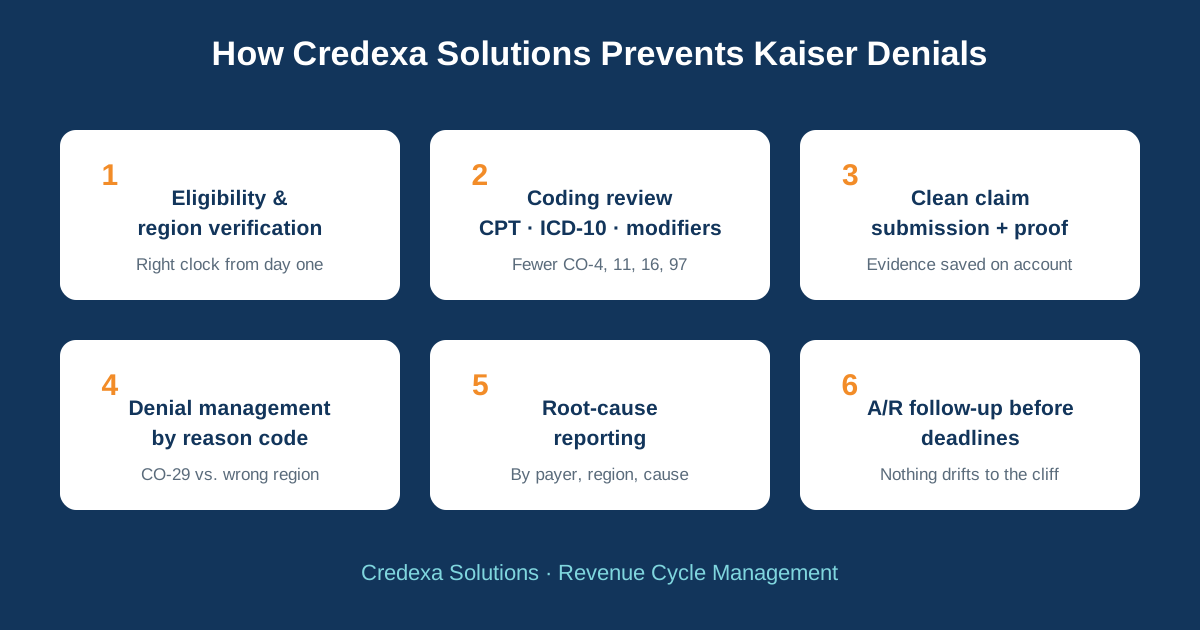
1. Front-End Accuracy: Eligibility and Region Verification
Every Kaiser deadline depends on identifying the right region and plan on day one. Credexa’s insurance eligibility verification process confirms coverage, plan type, and authorization requirements before the visit, so the correct filing clock is attached to the claim from the moment it is created.
2. Coding Review That Protects First-Pass Acceptance
Claims with incorrect CPT, HCPCS, ICD-10-CM, or modifier combinations are the ones that bounce back with CO-4, CO-11, CO-16, or CO-97 and burn filing days on rework. Credexa’s medical coding support checks code accuracy, diagnosis-to-procedure alignment, and modifier logic before the claim goes out, so payers see a clean, defensible claim the first time.
3. Clean Claim Submission With Proof Built In
Through Credexa’s claim submission services, claims are routed to the right payer ID and address, and the acceptance and acknowledgment reports are saved to each account. If Kaiser ever questions timeliness, the evidence is already attached, not something the team has to reconstruct months later.
4. Denial Management With Correct Code Interpretation
When a denial does arrive, reading it correctly determines everything that follows. A CO-29 might be valid, or it might be a misapplied limit, a routing problem, or a corrected-claim clock. Credexa’s denial management team classifies each denial by its adjustment reason and remark codes, identifies the root cause, and works the right remedy, whether that is a corrected claim, a reconsideration with proof of timely filing, or a provider dispute filed inside the regional window.
5. Root-Cause Reporting
A denial count alone does not tell you why claims fail. Credexa tracks denials by payer, region, code, and cause, so you can see whether misses come from late submission, wrong routing, missing authorization, or coding errors, and fix the process instead of the symptom. Our revenue cycle management reporting is designed to surface exactly those patterns.
6. Follow-Up Before the Deadline Becomes a Problem
Aging claims are worked by payer and by deadline, not by whoever remembers. Credexa’s accounts receivable follow-up prioritizes claims approaching their filing or dispute limits, so nothing quietly drifts toward the cliff.
What This Means for Your Practice
The goal is not just fewer CO-29 write-offs. It is a billing operation where the deadline is known at registration, the codes are right at submission, the proof is saved at acceptance, and denials are classified and worked correctly the first time. That combination protects your revenue and gives your clinical staff their time back.
If you would like a second set of eyes on your Kaiser claims, contact Credexa Solutions and bring your latest aging report. We will show you which claims are closest to their deadlines and where your denials are coming from.
A Practical Kaiser Timely Filing Checklist
Print this and keep it at the billing desk.
- Confirm the member’s Kaiser region and product at registration.
- Read your provider agreement for a different filing period.
- Log the earliest possible deadline on the account on day one.
- Submit electronically and save the acceptance and acknowledgment reports.
- Verify codes, modifiers, and diagnosis linkage before release.
- Work anything unpaid past the region’s processing window before resubmitting.
- For corrections, use frequency code 7 or 8 and the original claim number.
- For secondary claims, attach the primary remittance and count from its date.
- Track dispute windows separately from filing limits.
- Re-check the manual edition date at least once a year.
Frequently Asked Questions About the Kaiser Permanente Timely Filing Limit
What is the timely filing limit for Kaiser Permanente claims?
It depends on the region and plan. Published provider documents show 90, 120, 180, or 365 days for first claims, counted from the date of service or discharge. Your contract can set a longer period, so always check it first.
What is the Kaiser Permanente timely filing limit in Southern California?
Kaiser’s institutional manual states 90 days after the date of service or discharge, unless your agreement sets a different period or the law requires one. Non-contracted providers may fall under different rules.
Does Kaiser count calendar days or business days?
For first claims, the provider documents we reviewed use calendar days. Colorado’s 2024 manual is an exception for certain corrected-claim and reconsideration windows, which it counts in business days. When a document simply says “days,” assume calendar days and file early.
How long do I have to file a corrected claim with Kaiser?
It varies by region. The 2026 institutional manual lists 90 calendar days in Colorado and 365 calendar days in Georgia, Hawaii, the Mid-Atlantic States, and the Northwest, counted from the original remittance advice. If documents conflict, use the earlier date.
What does CO-29 mean on a Kaiser remittance?
CO-29 means the time limit for filing has expired. It is a contractual obligation code, so it is normally written off rather than billed to the patient. Before accepting it, verify the correct limit, your proof of first submission, and whether your contract allows longer.
Can I bill the patient for a claim Kaiser denied as untimely?
Generally not if you are a contracted provider. Northern California’s manual says contracted providers may not bill the member for a claim denied as untimely, though they may pursue a provider dispute. Check your own agreement for other regions.
How do I prove timely filing to Kaiser?
Use system-generated evidence: clearinghouse acceptance reports, payer acknowledgments, and remittance or denial notices that show dates. Typed or handwritten notes are typically not enough. Save the reports on the day you submit.
How is the Kaiser limit different from Medicare’s?
Original Medicare allows one calendar year from the date of service under federal regulation. Kaiser’s limits vary by region and are often shorter, so a claim that would be timely with Medicare can be late with Kaiser.
Does a billing company have to know all eight Kaiser regions?
A good one should, or at least have a documented process for identifying the member’s region and applying the right rules. Ask any vendor how it records region and plan at intake, how it tracks deadlines, and where it stores proof of submission.
How can Credexa Solutions help with Kaiser denials?
Credexa Solutions helps by verifying eligibility and plan details up front, reviewing codes for accuracy, submitting clean claims with saved proof, classifying and working denials by their reason codes, and following up on aging claims before deadlines pass.
Final Thoughts
The Kaiser Permanente timely filing limit is not one rule. It is a set of regional rules layered with plan types, contract terms, and separate clocks for corrections, secondary claims, and disputes. Practices that treat it as a single number tend to find out the hard way, through a CO-29 write-off they cannot recover.
The practices that avoid it share a handful of habits: they identify the region and plan at registration, log the earliest deadline immediately, submit clean claims with accurate codes, save proof the day they file, and classify every denial by its true cause. If you would rather have a dedicated team building those habits into your billing workflow, Credexa Solutions is ready to help. Reach out today to talk through your Kaiser claims and your denial trends.