By the Revenue Cycle Team at Credexa Solutions
A nursing facility visit gets documented correctly, coded correctly, and still comes back underpaid. Why? Because nursing facility billing has three moving parts that all have to line up on the same claim: the correct CPT code, the correct place of service, and the correct Medicare Part A vs. Part B routing. Get even one of those wrong and the claim reprices, denies, or gets quietly downcoded without anyone noticing until a payment audit six months later.
This guide breaks down every nursing facility E/M code from 99304 through 99316, walks through the 2026 place-of-service changes that now directly affect reimbursement, and shows exactly which documentation gaps trigger the denials we see most often when practices bring their nursing facility billing to Credexa Solutions.
Quick Answer: What Are Nursing Facility CPT Codes?
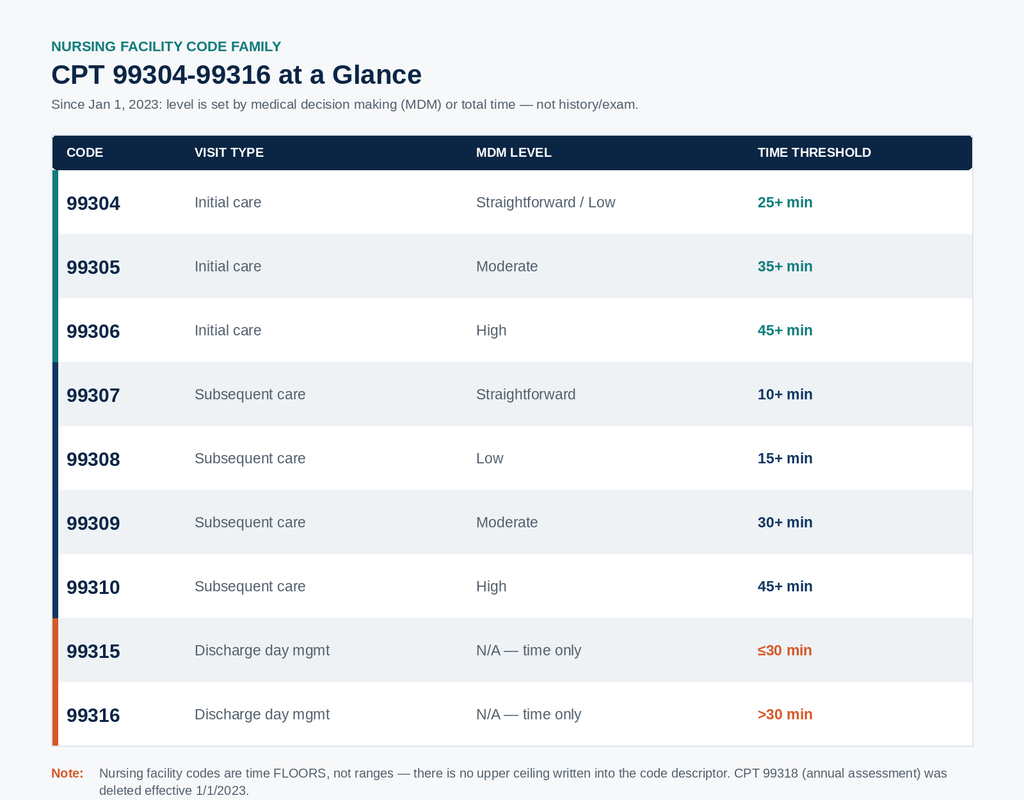
Nursing facility CPT codes are the evaluation and management (E/M) codes physicians and qualified non-physician practitioners use to bill Medicare Part B for visits performed in a skilled nursing facility (SNF) or nursing facility (NF). The family runs from 99304 to 99310 for initial and subsequent visits, plus 99315-99316 for discharge day management. Since January 1, 2023, code level is determined by medical decision making (MDM) or total time, not by history and exam. CPT 99318 no longer exists.
| Code | Visit Type | MDM Level | Time (minutes) |
|---|---|---|---|
| 99304 | Initial nursing facility care | Straightforward/Low | 25+ |
| 99305 | Initial nursing facility care | Moderate | 35+ |
| 99306 | Initial nursing facility care | High | 45+ |
| 99307 | Subsequent nursing facility care | Straightforward | 10+ |
| 99308 | Subsequent nursing facility care | Low | 15+ |
| 99309 | Subsequent nursing facility care | Moderate | 30+ |
| 99310 | Subsequent nursing facility care | High | 45+ |
| 99315 | Discharge day management | N/A (time only) | ≤30 |
| 99316 | Discharge day management | N/A (time only) | >30 |
Keep this table next to your charge capture screen. Practices that lift these numbers from outdated PDFs frequently carry the pre-2023 time values, and a mismatched threshold quietly pushes claims to the wrong code every single day.
Why This Code Family Trips Up Even Experienced Billers
Two things make nursing facility coding harder than office-visit coding.
First, the thresholds work in the opposite direction from what most coders expect. Office visit codes are ranges. Nursing facility codes are floors the encounter has to meet or exceed the stated time, and there’s no upper ceiling written into the code descriptor itself. A 46-minute subsequent visit is still a 99310; there’s no separate code for “long 99310.”
Second, this is one of the only settings where a physician’s professional claim and the facility’s institutional claim run through completely different systems, forms, and payment models for the exact same date of service. The physician bills CPT codes on the CMS-1500 to Part B. The facility bills a per diem rate on the UB-04 to Part A. When those two billing offices don’t communicate, the physician’s claim is usually the one left unpaid not because the code was wrong, but because nobody verified which side of the split it belonged to.
Initial Nursing Facility Care: 99304, 99305, 99306
Initial codes are billed once per admission, per physician, per specialty regardless of how long the stay lasts. If the same patient is discharged and later readmitted, the initial code resets.
99304 (straightforward/low MDM or 25+ minutes) fits a routine admission with a clear, low-risk plan for example, a short post-surgical stay for wound care with no active comorbidities complicating the picture.
99305 (moderate MDM or 35+ minutes) covers a patient arriving with multiple chronic conditions that require care-plan decisions, such as a post-hospitalization transfer with diabetes, hypertension, and a new medication regimen to coordinate.
99306 (high MDM or 45+ minutes) applies when the admission involves high-risk treatment decisions new anticoagulation, an active infection needing IV therapy, or a complex post-stroke care plan spanning multiple specialties.
One MDM pathway is unique to 99306 and gets left off almost every coding cheat sheet: multiple morbidities requiring intensive management. This is a defined high-risk category under the 2023 E/M guidelines that describes a patient whose combination of chronic conditions carries a real risk of clinical deterioration or hospital readmission even without a single acute crisis on the chart that day. A physician can legitimately reach high MDM through this pathway alone, but only if the note actually documents the specific conditions and the readmission risk. “Multiple comorbidities, stable” doesn’t meet the bar; naming the conditions and the risk factors does.
Initial nursing facility codes require modifier AI on the claim of the principal physician of record when more than one practitioner bills for the patient during the stay. Leaving it off is one of the most common causes of a missing-information denial on initial-care claims.
Medicare also won’t pay for an initial nursing facility visit and a separate office or ED E/M for the same patient on the same date even though CPT technically allows both to be reported with modifier 25. On a Medicare claim, follow Medicare’s rule, not CPT’s.
Subsequent Nursing Facility Care: 99307, 99308, 99309, 99310
Subsequent codes are billed per day Medicare pays only one nursing facility E/M per practitioner, per patient, per date of service, and excessive units under this code family are an active CMS audit focus.
99307 (straightforward MDM or 10+ minutes) is consistently the most underbilled code in the family. A stable post-op patient with no new symptoms and a quick medication check genuinely supports 99307, but many practices don’t bill a nursing facility visit at all for encounters this brief, leaving legitimate revenue uncaptured.
99308 (low MDM or 15+ minutes) covers routine management of stable chronic conditions adjusting a hypertension medication or reviewing unremarkable labs. Watch the documentation language here: notes that read only “stable, continue current management” are a common trigger for automated payer down coding, because they don’t name what was actually managed.
99309 (moderate MDM or 30+ minutes) is the highest-volume code in the family and carries the most audit exposure simply because of that volume. It fits an active clinical situation a heart failure exacerbation requiring diuretic titration, or a dementia patient with new behavioral symptoms that force a care-plan revision.
99310 (high MDM or 45+ minutes) is reserved for medically unstable patients facing high-risk treatment decisions a new sepsis presentation, a new DVT requiring an anticoagulation decision, or coordination of an emergency transfer. Reviewers consistently flag 99310 as the most overused code in this family, so when documentation could reasonably support either 99309 or 99310, the more conservative code is the more defensible one.
Under federal nursing home regulations, physicians must see patients at least once every 30 days for the first 90 days after admission, then at least once every 60 days after that but that’s a compliance schedule, not a payment rule. Medical necessity, not the calendar, still governs whether a visit is billable.
What Happened to Annual Assessments? CPT 99318 Is Gone
CPT 99318 was deleted effective January 1, 2023. It used to report the annual nursing facility assessment. That assessment is now billed with the standard subsequent care codes, 99307-99310, selected the same way as any other subsequent visit by MDM or time.
If 99318 still appears anywhere in your EHR templates, superbills, standing orders, or charge master, it will generate an automatic invalid-procedure-code denial on every claim that uses it. Because outdated articles referencing 99318 as active still rank in search results, it’s worth an internal audit of every claim submitted under this code since the deletion date, and a one-time sweep of every template that might still reference it.
Discharge Day Management: CPT 99315 and 99316
99315 reports discharge day management of 30 minutes or less; 99316 reports more than 30 minutes. Both are selected by time alone MDM doesn’t factor in and both require a face-to-face encounter with the patient, which can occur on a date before the actual physical discharge.
Discharge day work includes the final exam, discussing the stay with the patient or family, delivering discharge instructions, preparing prescriptions and referral paperwork, and coordinating post-discharge care. A code from this pair can also be reported when a physician pronounces a patient’s death.
This is consistently the most under-captured pair of codes in nursing facility billing not because of a coding error, but because most EHRs never generate a billing prompt on discharge day. The visit happens, the paperwork gets done, and no charge is ever created. Building a workflow trigger off the discharge order so a pending billing encounter opens automatically for the discharging provider to close recovers that revenue without relying on anyone’s memory.
Also worth flagging: nursing facility discharge codes are a separate family from hospital discharge codes (99238-99239). Billing a hospital discharge code for a nursing facility discharge creates a place-of-service mismatch that denies automatically.
Place of Service: Why POS 31 vs. POS 32 Now Changes Your Payment Rate
For years, POS 31 (skilled nursing facility) and POS 32 (nursing facility) paid the same rate for nursing facility E/M codes, so getting the place of service field wrong was a compliance issue but not usually a revenue issue. That changed for 2026.
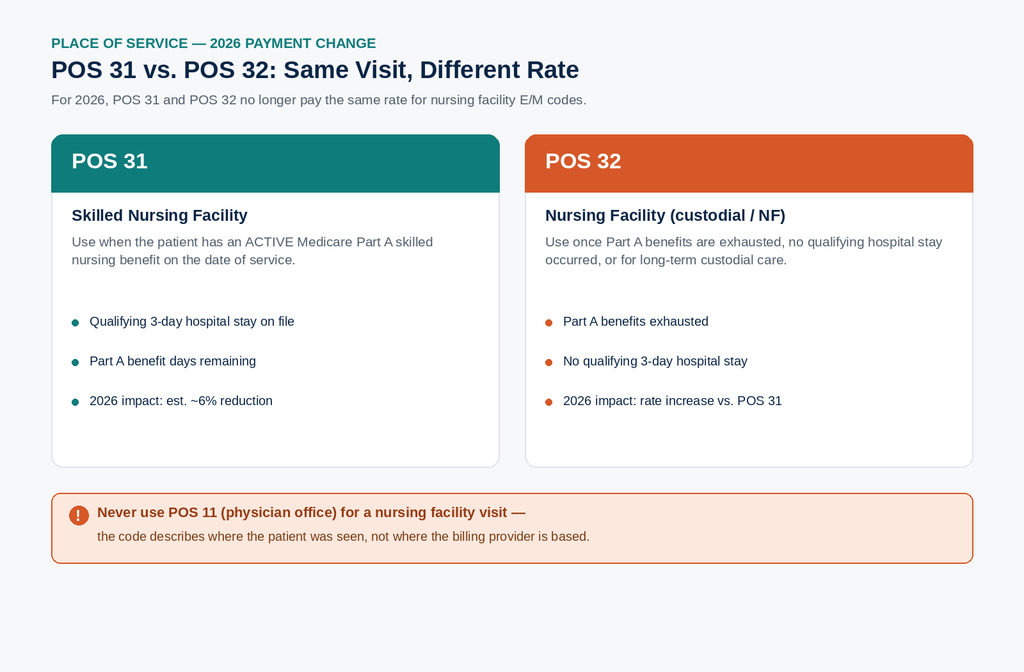
Use POS 31 when the patient has an active Medicare Part A skilled nursing benefit on the date of service. Use POS 32 once Part A benefits are exhausted, when no qualifying 3-day hospital stay occurred, or for a resident receiving long-term custodial care. POS 11 (physician office) is never correct for a nursing facility visit the code describes where the patient was seen, not where the billing provider is based.
The 2026 Medicare Physician Fee Schedule reduced the facility practice-expense allocation for this code family, which broke the long-standing payment parity between POS 31 and POS 32. Industry estimates put the impact at roughly a 6% reduction for a code like 99309 billed at POS 31, alongside an increase when billed at POS 32 meaning a resident who transitions off Part A partway through a stay needs their place of service updated in real time, not just at admission. Practices that default one code to an entire facility census, without checking Part A status per patient per visit, are now leaving real money on the table in one direction or the other.
Two POS codes almost never show up in coding references but are explicitly valid for this family: POS 54 (intermediate care facility for individuals with intellectual disabilities) and POS 56 (psychiatric residential treatment center). Physicians rounding in either setting often default to an office or inpatient code without realizing 99304-99316 already applies.
Is a Nursing Facility Visit Billed to Part A or Part B?
Nursing facility E/M codes are professional services billed to Medicare Part B on the CMS-1500. The facility’s own stay is billed separately to Part A on the UB-04, at a per diem rate set by the Patient-Driven Payment Model (PDPM). Both claims process at the same time, for the same patient, on the same dates through entirely different systems.
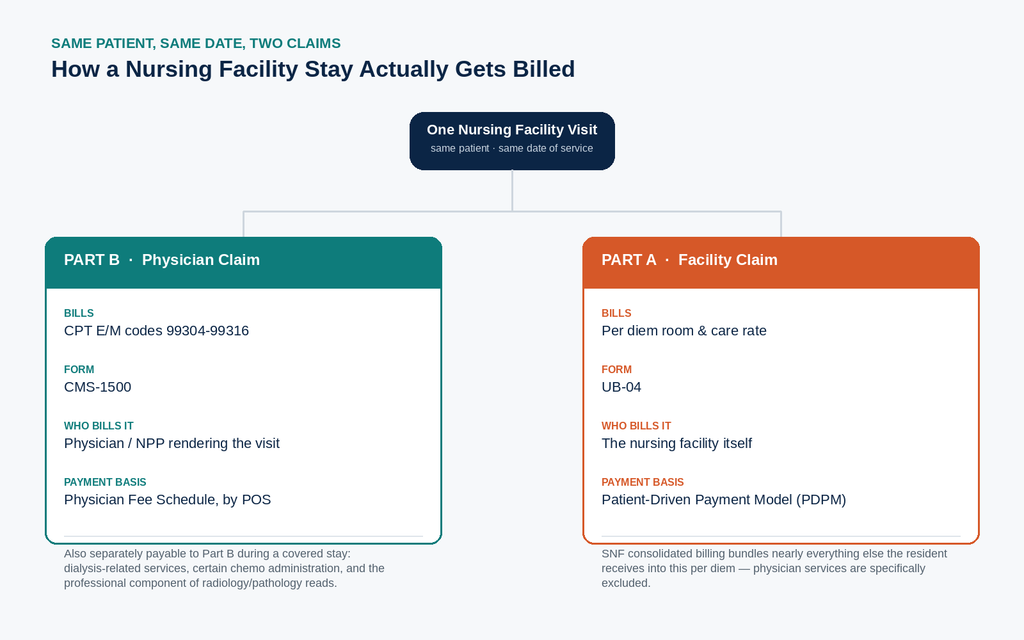
Physician services are specifically excluded from SNF consolidated billing, which is the rule that keeps this code family separately payable even during a covered Part A stay. Consolidated billing means the facility bills Medicare for nearly everything else the resident receives during that stay, bundled into one per diem rate. Services that stay separately payable to Part B include physician and qualified non-physician practitioner care, dialysis-related services, certain chemotherapy administration, and the professional (but not technical) component of radiology and pathology reads.
That professional/technical split is where billing teams most often get tripped up: the professional read bills to Part B, but the technical component is bundled and has to route through the facility instead of Medicare directly. Billing the technical component to Medicare returns a bundling denial.
Prolonged Nursing Facility Services: G0317, Not 99418 Directly
CPT’s prolonged services add-on for nursing facility care is 99418, but Medicare requires HCPCS G0317 instead for this setting. G0317 is only reportable alongside 99306 (initial care) or 99310 (subsequent care), and only when the base code was selected using time rather than MDM.
Medicare’s time threshold for G0317 sits above the base code’s own maximum time window for example, well beyond the 45-minute floor for 99310 and the qualifying time can be counted across the day before the encounter, the day of, and the three days after, as long as each activity is itemized with its own date and duration. A single total-minutes figure with no breakdown won’t hold up under review.
G0317 cannot be billed alongside discharge day management (99315/99316) or on the same date as certain other prolonged-service codes, but time spent in another care setting can sometimes count toward the prolonged-service threshold — a detail that represents recoverable revenue most practices never claim.
Telehealth for Nursing Facility Visits: The 2026 Frequency Limit Is Gone
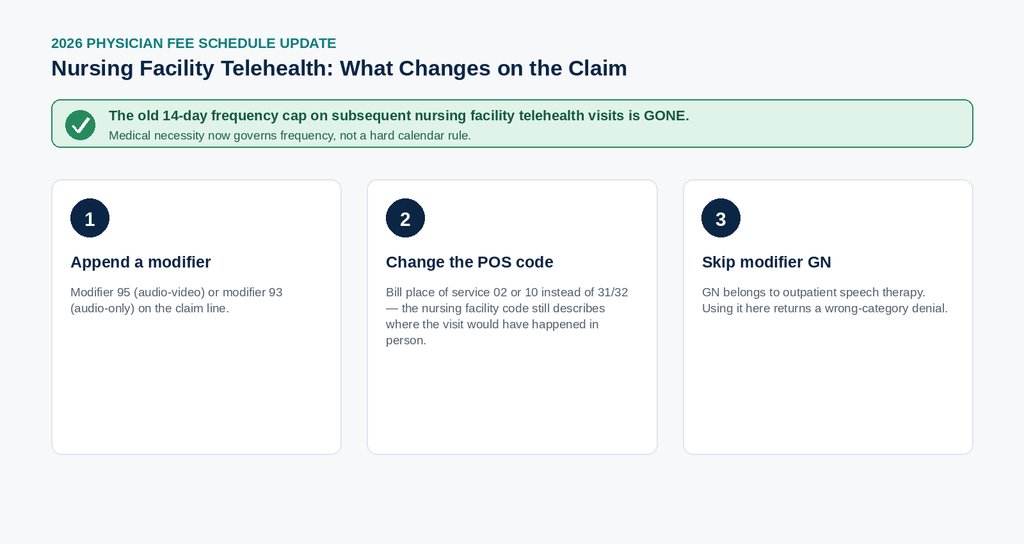
For 15 years, Medicare capped subsequent nursing facility telehealth visits at one every 14 days. The 2026 Physician Fee Schedule permanently removed that frequency limit for subsequent visits medical necessity now governs frequency instead of a hard calendar rule. Practices that scaled back nursing facility telehealth follow-ups because of the old cap have a real opening to bring them back.
Three mechanics change when the visit moves to telehealth: append modifier 95 (audio-video) or 93 (audio-only), bill place of service 02 or 10 instead of 31/32 (because the nursing facility code still describes where the visit would have happened in person), and skip modifier GN, which belongs to outpatient speech therapy and returns a wrong-category denial in this context.
The Denials Nursing Facility Claims Actually Get, and What Causes Them
Most nursing facility denials don’t come from picking the wrong CPT code. They come from the fields around it.
| Issue | Typical Denial | Root Cause |
|---|---|---|
| POS 32 billed during an active Part A stay | Payment adjustment | Place-of-service/coverage mismatch |
| Documentation doesn’t support billed MDM level | Medical necessity denial | Vague notes lacking specific MDM elements |
| Modifier AI missing on an initial care code | Missing/invalid information | Required modifier not appended |
| CPT 99318 billed after 2023 | Invalid procedure code | Deleted code still live in a template |
| Bundled service billed to Part B during Part A stay | Consolidated billing denial | Service should have routed to the facility |
| Primary diagnosis doesn’t support the service | Diagnosis/procedure mismatch | Insufficiently specific ICD-10 coding |
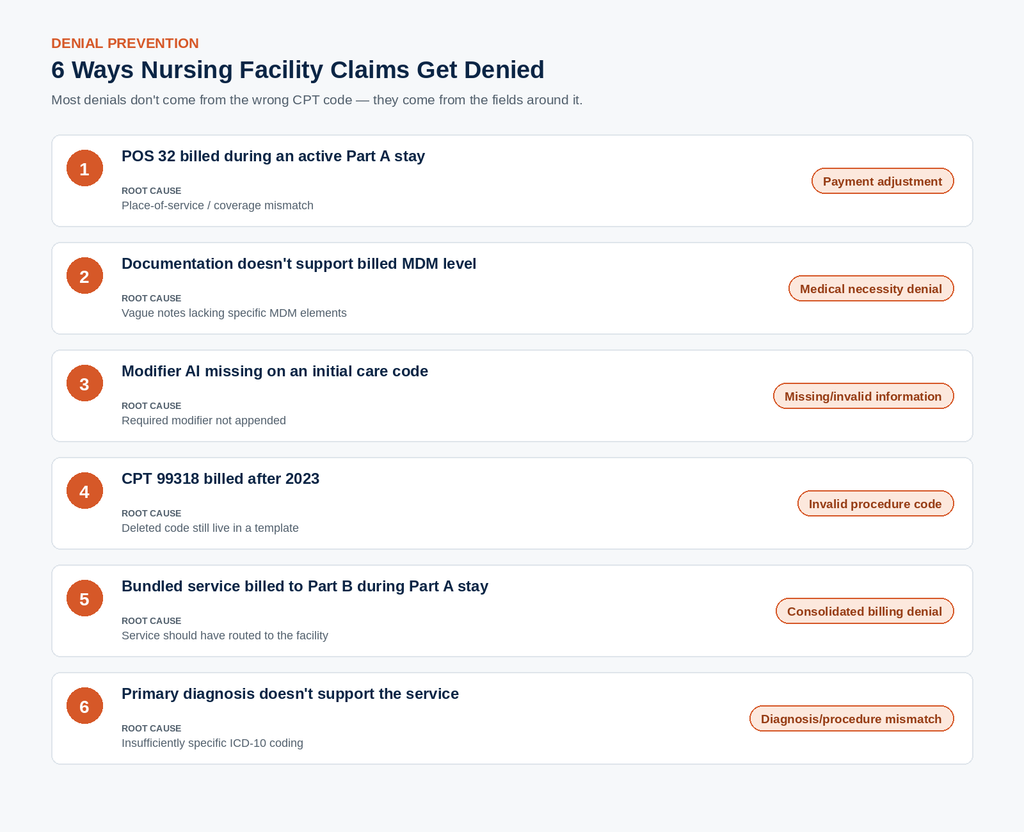
A pre-submission review of place of service, required modifiers, and MDM documentation catches the majority of these before the claim ever goes out. That kind of review is exactly what a dedicated medical billing and revenue cycle management partner builds into every claim before submission rather than after a denial arrives.
How Credexa Solutions Supports Nursing Facility Billing
Nursing facility billing sits at the intersection of E/M coding rules, Medicare Part A/Part B coordination, and place-of-service payment logic that changes from one fee schedule cycle to the next. Credexa Solutions works inside your existing EHR to review nursing facility claims for the code level, place of service, and required modifiers before they’re submitted — not after a denial comes back. Our revenue cycle management services also cover the AR follow-up needed to chase down claims that stall in Medicare’s system, and provider credentialing to keep enrollment current so a lapsed revalidation never becomes the reason a clean claim gets denied.
If your practice bills any volume of nursing facility visits, our team can review your last 90 days of claims for place-of-service accuracy and MDM documentation gaps at no cost. Get in touch with Credexa Solutions to schedule that review.
Related Reading on Credexa Solutions
- Revenue Cycle Management (RCM): Complete Guide for Healthcare Providers
- RCM Reporting Explained: The Real Driver Behind Better Collections and Cash Flow
- Medicare Timely Filing Limit 2026: The 12-Month Rule and CO-29 Denials
- BCBS Timely Filing Limit 2026: Complete Guide by Plan, State & Claim Type
- Radiology CPT Codes 2026: The Complete List, Modifiers & Billing Guide
- Wellpoint Provider Enrollment in 2026: The Complete Guide to Joining the Network
Frequently Asked Questions
What are the CPT codes for nursing facility visits? 99304, 99305, and 99306 report initial nursing facility care; 99307, 99308, 99309, and 99310 report subsequent nursing facility care billed per day; 99315 and 99316 report discharge day management. Since 2023, level is set by medical decision making or total time, not history and exam.
Is CPT 99318 still valid? No. CPT 99318 was deleted effective January 1, 2023. Annual nursing facility assessments now bill under the subsequent care codes, 99307-99310.
What’s the difference between POS 31 and POS 32? POS 31 applies when the patient has an active Medicare Part A skilled nursing benefit. POS 32 applies once Part A benefits are exhausted or for long-term custodial care. As of the 2026 fee schedule, the two no longer pay the same rate, so using the wrong one directly affects reimbursement, not just compliance.
Are nursing facility visits billed to Part A or Part B? The physician’s E/M visit bills to Medicare Part B on the CMS-1500. The facility’s stay bills separately to Part A on the UB-04 under PDPM. Both process concurrently for the same dates of service.
What is HCPCS G0317 used for? G0317 is the Medicare-specific code for prolonged nursing facility services, replacing CPT 99418 in this setting. It’s reportable only with 99306 or 99310, and only when the base code was time-based.
How often can a physician bill a subsequent nursing facility visit? Only once per practitioner, per patient, per calendar day. Federal rules also require a visit at least every 30 days for the first 90 days after admission, then every 60 days after but medical necessity, not the calendar, ultimately governs whether the visit is billable.
Does telehealth still have a frequency limit for nursing facility visits? No. The prior 14-day cap on subsequent nursing facility telehealth visits was permanently removed under the 2026 Physician Fee Schedule. Medical necessity now determines frequency.
This guide is intended for general informational purposes and does not replace review against your current CPT codebook, Medicare Administrative Contractor guidance, or payer-specific policy. Verify all codes, modifiers, and thresholds before claim submission. CPT is copyright of the American Medical Association.
Sources: Centers for Medicare & Medicaid Services (CMS) — Skilled Nursing Facility Billing Reference, Place of Service Code Set, Medicare Claims Processing Manual; American Medical Association CPT E/M Guideline Changes; U.S. Department of Health and Human Services Guidance Portal Nursing Facility Services Codes.