If you bill Wisconsin Medicaid, Badger Care Plus, or Senior Care or you order, refer, or prescribe for patients who use them you have to be enrolled through the Forward Health Portal before a single claim will pay. Not credentialed with a plan. Not licensed in the state. Enrolled, specifically, with the Wisconsin Department of Health Services (DHS).
This guide walks through the entire 2026 process end to end: what Forward Health actually is, who is legally required to enroll, the exact portal workflow, the $750 organizational application fee, realistic approval timelines, fingerprinting and risk-level screening, revalidation, and critically why a clean enrollment doesn’t guarantee clean claims. We’ll also flag the parts of this process that quietly cost practices the most money, because most of the damage in Wisconsin Medicaid enrollment happens after approval, not during the application.
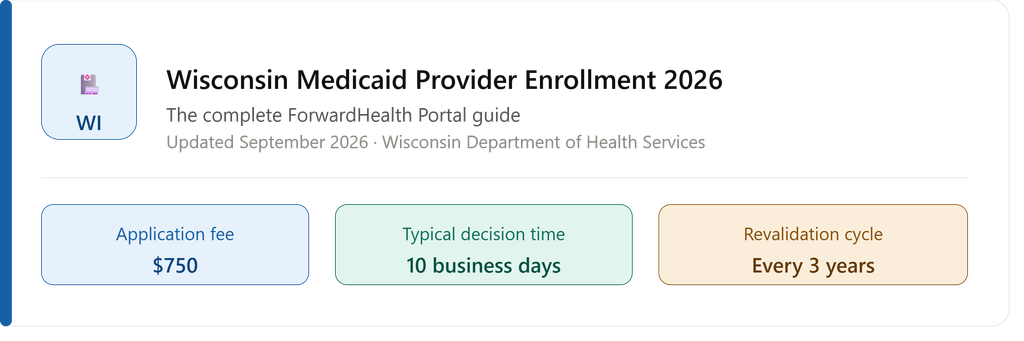
Quick answer: Wisconsin Medicaid provider enrollment is completed entirely online through the ForwardHealth Portal. Organizations pay a $750 CMS-mandated application fee. ForwardHealth typically decides within 10 business days of a complete application and is required to decide within 60 days. Revalidation is required every three years.
Table of Contents
- What ForwardHealth Is and How It Relates to Wisconsin Medicaid
- Who Must Enroll in Wisconsin Medicaid
- Individual vs. Group vs. LTC Waiver Enrollment
- Documents and Information You Need Before You Start
- Step-by-Step: The ForwardHealth Portal Application
- How Long Wisconsin Medicaid Enrollment Actually Takes
- The $750 Application Fee: Who Pays, When, and How to Avoid Denial
- Risk Levels, Site Visits, and Fingerprinting
- Your Effective Date — and the 365-Day Backdating Option
- After Approval: Portal Access, EFT, and ERA Setup
- BadgerCare Plus HMOs and Long-Term Care MCOs: The Second Enrollment You Can’t Skip
- 2026 Policy Changes: The LTC Waiver Mandate and the Home Health/Hospice Moratorium
- Revalidation: Every 3 Years, No Grace Period
- Why Claims Still Get Denied After a Successful Enrollment
- In-House vs. Outsourced Enrollment: A Real Cost Comparison
- Frequently Asked Questions
- Enrollment Checklist
1. What ForwardHealth Is and How It Relates to Wisconsin Medicaid
Forward Health is the administrative system the Wisconsin Department of Health Services uses to run Wisconsin Medicaid, Badger Care Plus, Senior Care, and the state’s Medicaid-funded long-term care waiver programs. It is not an insurance company, and it is not affiliated with Medicare. When someone tells you to “enroll with Forward Health,” they mean enroll with Wisconsin Medicaid the two terms describe the same enrollment action.
One enrollment through ForwardHealth establishes your participation at the state level across every program it administers:
| Program | Population Served |
|---|---|
| Wisconsin Medicaid (fee-for-service) | Statewide Medicaid members |
| BadgerCare Plus | Low-income adults, children, and families (mostly via HMOs) |
| SeniorCare | Prescription assistance for residents 65+ |
| Family Care / Family Care Partnership | Adult long-term care via managed care organizations |
| PACE | Program of All-Inclusive Care for the Elderly |
| IRIS | Self-directed long-term care |
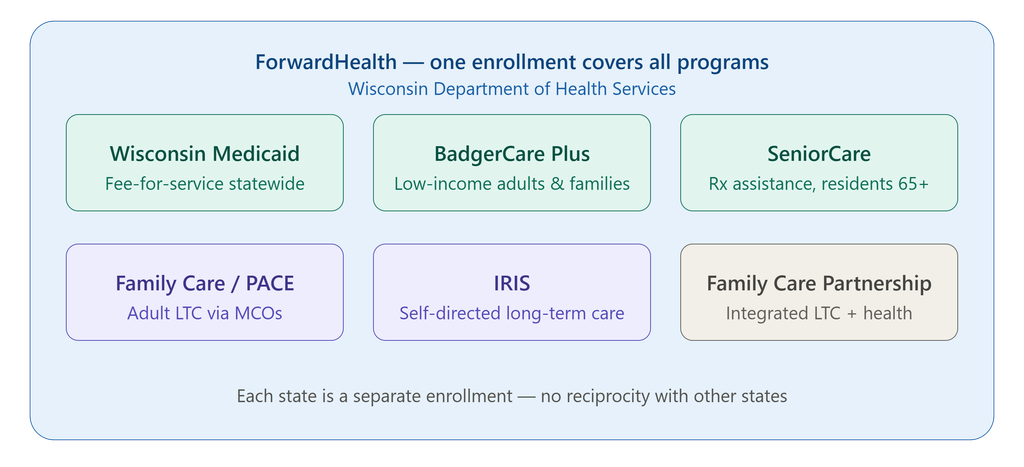
Wisconsin runs this process independently of every other state. There is no national Medicaid enrollment portal and no reciprocity enrollment in Illinois, Minnesota, or anywhere else does not carry over. If your organization operates in multiple states, each one is a separate application, a separate fee cycle, and a separate revalidation clock.
State enrollment through Forward Health is also only the first layer. It does not automatically enroll you with the managed care plans that actually deliver most Badger Care Plus and long-term care coverage more on that gap in Section 11, because it’s where a lot of “approved” providers still end up with denied claims.
2. Who Must Enroll in Wisconsin Medicaid
Federal and state rules require enrollment for anyone who renders, orders, refers, or prescribes for a Wisconsin Medicaid member — even if you never submit a claim yourself.
| Category | Applies To | Consequence of Skipping It |
|---|---|---|
| Individual practitioner | Physicians, NPs, PAs, therapists, and others who bill directly | Claims cannot be submitted or paid |
| Group practice | Practices billing under a Type 2 NPI with linked rendering providers | Linked providers can’t be paid under the group |
| Prescriber/referrer/orderer | Practitioners who prescribe, refer, or order but never bill | Other providers’ claims and prior authorizations get denied |
| Border-status provider | Out-of-state providers near the Wisconsin border | Reimbursement limited to specific defined exceptions |
The rule that catches practices off guard: For dates of service on or after July 15, 2013, Forward Health denies claims and returns prior authorization requests that don’t carry the name and NPI of a Medicaid-enrolled prescriber, referrer, or orderer. That means your practice can eat a denial because a referring physician outside your organization never enrolled. It’s worth verifying enrollment status for anyone you regularly refer to or order from, not just your own staff.
3. Individual vs. Group vs. LTC Waiver Enrollment
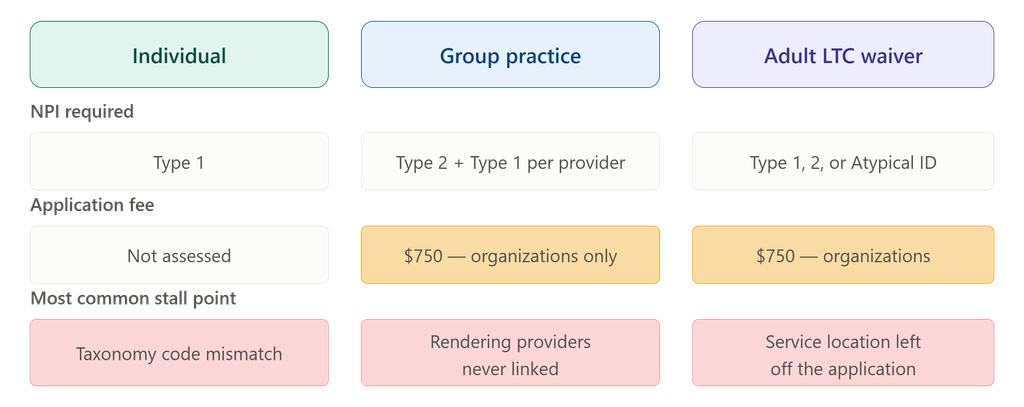
The provider type you select at the start of the application determines your NPI requirement, whether you owe the application fee, how many Medicaid IDs you’ll hold, and where the application is statistically most likely to stall.
| Individual | Group | Adult LTC Waiver | |
|---|---|---|---|
| NPI required | Type 1 | Type 2 (group) + Type 1 per rendering provider | Type 1, Type 2, or Atypical Provider ID |
| Application fee | Not assessed | Assessed for organizations, not professional groups | Assessed for organizations |
| Medicaid IDs issued | One | One for the group, plus linked rendering records | One per physical service location |
| Most common stall point | Taxonomy code mismatch | Rendering providers never linked/reported | A service location left off the application |
Individuals need a Type 1 NPI and a taxonomy code matching their enrolled specialty. No application fee applies. Choosing the wrong billing category rendering-only instead of billing is a common and costly mistake for solo practitioners, since rendering-only providers can’t submit claims at all.
Groups carry a Type 2 NPI for the practice plus a Type 1 for each linked rendering provider. Forward Health won’t allow two group enrollments sharing the same ZIP+4, NPI, and taxonomy multi-specialty practices at one address need to differentiate by NPI or taxonomy. The bigger risk: group membership and individual group affiliations are reported separately and don’t sync automatically. If nobody reports both sides, rendering providers appear unaffiliated and every claim billed under the group denies.
Adult LTC waiver providers operating from more than one physical address need a separate Medicaid ID per location this applies to adult family homes, community-based residential facilities, and facilities providing adult day services or prevocational services. This exists specifically so DHS can track Home and Community-Based Setting Rule compliance at each site.
4. Documents and Information You Need Before You Start
Gather everything before you open the portal. Two hard limits make this non-negotiable: the ForwardHealth Portal times out after 30 minutes of inactivity, and a saved application disappears after 10 calendar days.
There’s a financial reason to move fast too: any supplemental document that arrives more than 30 calendar days after submission pushes your enrollment effective date forward to match and every day it moves is a day of care you can’t bill for.
| Required Item | Common Pitfall |
|---|---|
| Tax identification number | Must match IRS records exactly |
| NPI (Type 1, Type 2, or Atypical Provider ID) | Wrong type restarts the application |
| Taxonomy code | Must align with your specialty and NPPES |
| Business and service addresses | Mismatches trigger review delays |
| Professional license/certification | Must be current on submission date, not approval date |
| DEA registration | Required where applicable |
| Ownership and control interests | Everyone at 5%+ ownership, direct or indirect |
| Managing employees and agents | Reported at enrollment and again at every revalidation |
File format matters more than it should. The portal only accepts .jpg, .jpeg, .pdf, .rtf, .txt, and .csv. Word documents and PNG images are rejected outright, and the extension has to genuinely match the file format a renamed file fails just as fast.
On the 5% ownership threshold: this isn’t a formality. It determines who must be fingerprinted if your provider type is classified high-risk, and fingerprints are due within 30 calendar days of submission or the application is denied outright. Map your full ownership structure including indirect interests before you submit, not after someone asks.
5. Step-by-Step: The ForwardHealth Portal Application
- Go to the Forward Health Portal and select “Become a Provider.” Use Edge, Chrome, Firefox, or Safari unsupported browsers can fail in ways that look identical to a portal outage.
- Select your applicant type and provider type carefully. This single choice sets your screening level, your document requirements, and your fee status. Pick incorrectly, and the fix is a brand-new application, not an edit.
- Complete the enrollment screens without long pauses. The 30-minute inactivity timeout has no warning and doesn’t preserve your current screen.
- Upload documents inside the application, not afterward. Documents uploaded during the workflow protect your submission date as your effective date.
- Use “Save and Exit” if you must stop. You’ll get an enrollment key and set your own password Forward Health cannot recover either one for you.
- Return within 10 calendar days. After that, your progress is gone and you start over. Starting an application on a Friday before a busy stretch is a common way to lose it.
- Submit and record your Application Tracking Number (ATN) immediately. No ATN means no submission was recorded, regardless of what the confirmation screen displayed.
- Pay the application fee within 10 business days, if one applies. Forward Health will not begin processing your file until the fee clears an unpaid fee looks like a slow application, not a rejected one.
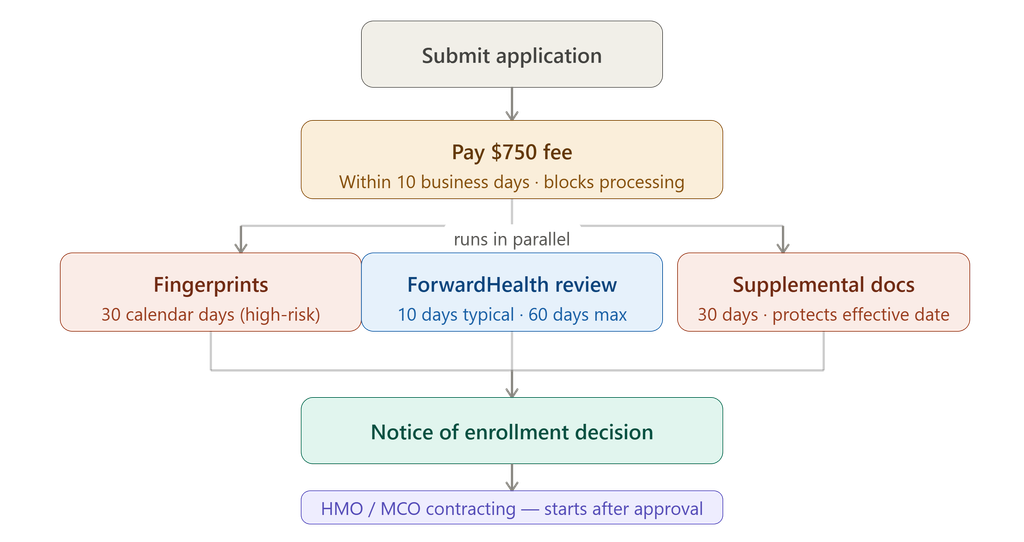
6. How Long Wisconsin Medicaid Enrollment Actually Takes
Forward Health’s current standard: a decision within 10 business days of a complete application, with a hard ceiling of 60 days. The word doing the heavy lifting is “complete” a single missing document means the clock hasn’t started yet, regardless of how long the file has been sitting.
| Stage | Typical Window | Runs in Parallel? |
|---|---|---|
| Application fee payment | 10 business days from submission | No — blocks processing until cleared |
| Fingerprints (high-risk only) | 30 calendar days from submission | Yes |
| Supplemental documents | 30 calendar days (protects effective date) | Yes |
| ForwardHealth decision | 10 business days typical, 60 days maximum | Starts once fee clears |
| Notice of Enrollment Decision | Issued on approval | Required before billing |
| MCO/HMO contracting | Separate, plan-specific timeline | Starts after state approval |
That last row is the one budget forecasts miss most often. State approval is not your go-live date if you’re billing through a managed care plan see Section 11.
7. The $750 Application Fee: Who Pays, When, and How to Avoid Denial
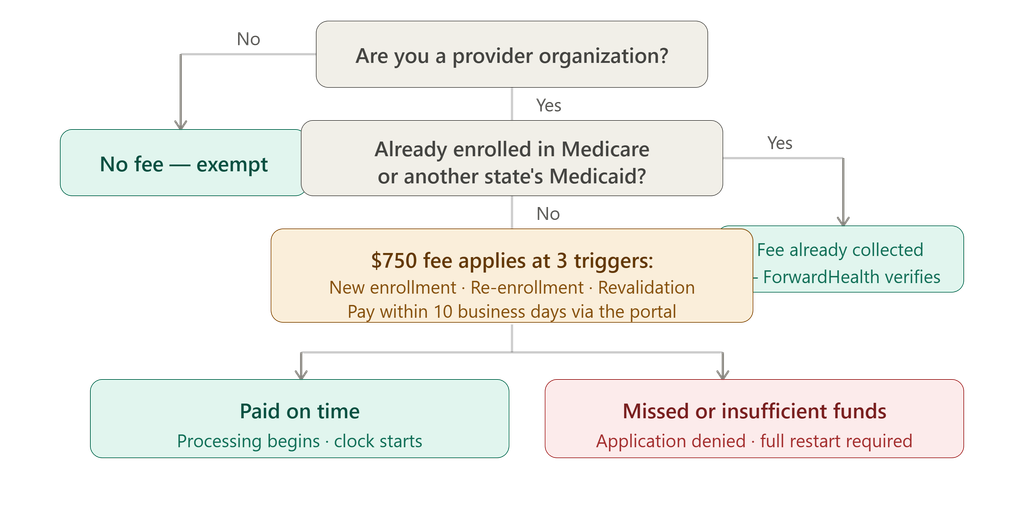
The application fee is $750, set federally by CMS and adjustable each January 1 Wisconsin doesn’t control the amount. It applies to provider organizations only. Individual providers and professional provider groups are exempt.
The fee applies to three triggers, not just first-time enrollment:
- New enrollment
- Re-enrollment after a lapse
- Revalidation (every three years)
That third bullet surprises organizations that budgeted for the fee once and assumed it was a one-time cost.
Exemption to check first: if you’re already enrolled in Medicare, or in another state’s Medicaid or CHIP program, you likely don’t pay twice Forward Health verifies the other enrollment and confirms the fee was already collected.
The rule that denies applications outright: pay within 10 business days of submission, through the Portal, with no paper checks or cash accepted. Miss the window, and the application isn’t paused it’s denied, requiring a full restart. Insufficient funds counts as nonpayment.
Refunds: the fee is generally non-refundable, with one exception if Forward Health denies your application specifically because of a CMS or state-imposed enrollment moratorium, the fee is returned.
Hardship exceptions exist but rarely succeed. They must be requested within 10 business days of submission, CMS reviews within 60 days, and critically “starting a new business” is explicitly not sufficient grounds for approval.
8. Risk Levels, Site Visits, and Fingerprinting
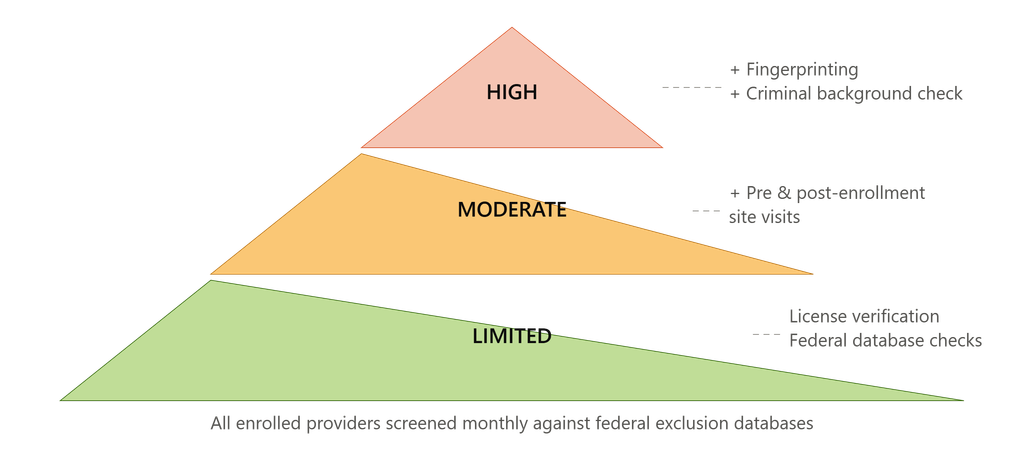
Every enrolling provider is assigned a limited, moderate, or high risk level based on provider type, following CMS classifications that ForwardHealth adopted.
| Risk Level | Screening Applied |
|---|---|
| Limited | License verification, federal database checks |
| Moderate | Everything in Limited, plus pre- and post-enrollment site visits |
| High | Everything in Moderate, plus fingerprinting and criminal background checks |
Note the detail many guides get wrong: site visits apply to moderate and high risk not limited. And enrollment isn’t a one-time gate; Forward Health screens every enrolled provider monthly against federal exclusion databases.
Fingerprinting applies to high-risk providers and anyone with 5%+ direct or indirect ownership. It must be completed within 30 calendar days of submission or the application is denied. Wisconsin uses Fieldprint for collection, at roughly $7.75 per person (subject to change), scheduled using a Wisconsin Medicaid Fieldprint code plus your ATN.
A disqualifier that overrides everything else: a Medicare, Medicaid, or CHIP-related conviction within the last 10 years for the provider or any 5%+ owner denies the enrollment outright, regardless of any other factor.
9. Your Effective Date and the 365-Day Backdating Option
Your enrollment takes effect on the date ForwardHealth receives a complete and accurate application. You keep your submission date as your effective date only if every requirement was met that day and every supplemental document arrived within 30 calendar days.
A lever most practices never use: groups may submit a written request for group billing enrollment backdated up to 365 days prior to the originally assigned effective date. Mental health service providers are excluded from this option. If your group enrolled months ago and has been writing off pre-effective-date claims, this request filed while you’re still inside your timely filing window can recover revenue that would otherwise be gone permanently.
10. After Approval: Portal Access, EFT, and ERA Setup
Approval is not the finish line. After approval:
- Request secure Portal access using your NPI, matching enrollment, and SSN/TIN (or Provider ID and financial payer details).
- Wait for a PIN letter by mail account setup cannot be completed without it.
- Activate your Portal account.
- Enroll in EFT (electronic funds transfer) paper enrollment isn’t accepted.
What trips people up here: the PIN letter goes to whatever address Forward Health has on file, not wherever you’ve since relocated. And EFT enrollment must be repeated separately for each financial payer setting it up once doesn’t cover the rest of your payer mix.
11. Badger Care Plus HMOs and Long-Term Care MCOs: The Second Enrollment You Can’t Skip
This is the gap that turns a clean Forward Health approval into a cash-flow problem. State enrollment registers you at the state level only. Badger Care Plus is delivered through regional HMOs, and long-term care programs (Family Care, Family Care Partnership, PACE, IRIS) run through MCOs or IRIS fiscal employer agents. Each requires its own separate contracting and credentialing process and none of them will begin reviewing your file until your state enrollment is confirmed.
| Program | Network Structure | Enrollment Path |
|---|---|---|
| BadgerCare Plus | County-contracted HMOs | State enrollment first, then contract per HMO in your service area |
| Family Care / Family Care Partnership / PACE / IRIS | LTC MCOs / IRIS agents | State enrollment first, then contract per MCO/agent |
Badger Care Plus participation is regional a detail that surprises practices expanding across county lines, since HMO coverage differs by county. Wisconsin’s landscape includes plans such as MHS Health Wisconsin, Quartz, Molina Healthcare of Wisconsin, Chorus Community Health Plans, Security Health Plan, and iCare.
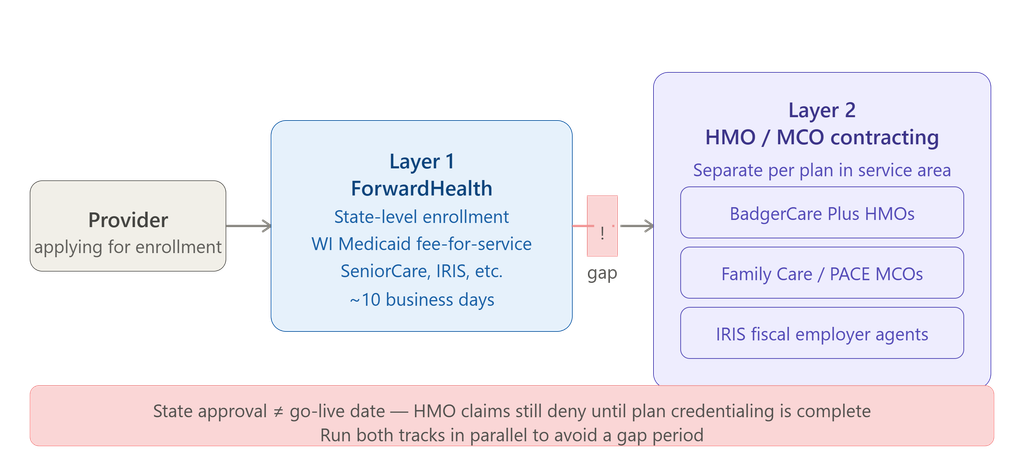
The gap period nobody budgets for: a provider approved at the state level but not yet credentialed with the relevant HMO will see claims for HMO-enrolled members denied. Running state enrollment and HMO/MCO contracting in parallel instead of waiting for one to finish before starting the other is the only real fix.
One rule worth memorizing: appeals go to the HMO first. DHS rejects appeals from providers who haven’t exhausted the HMO’s process first, so escalating straight to the state doesn’t speed anything up it just adds a rejection to the timeline.
12. 2026 Policy Changes: The LTC Waiver Mandate and the Home Health/Hospice Moratorium
Two significant policy shifts are active in 2026:
Adult LTC waiver enrollment mandate
Enrollment became mandatory for adult long-term care waiver providers, with a December 31, 2025 deadline to submit an application or revalidation. As of January 1, 2026, providers without a Medicaid ID cannot deliver services or receive payment from MCOs or IRIS fiscal employer agents. Reimbursement for dates of service on or after April 1, 2026 requires enrollment — and enrollment cannot be backdated to cover the gap (the 365-day backdating provision described above is a separate mechanism and doesn’t apply here).
Home health and hospice enrollment moratorium
Effective May 13, 2026, Forward Health is not approving new home health or hospice agencies, following nationwide federal moratoria imposed by CMS the same day. Already-enrolled agencies are unaffected and continue normal revalidation. One trap worth knowing: a change in majority ownership that triggers a re-enrollment requirement can get caught by this moratorium, turning a routine acquisition into a blocked application. CMS set the moratorium at six months (initial expiration around November 2026), extendable in additional six-month increments or liftable early check current status before assuming it still applies.
13. Revalidation: Every 3 Years, No Grace Period
Wisconsin requires revalidation every three years two years shorter than the federal five-year minimum, which catches providers transferring in from other states. Forward Health mails a Provider Revalidation Notice, and you have 30 days from your revalidation date to submit. You cannot revalidate early, but you can check your date anytime via the Check My Revalidation Date tool on the secure Portal.
Miss the window and you’re terminated not suspended. Reinstatement requires a brand-new application, additional screening, and possibly another $750 fee. Every clock in this guide, including fingerprinting, restarts from zero.
The most common cause of a missed revalidation: the notice goes to whatever address is on file. Practices that relocate without updating their ForwardHealth demographic record often don’t discover the lapse until a claim denies weeks after termination.
14. Why Claims Still Get Denied After a Successful Enrollment
Enrollment removes one denial cause it doesn’t remove the rest. Most post-enrollment denials trace back to a decision made during enrollment, not a billing mistake.
| Denial Pattern | Root Cause | Set During Enrollment? |
|---|---|---|
| Service date before effective date | Billing began before the Notice of Enrollment Decision arrived | Yes |
| Prescriber/orderer not enrolled | Claim missing a Medicaid-enrolled referring provider’s NPI | Yes |
| Wrong network | Billed fee-for-service when the member is HMO-enrolled, or to the wrong HMO | Yes |
| Taxonomy or group mismatch | Rendering provider never linked to the billing group | Yes |
| Timely filing | Denial sat unworked past the filing window | No, but compounds the rest |
Four of five patterns above are enrollment decisions resurfacing weeks later as claim denials which is why denial management that only resubmits claims, without correcting the enrollment record, tends to produce the same denial again next month.
15. In-House vs. Outsourced Enrollment: A Real Cost Comparison
Most practices don’t outsource enrollment because they lack the ability they outsource because the person handling it already has three other jobs, and enrollment is the task that slips first when the schedule fills up.
What Wisconsin’s overlapping clocks demand simultaneously:
- 10 business days to pay the application fee
- 30 calendar days for fingerprints
- 30 calendar days for supplemental documents
- 10 calendar days to return to a saved application
None of these deadlines send a reminder, and each one can independently deny or delay your file.
When in-house makes sense: a small, stable provider roster, no planned expansion, and a staff member whose job description genuinely includes enrollment management rather than absorbing it on top of existing duties.
When outsourcing pays for itself: multi-state operations, frequent provider turnover, LTC waiver or home health/hospice compliance exposure, or a team that’s already missed a fee or fingerprinting deadline once.
16. Frequently Asked Questions
How do I enroll as a Wisconsin Medicaid provider? Complete the online application on the Forward Health Portal under “Become a Provider,” selecting your applicant and provider type, uploading documents, and submitting. You’ll receive an Application Tracking Number at submission Wisconsin Medicaid enrollment is online-only.
How long does Wisconsin Medicaid provider enrollment take? Typically 10 business days for a complete application, with a 60-day maximum. Incomplete applications don’t start the clock, and managed care contracting adds time after state approval.
Is there an application fee for Wisconsin Medicaid enrollment? Yes, for provider organizations $750, set by CMS. Individual providers and professional provider groups are exempt. Payment is due within 10 business days of submission or the application is denied.
How do I check my Wisconsin Medicaid enrollment status? Use the Enrollment Tracking Search tool on the ForwardHealth Portal with your ATN, or call Provider Services at 800-947-9627.
Do I need an NPI to enroll? Most providers do Type 1 for individuals, Type 2 plus linked Type 1s for groups. Provider types that don’t qualify for an NPI enroll using an Atypical Provider Identifier instead.
How often do Wisconsin Medicaid providers revalidate? Every three years, with 30 days to respond once notified. You cannot revalidate early, and missing the deadline results in termination.
Can out-of-state providers enroll in Wisconsin Medicaid? Yes border-status enrollment exists for providers in adjacent states, and general out-of-state enrollment is available, though reimbursement is limited to specific defined situations.
Do I need to enroll separately with Badger Care Plus HMOs? Yes. Forward Health enrollment covers the state level only. Each HMO and long-term care MCO runs independent contracting and credentialing, beginning only after state enrollment is confirmed.
What happens if my enrollment application is denied? Forward Health notifies you in writing with the reason commonly an incorrect provider type, an unpaid fee, missed fingerprinting, or mismatched documentation. A denial requires a new application, not a correction.
[Internal link placeholder: Link this FAQ section’s closing line to your homepage or a relevant service page]
17. Wisconsin Medicaid Provider Enrollment Checklist
- Confirm provider type, specialty, and billing category before opening the portal
- Build a complete ownership roster everyone at 5%+ ownership, plus managing employees and agents
- Verify NPI, taxonomy, license, DEA, and tax ID all match across every system of record
- Prepare documents in accepted formats only: .jpg, .jpeg, .pdf, .rtf, .txt, .csv
- Complete the application inside the 10-calendar-day save window
- Record and securely store your ATN at submission
- Pay the $750 application fee within 10 business days, if applicable
- Complete fingerprinting within 30 calendar days if high-risk or a 5%+ owner
- Upload all supplemental documents within 30 calendar days to protect your effective date
- Wait for the Notice of Enrollment Decision before billing anything
- Calendar your revalidation date the day your Notice arrives not three years from now
External Sources Referenced
- ForwardHealth Portal — Enrollment Criteria
- ForwardHealth — Prescribing/Referring/Ordering Enrollment
- ForwardHealth — Out-of-State Provider Rules
- ForwardHealth — Ownership Reporting Requirements
- ForwardHealth — Risk Level Classification
- ForwardHealth — Fingerprint Requirements
- ForwardHealth — Provider Application Fee Policy
- ForwardHealth — Effective Date Policy
- ForwardHealth — Revalidation Policy
- ForwardHealth — HMO Provider Information
- ForwardHealth — Long-Term Care Provider Enrollment
- Wisconsin DHS — Provider Enrollment Forms
- Federal Register — Home Health Moratorium Notice
- Federal Register — Hospice Moratorium Notice
- ForwardHealth — Provider Services Contact Page
Need help navigating Wisconsin Medicaid enrollment, revalidation, or BadgerCare Plus HMO contracting? [Internal link placeholder: Link to your consultation/contact page] can walk your file from application to first paid claim.