By the Credentialing Team at Credexa Solutions
A physician calls a Centene contracting inbox, fills out an intake form, uploads a CAQH profile, and then waits. Six weeks later, nothing has moved not because the paperwork was wrong, but because nobody told them Ambetter provider enrollment isn’t a single process at all. It’s 29 separate ones, each run by a different Centene subsidiary, each with its own clock, its own inbox, and its own way of quietly losing a file.
That’s the piece most practices learn the hard way. This guide walks through how Ambetter provider enrollment actually works in 2026 who really credentials you, what the application demands, how long each phase takes, and the specific points in the process where applications stall. If your practice is deciding whether to join the Ambetter network, or you’ve already submitted and haven’t heard back, this is the version written to get you unstuck.
Quick Answer: What Ambetter Provider Enrollment Involves
- Who credentials you: A regional Centene health plan operating in your state, not “Ambetter” as a single national company
- Core requirement: An attested CAQH ProView profile, refreshed at least every 120 days
- Documents needed: State license, NPI (Type 1 and Type 2), DEA registration where applicable, malpractice face sheet, signed W-9, CV, and a release of information form
- Typical timeline: 60 to 90 days from a complete submission to an effective date, though some plans move faster and others slower
- Recredentialing: Required every 36 months to stay in network
- Cost if you outsource it: Market rates run roughly $100–$500 per payer; Credexa Solutions handles provider credentialing as part of a flat-rate RCM engagement with no separate per-application surprise fees
Keep reading for the full breakdown, or book a free enrollment consultation if you’d rather have someone else run the process.
What Ambetter Health Actually Is (And Why That Matters for Enrollment)
Ambetter Health is Centene Corporation’s brand for Affordable Care Act Marketplace plans. It isn’t an insurance company in its own right — it’s a label stamped on products sold through healthcare.gov and state exchanges, underwritten and administered by a network of regional Centene subsidiaries. According to Centene’s own 2026 SEC filings, Ambetter Health operates in 29 states, with a smaller ICHRA-focused product line, Ambetter Health Solutions, running in 13 states as of 2026.
That structure is the reason Ambetter provider enrollment feels harder than enrolling with a single national commercial payer. When you apply, you aren’t applying to “Ambetter.” You’re applying to whichever regional plan owns your state Superior HealthPlan in Texas, Sunshine Health in Florida, Peach State Health Plan in Georgia, Meridian in Michigan, and so on. Each of those entities runs its own contracting team, its own credentialing committee, and its own version of the application. A form that works for a Texas practice will bounce back to a New York group unopened.
It’s also worth knowing this: Ambetter is not Medicaid, even though the same regional Centene subsidiary frequently runs both products in a given state. A practice already credentialed with a Centene Medicaid plan is sometimes closer to Ambetter approval than it realizes more on that below.
Ambetter Provider Enrollment Requirements: The Document Checklist
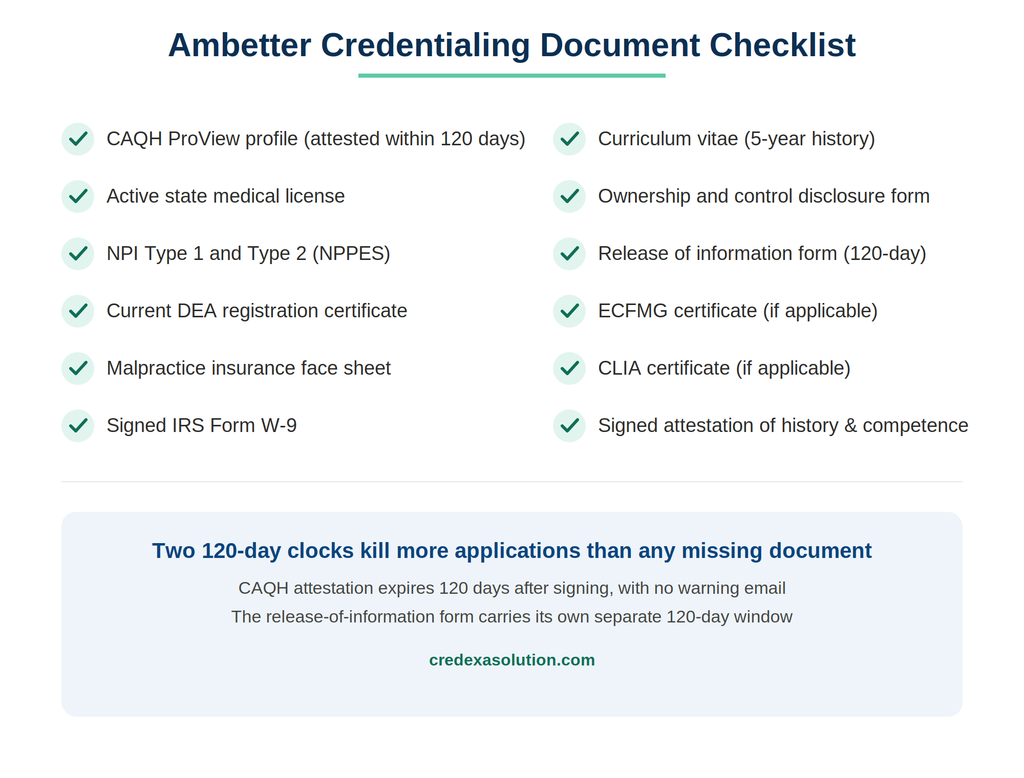
Before you submit anything, gather these. Missing even one item is the single most common reason a file sits untouched in a credentialing queue:
- Attested CAQH ProView profile, current within the last 120 days
- Active, unrestricted state medical license for every state where you’ll treat Ambetter members
- NPI Type 1 (individual) and, for groups or facilities, NPI Type 2 (organizational) — both issued through NPPES
- Current DEA registration certificate for each state of practice, where applicable
- State controlled substance registration, if your state requires one separately from DEA
- Malpractice insurance face sheet showing policy dates, carrier, and coverage limits
- Completed and signed IRS Form W-9
- Curriculum vitae covering at least five years, with any employment gap over six months explained
- Ownership and control disclosure form
- Signed release of information / attestation form, no older than 120 days at submission, covering license history, malpractice claims, and disciplinary actions
- ECFMG certificate, for internationally trained physicians
- CLIA certificate, if your practice performs in-house lab testing
Behavioral health providers — psychologists, licensed clinical social workers, marriage and family therapists, and Board Certified Behavior Analysts — go through the same credentialing framework, though several state plans route behavioral health applications through a separate contracting address than medical providers. Confirm which inbox applies before you submit; sending a BCBA application to the general medical contracting address is a quiet way to lose a month.
The Real Foundation of Ambetter Credentialing: CAQH ProView
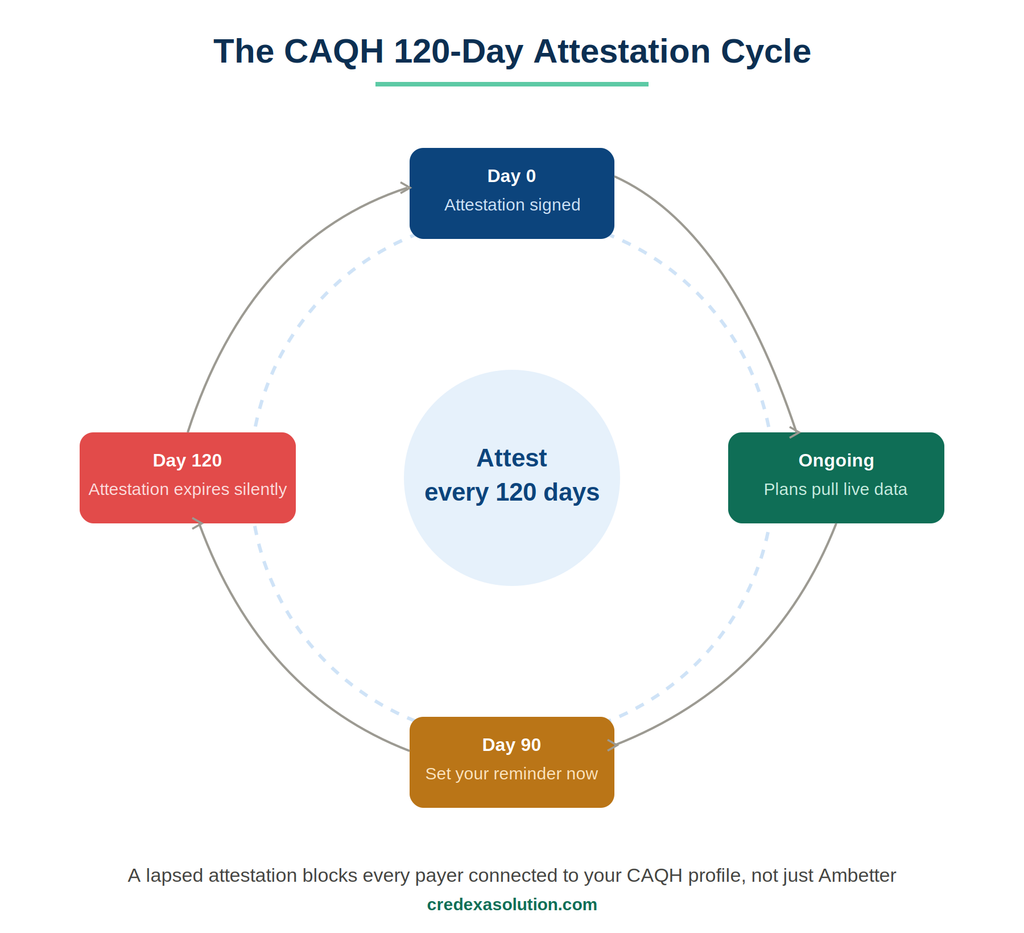
Almost every delay in Ambetter provider enrollment traces back to one system: CAQH ProView. Centene’s regional plans pull your credentialing data directly from CAQH rather than processing a separate paper application for each provider, which means a CAQH profile that’s incomplete, unauthorized, or expired stalls everything behind it.
Three rules matter more than the rest:
Authorization isn’t automatic. CAQH only releases your profile to payers you’ve specifically granted access to. A fully completed, fully attested profile is still invisible to a Centene plan until you check the box authorizing that plan to view it. This is the single most overlooked step in the entire process.
Attestation expires every 120 days. You don’t get a warning email when it lapses the plan simply sees a stale file and either pauses your application or, worse, quietly drops you from directories you’re already listed in. Set a recurring calendar reminder well before the deadline, not on it.
A finished CAQH profile is not an application. Completing CAQH tells a payer your data is available to review. It doesn’t submit a request to join their network. You still have to file a separate network participation request with each regional Ambetter plan.
If your CAQH profile has been sitting untouched for a while, it’s worth checking before you do anything else — our guide on CAQH ProView setup and maintenance walks through the update schedule practices tend to forget.
How to Become an Ambetter Provider: The 8-Step Process
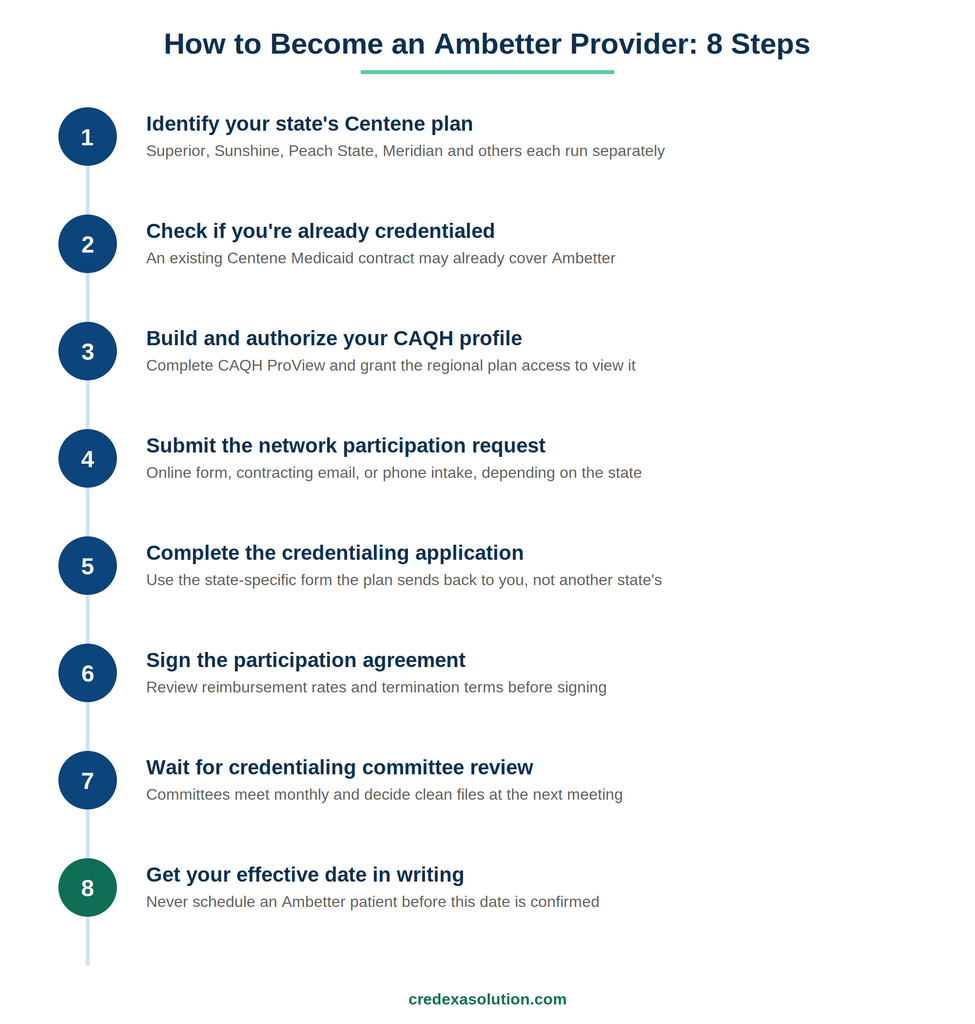
Step 1: Identify the regional Centene plan for your state
Start here, every time. The regional plan determines your application form, your contracting contact, and your credentialing timeline. If your practice spans multiple states, you’re repeating this entire process separately in each one — there is no multi-state shortcut.
Step 2: Check whether you’re already credentialed without knowing it
Several 2026 Ambetter provider manuals include a version of the same rule: a practitioner already credentialed with the affiliated Centene plan’s Medicaid or Medicare product may not need separate Ambetter credentialing. If your practice already participates in a state’s Medicaid managed care network through the same regional Centene subsidiary, call their contracting line and ask directly whether Ambetter can be added to your existing agreement rather than filed as a new application. This single phone call can save weeks.
Step 3: Build and authorize your CAQH ProView profile
Register at CAQH if you haven’t already, complete every section, and — critically — authorize the specific regional Centene plan to access your data.
Step 4: Submit the state plan’s network participation request
Each regional plan runs its own front door: an online intake form, a dedicated contracting email address, or occasionally a phone-based process. This is the request that formally opens your file and starts the intake clock.
Step 5: Complete the credentialing application the plan sends back
Once your participation request is reviewed, the regional plan issues a credentialing application specific to your provider type — physician, advanced practice provider, allied health, or facility. Complete the version they send you, not a form pulled from another state’s website; the fields and required attachments differ by plan.
Step 6: Sign the participation agreement
Some regional plans countersign before credentialing review begins; others wait until the credentialing committee has approved you. Either way, read the reimbursement schedule and termination clauses closely — this is the contract that determines what every future Ambetter claim actually pays.
Step 7: Wait for committee review and a written effective date
Credentialing committees typically meet monthly and decide “clean” applications — complete files with no outstanding requests — at the next scheduled meeting. A file that clears verification the day after a committee meets can wait nearly a full cycle before it’s even reviewed.
Step 8: Confirm your effective date in writing before scheduling patients
This is the step that protects your revenue. Regional Ambetter plans generally will not backdate an effective date, and several manuals specifically state that primary care providers cannot accept member panel assignments until credentialing is fully complete. Any Ambetter visit scheduled before your written effective date is likely to price out of network or deny outright — and there’s no appeal for a service rendered before a contract was active, because the claim was processed correctly. Save that confirmation email somewhere your billing team can find it.
How Long Does Ambetter Credentialing Take?
You’ll see “60 to 90 days” quoted everywhere, and it’s a reasonable planning number — but it collapses four separate phases into one average, which doesn’t tell you which phase your file is actually stuck in.
| Phase | What’s happening | Typical range |
|---|---|---|
| Intake review | The regional plan reviews your network participation request | Days to several weeks, depending on the state |
| Credentialing & primary source verification | License, education, malpractice, NPDB, OIG, and SAM.gov screening | Up to 60 calendar days in most plans |
| Committee decision | The credentialing committee formally reviews and approves the file | Meets at least monthly; clean files decided at the next meeting |
| Contracting & effective date | Agreement countersigned, systems loaded, directory updated | Often 30–60 days after signature |
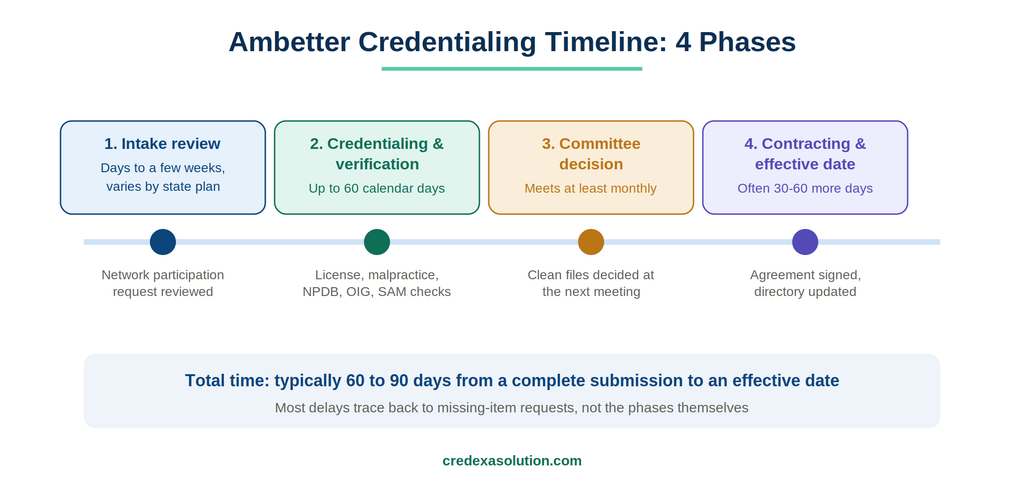
Two things cause most of the actual delay, and neither one is “slow paperwork”:
Missing-item requests that go unanswered. If a plan flags something incomplete or expired and doesn’t hear back promptly, several provider manuals allow the application to be closed out entirely — not paused, closed. That means restarting the credentialing clock from zero.
Submitting right after a committee meeting. Because committees meet on a monthly cadence, timing your final document submission matters almost as much as the documents themselves.
The practical fix is unglamorous: log your submission date, name one person on your team who owns the contracting inbox, and respond to any request within a few business days even a placeholder reply that says “we’re gathering this” keeps the file alive.
The Ambetter Provider Portal and Availity Essentials
Once you’re credentialed, eligibility checks, claim submissions, and prior authorization requests route through the Ambetter provider portal. Since 2024, Centene has been migrating most regional plans onto Availity Essentials, on a state-by-state schedule — some plans have fully migrated, and a few states still run a legacy portal alongside Availity for specific functions like referrals. Before your first claim goes out, confirm with your regional plan which portal handles which task; submitting through a retired legacy system is a quiet way to generate rejections that look like credentialing problems but aren’t.
Registering for Availity requires someone at your practice with the authority to sign agreements on the organization’s behalf — this is usually a practice administrator or owner, not front-desk staff.
Common Reasons Ambetter Enrollment Applications Get Delayed
Most Ambetter provider enrollment problems trace back to a handful of repeat offenders:
- Applying to the wrong regional plan. Submitting a Texas-style form to a Georgia inbox (or vice versa) simply never gets processed.
- Unauthorized CAQH access. The profile looks complete on your screen and is invisible on theirs.
- Lapsed CAQH attestation. Silent, unannounced, and blocks every payer connected to that profile — not just Ambetter.
- Incomplete missing-item responses. A partial reply to a documentation request often restarts review rather than resolving it.
- Behavioral health applications sent to the medical intake address. Several states separate these workflows entirely.
- Assuming a closed panel is a documentation problem. Some regional plans limit new enrollment by specialty and county based on network adequacy — a clean, complete application can still be declined simply because the plan doesn’t need more coverage in your area right then. That’s a timing issue, not a paperwork one, and it’s worth asking directly whether a decline is need-based or document-based.
Recredentialing: The 36-Month Clock Nobody Watches Closely
Ambetter recredentials practitioners at least every 36 months from the date of the original credentialing decision. Miss that window and several regional plans require a full restart of initial credentialing rather than a streamlined renewal — meaning the same 60-to-90-day process, and a real gap where every claim prices out of network.
A smaller, easier-to-miss obligation sits alongside it: most provider manuals require notifying the plan of relevant changes — address, TIN, license actions, new locations, departing providers — within about 10 days. Stale data doesn’t just create administrative headaches; it routes remittances to the wrong address and leaves inaccurate listings in the provider directory, which is exactly what generates patient complaints about “in-network” doctors who never answer.
Build a standing calendar around four dates: CAQH re-attestation (every 120 days), recredentialing (36 months), change notifications (10 days from any change), and periodic roster verification with your regional plan.
Getting Paid: What Happens After You’re Credentialed
Enrollment gets you a contract. It doesn’t get you paid — that’s a separate workstream, and it’s where a lot of newly credentialed practices lose their first few months of Ambetter revenue.
EDI and claims submission. Confirm your regional plan’s payer ID and paper claim address directly against their current quick reference guide before your first batch of claims goes out — a clearinghouse routed to the wrong entity produces a rejection that looks like a credentialing failure and isn’t.
EFT and ERA enrollment. Set this up before your effective date, not after your first remittance fails to arrive. Waiting adds weeks to a problem that takes minutes to prevent.
Timely filing. Most Ambetter plans give participating providers roughly 180 days from the date of service to file a clean claim, though this varies by state and product — verify against your specific state’s current manual rather than assuming a universal number. Our guide to Medicare and commercial timely filing rules covers how these windows compare across major payers.
Prior authorization. Approvals are typically granted at the CPT code level, which means a second procedure performed in the same encounter isn’t automatically covered by an existing authorization. Check the plan’s live authorization lookup tool before scheduling rather than relying on a saved list.
Premium-current status. Marketplace members pay their own monthly premiums, and a lapsed premium can turn what looked like a clean claim into a retroactive termination denial weeks after the visit. Verifying eligibility immediately before non-emergency services catches this before it becomes a write-off.
Is Joining the Ambetter Network Still Worth It in 2026?
This deserves an honest answer, because the market shifted meaningfully this year. Centene’s own SEC filings show Marketplace membership falling from roughly 5.5 million members at the end of 2025 to around 3.5 million by the second quarter of 2026 — a decline tied directly to the expiration of enhanced ACA premium tax credits. Several state products have scaled back; Ambetter’s New Hampshire plan, for example, is exiting that market entirely at the end of 2026.
That doesn’t make Ambetter enrollment a bad decision — it makes the volume math worth running for your specific market before you commit staff time to the application. A thinner overall membership base can still mean strong local demand if your specialty is undersupplied in your county, and network-need arguments tend to favor practices in exactly that position during contracting.
Before applying, pull your current payer mix to see how many existing patients already carry an Ambetter card, check your county against the plan’s current coverage map, and ask your contracting rep directly whether your specialty is considered at network adequacy locally. That conversation takes ten minutes and can save a quarter of wasted paperwork.
In-House vs. Outsourced Ambetter Credentialing: What It Actually Costs
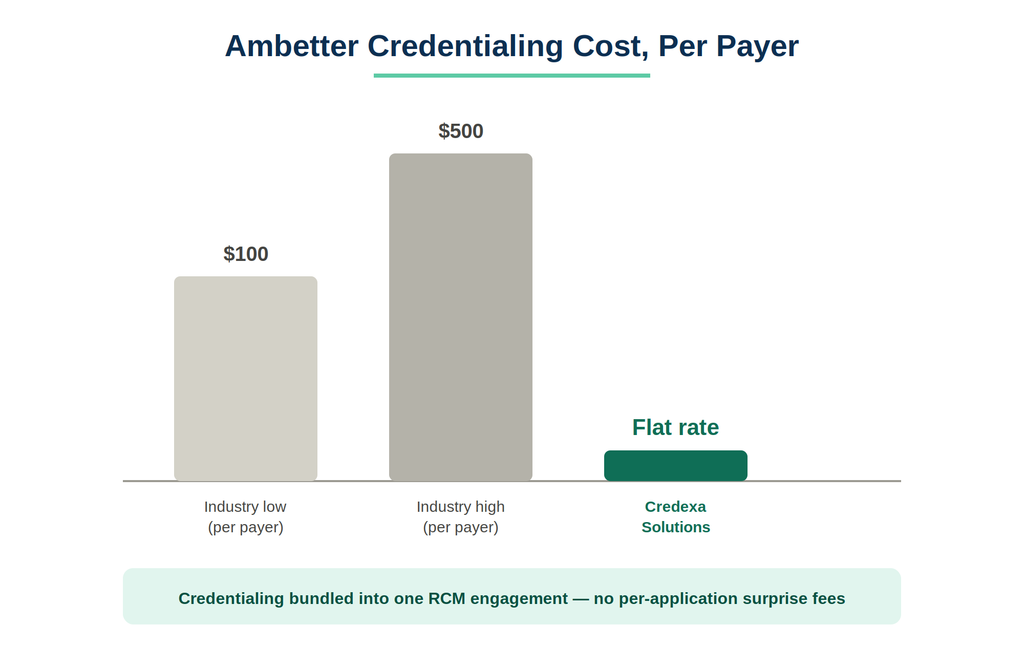
Published market rates for payer credentialing generally run $100 to $500 per practitioner, per payer, with recredentialing typically priced at 50–60% of the initial cost. For a multi-provider practice enrolling across several regional Ambetter plans which, again, Centene treats as separate payers even though they share a brand — those per-application fees add up fast, and that’s before counting staff hours spent chasing missing-item emails and monitoring CAQH attestation dates.
The in-house math often looks cheaper on paper and isn’t in practice. A credentialing coordinator’s salary doesn’t shrink because an individual application fee is low, and a file that sits untouched in a contracting inbox for five weeks has a real cost in delayed effective dates and lost billable visits.
Credexa Solutions bundles provider credentialing and payer enrollment into the same engagement as ongoing medical billing and revenue cycle management, so the team that files your Ambetter application is the same team watching your first remittance come back — no handoff, no separate vendor relationship to manage, and no missing-item email sitting in an inbox nobody checks.
How Credexa Solutions Handles Ambetter Provider Enrollment
Credentialing and billing tend to sit with different people even inside well-run practices, and that handoff is exactly where files stall and revenue leaks. Our credentialing team:
- Confirms the correct regional Centene plan for every state you practice in
- Builds and maintains your CAQH ProView profile, including authorization and the 120-day re-attestation cycle
- Submits and tracks your network participation request and credentialing application with weekly follow-up, not monthly check-ins
- Reviews your participation agreement terms before you sign
- Confirms your written effective date before any patient is scheduled
- Hands off directly into our eligibility verification, claim submission, and AR follow-up teams, so enrollment and billing stay connected instead of becoming two separate problems
If you’re weighing Ambetter alongside other Marketplace or Medicaid options, our guides on Wellpoint provider enrollment and Revenue Cycle Management fundamentals are good next reads, along with our breakdown of what strong RCM reporting should actually tell you once claims start flowing.
Frequently Asked Questions
How do I become an Ambetter provider? Identify the regional Centene plan that operates in your state, submit a network participation request to that specific plan, then complete credentialing and contracting with them directly. There is no single national Ambetter application.
How long does Ambetter credentialing take? Most complete applications move from intake to an effective date in roughly 60 to 90 days, though intake review alone can range from days to several weeks depending on the state, and credentialing committees generally meet monthly.
Is Ambetter Medicaid or a commercial plan? Ambetter is a commercial ACA Marketplace product, sold as a Qualified Health Plan. The confusion is understandable because the same regional Centene subsidiary frequently runs the state’s Medicaid managed care plan under a related brand.
Do I need a separate application for each state? Yes. Each state’s Ambetter product is credentialed by a different regional entity, so a group practicing across three states is running three separate applications on three separate timelines.
How often does Ambetter recredential providers? Every 36 months from the date of the original credentialing decision. Missing that window generally means restarting the full initial credentialing process rather than a simple renewal.
Can I see Ambetter patients while my application is pending? No. Claims for services rendered before your written effective date typically price as out-of-network, and several provider manuals prohibit primary care providers from accepting panel assignments until credentialing is fully complete.
What does Ambetter credentialing cost if I outsource it? Published industry rates run roughly $100 to $500 per payer. Credexa Solutions handles Ambetter provider enrollment as part of an integrated credentialing and billing engagement contact us for current pricing based on your state and provider count.

The Bottom Line
Ambetter provider enrollment isn’t complicated because the paperwork is hard — it’s complicated because it’s 29 separate processes wearing one brand name, and the failure points are almost always the same: the wrong regional plan, an unauthorized CAQH profile, a lapsed attestation, or a missing-item request that sat unanswered for too long.
Get the routing right, keep CAQH current, and put a name on the follow-up, and most of what makes this process feel unpredictable disappears. If you’d rather hand that off entirely, Credexa Solutions manages Ambetter credentialing and the billing behind it as one connected process — schedule a free consultation to find out what it would take to get your practice enrolled.