If your practice treats Medicaid patients, you already know the frustration. The care is the same, but the payment is slower, the rules are stricter, and the denials are harder to explain. In 2026, Medicaid reimbursement is also changing faster than most billing teams can track.
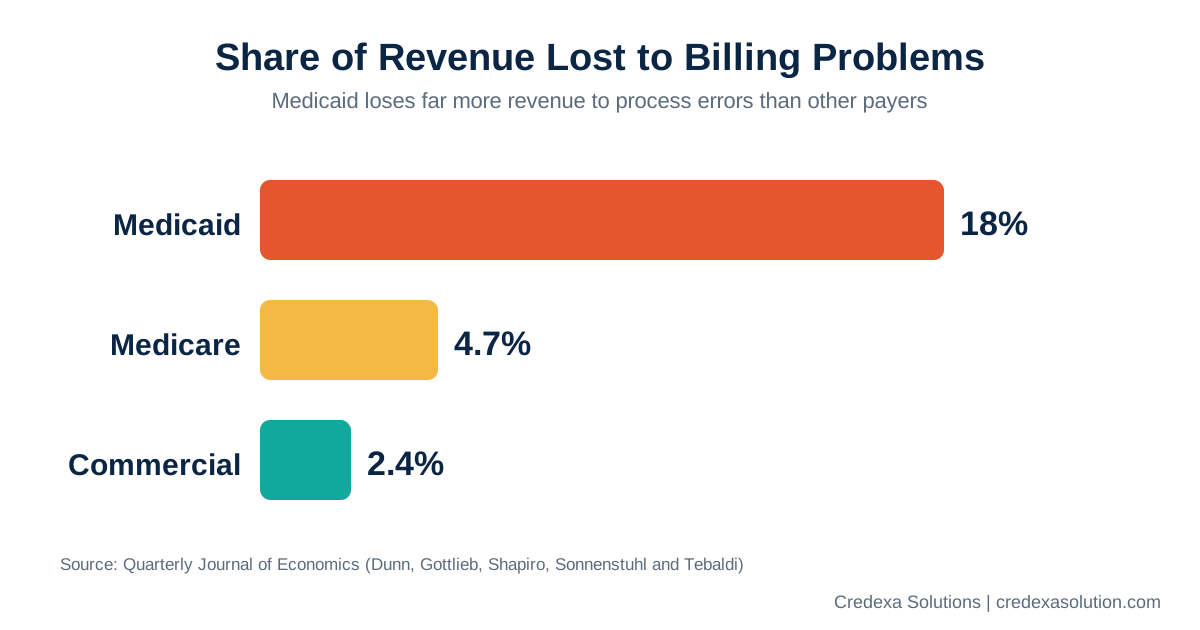
The good news is that most Medicaid revenue loss is not caused by low rates. It is caused by process failures, and process failures can be fixed. Peer-reviewed research in the Quarterly Journal of Economics found that physicians lose about 18% of Medicaid revenue to billing problems, compared with 4.7% for Medicare and 2.4% for commercial insurers (source study). The work is the same, but the leakage is several times higher. medsolercm
This guide explains how Medicaid billing works, where money disappears, what changed for 2026 and 2027, and the nine steps that recover and protect revenue. It also shows how Credexa Solutions supports providers from enrollment to clean claims.
Key Takeaways
- Medicaid reimbursement depends on which payer you bill: the state (fee-for-service) or a managed care organization (MCO).
- Documentation gaps, not fraud, drive most federal Medicaid payment errors.
- New prior authorization rules and shorter eligibility cycles change how you should verify coverage.
- Underpayments rarely show up as denials, so you must reconcile payments against the fee schedule.
- Enrollment and credentialing errors are one of the most avoidable causes of denied Medicaid claims.
What Is Medicaid Reimbursement, and Why Do Providers Lose Money?
Medicaid reimbursement is the payment a provider receives for covering services delivered to Medicaid-enrolled patients. The amount is set by the payer’s fee schedule, which is a maximum allowable amount for each procedure code. Because each state designs its own program within federal guardrails, there is no single national Medicaid fee schedule.
Providers lose money in three ways:
- Prevented losses: errors that could have been stopped at the front desk, such as expired coverage or a missing authorization.
- Recovered losses: denials you win back through appeals, at the cost of staff time and delayed cash.
- Unrealized revenue: services delivered but never charged, or visits billed at a lower level than the documentation supports.
Most practices track only the second category. The third is often the largest and is invisible on a denial report.
Consider a behavioral health practice with an authorization for 20 sessions that delivers 14. Nothing is denied, yet six approved sessions of revenue vanish. Or a provider bills a lower-level E/M code than the note supports. The claim pays correctly for what was submitted, and the difference is quietly lost on every similar visit.
Medicaid Fee-for-Service vs. Managed Care: Know Which Payer You Are Billing
“Medicaid” is not one payer. It is a program that pays providers through two structures, and confusing them is where many billing problems begin.
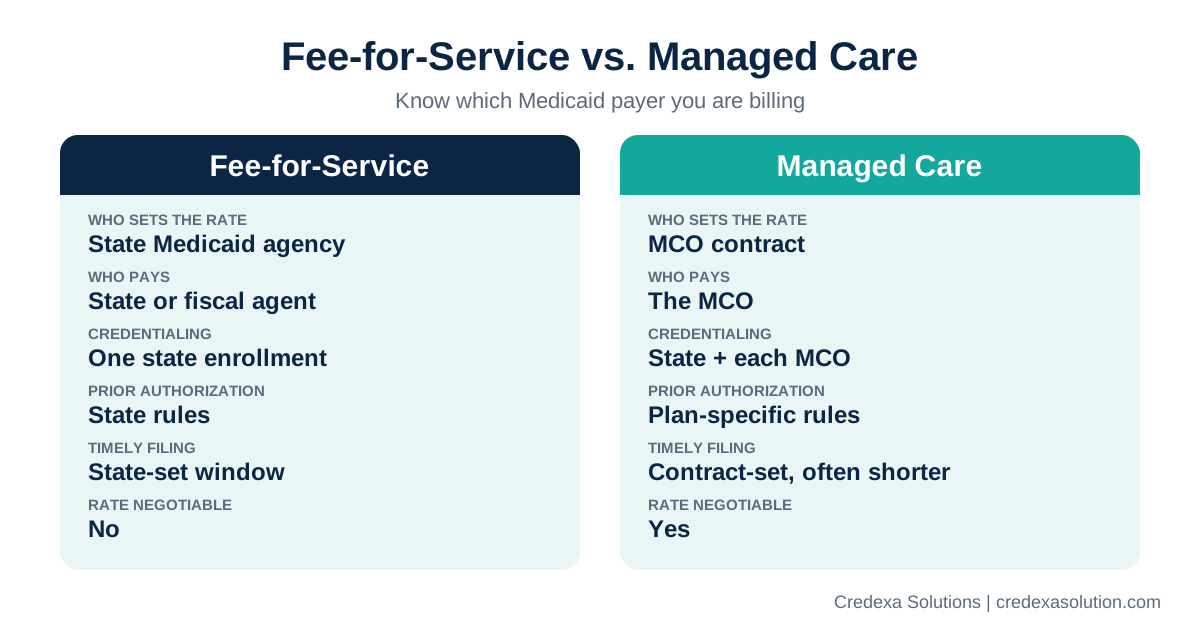
Fee-for-service (FFS): The state Medicaid agency sets the rate, adjudicates the claim, and pays you directly.
Medicaid managed care: The state pays an MCO a fixed monthly amount per member, and the MCO pays providers under its own contract, fee schedule, and rules. MACPAC reports that about 85% of Medicaid beneficiaries are enrolled in some form of managed care, and that MCOs have flexibility to pay differently from the state FFS rate.
| Factor | Fee-for-Service | Managed Care |
|---|---|---|
| Who sets the rate | State Medicaid agency | MCO contract |
| Who pays | State or fiscal agent | The MCO |
| Credentialing | One state enrollment | State enrollment plus each MCO |
| Prior authorization | State rules | Plan-specific rules |
| Timely filing | State-set window | Contract-set, often shorter |
| Rate negotiable | No | Yes |
Managed care also has its own prompt-payment rules. Under 42 CFR 447.46, MCO contracts must meet prompt-pay requirements, though the MCO and provider can agree on an alternative schedule if it is written into the contract. Read your contract and know your deadlines.
In a single state, a practice may deal with five MCOs, five portals, five authorization rulebooks, and five timely filing windows, all under the “Medicaid” label. That is why Medicaid provider enrollment and credentialing come first, a point we return to below.
Why Medicaid Reimbursement Rates Are Lower Than Medicare
Medicaid reimbursement rates are usually lower than Medicare rates because states set their own fee schedules. A rate for the same CPT code can differ widely between neighboring states. A practice in three states is managing three separate rate environments.
States also use supplemental payments instead of raising base rates. MACPAC found that in 2023, 31 states and the District of Columbia made a combined $2.6 billion in supplemental payments to physicians and other practitioners, about 22% of fee-for-service spending on those services. If your state pays supplemental amounts, modeling revenue from the base fee schedule alone will understate what you actually earn. medsolercm
Do not budget from national averages or ranking lists. Build your projections from your own state’s published fee schedule and your own MCO contracts.
What Changed in 2026 and What Is Coming in 2027
Several federal changes make 2026 and 2027 a critical planning window. Verify the current status of each item before acting, because timelines can shift.
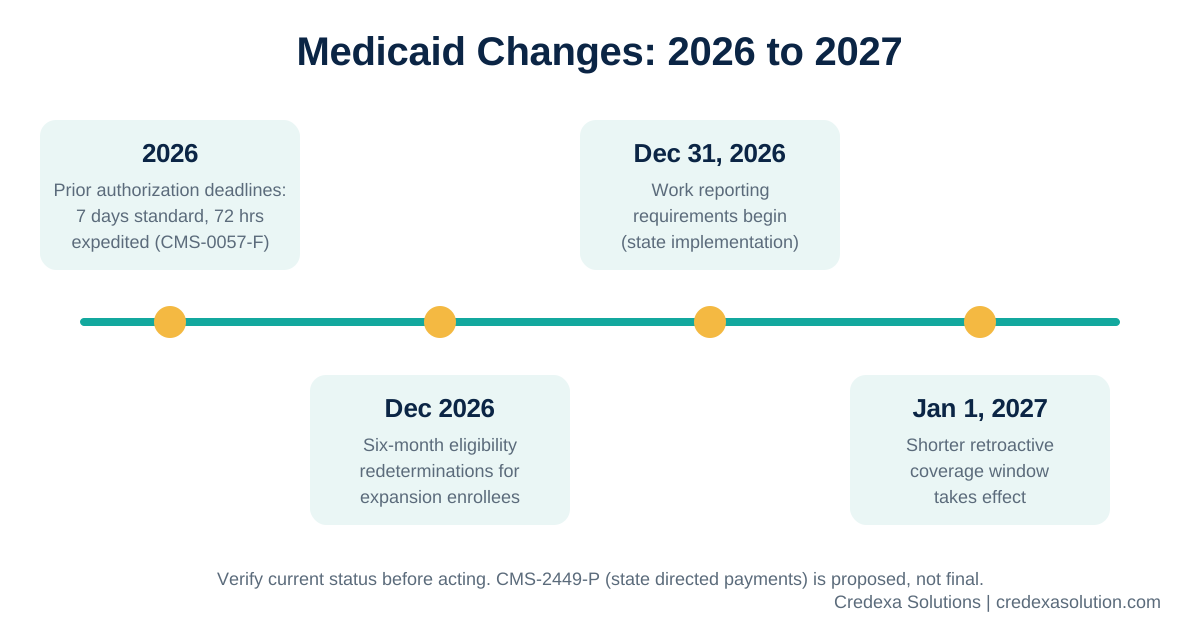
Prior authorization timeframes (CMS-0057-F). Under CMS-0057-F, impacted payers must decide standard non-drug prior authorization requests within seven calendar days and expedited requests within 72 hours. Beginning in 2026, they must also give a specific reason when denying a request. This covers Medicaid and CHIP fee-for-service and managed care, and Medicare Advantage. CMS also confirms that payers must publicly report prior authorization metrics starting in 2026, giving you plan-level data you never had before.
Eligibility changes (Public Law 119-21). Six-month redeterminations for expansion enrollees begin in December 2026, work reporting requirements roll out around the end of 2026, and the retroactive coverage window shrinks starting January 1, 2027. More churn means more patients who lose coverage between scheduling and the visit.
State directed payments. A proposed CMS rule (CMS-2449-P) would limit certain state directed and targeted practitioner payments. As of the last review it was not final, so treat it as risk to model rather than settled policy.
Three moves to make now:
- Audit your retroactive claim volume before January 2027.
- Map how much revenue depends on supplemental or directed payments.
- Build a re-verification routine before December 2026.
Where Medicaid Revenue Leaks: A Stage-by-Stage View
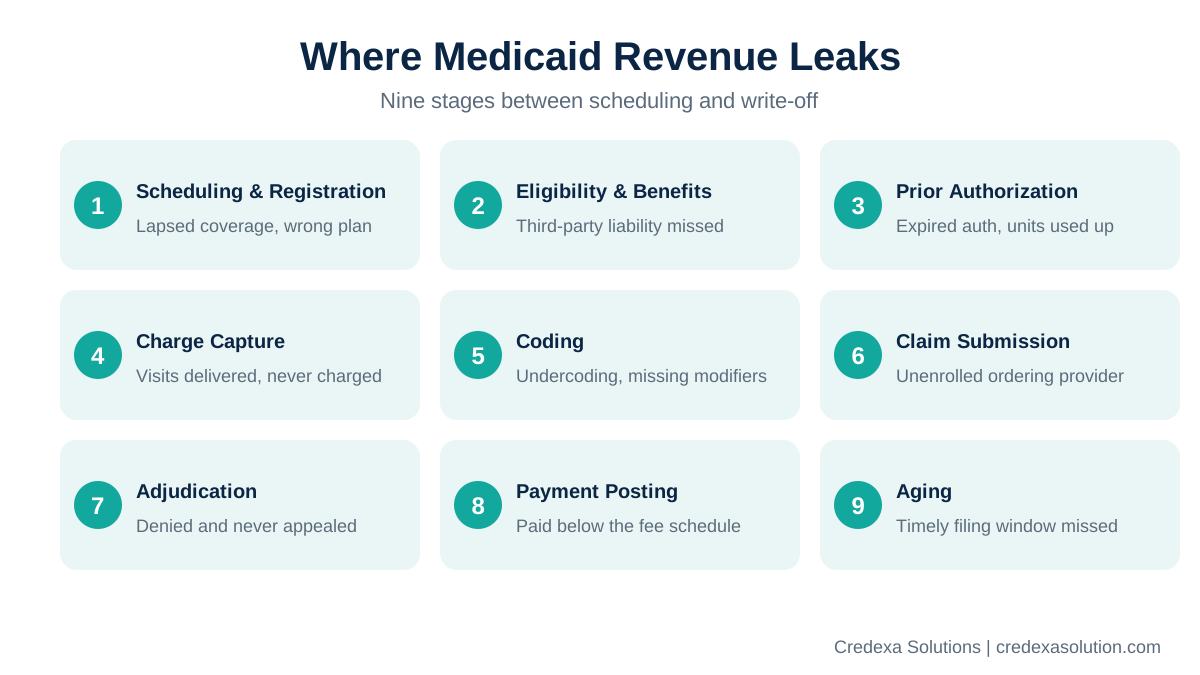
Revenue leaks at nearly every step between scheduling and write-off:
- Scheduling and registration: lapsed coverage or the wrong plan on file.
- Eligibility and benefits: third-party liability missed, so Medicaid is billed first.
- Prior authorization: expired authorizations, exhausted units, or services outside the approved scope.
- Charge capture: encounters delivered but never charged.
- Coding: a visit level below the documentation, missing modifiers, or bundling edits.
- Claim submission: an ordering provider who is not enrolled, or demographic mismatches.
- Adjudication: claims denied and never appealed.
- Payment posting: claims paid below the posted rate and written off as a “contractual adjustment.”
- Aging: claims that pass timely filing with no appeal path left.
No single-stage vendor catches all of these, because a front-desk fix and an appeal are different jobs. This is why the most effective Medicaid billing operations treat the revenue cycle as one connected system.
There is also a documentation lesson in the federal data. In its FY2025 Improper Payments Fact Sheet, CMS reported a 6.12% Medicaid improper payment rate, about $37.39 billion, and attributed 77.17% of those payments to insufficient documentation, which CMS says is generally not indicative of fraud. KFF notes that the large majority of Medicaid outlays, 93.9% in 2025, were paid properly. The improper payment rate is a program integrity measure, not a provider revenue metric, but the takeaway for practices is direct: the documentation gaps that cause federal errors also cause denials, recoupments, and rework.
9 Proven Ways to Increase Medicaid Reimbursement
1. Verify Eligibility Three Times
Run an eligibility inquiry (the X12 270/271 transaction) when the appointment is booked, on the date of service, and before the claim is sent. With six-month redeterminations coming, a check at scheduling can be out of date by the time the patient arrives. Coverage that was real when you checked may not exist on the day of care.
2. Identify Third-Party Liability Before You Bill
Medicaid is the payer of last resort, so other payers with legal liability generally pay first. Ask the other-coverage question at every registration, in the same words, and route any hit to a coordination of benefits queue. If Medicaid pays and other coverage is found later, the state can recoup the money.
3. Hold Payers to the Prior Authorization Clock
With enforceable decision timeframes, an authorization sitting undecided past the deadline is a payer outside a federal standard, and you can document it. Track four fields per plan: request date, any clock-stop for missing information, decision date, and denial reason. Build a standard authorization packet for your high-volume services so staff stop reassembling the same documents each time.
4. Code to the Documentation, and Document to the Code
Coding accuracy protects more revenue than almost any other single change. Two habits matter most:
- Follow the current Medicaid NCCI methodology. CMS updates the Medicaid NCCI program guidance annually. Procedure-to-procedure edits and Medically Unlikely Edits deny claims when code pairs or unit counts fall outside those rules.
- Document to the required specificity. Vague diagnoses cost you on the claim and understate the acuity of your whole patient panel, which matters when rates are set and negotiated.
When the same edit keeps firing, classify it before fixing it: a pair conflict, a unit-count issue, a modifier problem, or a coverage policy. Each has a different fix.
5. Run a Pre-Submission Review
Catch modifier errors, missing authorization numbers, demographic mismatches, and unenrolled ordering providers before the claim leaves your system. A denial prevented costs a fraction of a denial appealed.
6. Categorize Every Denial by Root Cause
Resubmitting a claim without fixing the underlying error just produces the same denial again. Log a cause for each denial and route it back to whoever created it: registration, scheduling, coding, or documentation. This is how denial rates fall over time instead of merely being worked.
7. Reconcile Payments Against the Fee Schedule
Underpayments never appear as denials. A claim paid below the posted state rate closes cleanly and posts as a contractual adjustment. To catch it, compare each remittance line against the published fee schedule or your MCO contract rate. Read the 835 electronic remittance carefully and separate true denials from contractual adjustments, because they look alike on summary reports and mean very different things.
8. Respect Timely Filing Deadlines
Timely filing denials, coded CO-29, generally cannot be appealed. Filing windows vary by state and by MCO contract. Work your aging report by filing-deadline proximity, not just by age, so claims nearing their deadline are prioritized.
9. Negotiate Your Managed Care Contracts
Because MCO rates are negotiable, they are one of the most overlooked levers in Medicaid billing. Review your MCO rates against the state FFS schedule, understand your prompt-pay terms, and consider single case agreements where you deliver care outside your contracted scope. Come to the table with your own denial and payment data.
Common Medicaid Denial Codes and Who Should Fix Them
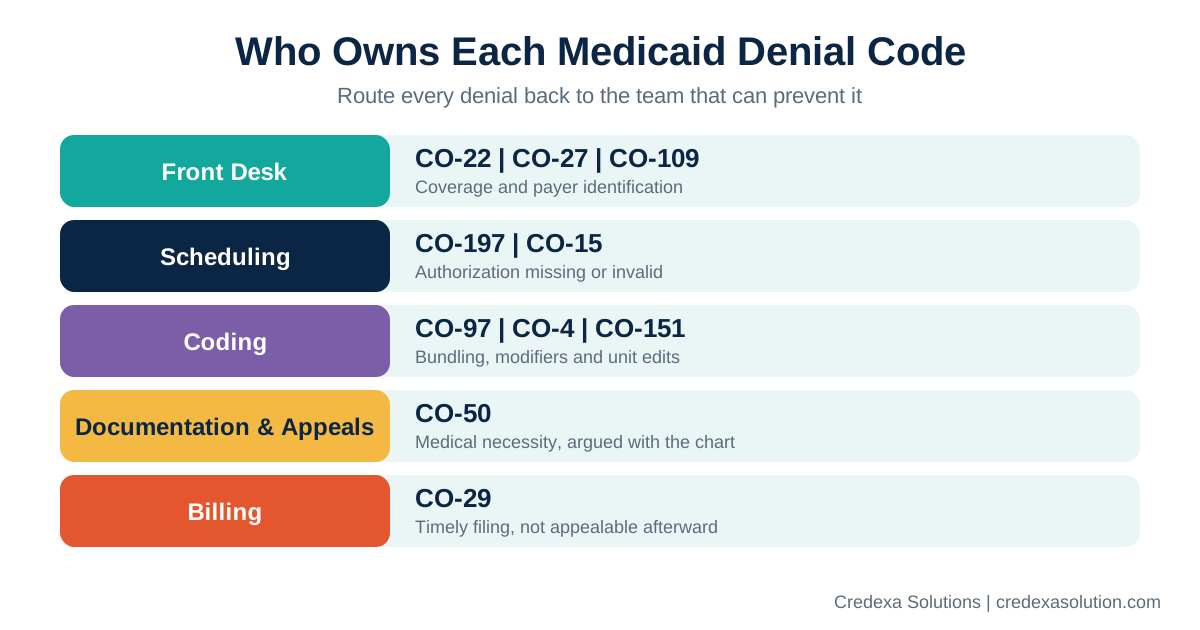
Medicaid denials arrive as Claim Adjustment Reason Codes (CARCs) on your remittance. The current descriptions are maintained by X12, and payer-specific usage varies, so confirm against your payer’s companion guide.
| Code | Family | What It Usually Signals | Owner |
|---|---|---|---|
| CO-16 | Submission data | Missing or invalid information | Billing |
| CO-18 | Submission data | Duplicate claim | Billing |
| CO-22 | Eligibility | Possible other coverage (coordination of benefits) | Front desk |
| CO-27 | Eligibility | Coverage terminated before service | Front desk |
| CO-109 | Eligibility | Wrong payer | Front desk |
| CO-197 | Authorization | Authorization absent | Scheduling |
| CO-15 | Authorization | Authorization invalid or missing | Scheduling |
| CO-97 | Bundling | Service included in another payment | Coding |
| CO-4 | Bundling | Modifier missing or inconsistent | Coding |
| CO-151 | Bundling | Information does not support the number of services | Coding |
| CO-50 | Medical necessity | Not deemed medically necessary | Documentation/appeals |
| CO-29 | Timely filing | Filing limit expired | Billing (prevention only) |
A useful rule of thumb: coverage and payer-identification denials belong to the front desk, authorization denials belong to scheduling, bundling and unit edits belong to coding, and medical necessity denials are argued with the chart. Only timely filing cannot be fixed after the fact.
One practical note: professional claims are submitted on the 837P and map to the CMS-1500 form, while institutional claims use the 837I and map to the UB-04.
Medicaid Provider Enrollment and Credentialing: The Foundation of Every Paid Claim
You cannot be reimbursed if you are not properly enrolled. State Medicaid enrollment gets you a Medicaid ID, but each MCO you want to bill requires its own contract and credentialing cycle. Errors here, such as an ordering or referring provider who is not enrolled, cause denials that no coding skill can fix.
Each state runs enrollment through its own portal and process, so state-specific guidance matters. For example, our Wisconsin Medicaid provider enrollment guide walks through the Forward Health portal step by step. If you plan to serve members of a major managed care plan, read our complete guide to becoming an Ambetter provider in 2026 to understand the enrollment and credentialing sequence.
Start enrollment early. Credentialing timelines are long, and a provider who begins seeing patients before approval risks unpaid claims.
Long-Term Care and Nursing Facilities: A High-Denial Setting
Facility-based and nursing facility billing adds its own coding complexity. Visit codes, place-of-service selection, and documentation requirements all affect whether claims pay. Confusing similar place-of-service codes is a common cause of denials in this setting. If your practice bills nursing facility visits, our nursing facility CPT codes 2026 guide covers codes 99304 to 99316, POS 31 versus 32, and how to prevent denials.
Metrics to Track for Better Medicaid Billing
You cannot improve what you do not measure. Track these monthly, split by payer (FFS versus each MCO):
- First-pass acceptance rate: claims paid on first submission.
- Denial rate by reason family: eligibility, authorization, bundling, enrollment, and timely filing.
- Days in accounts receivable: how long money takes to arrive.
- Appeal overturn rate: how often your appeals succeed.
- Underpayment recovery: dollars identified and recovered against the fee schedule.
- Charge lag: the time between the visit and the claim.
If your denial rate looks healthy but collections are flat, the leak is probably in a stage your reports do not cover, such as unbilled encounters or silent underpayments.
How Credexa Solutions Helps With Medical Billing
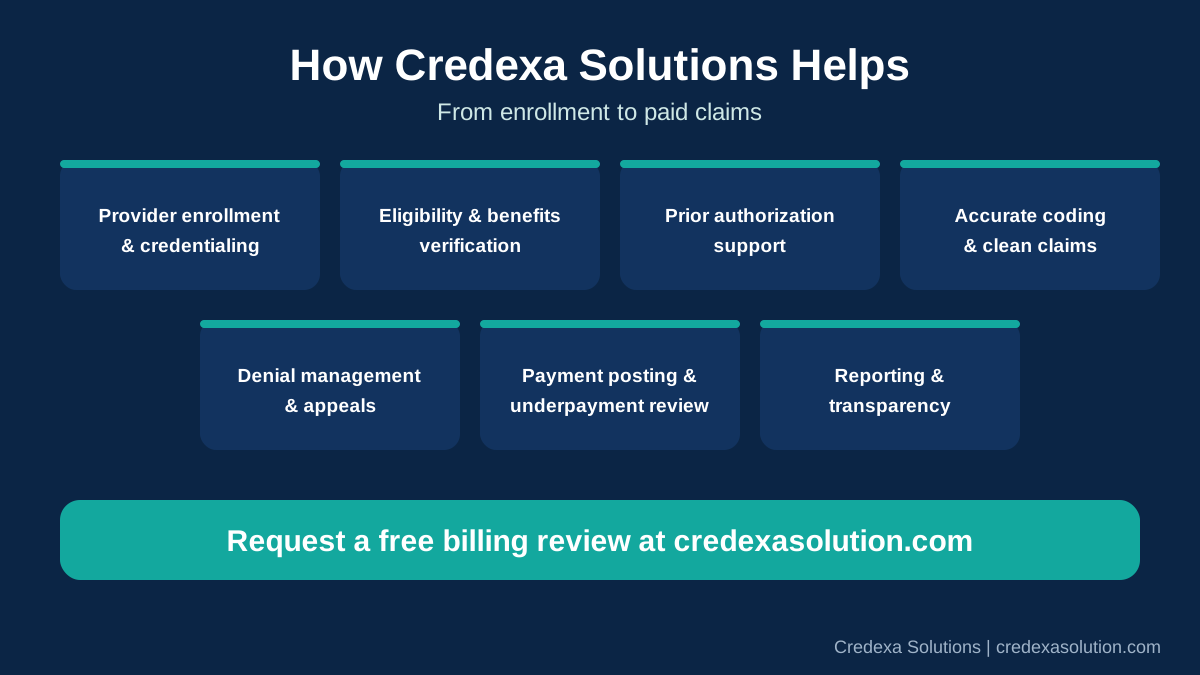
Optimizing Medicaid reimbursement takes coordinated work across enrollment, front-end verification, coding, claims, and follow-up. Credexa Solutions supports providers across that cycle so fewer claims fail and more payable claims get paid.
- Provider enrollment and credentialing: We help providers complete state Medicaid and payer enrollment, including MCO credentialing, so you are cleared to bill before claims go out.
- Eligibility and benefits verification: We verify coverage up front and again before submission to prevent avoidable eligibility and coordination-of-benefits denials.
- Prior authorization support: We track authorizations and requirements by plan, so approved services are scheduled, billed, and documented properly.
- Accurate coding and clean claims: Claims are reviewed against documentation, modifiers, and payer edits before submission to raise first-pass acceptance.
- Denial management and appeals: Denials are categorized by root cause, appealed where appropriate, and fed back to the source so the same error stops repeating.
- Payment posting and underpayment review: Remittances are compared against fee schedules and contract rates so short payments are identified instead of written off.
- Reporting and transparency: You get clear visibility into collections, denials, and A/R so you know where revenue stands.
Whether you are a small practice enrolling with your first Medicaid plan or a multi-location group managing several MCOs, Credexa Solutions helps you spend less time chasing claims and more time caring for patients. Contact Credexa Solutions today to request a billing review and find out where your Medicaid revenue is leaking.
Frequently Asked Questions
How does Medicaid reimbursement work?
Medicaid pays providers either directly through the state (fee-for-service) or through managed care organizations under their own contracts. The payer’s fee schedule sets the maximum allowable amount for each code.
Why is Medicaid reimbursement lower than Medicare?
States set their own rates within federal guardrails, and many base rates sit below Medicare. Some states add supplemental payments to offset this, so actual revenue can differ from the posted schedule.
What are the most common reasons Medicaid claims are denied?
The most common causes are eligibility and coverage problems, missing or invalid authorizations, bundling and modifier errors, provider enrollment issues, and missed timely filing deadlines.
Can Medicaid managed care rates be negotiated?
Yes. MCOs can pay differently from the state fee-for-service rate, so contracted rates are negotiable. Review your contract against the state schedule and use your own data when negotiating.
How can a practice increase Medicaid reimbursement?
Verify eligibility repeatedly, track authorizations, code to documentation, review claims before submission, find root causes of denials, reconcile payments against fee schedules, and meet filing deadlines.
Should I outsource Medicaid billing?
Many practices do, because Medicaid rules differ by state and by MCO, and specialist teams can keep pace with changes. The right partner covers enrollment through follow-up, not just claim submission.
Conclusion
Optimizing Medicaid reimbursement is about design, not luck. Know which payer you are billing, verify coverage more often, document and code precisely, hold payers to their deadlines, fix denial root causes, and check every payment against the rate you should have received. With new federal rules changing eligibility and prior authorization in 2026 and 2027, the practices that build these habits now will protect their revenue while others keep chasing denials.
If you want a partner to handle the heavy lifting, Credexa Solutions is ready to help you enroll, bill cleanly, and get paid faster.