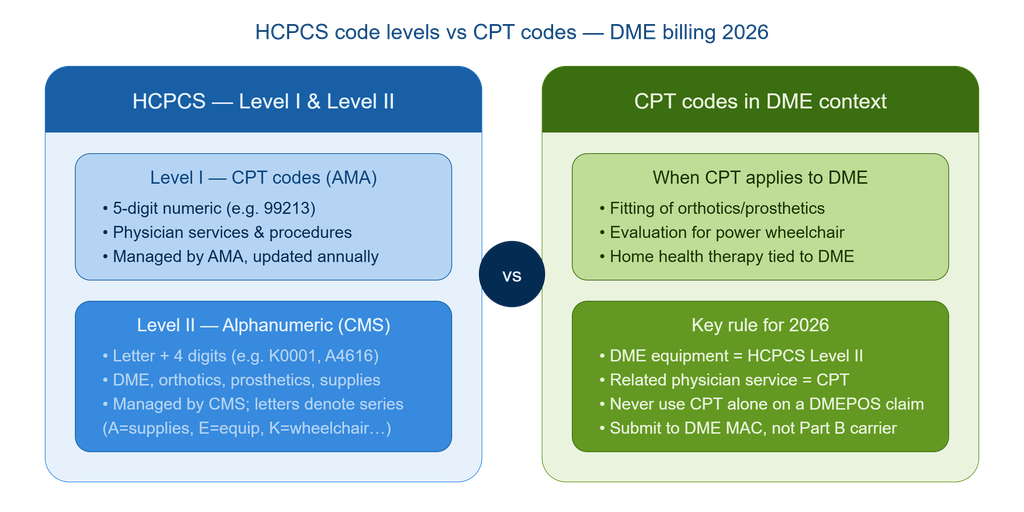
If you searched for “DME CPT codes,” here’s the short version: durable medical equipment is billed with HCPCS Level II codes, not CPT codes. CPT belongs to the AMA and reports what a clinician does. HCPCS Level II belongs to CMS and reports what a patient takes home a walker, a CPAP device, a wheelchair, a brace. That one distinction is the difference between a clean claim and a rejected one.
This guide breaks down every DME HCPCS code family, the modifiers that actually decide payment, the documentation Medicare demands before you deliver equipment, and the coding and prior authorization changes taking effect on October 28, 2026. If you bill DME for a living, bookmark this page the code set updates quarterly, and the rules below reflect where things stand right now.
Quick Answer: Is DME Billed With CPT or HCPCS?
| Question | Answer |
|---|---|
| Does DME use CPT codes? | No DME uses HCPCS Level II codes (E, K, A, L, B) |
| Who maintains HCPCS Level II? | CMS, updated quarterly (Jan, Apr, Jul, Oct) |
| Who maintains CPT? | The AMA, updated annually on January 1 |
| Do any CPT codes appear on a DME claim? | Yes for the service around the equipment (e.g., 97760 for orthotic fitting) |
| What decides whether the HCPCS code pays? | The modifier, the Standard Written Order, and proof of delivery |
Why Durable Medical Equipment Is Coded in HCPCS, Not CPT
Federal regulation, not preference, drives this split. Under 45 CFR § 162.1002, HIPAA assigns equipment, supplies, and ambulance transport to HCPCS Level II. CPT was built by the AMA to describe procedures a clinician performs during an encounter an office visit, a surgery, an injection. A CPAP machine sitting on a nightstand isn’t a procedure, so CPT never had a slot for it.
CMS created HCPCS Level II specifically to close that gap. The rule is spelled out in CMS’s DME MAC documentation requirements article. Think of it this way: the physician’s clinical work bills under CPT. The item the supplier hands the patient bills under a HCPCS Level II code. Two different code sets, two different roles, same claim.
For an item to qualify as DME at all, CMS applies a four-part test: the equipment must withstand repeated use, serve a medical purpose, be appropriate for use in the home, and for anything classified as DME after January 1, 2012 have an expected useful life of at least three years under 42 CFR § 414.202. Run any borderline item through that checklist before you touch a code book.
The Five HCPCS Level II Families Every DME Biller Should Know
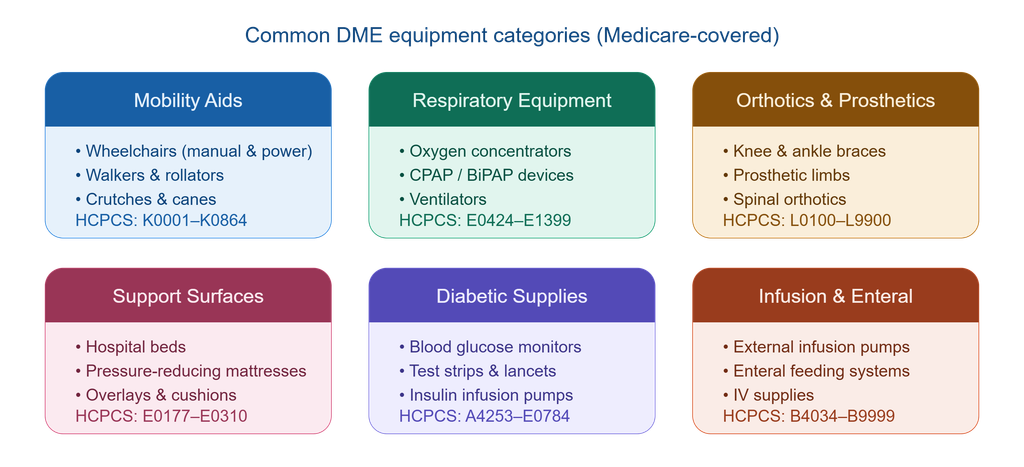
HCPCS Level II splits durable medical equipment into five alphanumeric families. Each one covers a different category of item, and mixing them up is one of the fastest ways to trigger a denial.
E-Codes: Durable Medical Equipment (E0100–E8002)
E-codes cover the bulk of what a DME supplier bills walkers, hospital beds, oxygen equipment, CPAP devices. The descriptors are unforgiving: one extra word can point to a completely different code.
| HCPCS | Descriptor |
|---|---|
| E0143 | Walker, folding, wheeled, adjustable or fixed height |
| E0135 | Walker, folding, without wheels |
| E0601 | Continuous positive airway pressure (CPAP) device |
| E1390 | Oxygen concentrator, single delivery port, 85%+ concentration |
| E0194 | Air fluidized bed |
| E1399 | Durable medical equipment, miscellaneous |
Notice E0143 and E0135 one has wheels, one doesn’t, and they price differently. That single adjective is where a lot of preventable denials start.
K-Codes: Wheelchairs and Temporary DMEPOS (K0001–K0900)
K-codes hold the manual wheelchair base classes and DME repair labor.
| HCPCS | Descriptor |
|---|---|
| K0001 | Standard wheelchair |
| K0003 | Lightweight wheelchair |
| K0005 | Ultralightweight wheelchair |
| K0823 | Power wheelchair, Group 2 |
| K0739 | DME repair labor (non-oxygen equipment), per 15 minutes |
K0005 is one of eight codes moving to required prior authorization on October 28, 2026 more on that below.
A-Codes: Supplies and Accessories (A4000–A9999)
A-codes cover consumables, dressings, and replacement parts. Unit definitions matter more here than anywhere else in the DME set.
| HCPCS | Descriptor |
|---|---|
| A4239 | CGM supply allowance, non-adjunctive (1 month = 1 unit) |
| A4253 | Blood glucose test strips, per 50 |
| A4636 | Replacement handgrip, cane/crutch/walker, each |
| A6197 | Alginate/fiber gelling dressing, 16–48 sq in |
A4239 bills as one unit per month, not per sensor or per transmitter. Billing it per component is a unit error that passes through the clearinghouse and gets caught by the DME MAC on review.
L-Codes: Orthotics and Prosthetics
L-codes describe braces, supports, and prosthetic components and they carry some of the highest improper payment rates in the entire DMEPOS program.
| HCPCS | Descriptor |
|---|---|
| L0456 | TLSO, flexible, prefabricated and customized to patient |
| L0457 | Same construction as L0456, off-the-shelf |
| L1833 | Knee orthosis, adjustable joints, prefabricated, off-the-shelf |
| L3761 | Elbow orthosis, adjustable locking joint, off-the-shelf |
| L3916 | Wrist hand orthosis, prefabricated, off-the-shelf |
L0456 and L0457 look nearly identical, but one is customized by a trained fitter and the other comes off a shelf and both land on the new prior authorization list on the same date.
B-Codes: Enteral and Parenteral Therapy (B9000–B9999)
B-codes cover feeding pumps, supply kits, and formula for patients on enteral or parenteral nutrition. They sit under the DME MAC alongside the other four families and follow the same quarterly update cycle. CMS publishes every change through the HCPCS Quarterly Update a printed code list from last quarter is not something you want to bill against today.
DME Equipment-to-Code Lookup: Common Items and Their HCPCS Codes
Matching what’s on the delivery ticket to the right code is where most billing teams lose time. Here’s a fast-reference table across the categories that generate the highest DME claim volume.
| Equipment | HCPCS | Typical Modifier | Coverage Note |
|---|---|---|---|
| Folding wheeled walker | E0143 | NU or RR | Not the same as E0135 (no wheels) |
| Standard wheelchair | K0001 | RR, then KH/KI/KJ | Requires documented MRADL deficit |
| CPAP device | E0601 | RR + KX | Sleep study plus in-person evaluation required |
| Hospital bed, semi-electric | E0260 | RR + KX | Positioning need must be documented |
| Portable gaseous oxygen | E0431 | RR | Gaseous — not the same as liquid (E0434) |
| TLSO brace, custom fit | L0456 | RT/LT + KX | Prior authorization required from 10/28/2026 |
| Shower chair / bath bench | E0240 family | GY or GA | Statutorily excluded as a convenience item |
| CGM supply allowance | A4239 | KX | One unit = one month’s supply |
For anything not on this table, verify the current descriptor against the CMS HCPCS code system rather than a saved spreadsheet the file refreshes four times a year.
When CPT Codes Actually Belong on a DME Claim
CPT never codes the equipment itself, but four service categories put real CPT codes on a DME-adjacent claim:
| CPT | What It Reports |
|---|---|
| 97760 | Orthotic management and training, initial encounter, per 15 min |
| 97761 | Prosthetic training, initial encounter, per 15 min |
| 97763 | Orthotic/prosthetic management, subsequent encounter (always-therapy code, needs GN/GO/GP) |
| 97605–97608 | Negative pressure wound therapy application (durable vs. disposable equipment) |
| 94660 | CPAP ventilation initiation and management |
| 95249–95251 | CGM training, calibration, and data interpretation |
| 99070 | Supplies furnished beyond those usually included (rarely paid by Medicare) |
One detail worth flagging: CPT 97762 was deleted effective January 1, 2018 and replaced by 97763. It’s been gone for eight years, yet it still surfaces in outdated billing cheat sheets and even in AI-generated overviews. If your fee schedule or template still references 97762, that line is wrong and needs to be pulled.
The timed-unit logic behind 97760/97761/97763 runs on the same framework used for other therapy specialties if your practice also handles skilled nursing or facility-based encounters, the place-of-service distinction matters just as much there as it does for DME. We cover exactly that in our guide to nursing facility CPT codes 99304–99316 and the POS 31 vs. 32 distinction, which is worth a read if your DME claims ever cross into a skilled nursing or facility setting.
DME Modifiers: The Real Reason Claims Get Rejected
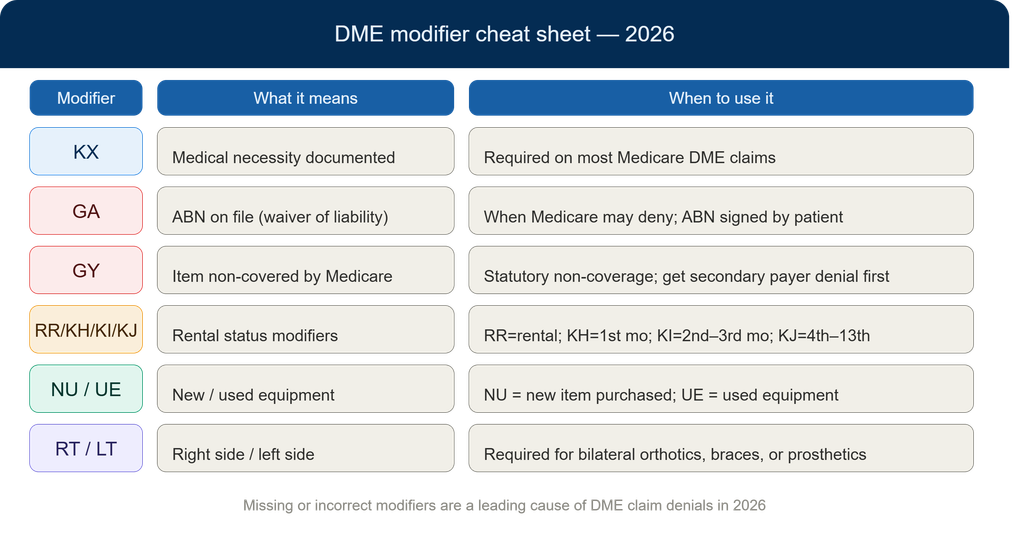
Most DME HCPCS codes require at least one modifier, and a missing or wrong one makes a claim unprocessable, not just denied meaning it never even reaches medical review. Modifiers do more work on a DME claim than on almost any other type of claim you’ll bill.
Purchase vs. Rental Status
| Modifier | Meaning |
|---|---|
| NU | New equipment purchase |
| RR | Rental |
| UE | Used equipment purchase |
| NR | New at the time of rental, later purchased by the beneficiary |
Capped Rental Sequence
Capped rental billing runs on a strict month-by-month sequence, and skipping a step stalls the entire chain:
- KH — first rental month
- KI — rental months two and three
- KJ — rental months four through thirteen
One outdated habit still shows up in older cheat sheets: appending KH to a purchase claim. That requirement was removed for dates of service on or after October 1, 2018, per the Medicare Claims Processing Manual, Chapter 20. Adding it now just gives the payer’s edit engine something to bounce.
Coverage and Medical Necessity
| Modifier | Meaning |
|---|---|
| KX | Documentation on file supports the coverage policy |
| GA | Signed Advance Beneficiary Notice (ABN) on file |
| GY | Item statutorily excluded from Medicare |
| GZ | Denial expected, no ABN signed |
Laterality and Component Modifiers
RT and LT carry right/left laterality on braces and orthoses bill a bilateral item on a single line without them, and the second unit disappears from the claim. RA reports replacement of a complete item; RB reports replacement of a component part only.
The 13-Month Capped Rental Rule (and the 36-Month Oxygen Exception)
Most capped rental DME pays across 13 months of continuous use, after which title transfers to the patient and rental billing stops. The KH/KI/KJ sequence is how the DME MAC tracks where a claim sits in that cycle.
Oxygen equipment runs on a separate 36-month payment cap instead of 13. After that period, maintenance and servicing can still bill under the applicable oxygen code with the MS modifier starting six months after the 36-month mark or the end of the manufacturer warranty, whichever is later, and payable once per patient every six months.
Rental-sequence errors are quiet revenue killers. A rental that should have converted to purchase at month 13 keeps billing rent. A modifier that should move from KI to KJ stays put. Neither one throws an error at submission the denials show up weeks later, once the appeal window has started shrinking.
Documentation Medicare Requires Before You Deliver Equipment
Every DMEPOS claim needs three things in place before or immediately after delivery: a Standard Written Order (SWO), proof of delivery, and a medical record that supports necessity.
The Standard Written Order
An SWO needs the beneficiary’s name or Medicare Beneficiary Identifier, the order date, an item description, quantity where applicable, the treating practitioner’s name or NPI, and a signature. The item can be described by general description, HCPCS code, narrative, or brand/model all four formats satisfy the requirement, so don’t send an order back to a physician demanding a HCPCS code that was never mandatory in the first place.
Written Order Prior to Delivery (WOPD)
For items on CMS’s Required Face-to-Face Encounter and WOPD List, the signed SWO has to exist before the item leaves your warehouse, and the treating practitioner needs a face-to-face encounter with the patient within the six months preceding the order. Telehealth satisfies that requirement under 42 CFR §§ 410.38, 410.78, and 414.65 a detail that matters if your referring physicians run hybrid or virtual clinics. The WOPD list itself is expanding to 105 items effective October 28, 2026, up from 83 today.
Proof of Delivery
Proof of delivery (POD) is a supplier standard, not an optional nicety you keep it and produce it on request. The date recorded has to be the date the beneficiary actually received the item, not the date it shipped. Retention runs seven years under the Medicare Program Integrity Manual, and a POD dated the ship date instead of the signature date is one of the most common findings in a CERT audit two years after the claim already paid.
DMEPOS Prior Authorization: Eight Codes Added Effective October 28, 2026
CMS published a Federal Register notice (CMS-6109-N, 91 FR 47972) adding eight HCPCS codes to the Required Prior Authorization List, effective October 28, 2026.
| HCPCS | Item | Scope |
|---|---|---|
| E0194 | Air fluidized bed | Nationwide |
| K0005 | Ultralightweight wheelchair | Nationwide |
| L0456 | TLSO, flexible, customized | Nationwide |
| L0457 | TLSO, flexible, off-the-shelf | Nationwide |
| L0486 | TLSO, triplanar, custom fabricated | Nationwide |
| L1833 | Knee orthosis, adjustable joints | Nationwide |
| L3761 | Elbow orthosis, locking joint | Phased rollout |
| L3916 | Wrist hand orthosis | Phased rollout |
L3761 and L3916 phase in across three dates: October 28, 2026 (New York, Michigan, Florida, California), January 26, 2027 (eight more states), and April 26, 2027 (everywhere else). CMS built this rollout around improper payment data upper limb orthoses ran a 40–48% improper payment rate from 2023–2025, and manual wheelchairs ran 22–42%. If you furnish elbow or wrist orthoses across state lines, your authorization workflow needs to be live in phase-one states well before your home state reaches its own phase.
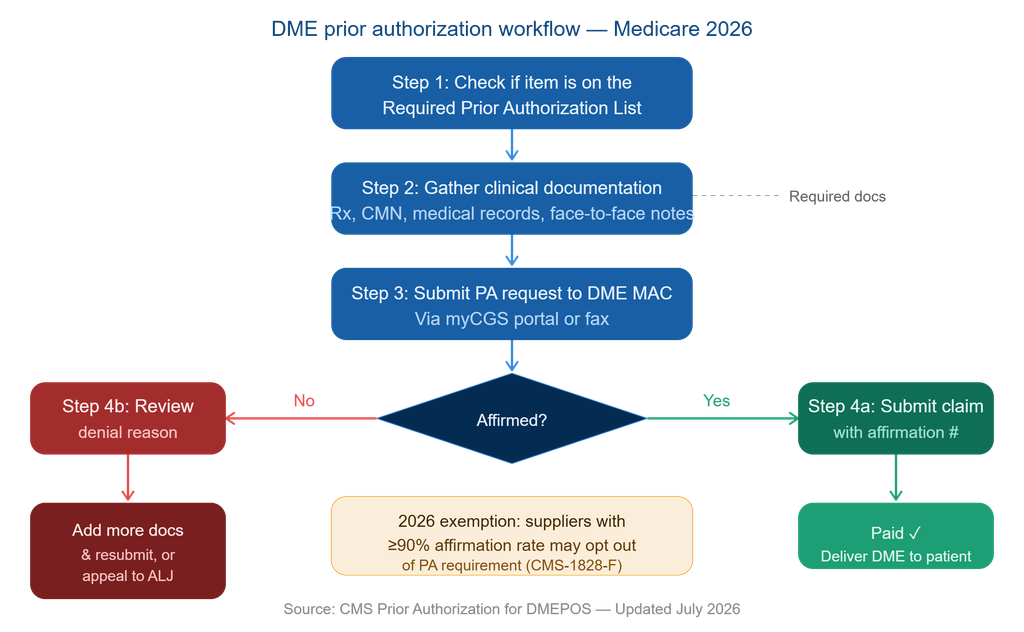
Verify any prior authorization question against the Federal Register notice or the CMS DMEPOS Master List directly the standalone PDF that many billing offices bookmark still carries a January 2026 date and won’t reflect these additions until it’s refreshed.
The Six DME Denials You’ll See Most, and How to Fix Each One
DME carries one of the highest denial rates in ambulatory billing, and the code you pick only gets a claim to the payer documentation decides whether it survives.
| Denial | Root Cause | Fix |
|---|---|---|
| CO-16 / M60 | Missing Certificate of Medical Necessity | Attach the CMN/DIF, then resubmit |
| CO-16 / N350 | No service description on a not-otherwise-classified code | Populate Box 19 or the NTE segment |
| PR-204 | Item outside the patient’s benefit plan | Confirm a signed ABN (GA modifier) before billing the patient |
| CO-252 | Supplier invoice not submitted | Send the invoice with the claim, not after |
| CO-50 | Not deemed medically necessary | Match the ICD-10 code to the LCD’s coverage criteria |
| CO-197 | Prior authorization not obtained | Check the current PA list before delivery, not after |
CO-16 shows up more than any other DME denial, and the remark code is what actually tells you what’s wrong M60 and N350 point to two completely different fixes. PR-204 is a timing issue: an ABN signed after delivery protects no one, and the balance becomes a write-off instead of a patient responsibility.
E1399 and Miscellaneous Codes: How to Get Them Paid
E1399 (durable medical equipment, miscellaneous) applies only when no existing HCPCS code fits the item, or the manufacturer hasn’t obtained a PDAC coding verification. Reaching for it when a specific code already exists is a denial trigger medical review checks for directly.
Every E1399 claim needs four things, placed in Box 19 (CMS-1500) or the NTE segment (837P) not as a separate attachment:
- A plain-language narrative description of the item
- Manufacturer name, make, and model number
- Manufacturer suggested retail price
- The supplier invoice
Skip the placement rule and you’ll land in the N350 loop: the claim rejects for a missing description, gets resubmitted with the same blank segment, and rejects again sometimes for three cycles before someone catches the actual problem, by which point the claim is uncomfortably close to its timely filing deadline.
DMEPOS Supplier Enrollment: The Step Most Practices Underestimate
Billing Medicare for DME requires a separate supplier enrollment beyond standard provider enrollment an approved CMS-855S application, accreditation from a CMS-approved organization, and a surety bond. Assuming a physician’s existing Medicare enrollment covers equipment billing is one of the most expensive mistakes in this space; any claim submitted before the 855S clears is unpayable, not pending.
The same enrollment discipline applies on the commercial and Medicaid side. If your DME business also serves Medicaid patients or bills a managed care plan, the enrollment mechanics look different state by state and payer by payer. We’ve broken both of those down separately:
- If you operate in Wisconsin or serve Wisconsin Medicaid patients, our Wisconsin Medicaid provider enrollment guide covering the new ForwardHealth portal walks through the state-specific enrollment steps that trip up new suppliers.
- If your patient base includes Ambetter members, our complete guide to becoming an Ambetter provider covers the credentialing timeline and documentation Ambetter requires before it will pay a claim.
Treat DME billing, Medicaid enrollment, and commercial credentialing as three separate tracks that all have to be current simultaneously a lapse in any one of them stops payment regardless of how clean the coding is on the claim itself.
DME Coding FAQs
Is DME billed with CPT or HCPCS codes? DME is billed with HCPCS Level II codes, not CPT. CMS maintains HCPCS as alphanumeric codes one letter plus four digits, like E0601 for a CPAP device. CPT, maintained by the AMA, covers clinical services. A provider can bill a CPT code for a service like orthotic fitting, but the device itself always carries a HCPCS code.
Is there a CPT code for durable medical equipment itself? No. HIPAA assigns equipment to HCPCS under 45 CFR § 162.1002. CPT 99070 covers supplies furnished beyond those usually included, but Medicare rarely pays it because a HCPCS code almost always exists instead.
What are the DME procedure code ranges? E-codes (E0100–E8002) cover most equipment, K-codes (K0001–K0900) cover wheelchairs and temporary items, A-codes (A4000–A9999) cover supplies, L-codes cover orthotics and prosthetics, and B-codes (B9000–B9999) cover enteral/parenteral therapy.
Do DME HCPCS codes require a modifier? Almost always, yes. Purchase/rental status (NU, RR, UE, NR) comes first, then the rental month sequence (KH, KI, KJ) for capped rental items, then any coverage modifier (KX, GA, GY, GZ) the local coverage policy requires.
What DME items does Medicare not cover? Equipment furnished mainly for comfort or convenience shower chairs, bath benches, grab bars, stair lifts, and home modifications falls outside the Medicare DME benefit. Get an ABN signed before delivery and append GA, or the balance becomes a write-off.
How much does the DME prior authorization list change in 2026? Eight codes join the Required Prior Authorization List on October 28, 2026: E0194, K0005, L0456, L0457, L0486, and L1833 nationwide, plus L3761 and L3916 on a phased, state-by-state rollout through April 2027.
What’s the difference between HME and DME? None, for billing purposes. HME (home medical equipment) and DME (durable medical equipment) are used interchangeably in supplier marketing, but Medicare, the DME MACs, and the HCPCS code set all use “DME.” The same codes and coverage rules apply regardless of which term appears on the referral.
How Credexa Solutions Helps With DME Billing
Getting the HCPCS code right is only the first step. What actually decides whether a DME claim pays is the modifier sequence, the Standard Written Order, proof of delivery timed correctly, and a prior authorization workflow that’s already live before October 28, 2026 changes take effect.
That’s the layer where most in-house billing teams lose time not because the coding is hard to learn, but because tracking rental months, chasing signed orders before delivery, and re-verifying prior authorization status against a code list that changes quarterly is a volume problem, not a knowledge problem.
Credexa Solutions handles that volume for DME suppliers and the practices that furnish equipment alongside patient care from HCPCS code selection and modifier accuracy, through Standard Written Order collection and proof-of-delivery documentation, to prior authorization tracking, claim submission, and denial follow-up on CO-16, CO-50, and CO-197 patterns before they turn into aged, unrecoverable AR. If your DME suppliers also need Medicaid or commercial payer enrollment, our credentialing team runs that in parallel so a coding fix doesn’t get stuck behind an enrollment gap.
If your DME denial rate looks like the patterns covered on this page, talk to the Credexa Solutions team about a free billing review before your next claim batch goes out.