If you bill Molina Healthcare and you’re using one number as “the” timely filing limit, that number is probably wrong for at least one of your patients. Molina isn’t a single national insurer with one filing rule it’s a managed care organization that signs a separate contract with every state Medicaid agency it works with, and each of those contracts sets its own claims deadline. Layer Medicare Advantage and Marketplace plans on top of that, and a practice billing Molina in three or four states can legitimately be running six or seven different deadline clocks at once.
That’s the root cause behind most Molina timely filing denials. It’s rarely a slow biller. It’s a team applying a 180-day rule to a market where Molina only allows 90, or measuring from the wrong trigger date, or missing the fact that a corrected claim runs on an entirely separate clock from the original submission.
This guide breaks down Molina’s timely filing limit by state, by line of business, and by claim type Medicaid, Medicare Advantage, Marketplace, corrected claims, coordination of benefits, and appeals so you know exactly which clock applies before you build your AR worklist around it.
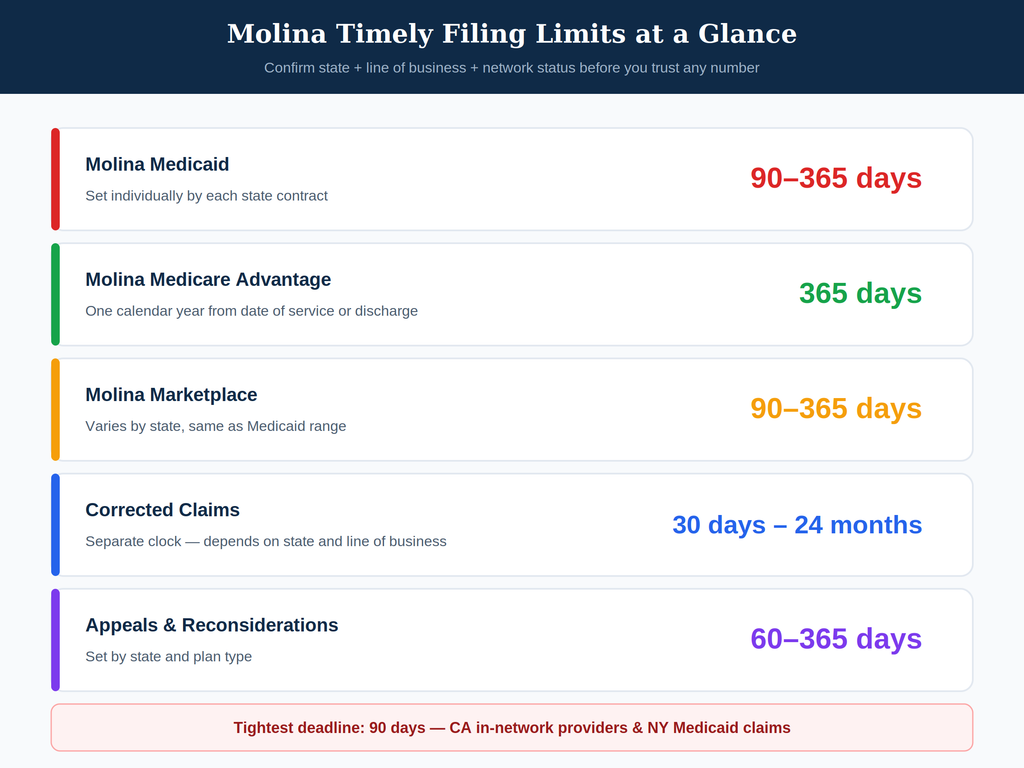
Quick Answer: Molina’s Timely Filing Limits at a Glance
- Molina Medicaid: Ranges from 90 to 365 calendar days, set individually by each state contract
- Molina Medicare Advantage: One calendar year (365 days) from the date of service, or from discharge for inpatient claims
- Molina Marketplace: 90 to 365 calendar days, varying by state
- Corrected claims: 30 calendar days up to 24 months, depending on the state and line of business
- Appeals and reconsiderations: 60 to 365 days, again set by state and plan type
- Tightest deadline on record: 90 calendar days this applies to in-network providers in California and to Molina Medicaid claims in New York
If you take away one thing from this guide, make it this: before you calculate any Molina deadline, confirm three variables — the state, the line of business, and whether you’re an in-network or out-of-network provider. Get any one of those wrong and the number you’re working from is unreliable.
Why Molina Doesn’t Have One National Timely Filing Deadline
Most commercial payers think Cigna, Aetna, or UnitedHealthcare publish a single default filing window for their commercial book of business, and your provider contract can adjust it from there. Molina works differently because most of its revenue comes from Medicaid managed care, and Medicaid is administered at the state level.
Every state Medicaid agency that contracts with Molina negotiates its own terms, including how long Molina gives providers to submit a claim. That’s why a claim filed on day 100 is perfectly fine in Ohio (365-day window) but already denied in California if you’re a participating provider (90-day window). Molina isn’t being inconsistent it’s honoring dozens of separate state agreements simultaneously.
This also explains why generic search results and AI-generated answers about “the Molina timely filing limit” are so often wrong. There is no single figure to find. There’s a matrix, and the only reliable way to read it is state by state.
Is Molina Healthcare the Same Thing as Medicaid?
No and this distinction matters for billing. Molina Healthcare is a publicly traded managed care organization. Medicaid is the government insurance program itself. States contract with companies like Molina to administer Medicaid benefits on their behalf, which is why you’ll sometimes see Molina referred to as a Medicaid Managed Care Organization, or MCO.
Practically, that means enrolling with your state’s Medicaid program does not automatically enroll you with Molina they’re separate credentialing processes. It also means Molina sells products that have nothing to do with Medicaid, including Medicare Advantage and Marketplace/ACA exchange plans, each with its own filing rules. Always confirm the plan type printed on the member’s ID card before you assume which deadline applies. For a broader look at how provider enrollment ties into claims readiness, see our guide to revenue cycle management for healthcare providers.
Molina Medicaid Timely Filing Limits, State by State
Molina’s Medicaid timely filing window is the most variable of its three lines of business, because it’s set entirely by individual state contracts. Below is a snapshot of confirmed windows across major Molina Medicaid markets. Where Molina publishes both participating and non-participating figures, the window is noticeably wider for out-of-network providers sometimes double.
| State | Timely Filing Window | Typical Trigger Date |
|---|---|---|
| California (in-network) | 90 days | Date of service / discharge |
| California (out-of-network) | 180 days | Date of service / discharge |
| New York | 90 days | Date of service / discharge |
| Texas | 95 days | Date of service |
| Florida | 180 days (6 months) | Date of service / discharge |
| Illinois (out-of-network) | 180 days | Date of service |
| Virginia | 180 days | Date of service |
| Washington | 180 days | Date of service / discharge |
| Wisconsin | 180 days | Date of service / discharge |
| Ohio | 365 days | Date of service / discharge |
| Kentucky | 365 days | Discharge (inpatient) / DOS (outpatient) |
| Iowa (out-of-network) | 365 days | Date of service / discharge |
| Michigan | Varies — confirm current manual | Date of service |
| All other markets | Confirm in your current provider manual | — |
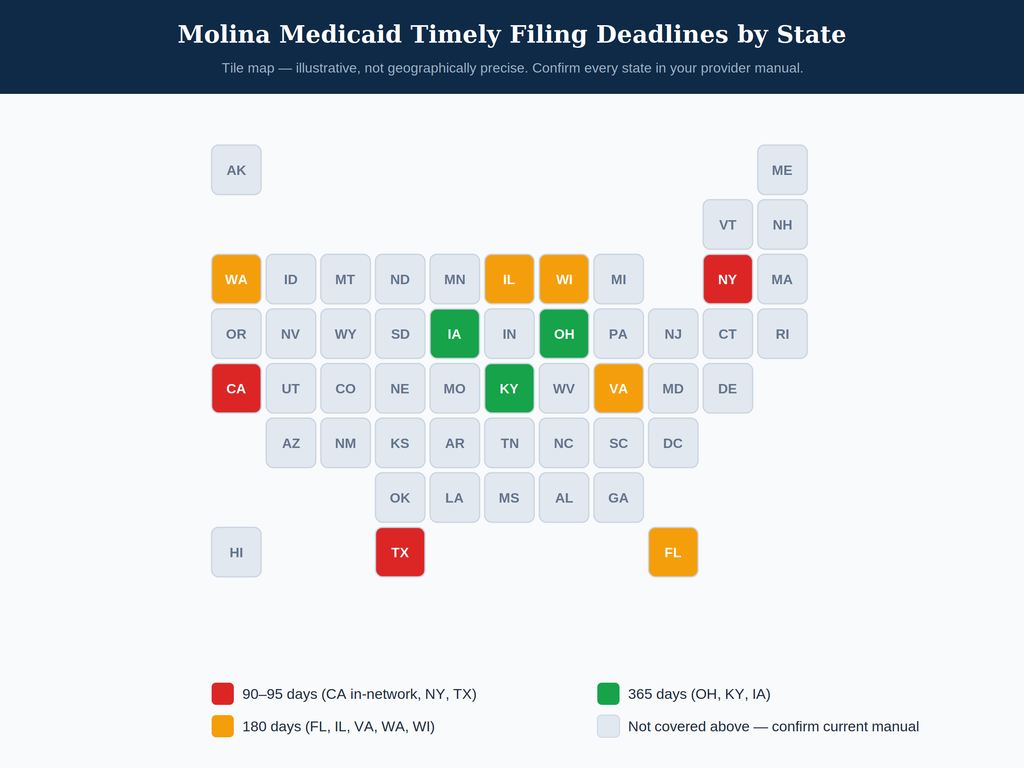
Two things worth flagging. First, the California gap is the one billing teams get wrong most often. A large share of published guidance online cites 180 days for California across the board, but that’s the non-participating figure. If your practice is in-network with Molina in California, your real deadline is 90 days filing on day 120 under the assumption you have until day 180 means you’ll take a denial with no appeal argument left. Second, Michigan has had multiple conflicting figures published across different Molina documents over the years, some of them outdated. Never trust a Michigan filing limit you haven’t confirmed against the current provider manual and your own contract.
If you operate in a state not listed above, don’t default to any number here pull your Molina provider manual for that state directly, or confirm it as part of your enrollment and credentialing workflow.
Molina Medicare Advantage: The One Consistent Deadline
Unlike Medicaid, Molina’s Medicare Advantage timely filing limit doesn’t vary by state. It follows the federal standard: one calendar year (365 days) from the date of service, or from the date of discharge for inpatient stays. This mirrors the filing rule under Original Medicare you can compare the two directly in our breakdown of the Medicare timely filing limit and how CO-29 denials get resolved.
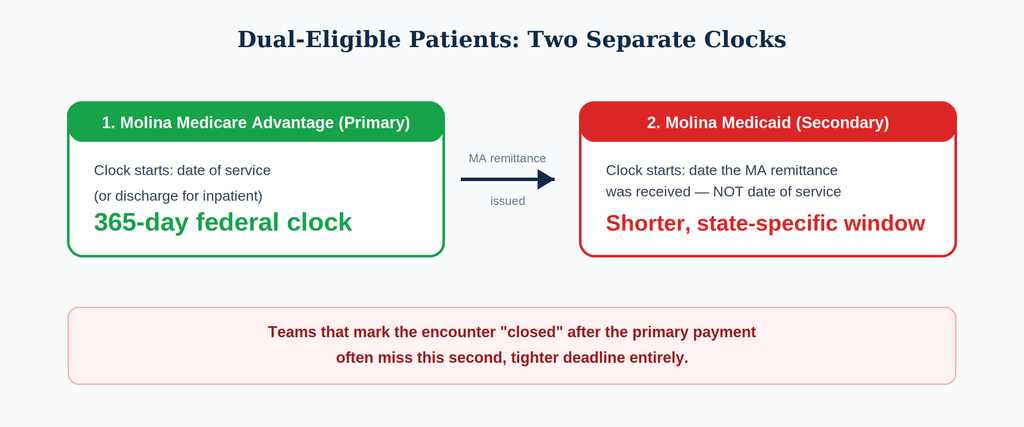
The place practices lose money on this line of business isn’t the primary claim it’s the secondary claim for dual-eligible patients who carry both Molina Medicare Advantage and Molina Medicaid. The Medicare Advantage claim runs on the 365-day federal clock, but once that pays, the Medicaid secondary claim starts its own, usually much shorter, state-specific window often measured from the date you received the Medicare Advantage remittance, not the original date of service. Teams that mark the encounter “closed” after the primary payment often miss this second, tighter deadline entirely.
Molina Marketplace (ACA Exchange) Timely Filing Limits
Molina’s Marketplace plans its ACA exchange products, not to be confused with Ambetter, which is a Centene brand carry the same state-by-state variability as Medicaid. Some markets mirror the Medicaid window; others don’t.
| Marketplace State | Timely Filing Window |
|---|---|
| California | 90 days |
| Texas | 95 days |
| Washington | 180 days |
| Florida | 180 days (6 months) |
| Nevada | 365 days |
| South Carolina | 365 days |
| Kentucky | 365 days |
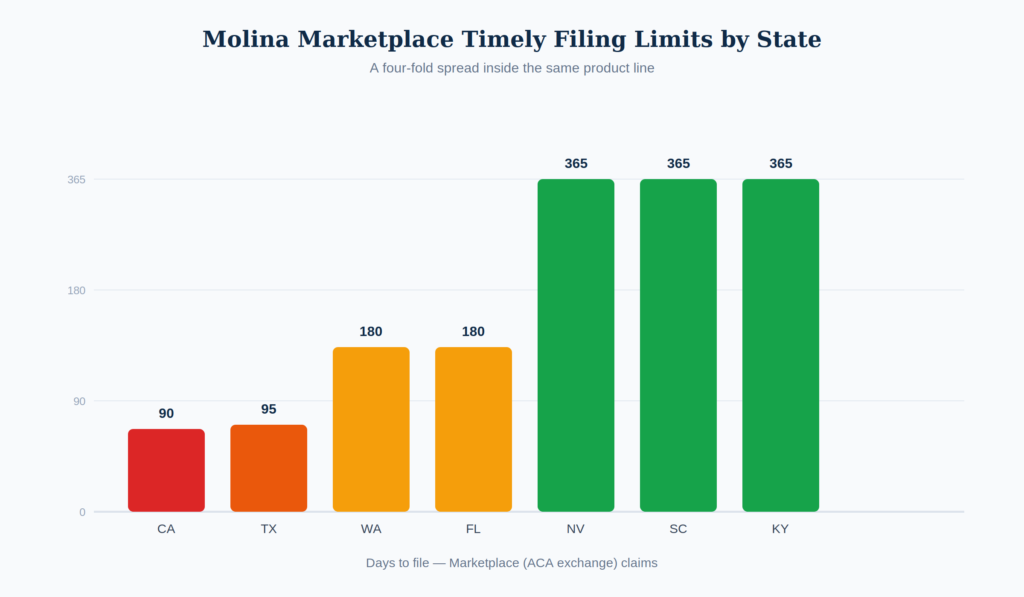
A four-fold spread between California’s 90-day window and Nevada’s 365-day window, inside the same product line, is exactly why a one-size-fits-all internal policy doesn’t hold up against Molina. If your practice bills Marketplace claims across multiple states, your deadline matrix needs a row for each one Medicaid deadlines and Marketplace deadlines in the same state are not guaranteed to match.
Corrected Claims: A Separate Clock From the Original Filing Deadline
This is where a lot of otherwise-compliant billing teams lose recoverable revenue. Molina’s timely filing limit for the original claim and its deadline for a corrected claim are two different numbers, often measured from two different trigger dates the date of service, the remittance advice date, or the date of adjudication, depending on the state.
Some markets give as little as 30 days from the remittance advice to submit a correction. Others allow up to 24 months. There is no shortcut here the corrected claim window has to be confirmed per state, per line of business, in Molina’s corrected claims policy.
A few practical reminders that prevent avoidable losses:
- Frequency code 7 submits a replacement claim; frequency code 8 voids a prior claim. Using the wrong code routes the claim to the wrong workflow.
- A denied claim is not the same as a claim eligible for correction. Adjustments and replacements apply to previously paid claims. Resubmitting a denied claim as a “corrected claim” typically gets bounced back, and the clock keeps running against your original filing deadline the entire time it sits in the wrong queue.
- Corrected claims commonly get delayed simply by sitting in a work queue. Since several states give only 30 days, a two-week internal delay can burn away half your window before the claim ever leaves the building.
Coordination of Benefits: When Molina Is the Secondary Payer
When Molina is secondary to another insurer, the filing clock generally starts on the date the primary payer issues its final determination or EOB not the original date of service. But the exact window still varies by state, commonly running somewhere between 60 and 180 days from that primary determination.
The safest practice is to attach the primary payer’s EOB to every secondary claim and log the date you actually received it, since that’s the date a coordination-of-benefits appeal will turn on if the claim gets denied as untimely.
Rejected Claims Don’t Stop the Clock
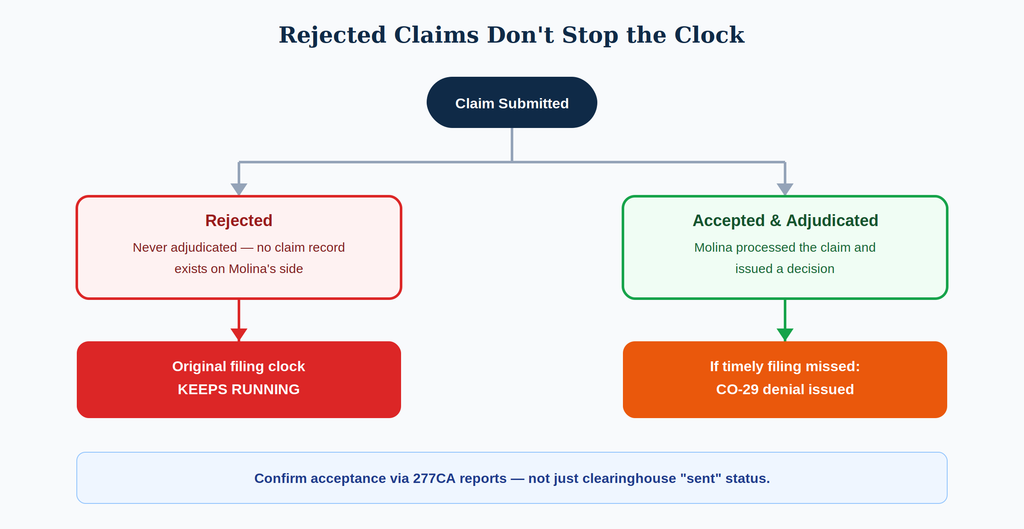
This is one of the most consequential and least understood rules in Molina’s filing policy: timely filing requirements apply until Molina accepts the claim not until you transmit it.
There’s a real difference between a rejection and a denial. A rejection happens before adjudication usually at the clearinghouse level or in Molina’s front-end edits because something in the claim file was missing or invalid. No claim record exists on Molina’s side, and no denial code gets issued. A denial happens after adjudication: the claim was accepted, processed, and Molina issued a decision with a reason code attached.
A rejected claim was never actually received. If it sits in a rejection queue for three weeks before someone catches it, those three weeks still count against your original filing deadline. Confirmation from your clearinghouse that a file was “sent” is not the same as confirmation that Molina accepted it work your 277CA acceptance reports, not just your submission logs, and route rejections to a queue that’s checked daily, not weekly.
CO-29 Denials: What They Mean and How to Fight One
CO-29 is the standard claim adjustment reason code (maintained by X12) indicating the claim was received after the timely filing deadline. Because it carries a “CO” (Contractual Obligation) group code, the balance is not billable to the patient it becomes a contractual write-off unless you successfully appeal it.
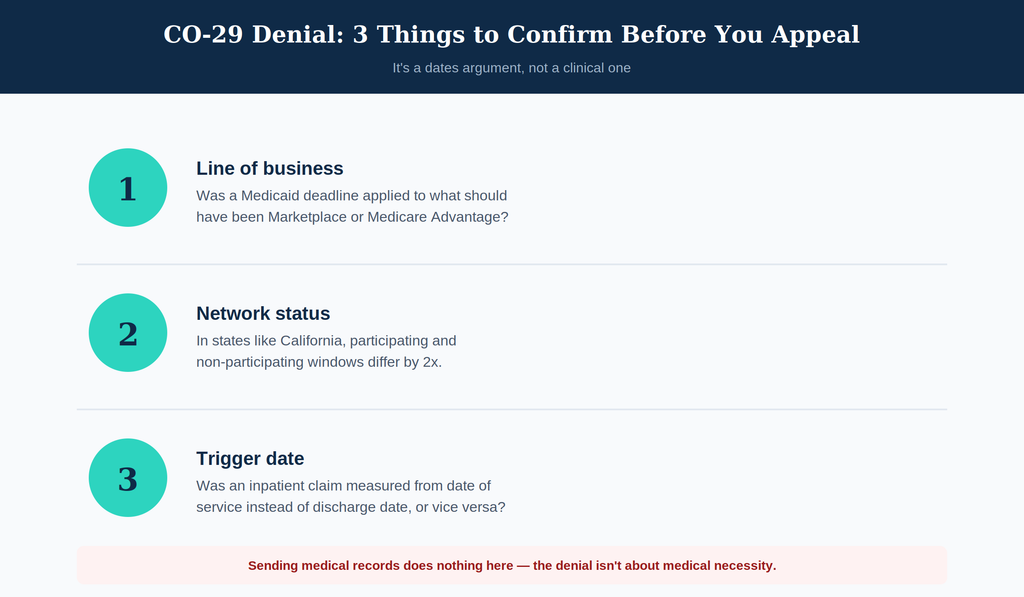
A CO-29 appeal is a dates argument, not a clinical one. Sending medical records or a letter of medical necessity does nothing here, because the denial has nothing to do with whether the service was medically appropriate. Before you appeal, confirm three things:
- Line of business — was a Medicaid deadline applied to what should have been a Marketplace or Medicare Advantage claim?
- Network status — in states like California, participating and non-participating windows differ by a factor of two, so an incorrectly applied network status is an easy, winnable appeal.
- Trigger date — was an inpatient claim measured from the date of service instead of the discharge date, or vice versa?
If the denial is accurate and the claim really was late, most Molina policies state that the balance still can’t be billed to the Medicaid member it stays a provider write-off. That makes prevention far more valuable than any appeal, which is why deadline tracking belongs inside your standard AR workflow rather than treated as a special project. For a deeper look at building that kind of proactive workflow, our guide on RCM reporting and the metrics that actually drive collections covers how to surface aging claims before they hit their deadline.
Molina Appeal and Reconsideration Deadlines
The appeal window is a separate clock from the original filing deadline, and it typically runs from the date of the adverse determination or the original remittance advice not the date of service. Confirmed windows across Molina’s Medicaid, Marketplace, and Medicare Advantage lines range from roughly 60 days up to a full year, depending on the state and product.
Federal Medicaid managed care rules under 42 CFR Part 438, Subpart F set baseline requirements for how Medicaid MCOs like Molina must handle grievances and appeals, including minimum notice periods for adverse benefit determinations but note that those federal timelines primarily govern enrollee appeal rights. A provider’s own claim dispute process runs on the state’s provider dispute rules and your Molina contract, which can carry a different number entirely. Don’t calendar a provider claim dispute off the member appeal rule; they’re not interchangeable.
It’s also worth distinguishing three terms that get used loosely: a corrected claim replaces a previously paid claim; a claim dispute or reconsideration challenges how an already-adjudicated claim was processed; and an appeal challenges a formal adverse benefit determination, which on the Medicaid side can escalate to a State Fair Hearing if Molina upholds its own decision. Filing under the wrong category routes your case to the wrong review team and can burn the clock before anyone even looks at the merits.
Recognized Exceptions That Can Extend a Molina Filing Deadline
Molina does recognize a limited set of circumstances that can extend a filing window beyond the standard deadline, though these are documented exceptions, not routine excuses:
- Retroactive Medicaid eligibility — when coverage is applied retroactively, the clock generally moves to the date Molina receives notice of that eligibility, not the original date of service
- Delayed coordination of benefits — the window keys to the date you received the primary payer’s determination
- Newborn enrollment delays — some states allow additional time measured from when the member’s correct information was made available
- System or payer processing errors — documented outages or processing failures on Molina’s end or the state fiscal agent’s end
- Court orders or hearing decisions — mandated retroactive billing situations
None of these apply to routine internal delays a claim that sat in a work queue, a staffing gap, or a missed follow-up doesn’t qualify as an exception, and submitting it as one typically just wastes appeal effort that could have gone toward a claim you can actually win.
Building a Molina Deadline Matrix That Actually Holds Up
Given how many variables affect a single Molina deadline, a workable system needs to track more than just “days remaining.” Here’s the structure that holds up under real claim volume:
- Map every market you bill Molina in by state, line of business, and network status this is the backbone of your deadline matrix.
- Set internal submission targets well inside the actual deadline. If your tightest market gives you 90 days, target submission within 10–14 days of the date of service so you have room to fix a clearinghouse rejection without risking the deadline.
- Monitor acceptance, not transmission. A claim sitting in a rejection queue hasn’t been filed, no matter what your practice management system shows.
- Separate rejections from denials on your worklist. They run on different clocks and require different actions.
- Prioritize your AR worklist by deadline proximity, not dollar value. A small balance three days from its Molina deadline is a bigger risk than a large balance with months of runway left but most worklists sort by dollar amount by default, which buries the real risk.
- Capture your proof of timely filing at submission, not after a denial. Acceptance reports and confirmation records have a way of disappearing by the time a CO-29 denial actually shows up weeks or months later.
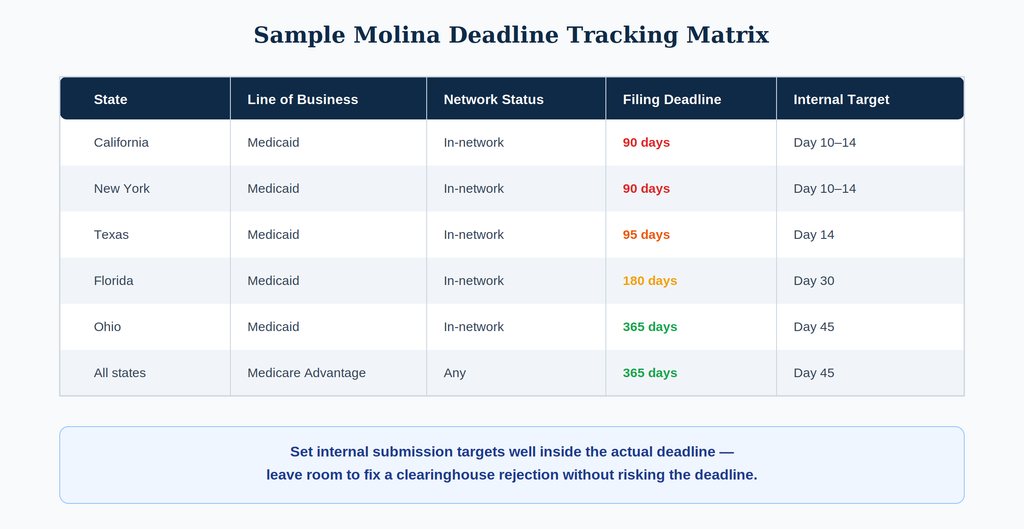
Most billing teams already understand these principles individually. What breaks down is ownership nobody is assigned to keep the deadline matrix current when a state contract changes, and payer bulletins updating a filing window or a claims address don’t always make it to the people working the AR queue.
How Molina Compares to Other Major Payers
Molina’s state-by-state structure puts it closer to other Medicaid managed care organizations than to traditional commercial insurers. If you’re building deadline policies across your full payer mix, it helps to see where each one falls:
- BCBS operates as a federation of independent regional plans, each publishing its own timely filing rules structurally closer to Molina’s state-by-state model than a single national default
- Medicare applies one federal 12-month rule nationwide, which is exactly what Molina Medicare Advantage mirrors
- Commercial payers with a single national default plan can typically be adjusted through your provider contract, but Medicaid MCO contracts like Molina’s are set by the state, not negotiated claim by claim
Getting Molina Claims Paid Without Losing Track of the Deadline
Looking up a single Molina timely filing limit takes a few minutes. Keeping an accurate matrix current across every state, every line of business, and every corrected-claim and appeal window — while still working your existing AR queue is a staffing and process problem more than a knowledge gap.
That’s the layer Credexa Solutions sits in. We track payer-specific deadlines by state and product as a standard part of AR follow-up, so claims don’t age out simply because a filing window moved or a state contract changed. That work sits alongside eligibility verification, clean claim submission, payment posting, and denial management as part of our full-service medical billing support not as a separate add-on service.
If you want a clear read on where your current Molina AR stands against these deadlines, get in touch with our team for a free billing review, or learn more about how we approach provider credentialing and enrollment for practices entering new Molina markets. You can also browse more payer-specific filing guides on our blog, or learn more about our approach on our About Us page.

Frequently Asked Questions
What is the Molina Healthcare timely filing limit? There’s no single figure Molina Medicaid runs 90 to 365 days depending on the state contract, Medicare Advantage runs one calendar year, and Marketplace plans run 90 to 365 days by state. The tightest confirmed window is 90 days, applying to in-network providers in California and to claims in New York.
What is Molina’s timely filing limit in California? 90 calendar days for participating (in-network) providers, and 180 calendar days for non-participating providers. This is the single most commonly confused figure in Molina billing, since many sources cite only the 180-day out-of-network number.
Is Molina Healthcare the same as Medicaid? No. Molina is a managed care organization contracted by state Medicaid agencies to administer benefits on their behalf. Medicaid is the government program itself. Molina also offers Medicare Advantage and Marketplace plans that are entirely separate from Medicaid.
What does a CO-29 denial mean on a Molina remittance? CO-29 indicates the claim was received after the timely filing deadline. Because it’s a contractual obligation code, the balance can’t typically be billed to the patient it’s written off unless successfully appealed with a dates-based argument.
How long do I have to submit a corrected claim to Molina? It varies significantly by state and line of business anywhere from 30 days to 24 months and the clock often starts from the remittance advice date or adjudication date rather than the original date of service. Always confirm the specific window for your state before assuming it matches the original filing deadline.
Can Molina members be billed after a timely filing denial? Generally, no. Claims denied for missing the filing deadline are treated as a contractual write-off, and providers are typically prohibited from balance-billing the member for that amount. Always verify this against your specific provider agreement and state Medicaid rules.
Does a rejected claim count as filed on time with Molina? No. Timely filing requirements apply until Molina actually accepts the claim, not until it’s transmitted. A claim rejected at the clearinghouse or in Molina’s front-end edits was never received, so the original filing clock keeps running the entire time it sits unresolved.
Credexa Solutions provides medical billing, revenue cycle management, and provider credentialing support for healthcare practices navigating multi-state, multi-payer billing including Medicaid managed care organizations like Molina Healthcare. Contact our team for a free billing analysis.