Few diagnoses cause as many coding disputes as low blood oxygen. One chart says “hypoxia,” the next says “acute hypoxic respiratory failure,” and a third only says “desaturation, placed on oxygen.” Each phrase leads to a different code, and each code can change severity, reimbursement, and audit exposure.
This guide walks through the hypoxia ICD-10 code (R09.02), the full respiratory failure family (J96), oxygen dependence (Z99.81), sequencing rules, documentation habits, MCC and DRG impact, and how to defend a downgraded claim. It is written for medical coders, billers, CDI specialists, and practice managers.
Quick Answer: What Is the ICD-10 Code for Hypoxia?
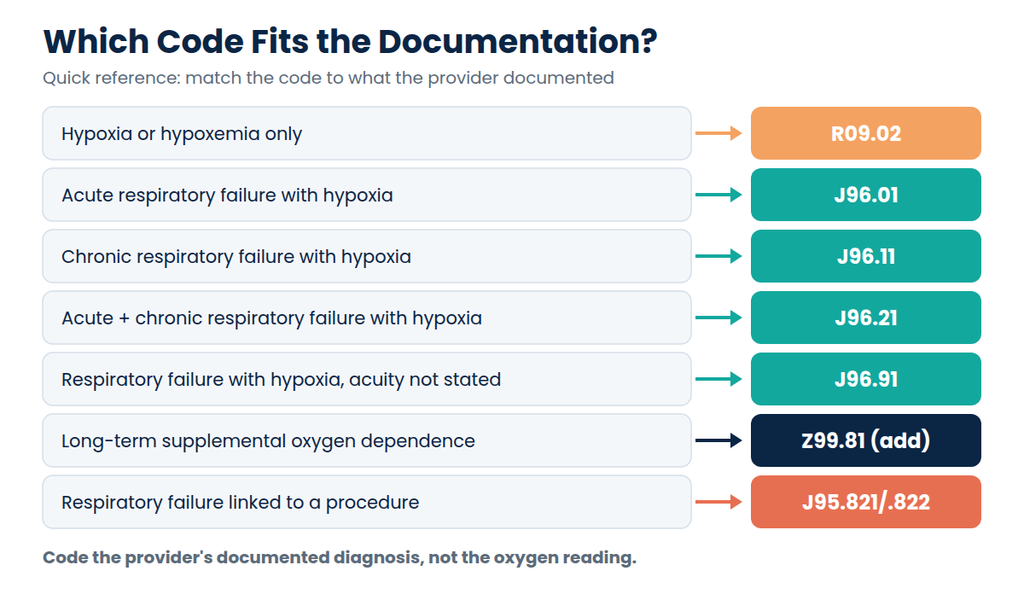
The ICD-10 code for hypoxia is R09.02 (Hypoxemia). It applies when a provider documents hypoxia or hypoxemia and no more definitive diagnosis explains it. If the provider documents respiratory failure, you move to category J96, and the code depends on acuity and type.
| What the provider documented | Code direction |
|---|---|
| Hypoxia or hypoxemia only | R09.02 |
| Acute respiratory failure with hypoxia | J96.01 |
| Chronic respiratory failure with hypoxia | J96.11 |
| Acute and chronic respiratory failure with hypoxia | J96.21 |
| Respiratory failure with hypoxia, acuity not stated | J96.91 |
| Long-term oxygen dependence | Add Z99.81 if supported |
| Respiratory failure linked to a procedure | Review J95.821 / J95.822 |
The question that decides everything is not “how low was the SpO2?” It is “what diagnosis did the provider document?”
R09.02 Hypoxemia Explained
R09.02 sits in Chapter 18 of ICD-10-CM, the chapter for symptoms, signs, and abnormal findings. You can confirm it in the CDC’s ICD-10-CM browser tool. It is a billable code under subcategory R09.0, which also contains R09.01 (Asphyxia).
Symptom codes follow a simple rule in the Official Guidelines. You code a sign or symptom when no related definitive diagnosis has been established. Once a diagnosis explains the symptom, and the symptom is routinely associated with that condition, you stop coding the symptom separately. Hypoxemia follows this logic like any other finding.
A few facts worth remembering about R09.02:
- It is not a CC or MCC. It adds no severity weight to an inpatient DRG.
- There is no “unspecified hypoxia” sub-code. Hypoxia NOS, hypoxia unspecified, and hypoxemia all index to R09.02. Don’t look for a fifth or sixth character.
- It has no acuity axis. Acute hypoxia, chronic hypoxia, and persistent hypoxemia all land on R09.02 unless respiratory failure is documented.
- It can be first-listed in outpatient encounters when hypoxemia is the established reason for the visit and no definitive diagnosis has been made.
Are hypoxia and hypoxemia the same in ICD-10?
Clinically they differ. Hypoxemia is low oxygen in arterial blood. Hypoxia is inadequate oxygen delivery to tissues, a broader problem. The NCBI StatPearls chapter on hypoxia explains the distinction well. For coding, however, both terms lead to R09.02, so documenting either one supports the same code.
R09.02 or J96? The Deciding Question
The line between the symptom code and a respiratory failure code is the provider’s diagnostic statement. Oxygen values, flow rates, and devices are clinical indicators. They can justify a compliant query, but they are not coding rules. The Official Guidelines state that code assignment rests on the provider’s diagnosis, not on the clinical criteria behind it.
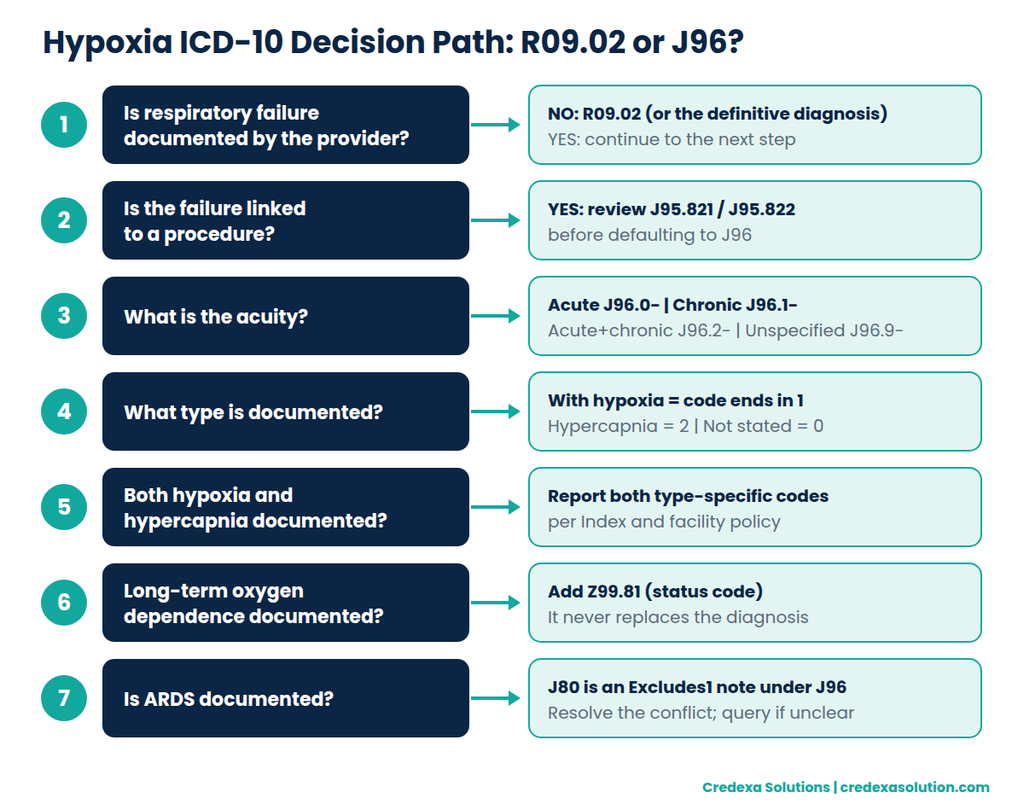
Here is a practical decision path:
- Is respiratory failure documented? If not, consider R09.02 or whatever definitive diagnosis is documented.
- Is it linked to a procedure? If so, review J95.821 or J95.822 before defaulting to J96.
- What is the acuity? Acute is J96.0-, chronic is J96.1-, acute and chronic is J96.2-, unspecified is J96.9-.
- What is the type? With hypoxia ends in 1, with hypercapnia ends in 2, unspecified type ends in 0.
- Are both hypoxia and hypercapnia documented? Don’t collapse them into an unspecified-type code. Follow the current Index, your organization’s policy, and any applicable Coding Clinic advice.
- Is long-term oxygen dependence documented? Add Z99.81 when supported.
- Is ARDS documented? J80 is an Excludes1 note under J96, so resolve the conflict rather than reporting both by habit.
Documentation that supports a J96 code versus R09.02
Statements that support J96.01:
- “Acute respiratory failure with hypoxia due to community-acquired pneumonia, 4 L nasal cannula to maintain SpO2 above 90%.”
- “Acute hypoxic respiratory failure, PaO2 52 on room air, started on high-flow oxygen.”
Statements that support only a symptom code:
- “Hypoxia, SpO2 86%.”
- “Desaturated to 88% overnight, oxygen applied.”
- “Low O2 sat, will monitor.”
A coder cannot upgrade the second list into the first. If the picture looks like respiratory failure but the note says only “hypoxia,” the right move is a compliant query, not an assumption.
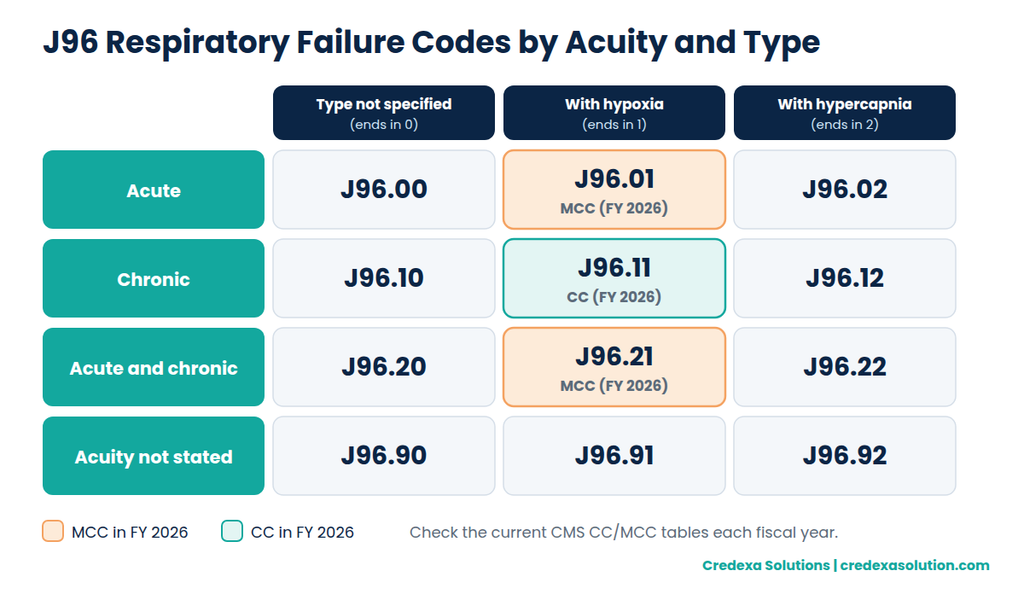
The Full J96 Respiratory Failure Code Family
Category J96 is built on two axes: acuity and type.
| Code | Descriptor |
|---|---|
| J96.00 | Acute respiratory failure, unspecified whether with hypoxia or hypercapnia |
| J96.01 | Acute respiratory failure with hypoxia |
| J96.02 | Acute respiratory failure with hypercapnia |
| J96.10 | Chronic respiratory failure, unspecified whether with hypoxia or hypercapnia |
| J96.11 | Chronic respiratory failure with hypoxia |
| J96.12 | Chronic respiratory failure with hypercapnia |
| J96.20 | Acute and chronic respiratory failure, unspecified whether with hypoxia or hypercapnia |
| J96.21 | Acute and chronic respiratory failure with hypoxia |
| J96.22 | Acute and chronic respiratory failure with hypercapnia |
| J96.90 | Respiratory failure, unspecified, unspecified whether with hypoxia or hypercapnia |
| J96.91 | Respiratory failure, unspecified, with hypoxia |
| J96.92 | Respiratory failure, unspecified, with hypercapnia |
There are no codes titled “persistent hypoxia” or “acute respiratory failure without hypoxia.” If acute respiratory failure is documented without a type, J96.00 is the fit. If only hypercapnia is documented, use J96.02.
Acute Respiratory Failure with Hypoxia ICD-10 (J96.01)
J96.01 is the most searched code in this family and the one most often scrutinized. In FY 2026 it is an MCC when reported as a qualifying secondary diagnosis. The terms “acute hypoxic respiratory failure” and “acute hypoxemic respiratory failure” are common clinical phrasing that maps to it when the record supports acute respiratory failure with hypoxia.
Clinical review teams often look for indicators such as a low room-air PaO2 or SpO2, a reduced PaO2/FiO2 ratio, tachypnea, accessory muscle use, and escalation to high-flow oxygen or noninvasive ventilation. These help validate the diagnosis. They never replace the provider’s statement.
The J96 category carries Excludes1 notes that include ARDS (J80), postprocedural respiratory failure (J95.82-), and respiratory arrest. Check the current Tabular List whenever these conditions appear together.
Chronic Respiratory Failure with Hypoxia ICD-10: J96.11 vs J96.21
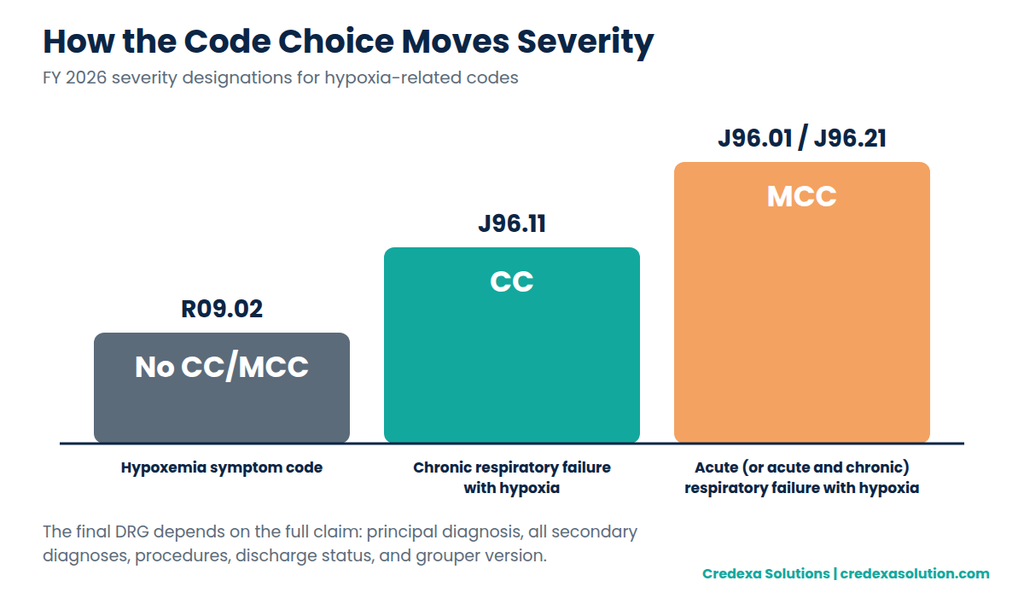
J96.11 is chronic respiratory failure with hypoxia, a CC in FY 2026. J96.21 is acute and chronic respiratory failure with hypoxia, an MCC. The gap between them is the acute component.
| Code | Documentation | FY 2026 severity |
|---|---|---|
| R09.02 | Chronic hypoxemia, no respiratory failure diagnosed | Non-CC |
| J96.11 | Stable chronic respiratory failure with hypoxia | CC |
| J96.21 | Acute decompensation on chronic respiratory failure with hypoxia | MCC |
Being on home oxygen does not by itself prove chronic respiratory failure. A patient on 2 L at baseline who now needs 6 L is a strong clinical indicator of acute-on-chronic disease, but the provider must still name the diagnosis. Never select an acute code just to reach a higher severity level.
Hypercapnic Respiratory Failure: J96.02, J96.12, J96.22
Respiratory failure with hypercapnia (sometimes called type 2 respiratory failure) follows the same acuity pattern. Elevated PaCO2 with acidemia can support the diagnosis, but the coder needs the documented acuity and type. When the provider documents both hypoxia and hypercapnia, report the applicable type-specific codes according to the Index and your facility’s policy rather than defaulting to an unspecified-type code.
A note on “respiratory insufficiency.” This phrase is not automatically respiratory failure. Code what is actually documented, and query if the clinical picture suggests a more specific diagnosis. Terms like distress, desaturation, and insufficiency point toward symptom codes such as R06.89 or R09.02 depending on the Index path.
Oxygen Dependence ICD-10 Code: Z99.81
Z99.81 (Dependence on supplemental oxygen) is a status code. It never replaces the underlying diagnosis, but it can be reported alongside chronic respiratory failure, COPD, or hypoxemia when documented. Good documentation states whether oxygen use is continuous, nocturnal, or exertional, plus the prescribed flow or device and the condition driving the need. Don’t confuse it with Z99.11, which is dependence on a ventilator.
Medicare oxygen criteria are coverage rules, not coding rules
CMS National Coverage Determination 240.2 sets the testing criteria for Medicare home oxygen coverage, such as a PO2 at or below 55 mm Hg or SpO2 at or below 88% at rest on room air. Those numbers decide whether home oxygen is covered. They do not decide whether the diagnosis is R09.02 or J96.11. Mixing the two is one of the most common billing errors in DME and respiratory claims.
Special Situations Where R09.02 Is the Wrong Code
Postoperative hypoxia vs postprocedural respiratory failure. A patient who needs oxygen after surgery does not automatically have a complication. If the provider documents only hypoxemia, R09.02 may fit. If the provider diagnoses acute postprocedural respiratory failure and links it to the procedure, J95.821 may apply. Timing alone is not enough.
ARDS. J80 (Acute respiratory distress syndrome) is a separate diagnosis and sits in the J96 Excludes1 note. Query the provider when both terms appear.
Respiratory arrest. R09.2 is not interchangeable with hypoxia or respiratory failure, and J96 also excludes it.
Anoxic brain injury and perinatal hypoxia. These use G93.1 and Chapter 16 codes (such as the P20 category for intrauterine hypoxia) instead of R09.02 when the specific condition is documented.
Nocturnal hypoxemia. A frequent mistake is treating G47.36 as a generic sleep hypoxemia code. Its official descriptor is sleep related hypoventilation in conditions classified elsewhere. Overnight desaturation alone does not support it. Confirm the documented sleep diagnosis and the Index path before assigning any G47 code.
Sequencing Rules for Respiratory Failure
For inpatient claims, acute or acute-and-chronic respiratory failure may be the principal diagnosis when, after study, it is chiefly responsible for the admission. If it develops after admission or is not the main reason for the stay, it can be reported as a secondary diagnosis. When it appears with pneumonia or a COPD exacerbation, there is no universal “always first” or “always second” rule. The circumstances of admission decide.
Chapter-specific rules override the general approach:
- Sepsis: When severe sepsis is present on admission and meets the principal diagnosis definition, sequence the systemic infection first, then R65.2-, then the associated organ dysfunction codes. The organ dysfunction must be associated with the sepsis.
- COVID-19: For an acute respiratory manifestation of confirmed COVID-19, sequence U07.1 first, followed by manifestations such as J12.82 or J96.0- as supported.
- Outpatient and observation: Use first-listed diagnosis rules. Don’t code conditions documented as “probable” or “suspected”; report the highest degree of certainty, which may be a symptom such as hypoxemia.
What Providers Should Document to Prevent Queries
Strong respiratory failure documentation includes six elements:
- The diagnosis itself. Write “respiratory failure,” not just “hypoxia” or “distress.”
- Acuity. Acute, chronic, or acute and chronic.
- Type. With hypoxia, with hypercapnia, or both.
- Cause. Pneumonia, COPD exacerbation, heart failure, sepsis, and so on.
- Clinical evidence. SpO2, PaO2, PaCO2, pH, respiratory rate, work of breathing, imaging, and baseline status.
- Treatment and response. Device, flow or FiO2, escalation from baseline, and how the patient responded.
Sample documentation language
| Code | Example wording |
|---|---|
| J96.01 | “Acute respiratory failure with hypoxia due to [cause]; PaO2 [value] on room air; started on [device/flow].” |
| J96.11 | “Chronic respiratory failure with hypoxia secondary to [cause]; home oxygen [flow] L; stable at baseline.” |
| J96.21 | “Acute and chronic respiratory failure with hypoxia; baseline [flow] L, now requiring [flow/device].” |
| R09.02 | “Hypoxemia, SpO2 [value] on room air; respiratory failure not diagnosed; workup ongoing.” |
| Z99.81 | “Dependent on supplemental oxygen, [flow/device], [continuous/nocturnal/exertional].” |
A compliant query looks like this
A good query lists the clinical indicators, offers reasonable options (including “other” and “unable to determine”), and never leads the provider toward the highest-paying answer. For example: SpO2 84% on room air, PaO2 51, RR 28, improved to 93% on 6 L. The note states “hypoxia.” Please clarify the condition being treated: acute respiratory failure with hypoxia, hypoxemia without respiratory failure, other (specify), or unable to determine. Follow current ACDIS and AHIMA compliant query practice guidance and your organization’s policy.
Why Code Choice Moves Money: MCC, MS-DRG, and Risk Adjustment
In FY 2026, J96.01 and J96.21 are MCCs, J96.11 is a CC, and R09.02 carries no severity designation. If J96.01 is the only MCC on a pneumonia admission, replacing it with R09.02 can drop the case a severity tier. If another MCC is already present, the DRG may not change at all. The final assignment always depends on the full set of diagnoses, procedures, discharge status, and grouper version, so validate against the current CMS IPPS resources rather than predicting from one code.
Risk adjustment adds another layer. Certain J96 diagnoses map into the cardio-respiratory failure and shock hierarchy in the CMS-HCC V28 model, while R09.02 does not carry the same weight. Confirm mappings in the current CMS risk adjustment files. Documentation should reflect what is clinically true and assessed. It should never be shaped by what pays more.
Procedure coding that often accompanies respiratory failure
Diagnosis codes describe the condition. CPT, HCPCS, and ICD-10-PCS describe the services. Professional claims may include critical care (99291, 99292), blood gases, and ventilator management, but NCCI edits bundle many of them together. For example, pulse oximetry codes 94760 to 94762 are bundled with critical care. Facility coders must also count consecutive ventilation hours carefully, since PCS ventilation codes are split by duration and affect DRG assignment. Noninvasive support and high-flow oxygen are not coded like invasive mechanical ventilation.
Clinical Validation Denials: Why Payers Downgrade J96.01 to R09.02
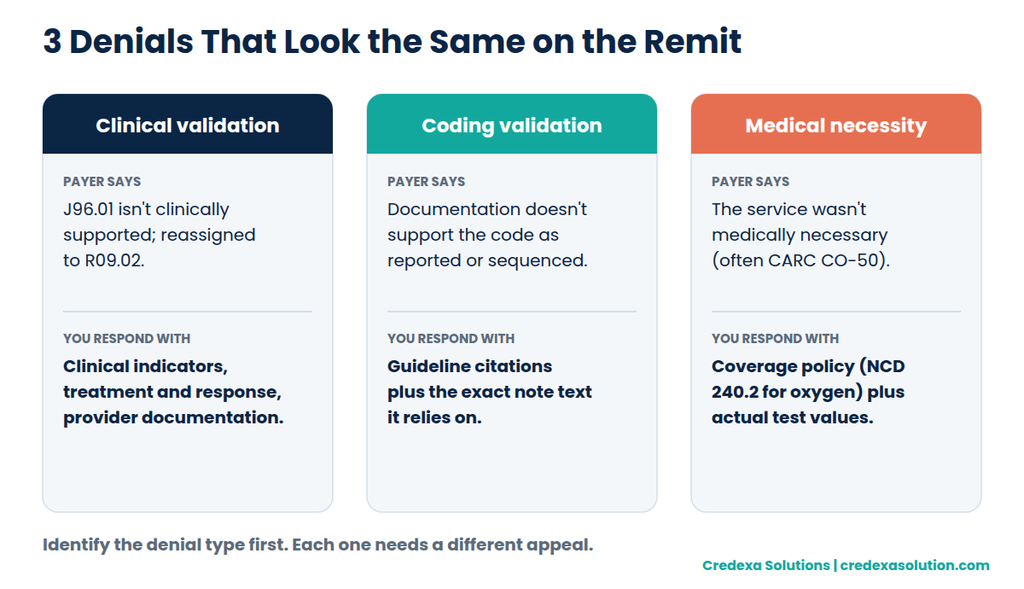
Payers often reassign J96.01 to R09.02 and regroup the DRG. Three different denial types can hide behind similar remits, and each needs a different appeal:
| Denial type | Payer’s argument | Best response |
|---|---|---|
| Clinical validation | The diagnosis isn’t supported by the clinical picture | Indicators, treatment, response, and provider documentation |
| DRG or coding validation | Documentation doesn’t support the code as reported or sequenced | Guideline citations plus exact note text |
| Medical necessity | The service wasn’t necessary under policy | Coverage policy, such as NCD 240.2 for oxygen, plus test values |
What a winning appeal contains
- The provider’s diagnosis quoted verbatim, with date, note type, and author.
- The Official Guidelines language that code assignment is based on the provider’s diagnostic statement.
- A timestamped table of clinical indicators, with the room-air qualifier.
- Treatment and response, including baseline and escalation.
- The payer’s own criteria, mapped point by point to the record.
- A provider addendum only if the payer accepts late entries, and never a new diagnosis added after the fact.
The best defense is prevention. Review charts that combine “hypoxia” with an oxygen escalation, send compliant queries before discharge rather than after a denial, and run a pre-bill check confirming the diagnosis appears in the discharge summary.
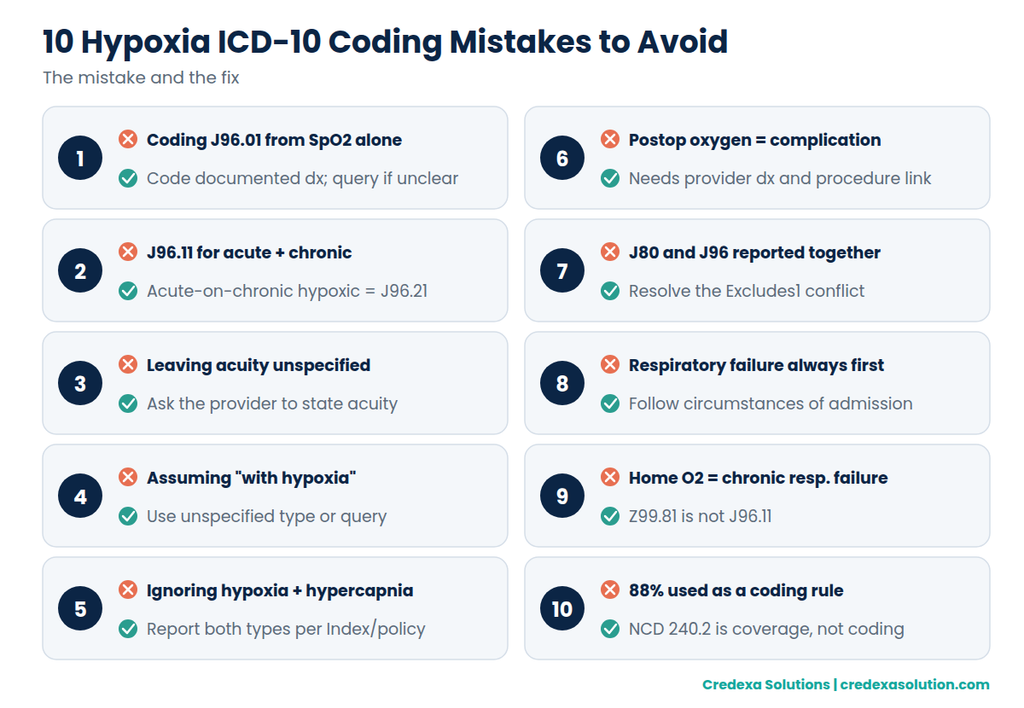
Ten Hypoxia Coding Mistakes to Avoid
- Coding J96.01 from a saturation value alone.
- Using J96.11 when acute and chronic failure are both documented (J96.21).
- Leaving acuity unspecified when the provider could clarify it.
- Assuming “with hypoxia” when the type was never documented.
- Ignoring simultaneous hypoxia and hypercapnia.
- Inferring postprocedural respiratory failure from postoperative oxygen use.
- Reporting J80 and J96 together without resolving the Excludes1 note.
- Sequencing respiratory failure first on every admission.
- Treating home oxygen use as proof of chronic respiratory failure.
- Applying Medicare’s 88% oxygen coverage threshold as an ICD-10 coding threshold.
FY 2026 vs FY 2027: Which Code Set Applies?
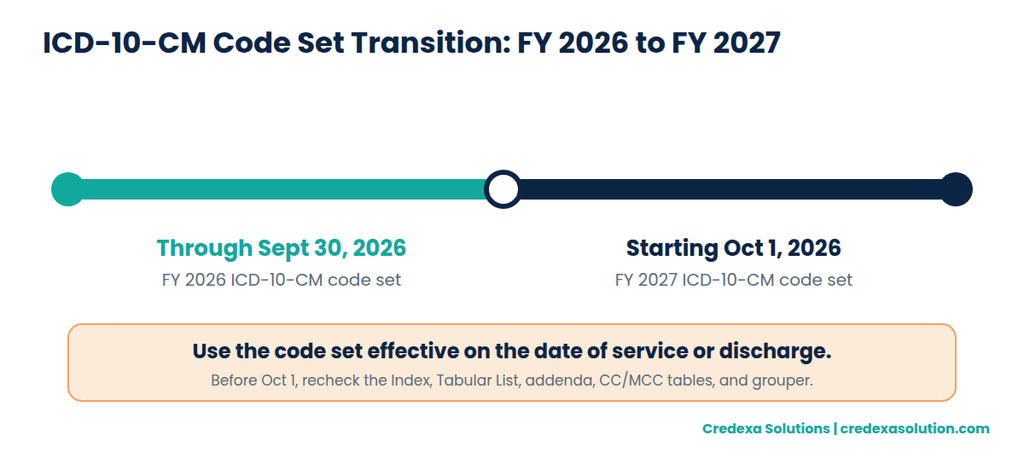
FY 2026 ICD-10-CM remains in effect through September 30, 2026. CMS has published the FY 2027 code files and guidelines for use starting October 1, 2026. The rule is straightforward: use the code set effective on the date of service or discharge. Don’t apply FY 2027 codes to a September claim just because the files are public. Before claims cross the October 1 line, recheck the FY 2027 Index, Tabular List, addenda, CC/MCC tables, and grouper, and confirm on the CMS ICD-10 page that nothing affecting your respiratory cases has changed.
Clean Coding Isn’t Enough If the Claim Never Gets Paid
Perfect diagnosis coding still fails when the front end of the revenue cycle is broken. A J96.01 claim won’t pay if the provider isn’t properly enrolled with the payer, and enrollment mistakes are one of the quietest sources of lost revenue.
That is why credentialing and coding belong in the same conversation. If your practice is joining new networks, these guides cover the enrollment side in depth:
- Medicaid enrollment: Walk through portal steps, required documents, and common rejection reasons in the Wisconsin Medicaid provider enrollment 2026 ForwardHealth portal guide.
- Commercial and marketplace plans: See how to get in-network with a major marketplace carrier in the complete Ambetter provider enrollment and credentialing guide.
- Specialty billing accuracy: If your practice bills procedural specialties, the lithotripsy CPT codes 2026 billing, reimbursement, and denial prevention guide shows the same documentation-first discipline applied to urology.
Hypoxia coding and procedure coding share one principle: the claim must match the record, and the record must match the payer’s rules.
How Credexa Solutions Helps with Medical Billing
Whether you are a physician practice, a hospitalist group, a pulmonology clinic, or a DME supplier, the pattern is consistent. Denials come from small breaks in documentation, coding, enrollment, or follow-up. Credexa Solutions helps close those gaps with an end-to-end approach:
- Accurate medical coding and claim submission. Diagnosis and procedure codes are matched to provider documentation and checked against current code sets, including the FY 2026 to FY 2027 transition, before claims go out. That lowers first-pass rejections on high-scrutiny codes like J96.01.
- Denial management and appeals. When a payer downgrades a diagnosis or challenges medical necessity, the team identifies the denial type, builds the evidence packet, and tracks the appeal through every level.
- Provider enrollment and credentialing. From Medicaid portals to commercial payers like Ambetter, Credexa handles applications and follow-ups so providers can bill sooner and avoid enrollment-related denials.
- Accounts receivable follow-up. Aged claims are worked systematically so revenue doesn’t sit in limbo.
- Documentation and coding insights. Recurring query patterns and denial trends are turned into feedback that helps providers document more clearly.
If respiratory failure queries, DRG downgrades, or credentialing delays are costing your practice revenue, visit Credexa Solutions to see how their medical billing and credentialing specialists can help you get paid accurately and on time.
Frequently Asked Questions About the Hypoxia ICD-10 Code
What is the ICD-10 code for hypoxia unspecified?
R09.02, Hypoxemia. There’s no extension for acuity or “unspecified.”
Can R09.02 be a principal diagnosis?
In outpatient care it can be first-listed when hypoxemia is the established reason for the encounter. For inpatient claims, principal diagnosis selection follows Section II of the guidelines and chapter-specific rules.
Is J96.01 an MCC?
Yes, for FY 2026, when reported as a qualifying secondary diagnosis. Recheck severity designations each fiscal year.
What’s the difference between J96.01 and J96.21?
J96.01 is acute respiratory failure with hypoxia. J96.21 requires documentation of both a chronic baseline and an acute component.
What is the ICD-10 code for oxygen dependence?
Z99.81. It is a status code that supplements, never replaces, the underlying diagnosis.
Does a low SpO2 support J96.01 on its own?
No. It is a clinical indicator, but J96.01 requires the provider’s diagnosis of acute respiratory failure with hypoxia.
Is G47.36 the code for nocturnal hypoxemia?
No, not as a general rule. Its descriptor is sleep related hypoventilation in conditions classified elsewhere.
Final Takeaway
The safest way to select a hypoxia ICD-10 code is to code the diagnosis the provider actually documents, at the highest supported specificity, and never turn a lab value into a diagnosis by inference. R09.02 reports hypoxemia when nothing more definitive applies. The J96 family reports respiratory failure by acuity and type. Everything else, including sequencing, Z99.81, MCC impact, and appeals, follows from that documentation.
Strong coding also needs strong operations around it: clean enrollment, accurate claims, and disciplined follow-up. That is exactly where Credexa Solutions can support your practice.