
If you searched “Humana timely filing limit” expecting a single number, here’s the problem: there isn’t one. Humana runs Medicare Advantage, state Medicaid managed care, and TRICARE East under three completely different regulatory frameworks, and each one sets its own claims deadline. Depending on the plan sitting in front of you, that window could be 90 days, 180 days, or a full 365 days — and getting it wrong is one of the most common, and most avoidable, sources of denied revenue in healthcare billing.
This guide breaks down every Humana filing deadline that’s currently active in 2026 initial claims, corrected claims, coordination of benefits, and appeals by plan type and by state, with the regulatory and payer sources cited so you can verify each figure yourself. We’ll also cover what changed when Humana exited the commercial insurance market, what CO-29 denials mean for your appeal strategy, and how the 2027 Medicare Advantage plan terminations are already creating an accounts receivable problem for practices that haven’t started tracking it.
Why Humana Doesn’t Publish One Timely Filing Limit
Humana is no longer a single-line commercial carrier. In 2026, its book of business splits into three distinct regulatory categories, and each one answers to a different rulebook:
- Medicare Advantage (Part C) — regulated by the Centers for Medicare & Medicaid Services (CMS) under federal law
- Medicaid managed care (Humana Healthy Horizons) — regulated jointly by federal Medicaid rules and each individual state’s contract
- TRICARE East (administered through Humana Military) — regulated by the Defense Health Agency under a separate federal statute
None of these three frameworks share a filing deadline. A practice that treats “Humana” as one payer with one rule is set up to lose claims the moment its patient panel includes more than one type of Humana coverage which, for most primary care and multi-specialty practices, is nearly guaranteed.
Here’s a scenario that plays out constantly: a scheduler sees two Humana ID cards back to back. One is a Medicare Advantage plan, giving the practice a full year to file. The other is Humana Healthy Horizons in Indiana, where the deadline is 90 calendar days. If both claims run on the same internal timeline, one of them misses its window by months before anyone notices.
This is exactly the kind of detail a generic aging-claims workflow misses. Sorting accounts receivable by dollar amount instead of filing deadline proximity is how write-offs pile up quietly, one claim at a time.
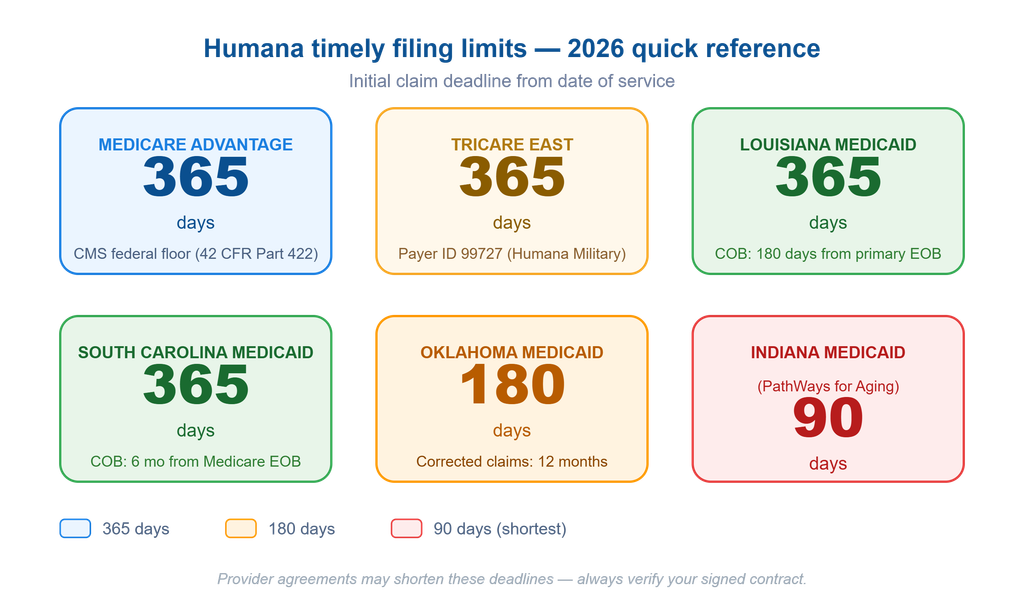
Humana Timely Filing Limits: The 2026 Quick Reference
| Plan Type | Initial Claim Deadline | Corrected Claim | Appeal / Reconsideration |
|---|---|---|---|
| Medicare Advantage (Part C) | 365 days from date of service | Same 365-day clock, no reset | 65 calendar days from denial notice |
| Healthy Horizons Medicaid — Louisiana | 365 days from date of service | 365 days, same clock | 180 days from remittance advice |
| Healthy Horizons Medicaid — South Carolina | 1 year from date of service/discharge | 1 year, same clock | Per state provider manual |
| Healthy Horizons Medicaid — Oklahoma | 180 days from date of service/discharge | 12 months (longer than original) | Per state provider manual |
| Healthy Horizons Medicaid — Indiana (PathWays) | 90 calendar days from date of service | Verify state contract | 60 days from denial |
| TRICARE East (Humana Military) | 365 days from date of service | Per TRICARE process | Per TRICARE appeals process |
| Legacy Commercial (exited 2024) | 90 days (historical) | N/A runout AR only | 180 days from denial |
Keep in mind that a provider’s own participation agreement can shorten any of these federal or state floors. Always check your signed contract before calendaring a deadline based on a published default
Humana Medicare Advantage: The 365-Day Rule and Its Exceptions
Humana Medicare Advantage requires initial claims within 365 days of the date of service. That number isn’t a Humana policy choice it’s the floor set by CMS under the Medicare Advantage prompt-payment regulations at 42 CFR Part 422, Subpart K. Every Part C plan operating nationally, Humana included, has to give providers at least this much time.
Two details trip up billing teams constantly:
Your provider agreement can go shorter than 365 days. Humana’s own claims guidance allows the timeline to be governed by “the provider agreement” where one exists. If your practice recently renegotiated a Humana contract, don’t assume the standard year applies pull the timely filing clause and read it directly. The Humana provider claims submission guidance states the general policy, but a signed contract overrides it.
Original Medicare and Medicare Advantage are not the same clock. Fee-for-service Medicare allows a calendar year from the date of service under 42 CFR 424.44 — a similar number, but a separate rule with its own appeal ladder and payer ID. Our guide to the Medicare timely filing limit and CO-29 recovery process covers that version in full.
Dual-Eligible and Coordination of Benefits Claims
When a patient is enrolled in both Medicare and a Humana secondary plan, the filing clock for the secondary claim typically starts on the date of the primary payer’s Explanation of Benefits (EOB) not the date of service. Practices that submit the secondary claim immediately after the visit and then wait weeks or months for Medicare’s remittance sometimes discover, too late, that the window was measured from a date they never tracked. Always confirm which date governs the specific plan you’re billing before building a standard workflow around it.
Humana Healthy Horizons Medicaid: A Different Deadline in Every State
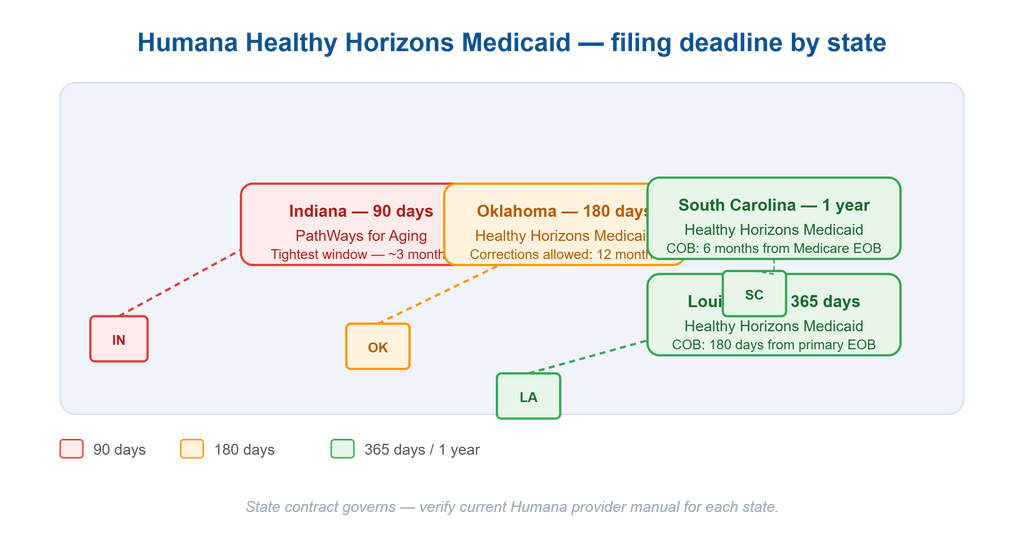
Unlike Medicare Advantage, Humana does not run one national Medicaid filing standard. Humana Healthy Horizons operates under separate state contracts, and each state sets its own number inside the federal ceiling established by 42 CFR 447.45, which caps state Medicaid filing windows at 12 months from the date of service a ceiling, not a guarantee of that full length.
Indiana: 90 Days, the Tightest Window in the Book
Humana Healthy Horizons operates in Indiana exclusively through the PathWays for Aging program, requiring claims within 90 calendar days of the date of service for both in-network and out-of-network providers. That’s roughly a quarter of what many billing guides assume applies to all Humana Medicaid business an easy deadline to miss if your team defaults to the Medicare Advantage timeline.
The Indiana Health Coverage Programs (IHCP) claims guidance confirms the 90-day standard, and the Humana Indiana Medicaid claims and payments page covers submission. If you’re credentialing into an Indiana Medicaid managed care plan, our Wellpoint 2026 provider enrollment guide covers a comparable managed Medicaid enrollment timeline.
Oklahoma: 180 Days Initial, 12 Months for Corrections
Humana Healthy Horizons in Oklahoma requires initial claims within 180 days (six months) of the date of service or discharge but gives providers a full 12 months to file a corrected claim. That’s the inverse of how most payers structure their rules, where the correction window is usually shorter than or equal to the original filing period, not longer.
This distinction matters in practice. A claim denied on day 170 for a coding error, NPI mismatch, or missing modifier isn’t dead it still has nearly a year of room to be corrected and resubmitted, even though the original filing window has technically closed.
Louisiana and South Carolina: A Full Year, With Different COB Math
Both states give providers 365 days (Louisiana) or one year (South Carolina) from the date of service to file, and both treat corrected claims on the same clock as the original. Where they diverge is coordination of benefits:
- Louisiana allows 180 calendar days from the date of Medicare’s EOB when Medicare pays first.
- South Carolina is more generous: providers get either two years from the date of service, or six months from the Medicare remittance, whichever applies.
Louisiana also separates encounter data reporting from claims submission encounter data runs on a 30-day clock, which is easy to miss if your team assumes one submission satisfies both requirements.
If Your State Isn’t Listed
Humana does not publish a single retrievable filing figure for every Healthy Horizons state. If you’re billing a state not covered above, don’t default to a national average pull the state-specific Humana provider manual, or call the number on the back of the member’s ID card. It’s a ten-minute call, and it’s the only answer that will hold up if a claim is ever challenged on appeal.
Do Corrected Claims Reset the Filing Clock?
For Medicare Advantage: no. A corrected claim runs on the same 365-day clock as the original date of service filing a correction does not restart the window. If your original claim was submitted on day 300 and comes back denied for a billing error, you have the remaining 65 days to correct and resubmit, not a fresh year. This catches practices that assume “corrected” means “new deadline.”
For Medicaid: it depends entirely on the state, and Oklahoma is the clearest proof that there’s no universal rule:
- Louisiana: claims and corrected claims both run 365 days from the date of service same clock.
- South Carolina: claims and corrected claims both run one year from the date of service or discharge same clock.
- Oklahoma: initial claims run 180 days; corrected claims get 12 months a longer window than the original.
Any blanket claim that “Humana corrected claims always follow the original filing deadline” breaks down the moment Oklahoma enters the conversation.
It’s also worth separating a corrected claim from an appeal they travel through different review paths. A corrected claim fixes a billing error on the original submission (wrong modifier, incorrect diagnosis code, missing NPI) and is submitted with a resubmission code referencing the original claim number. An appeal challenges a payer’s determination on a claim that was otherwise filed correctly and on time. Submitting one as the other just sends the claim into the wrong queue and adds delay to both.
Coordination of Benefits: When the Clock Starts at the Primary Payer’s EOB
When Medicare or another primary payer adjudicates first and Humana pays secondary, the filing window for the secondary claim generally starts from the date on the primary payer’s EOB, not the original date of service. This is where COB claims most often get denied for reasons that have nothing to do with actual lateness.
Always attach the primary payer’s remittance advice to the secondary claim. A COB claim submitted without proof of the primary payer’s adjudication date can’t be verified as timely, so it gets denied on a technicality often coded as a coordination-of-benefits denial rather than a straightforward timely filing rejection, which sends staff looking for the wrong fix.
There’s also a lesser-known exception worth knowing: if a claim was misdirected to the wrong carrier by an honest mistake, Humana’s filing clock for the correct submission generally starts from the date you were notified of the error not the original date of service. The catch is proof. You need something documented: a rejection letter, a remittance showing the date from the wrong payer, or a timestamped portal message. An undocumented phone call won’t survive a review.
Appeals and Reconsiderations: The 65-Day Window That Catches People
Humana’s appeal deadlines vary sharply by plan type, and the shortest one is also the one tied to the largest share of Humana’s membership:
- Medicare Advantage reconsiderations: 65 calendar days from the date on the denial notice not the date you received it in the mail.
- Louisiana Medicaid: 180 days from the remittance advice for a reconsideration request.
- Michigan D-SNP: 60 calendar days from the notice of claim outcome.
- Legacy commercial runout claims: 180 days from the denial date.
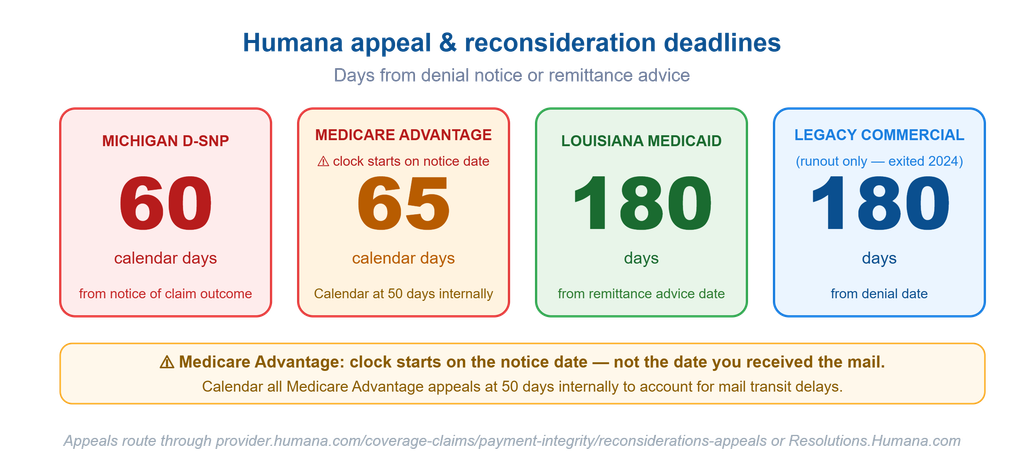
The 65-day Medicare Advantage window deserves special attention because it’s shorter than most billing teams’ muscle memory, which is often calibrated to the 180-day windows common in commercial insurance. Because the clock starts on the notice date rather than the received date, mail delays quietly eat into the available time before anyone opens the envelope. A practical fix: calendar Medicare Advantage appeals at 50 days internally, not 65, to leave a buffer for documentation and mail transit.
Appeals and reconsiderations can be filed through Humana’s reconsiderations and appeals page or tracked online through Resolutions.Humana.com, which assigns a trackable case number.
CO-29 Denials: What They Mean and How to Prove You Filed on Time
CO-29 is the standard claim adjustment reason code indicating a claim was submitted after the payer’s filing deadline. It often appears alongside remark code N390. A CO-29 denial is not an argument you can appeal on the merits it’s a documentation problem, and it’s only recoverable if you can produce proof of a submission date that falls inside the applicable window.
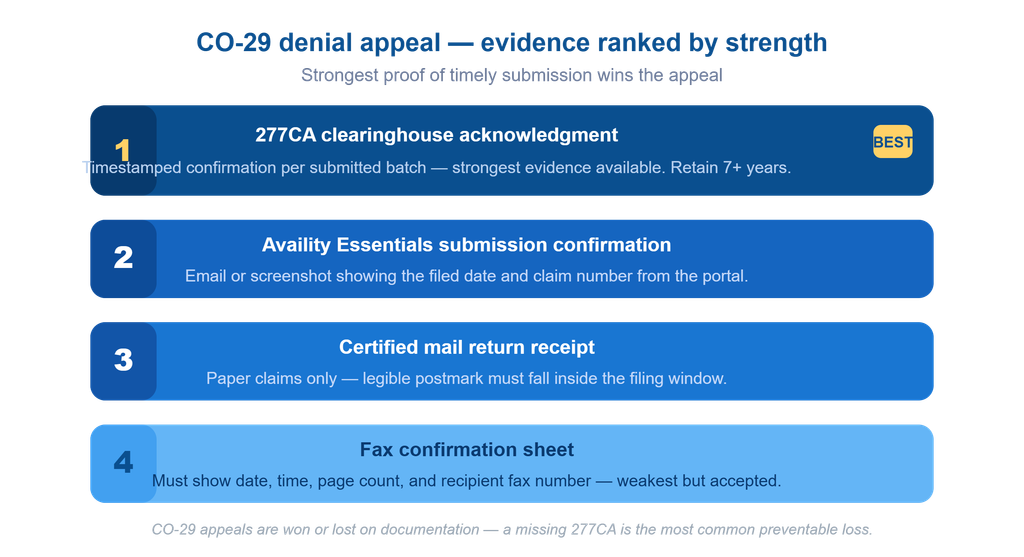
Ranked by strength of evidence:
- 277CA clearinghouse acknowledgment — the timestamped confirmation your clearinghouse generates for every submitted batch. This is the strongest evidence available.
- Availity Essentials confirmation — an email or screenshot showing the filed date.
- Certified mail return receipt — for paper claims, with a legible postmark.
- Fax confirmation sheet — showing date, time, page count, and recipient number.
Retention policy matters more than most practices realize. Store 277CA acknowledgments for at least seven years. Many practices purge these records after 90 days to save storage space, and that purge is exactly what kills a winnable appeal six months later when a CO-29 denial finally surfaces on an aging report. A denial management workflow that doesn’t account for retention policy is a process gap, not just a billing error and it’s one of the first things worth auditing if timely filing denials are a recurring line item on your write-off report.
Humana Payer ID and Claims Submission Addresses (2026)
| Submission Type | Payer ID | Address / Method |
|---|---|---|
| Medical & behavioral health claims | 61101 | Electronic via Availity Essentials, or Humana Claims Office, P.O. Box 14601, Lexington, KY 40512-4601 |
| Encounter data (noncapitated) | 61102 | Electronic submission via Availity Essentials |
| Provider clinical/administrative appeal | N/A | Humana Grievances and Appeals, P.O. Box 14546, Lexington, KY 40512-4546 |
| Member appeal or grievance | N/A | P.O. Box 14165, Lexington, KY 40512-4165 |
| Michigan Dual Integrated D-SNP | 61101 | P.O. Box 14359, Lexington, KY 40512-4359 |
| TRICARE East (Humana Military) | 99727 | See Humana Military claims guidance |
Two things to flag here. First, TRICARE East claims use an entirely separate payer ID (99727) from the standard medical payer ID (61101) routing a TRICARE claim to the wrong one is a common, avoidable rejection. Second, Humana applies a $5 administrative fee on paper claims where the reimbursement is $10 or more, which is a concrete financial reason (beyond speed) to submit electronically through a clearinghouse whenever possible.
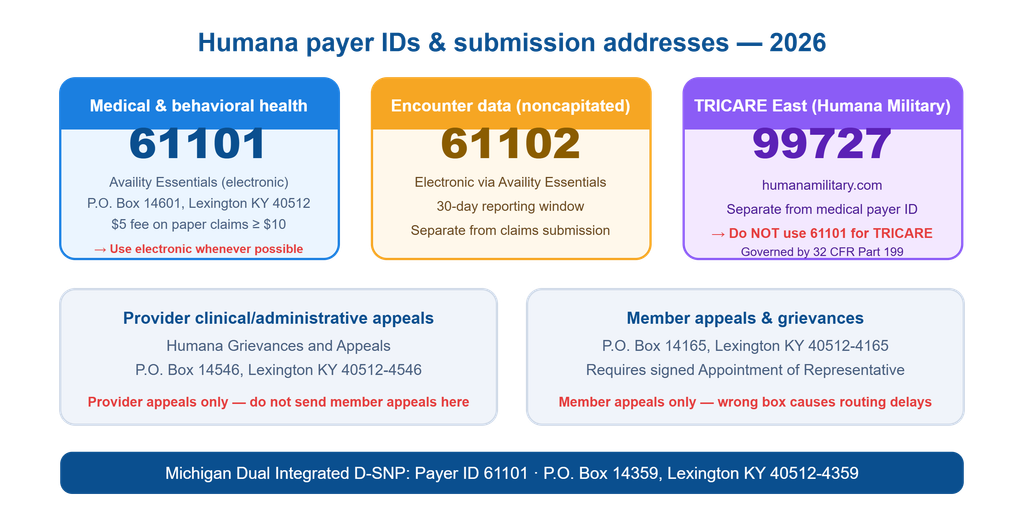
The two appeals mailboxes are also not interchangeable P.O. Box 14546 handles provider appeals, while P.O. Box 14165 is for member appeals and grievances filed with a signed Appointment of Representative form. Sending an appeal to the wrong box doesn’t bounce back; it gets rerouted internally, quietly consuming days from a 65-day window you can’t afford to lose.
TRICARE East and Humana Military: A Separate Rulebook Entirely
Humana Military administers TRICARE East under a Defense Health Agency contract, governed by 32 CFR Part 199 not the Medicare Advantage or Medicaid frameworks that apply to the rest of Humana’s business. Participating providers generally have 365 days from the date of service to file.
Two exceptions rarely appear in general billing guidance: Active Duty Service Members are exempt from the standard timely filing rule entirely for claims tied to their date of service in that status, and a documented incapacity exception allows Humana Military to consider claims for services received within the preceding six years when a beneficiary was unable to communicate or was mentally incompetent without an appointed legal guardian.
The Humana Military provider claims page has current submission requirements. Remember: TRICARE claims route through payer ID 99727, not the standard 61101 used for Humana’s medical and behavioral health lines.
The 2024 Commercial Exit: Why Outdated Numbers Still Circulate
Humana announced its exit from the employer group commercial medical products business in early 2023, with the wind-down completing in 2024, as confirmed in Humana’s own exit announcement. The “90-day” Humana filing limit still repeated across billing guides and forums describes a product line that no longer exists and the rule had already changed more than once before that, from a 180-day physician/90-day facility split in earlier manuals to a flat 90 days shortly before the line was discontinued entirely.
If your practice is still carrying open Humana commercial accounts receivable from 2023 or earlier, the appeal window on those denials is 180 days from the denial date after that, recovery becomes very difficult. Medicare Advantage, Medicaid, military, and specialty lines were unaffected by the commercial exit.
2027 Plan Exits: A New AR Problem Starting Now
Humana has confirmed plan terminations affecting a significant share of its Medicare Advantage membership for 2027, concentrated among plans rated 3.5 stars or lower. Federal rules require non-renewal notices to be dated by October 2, with affected coverage ending December 31, 2026.
This creates three billing consequences that are easy to overlook: runout accounts receivable, since providers can still hold up to 365 days of claims on 2026 dates of service against a plan number that no longer shows on a live eligibility check; re-contracting exposure, since any Humana Medicare Advantage agreement renegotiated for 2027 needs its timely filing clause re-read rather than assumed; and outdated assumptions, since “Medicare Advantage” doesn’t automatically mean a full year on a freshly signed agreement the clause governs, not the category.
If your aging report includes Humana balances untouched since mid-2026, that’s the segment to prioritize before the runout clock accelerates.
Building a Filing Deadline System That Actually Holds
Most Humana timely filing denials aren’t a knowledge problem billing staff can usually recite the general numbers. They’re a process problem: nothing in the workflow applies the correct deadline to the correct plan before the window closes. Three habits fix the majority of it:
- Build your filing deadline matrix by plan type and state, not by payer name. “Humana” is not one deadline; it’s five or more, depending on your patient mix.
- Retain 277CA acknowledgments and Availity confirmations for at least seven years, not the 90-day retention window many practices default to.
- Re-read the timely filing clause on any Humana contract renegotiated for 2027, especially for Medicare Advantage agreements assumed to carry the standard 365-day floor.
If you’re comparing this against another major payer to build a broader deadline matrix, our guides on the BCBS timely filing limits by plan and state and the Medicare 12-month filing rule and CO-29 recovery process cover the two payers most commonly confused with Humana’s rules.
How Credexa Solutions Helps Practices Stay Ahead of Humana Deadlines
Tracking five separate Humana filing windows across Medicare Advantage, multiple Medicaid states, TRICARE East, and legacy commercial runout isn’t a side task — it’s a full workflow, and exactly the kind of detail that slips when a billing team is also handling eligibility checks, coding, and payment posting.
Credexa Solutions manages the full revenue cycle for practices across more than 100 specialties, with a dedicated team handling clean claim submission, eligibility verification, denial management, and AR follow-up sorted by deadline proximity rather than dollar amount alone supporting a 98%+ first-pass claim acceptance rate and an average of 25 days in accounts receivable across our client base.
If your Humana claims are being tracked with a single deadline instead of five, a free billing analysis can show which claims are still inside their filing window and which are at risk before the next plan exit accelerates your runout clock. Get in touch with our team, or explore our revenue cycle management guide and RCM reporting breakdown for how deadline tracking fits into a broader collections strategy.
Frequently Asked Questions
What is the Humana timely filing limit for claims in 2026? There isn’t one universal number. Medicare Advantage allows 365 days from the date of service. Humana Healthy Horizons Medicaid varies by state: 90 days in Indiana, 180 days in Oklahoma, and 365 days in Louisiana and South Carolina. TRICARE East allows 365 days. The number that applies to a specific claim depends on the plan on the member’s ID card and, for contracted providers, the terms of the participation agreement.
How long do you have to file a claim with Humana? Between 90 and 365 days, depending on the plan type. Medicare Advantage and TRICARE East both allow a full year. Humana Healthy Horizons Medicaid ranges from 90 days (Indiana) to a full year (Louisiana and South Carolina), with Oklahoma at 180 days for initial claims.
What is Humana’s timely filing limit for appeals? Medicare Advantage reconsiderations are due within 65 calendar days of the denial notice date measured from the date on the notice, not the date it was received. Louisiana Medicaid allows 180 days from the remittance advice, and Michigan D-SNP allows 60 calendar days from the notice of claim outcome.
Does a corrected claim reset Humana’s filing deadline? For Medicare Advantage, no corrected claims run on the same 365-day clock as the original date of service. Medicaid rules vary by state: Oklahoma actually allows a longer window for corrected claims (12 months) than for original claims (180 days), while Louisiana and South Carolina keep corrected claims on the same clock as the original submission.
What is the timely filing limit for Humana Medicare Advantage claims specifically? 365 days from the date of service, reflecting the CMS floor for Part C plans. Individual provider agreements can shorten this window, so contracted practices should verify their specific contract language rather than assume the federal default applies.
What is Humana’s payer ID? Humana uses payer ID 61101 for medical and behavioral health claims and 61102 for encounter data submissions. TRICARE East claims route through Humana Military under a separate payer ID, 99727.
What are common Humana denial codes billing teams should know? CO-29 indicates a claim was filed past the deadline. CO-197 indicates missing prior authorization. CO-16 indicates incomplete information. PR-96 indicates a non-covered service. CO-22 indicates another payer should have paid first, and it frequently appears alongside CO-29 on coordination of benefits claims read both codes together before deciding whether to correct or appeal.
Can a practice bill the patient after a Humana timely filing denial? Generally, no. For participating providers, a timely filing denial is typically treated as a contractual write-off, and most participation agreements prohibit balance billing the patient for a deadline the practice missed. Confirm this against your specific participation agreement and applicable state balance billing law before sending any statement.
How do you prove timely filing to Humana during an appeal? The strongest evidence is a 277CA clearinghouse acknowledgment showing a submission timestamp inside the filing window. Availity Essentials confirmations, certified mail return receipts with a postmark, and dated fax confirmation sheets are also accepted. Retain these records for at least seven years, since CO-29 appeals are won or lost almost entirely on documentation.
Sources
- 42 CFR 424.44 — Time limits for filing Medicare claims
- 42 CFR Part 422, Subpart K — Medicare Advantage organization contracts
- 42 CFR 447.45 — Timely claims payment under Medicaid
- Humana provider claims submission guidance
- Humana reconsiderations and appeals
- Humana Indiana Medicaid claims and payments
- Humana Michigan D-SNP claims and payments
- Indiana Health Coverage Programs — Humana claims guidance
- Humana Military provider claims guidance
- Humana employer group commercial exit announcement
- Resolutions.Humana.com — online appeals portal
Timely filing windows are ultimately governed by your specific participation agreement and current payer guidance. Verify every deadline against your own contract before relying on any published default.