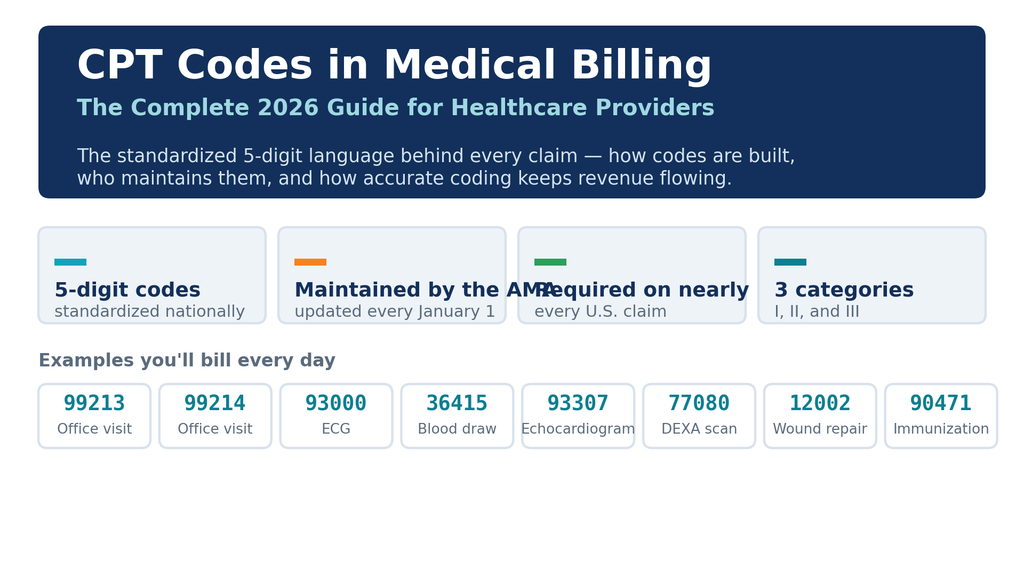
If you’ve ever looked at a patient statement or an insurance Explanation of Benefits (EOB) and wondered what those five-digit numbers next to each service mean, you’ve already encountered CPT codes in medical billing. These codes are the invisible infrastructure behind every office visit, lab test, surgery, and vaccination billed in the United States healthcare system.
For healthcare providers, practice managers, and medical billing teams, understanding CPT codes isn’t optional it’s the difference between clean claims that get paid on time and denied claims that drain revenue and staff hours. In this guide, we’ll break down exactly what CPT codes are, how they’re structured, the three categories every biller needs to know, real-world examples, common errors, and the best practices that keep your revenue cycle healthy in 2026.
Whether you’re a solo practitioner trying to make sense of your superbill or a billing manager training new coders, this guide gives you a practical, up-to-date foundation and shows you where to go for deeper support like provider credentialing and enrollment when CPT coding alone isn’t enough to get your claims paid.
Table of Contents
- What Are CPT Codes?
- Who Maintains and Updates CPT Codes?
- The Structure of a CPT Code
- The Three Categories of CPT Codes
- CPT Codes vs. ICD-10 vs. HCPCS: What’s the Difference?
- Why CPT Codes Matter in Medical Billing
- Common CPT Code Examples by Specialty
- CPT Modifiers: The Fine Print That Changes Reimbursement
- Common CPT Coding Errors (and How They Cost You)
- Best Practices for CPT Coding Accuracy in 2026
- How CPT Codes Fit Into the Bigger Revenue Cycle
- How Credexa Solutions Helps Providers Get CPT Coding and Billing Right
- Frequently Asked Questions
1. What Are CPT Codes?
CPT codes (Current Procedural Terminology codes) are standardized five-character codes used to describe medical, surgical, and diagnostic services performed by healthcare providers. They were created and are maintained by the American Medical Association (AMA), and they function as a universal language that lets physicians, hospitals, coders, and insurance payers communicate about exactly what service was rendered during a patient encounter.
Every time a provider bills for an office visit, an X-ray, a vaccination, or a surgical procedure, a CPT code is attached to that claim. Without this shared coding language, insurance companies would have no consistent way to process claims, calculate reimbursement, or compare data across millions of encounters nationwide.
In simple terms: ICD-10 codes tell the payer why a patient was seen (the diagnosis), while CPT codes tell the payer what was done (the service or procedure). Both are required on nearly every medical claim submitted in the U.S.
2. Who Maintains and Updates CPT Codes?
The CPT code set is copyrighted and updated annually by the American Medical Association’s CPT Editorial Panel, a body of physicians, coders, and industry experts who review requests for new codes, revisions, and deletions. New and revised codes typically take effect on January 1 each year, although Category III codes (covered below) are updated twice a year.
The Centers for Medicare & Medicaid Services (CMS) also publishes the CPT/HCPCS code set for public reference and uses it as the foundation for Medicare’s payment schedules. Because CMS payment policy is closely tied to CPT coding, any biller working with Medicare or Medicaid claims needs to track updates from both AMA and CMS every year.
Staying current matters because codes are added, revised, or retired constantly. A code that was valid and reimbursable last year might be deleted or bundled into a different code this year and billing with an outdated code is one of the fastest ways to trigger a denial.
3. The Structure of a CPT Code
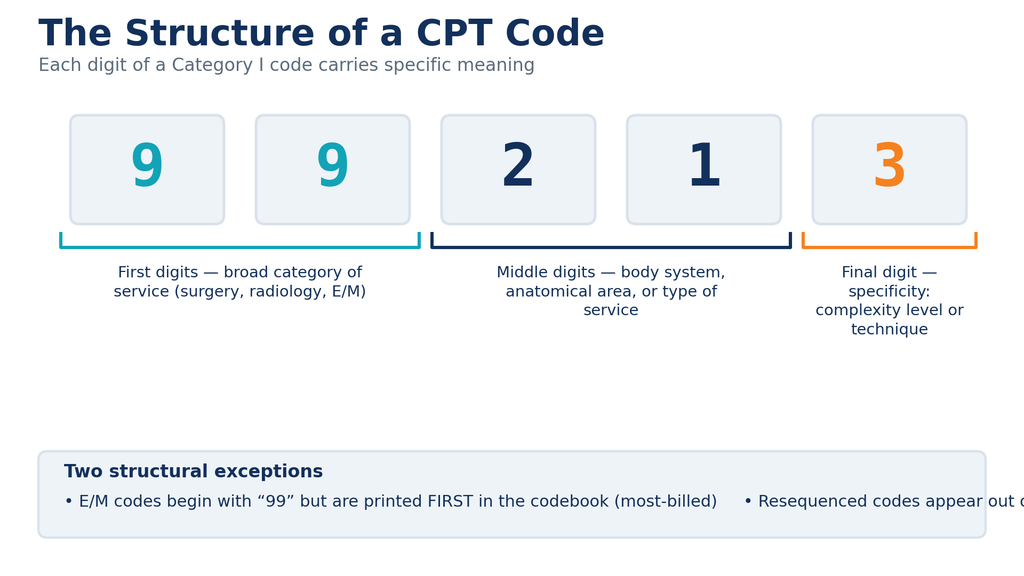
Understanding how a CPT code is built helps coders select the right one faster and with more confidence. Category I CPT codes the most commonly used are five numeric digits, and each digit carries meaning:
- First digits: Identify the broad category of service (e.g., surgery, radiology, evaluation and management).
- Middle digits: Narrow the code down to a specific body system, anatomical area, or type of service.
- Final digit: Adds specificity — distinguishing between variations of a similar procedure, such as complexity level or technique.
This layered structure means codes within the same numeric family are often clinically related, which is why CPT code books group them into “code families” rather than listing them in pure numerical order. Two notable exceptions exist:
- Evaluation and Management (E/M) codes begin with “99” but are printed first in the CPT codebook because they are the most frequently billed codes in outpatient medicine.
- Resequenced codes appear out of numeric order because AMA clusters clinically related codes together for easier lookup, even when a new code doesn’t fit sequentially.
4. The Three Categories of CPT Codes
CPT codes fall into three distinct categories, and knowing the difference is essential for accurate billing.
Category I Codes
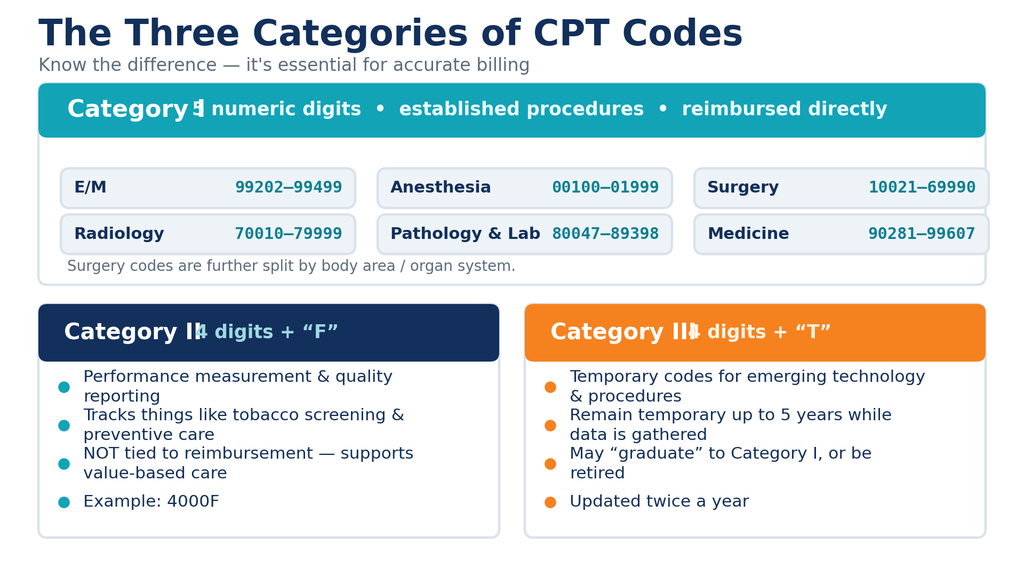
Category I codes represent established, widely performed procedures and services that (when applicable) have FDA approval. These are the codes payers reimburse for directly, and they make up the bulk of everyday medical billing. The six main sections of Category I codes are:
| Section | Code Range |
|---|---|
| Evaluation & Management (E/M) | 99202–99499 |
| Anesthesia | 00100–01999 |
| Surgery | 10021–69990 |
| Radiology | 70010–79999 |
| Pathology & Laboratory | 80047–89398 |
| Medicine Services & Procedures | 90281–99607 |
Surgery codes are further broken down by body area or organ system, so an orthopedic procedure and a cardiovascular procedure will sit in entirely different numeric ranges within the surgery section.
Category II Codes
Category II codes are supplemental tracking codes made up of four digits followed by the letter “F” (e.g., 4000F). They are used for performance measurement and quality reporting capturing details like whether a patient’s tobacco use was documented or whether a specific screening was performed. Category II codes are not tied to reimbursement; they exist purely to support quality initiatives, population health tracking, and value-based care reporting.
Common Category II groupings include:
- Patient History (1000F–1505F)
- Physical Examination (2000F–2060F)
- Diagnostic/Screening Results (3006F–3776F)
- Therapeutic or Preventive Interventions (4000F–4563F)
- Patient Safety (6005F–6150F)
Category III Codes
Category III codes are temporary codes four digits followed by the letter “T” used to track emerging technology, services, and procedures that haven’t yet met the criteria for a permanent Category I code. A Category III code can remain temporary for up to five years while providers gather utilization data. If the procedure proves widely adopted, safe, and effective, it may eventually “graduate” to a Category I code. If not, the code can be retired.
AMA releases new or revised Category III codes twice yearly, making it critical for billing teams in specialties involving newer technology (like certain digital health, robotic, or diagnostic services) to review updates regularly.
A Brief History of CPT Codes
The AMA first introduced CPT codes in 1966, initially to standardize surgical procedure terminology. The system expanded through the 1970s to cover diagnostic and therapeutic procedures across every specialty, and by 1983 CMS (then known as HCFA) adopted CPT as part of its own coding system for Medicare and Medicaid claims. Today, CPT is required under HIPAA as the national standard code set for reporting physician and outpatient procedures, which is why virtually every payer in the U.S. commercial or government expects claims to use current-year CPT codes.
Understanding this history matters practically: it explains why CPT updates are non-negotiable. Because CPT is codified into federal transaction standards, a practice that bills with outdated or incorrect codes isn’t just risking a denial it’s technically out of step with the code set payers are contractually and legally required to recognize.
5. CPT Codes vs. ICD-10 vs. HCPCS: What’s the Difference?
Providers new to billing often confuse these three code sets. Here’s the simplest way to remember the distinction:
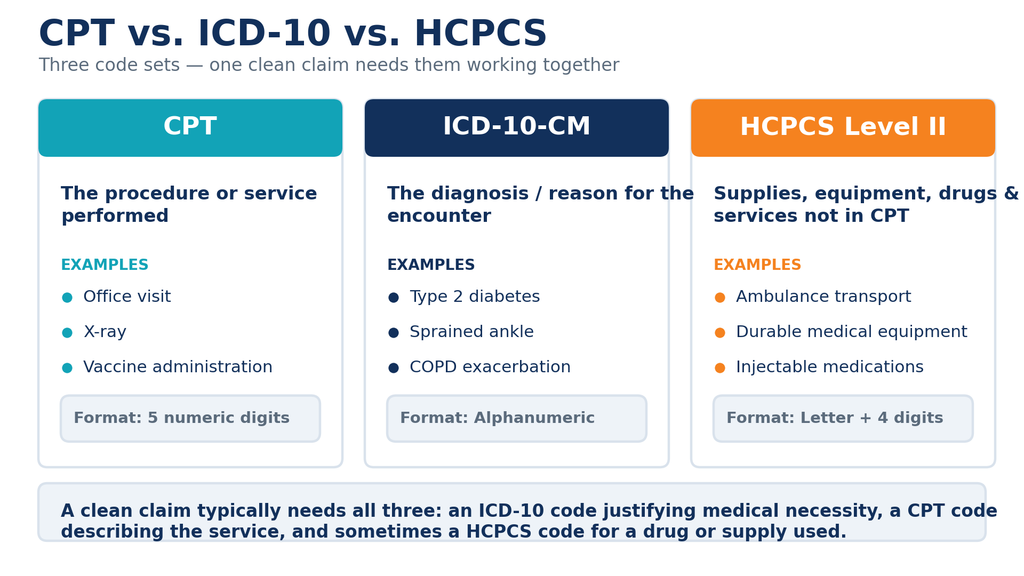
- CPT codes describe the procedure or service performed (e.g., an office visit, an X-ray, a vaccine administration).
- ICD-10-CM codes describe the diagnosis or reason for the encounter (e.g., type 2 diabetes, a sprained ankle).
- HCPCS Level II codes describe supplies, equipment, drugs, and services not covered by CPT things like ambulance transport, durable medical equipment, or certain injectable medications.
A single clean claim typically needs all three working together: an ICD-10 code justifying medical necessity, a CPT code describing the service, and sometimes a HCPCS code for a supply or drug used during that service. Mismatches between diagnosis and procedure codes are among the most common reasons claims get flagged or denied.
6. Why CPT Codes Matter in Medical Billing
CPT codes aren’t just administrative bookkeeping they directly affect a practice’s cash flow, compliance standing, and reputation. Here’s why they matter so much:
Clear, Standardized Communication
CPT codes give every stakeholder in the healthcare system physicians, coders, billers, payers, and auditors a shared language. A claim coded correctly is understood the same way whether it’s processed in California or Florida.
Accurate Reimbursement
Each CPT code is tied to a relative value unit (RVU) that determines how much a payer reimburses for that service. Using the wrong code even one digit off can mean underbilling (lost revenue) or overbilling (compliance risk and recoupment).
Transparency for Patients
Itemized statements built around CPT codes help patients understand exactly what they were billed for, reducing disputes and improving trust between practices and the people they treat.
Data, Research, and Public Health Tracking
Standardized coding allows researchers, public health agencies, and payers to analyze utilization trends, measure outcomes, and identify cost drivers across the healthcare system.
Operational Efficiency
Clean, accurate CPT coding reduces the back-and-forth between billing staff and payers, shortens the revenue cycle, and frees up administrative time that would otherwise go toward appeals and resubmissions.
Compliance and Audit Protection
Payers, CMS, and the Office of Inspector General (OIG) routinely audit claims data for outlier coding patterns practices billing significantly more high-level E/M codes than their peers, for example, or specialties with unusual modifier usage. Accurate, well-documented CPT coding is a practice’s first line of defense in an audit, since it demonstrates that billed codes match the medical necessity and complexity actually reflected in the chart.
Payer Contract Performance
Many commercial payer contracts tie reimbursement rates, value-based bonuses, or shared-savings calculations to CPT and Category II code reporting. Practices participating in value-based care models, accountable care organizations (ACOs), or quality incentive programs depend on accurate Category II reporting to demonstrate the preventive and management services that unlock those payments meaning CPT accuracy directly affects revenue beyond the individual claim level.
7. Common CPT Code Examples by Specialty
To make this more concrete, here are some frequently used CPT codes across different care settings:
- 99213 / 99214 – Established patient office visit (low to moderate complexity)
- 99203 / 99204 – New patient office visit
- 90471 / 90472 – Immunization administration
- 90716 – Varicella (chickenpox) vaccine administration
- 93000 – Electrocardiogram (ECG) with interpretation and report
- 36415 – Routine venipuncture (blood draw)
- 93307 – Complete transthoracic echocardiogram
- 12002 – Simple repair of a superficial wound, 1 inch or less
- 77080 – Bone density scan (DEXA), axial skeleton
- 87635 – Detection of SARS-CoV-2 (COVID-19)
For specialty-specific coding, the volume of codes grows quickly:
- Cardiology relies heavily on diagnostic and interventional codes for stress tests, echocardiograms, and catheterizations.
- OB/GYN practices use codes covering prenatal visits, delivery, and gynecologic procedures.
- Podiatry has its own dense set of foot- and ankle-specific codes.
- Behavioral health billing depends on psychotherapy and evaluation codes (like 90833 or 90837), often paired with E/M codes for combined visits.
Because reimbursement varies by payer, specialty, and geography, practices are wise to cross-reference codes using AMA or CMS resources before submitting claims and to keep documentation airtight to support whichever code level is billed.
E/M Coding: The Highest-Volume Code Family
Evaluation and Management (E/M) codes deserve special attention because they represent the single largest volume of claims submitted across outpatient medicine. Since the 2021 E/M guideline overhaul, providers select office visit levels (99202–99215) based on either medical decision-making (MDM) complexity or total time spent on the date of the encounter not the older, documentation-heavy history/exam point system. This shift simplified coding in some ways but also created new risk: practices that haven’t updated their documentation habits to reflect MDM-based or time-based selection criteria are prone to both under coding (leaving revenue on the table) and upcoding (audit exposure). Reviewing E/M code selection logic with your coding team at least once a year is one of the highest-leverage best practices in this entire guide, given how much of a typical practice’s revenue runs through this single code family.
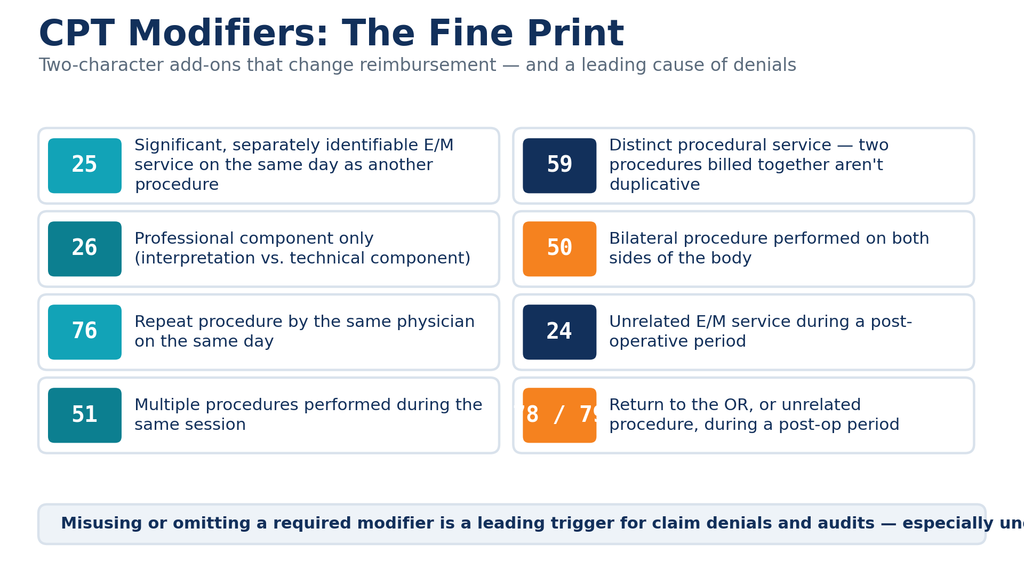
8. CPT Modifiers: The Fine Print That Changes Reimbursement
Modifiers are two-character codes appended to a CPT code to indicate that a service was altered in some way without changing its core definition. They’re a frequent source of confusion and denials for billing teams. A few of the most common:
- Modifier 25 – Significant, separately identifiable E/M service performed on the same day as another procedure.
- Modifier 59 – Distinct procedural service, used to indicate two procedures billed together aren’t duplicative.
- Modifier 26 – Professional component only (used when billing separately for interpretation vs. equipment/technical component).
- Modifier 50 – Bilateral procedure performed on both sides of the body.
- Modifier 76 – Repeat procedure by the same physician on the same day.
Misusing modifiers or omitting one that’s required is a leading trigger for claim denials and post-payment audits, especially under Medicare’s National Correct Coding Initiative (NCCI) edits.
Other frequently used modifiers include Modifier 24 (unrelated E/M service by the same physician during a post-operative period), Modifier 51 (multiple procedures performed during the same session), and Modifier 78/79 (return to the operating room, or an unrelated procedure, during a post-op period). Each payer Medicare, Medicaid, and individual commercial carriers can apply slightly different edits to how these modifiers are recognized, which is why billing teams working across multiple payer contracts need a modifier reference sheet that reflects payer-specific policy, not just AMA’s general guidance.
9. Common CPT Coding Errors (and How They Cost You)
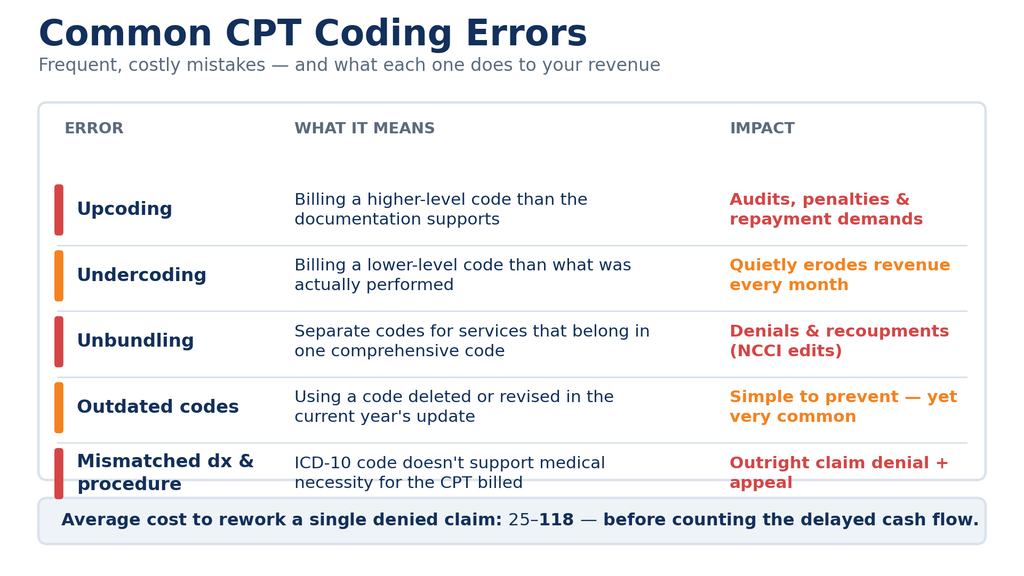
Even experienced billing teams make mistakes. The most frequent and costly CPT coding errors include:
Upcoding and Undercoding
Billing a higher-level code than the documentation supports (upcoding) can trigger audits, penalties, and repayment demands. Billing a lower-level code than what was actually performed (undercoding) quietly erodes revenue month after month.
Unbundling
Billing separate CPT codes for services that should be reported together under a single comprehensive code, often flagged by NCCI edits and resulting in denials or recoupments.
Outdated Codes
Using a CPT code that was deleted or revised in the current year’s update. This is one of the simplest errors to prevent, yet one of the most common in practices that don’t budget time for annual code review.
Mismatched Diagnosis and Procedure Codes
When the ICD-10 code doesn’t support medical necessity for the CPT code billed, payers will deny the claim outright, requiring an appeal and resubmission.
Missing or Incorrect Modifiers
As noted above, modifier errors are a leading cause of denials, particularly for same-day multiple procedures or bilateral services.
The downstream impact of these errors is significant: delayed cash flow, increased administrative cost per claim, higher denial rates, and in cases of consistent over coding regulatory scrutiny that can jeopardize a practice’s standing with payers altogether.
The Real Cost of a Denied Claim
Industry estimates generally put the average cost of reworking a single denied claim somewhere between $25 and $118 depending on practice size and complexity and that’s before accounting for the delayed cash flow while the claim sits unresolved. For a practice submitting hundreds of claims a week, even a modest CPT-related denial rate compounds into a significant drag on both staff time and collections. This is exactly why leading practices treat CPT accuracy as a revenue strategy, not just a compliance checkbox every percentage point shaved off the denial rate translates directly into faster, more predictable cash flow.
10. Best Practices for CPT Coding Accuracy in 2026
Here’s how leading practices and billing teams keep CPT coding accurate and denial rates low:
- Stay current with annual and mid-year code updates. Assign someone on your team or your billing partner to track AMA and CMS releases every year.
- Code to the highest level of specificity supported by documentation. Avoid unspecified or “catch-all” codes unless no more specific option exists.
- Build a documentation-first culture. Every CPT code billed should be fully supported by the clinical note. If it’s not documented, it wasn’t done as far as payers are concerned.
- Audit a sample of claims regularly. Internal or third-party coding audits catch patterns of error before they become a compliance problem.
- Invest in ongoing coder training. CPT, ICD-10, and payer-specific billing rules change constantly; annual training keeps your team sharp.
- Use verified coding resources. Rely on the official AMA CPT codebook, CMS code lookup tools, or reputable coding platforms not outdated PDFs or guesswork.
- Track denial trends by CPT code. If a specific code keeps getting denied, investigate whether it’s a documentation gap, a modifier issue, or a payer-specific policy.
- Coordinate coding with credentialing. Even a perfectly coded claim will deny if the rendering provider isn’t properly enrolled with that payer which is why credentialing and coding accuracy have to work hand in hand.
- Standardize your superbill or charge capture tools. Outdated charge tickets or EHR templates that still list deleted or revised codes are a quiet, recurring source of claim errors review and refresh these annually alongside your official code updates.
- Set a denial-review cadence. Weekly or biweekly review of denied claims, grouped by CPT code and denial reason, turns raw denial data into an early-warning system for coding or documentation gaps before they scale across your whole claim volume.
11. How CPT Codes Fit Into the Bigger Revenue Cycle
CPT coding doesn’t operate in isolation it’s one link in a much longer chain that determines whether a practice actually gets paid. That chain typically includes patient eligibility verification, prior authorization, accurate coding, clean claim submission, payment posting, and denial management/AR follow-up.
A practice can have flawless CPT coding and still see revenue stall if other parts of the cycle break down for example, if a provider isn’t properly credentialed with a payer, or if reporting doesn’t surface where claims are getting stuck. That’s why coding accuracy has to be paired with strong revenue cycle management (RCM) and clear visibility into claim performance the kind covered in our guide on how RCM reporting drives better collections and cash flow.
Provider enrollment is another piece that’s easy to overlook. A physician can be coding every claim perfectly, but if their enrollment with a state Medicaid program or commercial payer lapses or was never completed correctly, claims will deny regardless of coding accuracy. If your practice is expanding into new states or renewing enrollment, resources like our Alabama Medicaid provider enrollment guide and Pennsylvania insurance credentialing guide walk through the documentation, timelines, and revalidation steps required to keep claims flowing.
Why Coding Accuracy Alone Isn’t Enough
It’s worth repeating because it’s such a common blind spot: a practice can have a coding accuracy rate near 100% and still see claims deny at an alarming rate if credentialing, eligibility, or payer enrollment fall out of sync. Payers match every claim against the rendering provider’s enrollment status, taxonomy code, and effective dates before they even look at whether the CPT code was billed correctly. That’s why any practice serious about reducing denials needs a workflow that treats coding, credentialing, and eligibility verification as one connected system rather than three separate departments working in silos.
12. How Credexa Solutions Helps Providers Get CPT Coding and Billing Right
At Credexa Solutions, we work with healthcare practices to manage the full revenue cycle not just claim submission, but the accuracy and compliance behind every code billed. Our team supports:
- Medical billing services with accurate CPT and ICD-10 coding on every claim
- Provider credentialing and payer enrollment, so coding accuracy actually translates into payment
- Eligibility verification and prior authorization, reducing denials before a claim is even submitted
- Denial management and AR follow-up, recovering revenue from claims that stall due to coding or enrollment issues
- RCM reporting, giving practices visibility into denial trends, days in AR, and first-pass acceptance rates
If your practice is losing revenue to coding errors, denials, or credentialing delays, our team can review your current billing workflow and show you where the gaps are get in touch with Credexa Solutions to start with a free billing analysis.
13. Frequently Asked Questions
What are CPT codes used for in medical billing? CPT codes describe the specific medical, surgical, or diagnostic service a provider performed during a patient encounter. Payers use them to determine what to reimburse, and they’re required on nearly every healthcare claim submitted in the U.S.
How many digits are in a CPT code? Category I CPT codes are five numeric digits. Category II codes are four digits plus the letter “F,” and Category III codes are four digits plus the letter “T.”
Who created and maintains CPT codes? The American Medical Association (AMA) created and maintains the CPT code set through its CPT Editorial Panel, updating codes annually (and Category III codes twice a year).
What’s the difference between CPT and ICD-10 codes? CPT codes describe the procedure or service performed. ICD-10 codes describe the diagnosis or reason for the visit. Both are required together to support medical necessity on a claim.
What happens if a CPT code is billed incorrectly? Incorrect CPT coding can lead to claim denials, delayed payments, revenue loss from undercoding, audit risk from overcoding, and in repeated cases, damaged standing with payers.
Where can I look up a current CPT code? The official source is the AMA CPT codebook. CMS also publishes a public CPT/HCPCS code list that providers and billers can reference for Medicare-related billing.
Are CPT codes the same for every insurance payer? The code itself is standardized nationally, but reimbursement amounts, covered indications, and modifier requirements can vary by payer. A code that’s reimbursed one way under Medicare may be handled differently by a commercial carrier or a state Medicaid program, which is why payer-specific policy manuals still matter even with a universal code set.
How often do CPT codes change? Category I and Category II codes are typically updated once a year, effective January 1. Category III codes are released and revised twice a year to keep pace with emerging technology and procedures.
What is a CPT modifier and when is it needed? A modifier is a two-character add-on to a CPT code that clarifies how a service was performed without changing its core meaning for example, indicating a bilateral procedure or a separately identifiable evaluation and management service on the same day as another procedure. Modifiers are needed whenever the standard code alone doesn’t fully capture the circumstances of the service.
Can a denied claim due to a CPT error be corrected and resubmitted? Yes. Most payers allow a corrected claim to be resubmitted once the coding error is fixed, though timely filing limits apply. Prompt denial review and correction is essential, since missing a payer’s resubmission window can turn a fixable coding error into permanently lost revenue.
Need help making sure your practice’s coding, credentialing, and claims all work together? Contact Credexa Solutions for a free revenue cycle review.