Enrolling as a healthcare provider with Alabama Medicaid is more complex than most practitioners realize. While the state’s electronic portal operated by Gainwell Technologies appears straightforward on the surface, missing a single step or misunderstanding a new 2026 requirement can delay your billing by months or even result in denial of enrollment altogether. This comprehensive guide walks you through every aspect of Alabama Medicaid provider enrollment, including the critical changes implemented in 2026 that could affect your practice immediately.
What Changed in Alabama Medicaid Provider Enrollment in 2026: Six Critical Updates
The Alabama Medicaid program has undergone significant changes between July 2025 and August 2026. Understanding these updates is essential for any provider planning to enroll or revalidate. Each of these changes carries direct implications for your application timeline and documentation requirements.

The Mandatory Email Requirement Now Blocks Applications
Effective July 1, 2025, Alabama requires email contact information for all provider enrollment and revalidation applications. This requirement applies to four specific field types: service location, pay-to address, mail-to address, and patient contact and directory. This is not a optional field that Alabama will work with you on after submission. If you leave any one of these email fields blank, the state returns your entire application as a denial rather than allowing you to correct it before resubmission. This means you must resubmit your application from scratch, and the clock restarts on your processing timeline. For providers on tight schedules, this single omission can cost weeks of billing delays.
Participation Requirements Were Revised Effective January 1, 2026
Alabama’s Medicaid Participation Requirements document was revised in December 2025, with the revised version taking effect on January 1, 2026. This document contains crucial information including the provider-type requirement chart and the current application fee amounts. While the Alabama Medicaid enrollment forms page publishes this document as a PDF, most search engines struggle to index PDF content, which means the critical requirements published in this document rarely surface in general search results. You must access this document directly to verify that your provider type, documentation, and fee obligations are current.
ABA Providers Face New Operational and Credential Requirements
Applied Behavior Analysis therapy providers experienced two significant rule changes within a single year. Effective February 24, 2026, under Provider Alert ID 16713, any ABA provider enrolled as Type 17 must now operate from a physical facility with visible business signage that displays the business name. Home office arrangements without signage no longer qualify for enrollment, and existing providers operating under the old rules must verify compliance or face revalidation challenges. Then, effective May 18, 2026, the state further restricted ABA-qualifying diagnoses to only those diagnosed and treated by licensed psychologists, psychiatrists, and pediatricians. This two-part change represents a significant tightening of enrollment requirements for an entire specialty.
Out-of-State Hospitals Face a 24-Month Purge Rule
Provider Alert ID 16740, issued on May 7, 2026, discontinue the Out-of-State ASC and Hospital Update Form as of May 1, 2026. Hospitals now enroll for a five-year period regardless of their location, applying equally to in-state, out-of-state, and bordering facilities. More critically, the alert introduces a purge rule: a hospital with no paid claim recorded within a 24-month window may be purged from the provider file entirely. Reopening a purged file is not a simple administrative fix it requires submitting a completely new enrollment application rather than a quick phone call or reinstatement request. This means any facility experiencing a temporary lull in billings faces the risk of sudden disenrollment.
The 2026 Off-Cycle Revalidation Sweep Is Live Now
In response to a CMS directive, Alabama launched an off-cycle revalidation project under Provider Alert ID 16754 on June 5, 2026. This project operates on two tracks: a swift revalidation track for high-risk provider types and a 24-month cycle for moderate and limited risk types. Revalidation notices are being distributed in phases, which means providers in different service areas may receive notices at different times. However, timing variations between providers do not extend individual deadlines. More critically, failure to revalidate and submit required documentation results in an end-date on your provider file. Once ended, you must submit an entirely new enrollment application you cannot simply reinstate or appeal. This transforms a routine paperwork exercise into a potential revenue catastrophe if missed.
DME and Prosthetics Enrollment Rules Completely Change on October 1, 2026
Provider Alert ID 16789, published August 12, 2026, removes the state Board license requirement for DME and prosthetics providers effective October 1, 2026. What replaces the Board license is Medicare enrollment, accreditation, and certification. The transition window opened July 1, 2026, meaning providers have approximately five weeks to verify their Medicare credentials and update their Alabama Medicaid file accordingly. This timing is critical because DME and Medical Supply providers also sit on the high-risk swift revalidation track mentioned above. A DME provider can simultaneously face a swift revalidation demand and a complete credentialing rule change. If your Medicare accreditation has lapsed or expired, that gap surfaces during revalidation instead of before it, with serious consequences.
Understanding Provider Types and NPI Requirements in Alabama Medicaid
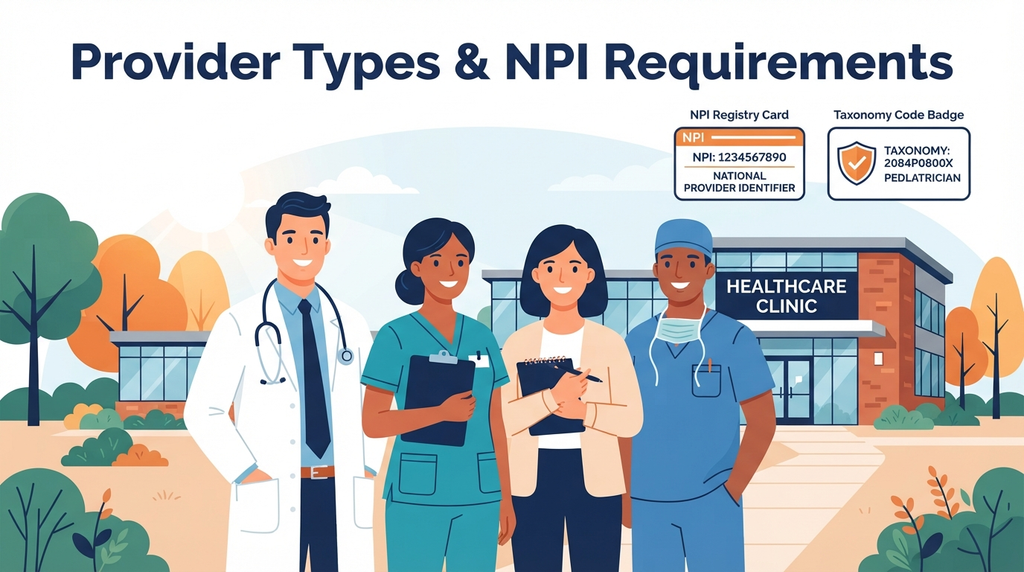
Federal law requires all physicians and other practitioners who prescribe, order services for, or refer Medicaid beneficiaries to enroll as a Medicaid provider. The enrollment trigger is not billing it is the act of ordering, prescribing, or referring. Alabama Medicaid sorts applicants into four distinct enrollment pathways, and selecting the wrong one can cost you weeks of processing delays.
Individual Provider Enrollment Under a Type 1 NPI
Solo practitioners, physicians, nurse practitioners, physician assistants, therapists, and licensed behavioral health clinicians all enroll as individual providers using a Type 1 NPI. Your Type 1 NPI must match exactly with your record in the NPPES NPI registry maintained by CMS. You must also hold an active Alabama license and maintain a taxonomy code that aligns with both your NPPES record and your actual clinical practice. One significant benefit that most providers do not know about: individual physicians and non-physician practitioners are exempt from the $750 application fee. This exemption is written directly into Alabama’s participation requirements, saving your practice $750 per enrollment or revalidation.
Group Practice Enrollment Under Type 1 and Type 2 NPIs
Group practices, clinics, and organizations billing under a Tax ID require both a Type 1 NPI for each rendering provider and a Type 2 NPI for the organization itself. Both NPIs must exist and be registered before you begin the enrollment process. Groups must also complete the Provider Disclosure Form, which requires disclosure of every owner, officer, director, shareholder, and managing employee. You must also submit a signed W-9 tax form and EFT verification through either a voided check or a bank letter. A critical correction: many published guides reference federal disclosure forms, but Alabama uses its own proprietary Provider Disclosure Form (revised October 31, 2024) plus a separate Individual Disclosure Information Form for individual revalidations. Searching for federal form numbers will not return Alabama’s specific forms.
OPR Providers: Ordering, Prescribing, and Referring Without Billing
OPR stands for Ordering, Prescribing, and Referring. These providers must enroll with Alabama Medicaid even if they never submit a single claim. The mechanics are straightforward: when another provider bills against your order, referral, or prescription, Alabama’s system checks whether you are enrolled. If you are not enrolled, their claim denies. Your paperwork gap becomes another provider’s revenue problem. Yet OPR is frequently overlooked in generic enrollment guides, and practitioners who miss this requirement often chase OPR-driven denials through coding review for months before anyone checks whether they are enrolled as a provider. OPR appears as a distinct category in Alabama’s own 33-category revalidation list, which demonstrates that the state treats it as a serious enrollment category. For more information on specialty credentialing requirements, review our comprehensive guide on insurance credentialing in Pennsylvania, which covers similar enrollment complexity across state lines.
Facility and Institutional Provider Types
Hospitals, skilled nursing facilities, home health agencies, hospices, ambulatory surgical centers, Federally Qualified Health Centers, rural health clinics, independent labs, and transportation providers all fall into the facility and institutional category. Two critical consequences follow: these are the provider types that owe the $750 application fee, and they carry heavier screening requirements than individual practitioners, including mandatory site visits and fingerprint background checks in some cases.
The Complete Alabama Medicaid Provider Enrollment Portal Process
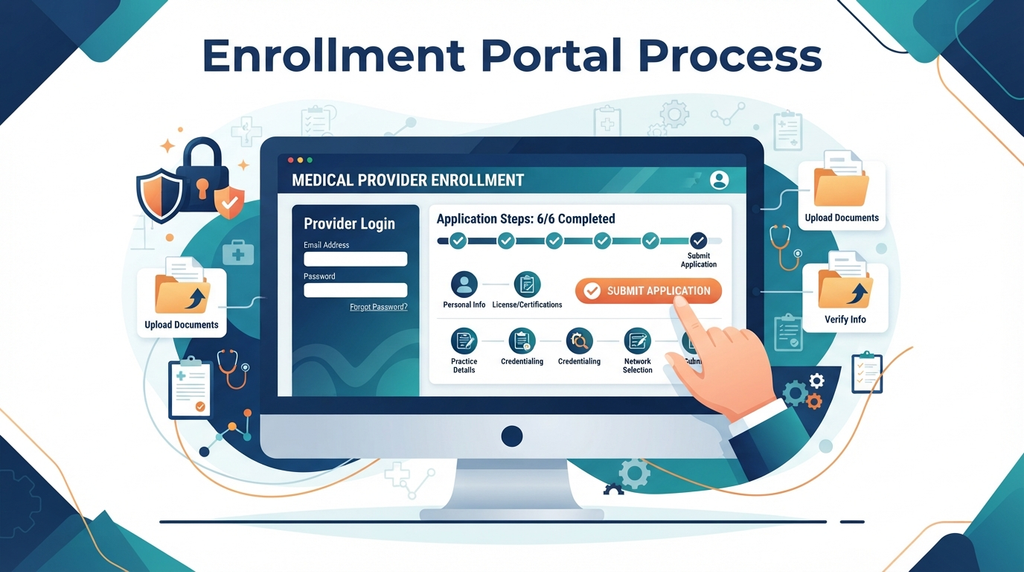
Alabama Medicaid provider enrollment must be completed entirely through the electronic portal operated by Gainwell Technologies. There is no paper-only option that bypasses this system. The enrollment process unfolds across six main steps, but the portal contains specific quirks that can destroy your application if you are not aware of them beforehand.
Step 1: Register Your Portal Account and Name an Administrator
Begin by creating administrative credentials. You will need your NPI, your Tax ID (either an EIN or SSN depending on your billing structure), and a practice email address that someone checks daily. You must designate an authorized organizational representative as Primary Administrator. This person should be someone who you expect will remain with your practice for the foreseeable future, because the login credentials you create cannot be reset or recovered if that person leaves.
Step 2: Select Your Application Type and Provider Category
Log into the portal and choose between New Enrollment, Re-enrollment, or Revalidation. Then select your specific provider type and taxonomy code. Your taxonomy code must match your NPPES record exactly—not approximately, but exactly. Alabama’s own enrollment alert from December 19, 2023 identified provider name mismatch and missing documents as the two leading denial causes, both of which are entirely avoidable with ten minutes of verification before submission.
Step 3: Enter Your Demographics, Licensure, and Ownership Disclosures
Enter your practice location, Alabama license numbers, and IRS tax classification. Then disclose all ownership interests. Anyone holding 5 percent or greater ownership or control interest must be disclosed, along with managing employees. For individuals you must supply name, address, date of birth, and Social Security number. For corporate owners you must supply the tax identification number.
Step 4: Upload Supporting Documents or Use the Portal-Generated Barcode Cover Sheet
Alabama’s guidance on document submission contains what appears to be contradictory instructions. The forms page states that faxed requests will not be accepted. However, the Enrollment Supporting Documentation Process (effective December 7, 2016) permits fax submission when paired with a barcode cover sheet generated by the portal itself. The Provider File Update Request Form instructions explicitly point to fax submission at (334) 215-7416 with the barcode cover sheet attached. Both statements are actually accurate for their respective workflows. The safest approach: route everything through the portal’s Forms workflow whenever possible. Use fax only with the portal-generated barcode cover sheet when an upload will not process. A plain fax with no barcode will be discarded. Note that Alabama publishes two different fax numbers for different purposes. Use (334) 215-7416 for DEA and document uploads. Use (334) 215-4298 for Gainwell. Most providers mix these up.
Step 5: Execute the Provider Agreement Electronically
You must electronically sign the Non-Institutional Medicaid Provider Agreement. The signing provider or an authorized officer commits the practice to billing rules, record retention obligations, compliance requirements, and cooperation with federal audits. Read this agreement before signing. Most practices do not, and the record-retention clause in particular carries serious implications during an audit.
Step 6: Submit and Record Your Tracking Credentials
When you submit your application, the portal generates tracking credentials. Write these down in a location that will survive staff turnover, because you will need all three credentials to check your status later, and one of them cannot be recovered if lost. This is not a theoretical concern practices lose these credentials regularly when staff changes occur, and the credentials cannot be reset by enrollment staff.
Critical Portal Quirks That Destroy Applications
The Alabama enrollment portal has published constraints that most guides never mention, yet each one has ended someone’s application:
- The portal saves your progress exactly once. After you exit and resume, the save function disappears, and you must complete or cancel your application in that single sitting.
- Browser back and forward buttons destroy your progress. You must use the navigation controls within the application itself.
- Page inactivity destroys your progress. Do not start your application 20 minutes before a lunch break.
- A password you create cannot be reset. Enrollment staff have no access to it and cannot recover it if you lose it.
- Supported browsers are Microsoft Edge and Mozilla Firefox at an optimal screen resolution of 1024 by 768.
Additionally, Alabama implemented multi-factor authentication using time-based one-time passcodes starting in December 2024, with rollout phased through April 2025. The portal’s training video on this feature indicates how many support calls the implementation generated. Block a full 90 uninterrupted minutes for this process. Gather every document first. Treat the application like a single-session task. That approach costs you an afternoon. The alternative costs you a complete resubmission.
Complete Documentation Requirements by Provider Type
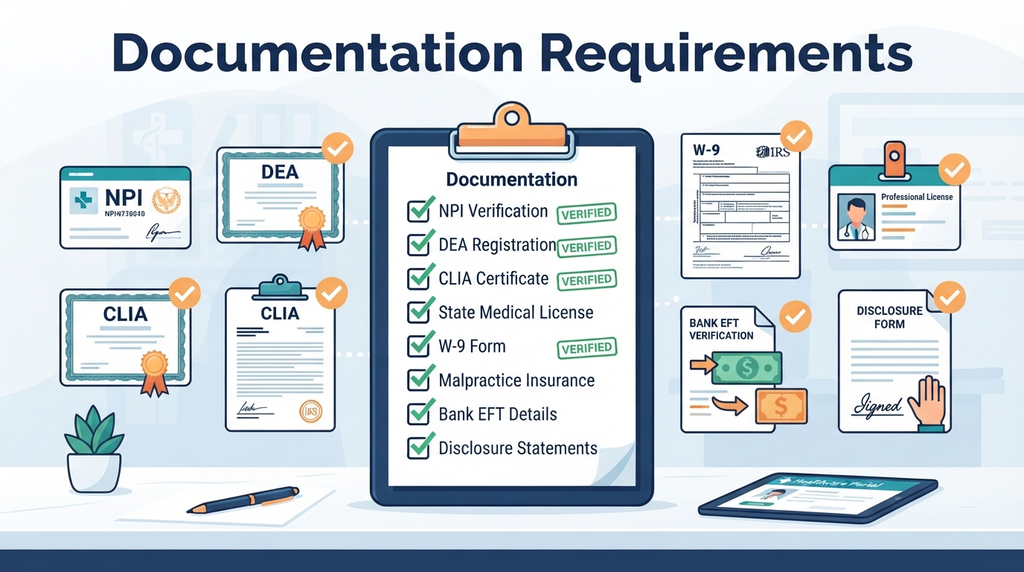
Alabama requires seven categories of baseline information on every application: your NPI, business office data, specific office data, provider licensure data, IRS tax identification, banking information, and group identification data. Beyond this baseline, your specific documentation depends on your provider type and services.
Documents Required on Every Enrollment
Your NPI must match your NPPES record. Business office data includes address, phone, fax, and the email fields Alabama added in 2025. Specific office data includes CLIA certification where applicable and employee names and Social Security numbers where required. Every applicant must submit the Civil Rights Compliance Information Request Package (revised February 19, 2025). Providers not already enrolled with Medicare must also submit their civil rights compliance policies.
Conditional Documents Based on Your Services
Nine documents apply only when specific conditions apply to your practice:
- CLIA Certificate: Required if your practice performs laboratory services
- DEA Certificate: Required if you prescribe controlled substances
- IV Sedation Certification: Required for dental providers administering IV sedation
- EPSDT Agreement: Required if you perform EPSDT screenings
- Plan First Agreement: Required if you participate in Plan First
- Telemedicine Services Agreement: Required if you deliver telemedicine services
- Mobile Dental Facilities Certification: Required if you operate mobile dental facilities
- Certification of Mammography Systems: Required if you perform mammography
- EVV Attestation Form: Required for Private Duty Nursing, Home Health, or TA Waiver providers
Additional Documents for Groups and Facilities
Groups and facilities must also submit a signed W-9 tax form, the Provider Disclosure Form covering all owners and officers, EFT verification through a voided check or bank letter, and for physician groups operating as corporations, the Corporate Board of Directors Resolution (revised January 14, 2026).
Electronic Visit Verification Attestation
If you provide Private Duty Nursing, Home Health, or TA Waiver services, you must complete the EVV attestation form as part of your enrollment application not after approval, but during the application process itself. CMS mandated Electronic Visit Verification for personal care and home health services effective January 1, 2024, and Alabama incorporated this requirement directly into enrollment. Skipping this attachment leaves your application incomplete, and the state does not call to inform you of missing attachments.
The $750 Application Fee: Who Pays and Who is Exempt
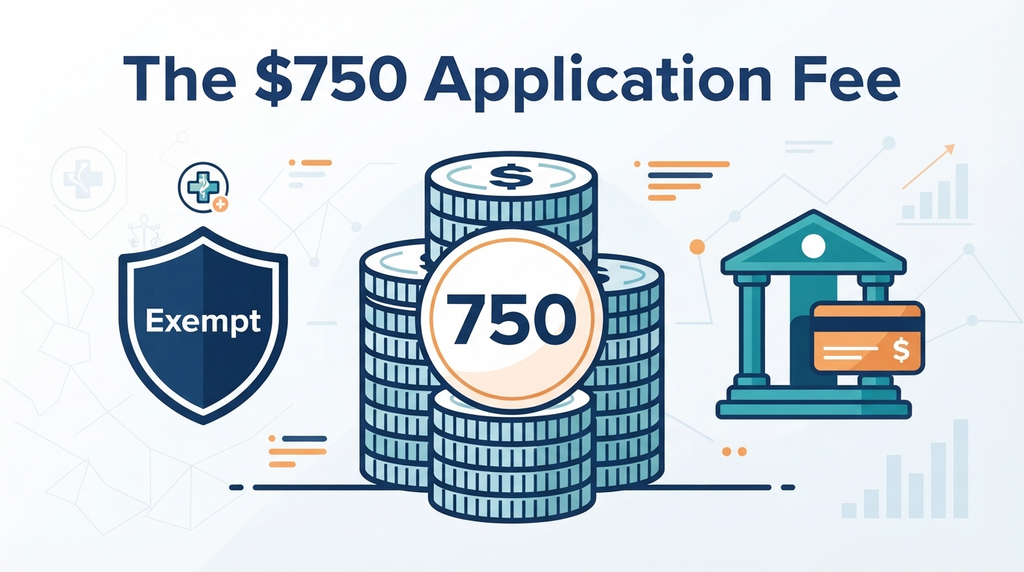
The current Alabama Medicaid application fee for calendar year 2026 is $750, applied to institutional providers enrolling or revalidating between January 1 and December 31, 2026. Understanding which provider types owe this fee and which are exempt is critical to your budget planning.
Provider Types That Owe the Fee
Ten provider categories are responsible for paying the $750 fee: Hospital, Laboratory, Nursing Home and Skilled Nursing Facility, Home Health, Hospice, Ambulatory Surgical Center, Federally Qualified Health Center, Rural Health Clinic, Transportation, and Therapy Groups (including ABA Therapy).
Who Is Exempt
Individual physicians and non-physician practitioners are exempt. This covers most solo practitioners and group practitioners in Alabama. Institutional providers can also claim exemptions in specific circumstances: if you already paid the fee to Medicare or another state this calendar year, if you are enrolled with Medicare, another state Medicaid program, or CHIP, you may qualify. Submit documentation proving this alongside your application rather than after it. Hardship exemptions come from CMS (not from Alabama), and if CMS grants one, submit the proof at initial application or revalidation.
Why the Fee Amount Changes Annually
The fee adjusts annually based on the consumer price index. This means the $750 figure published today will likely differ from next year’s fee. Check the current Federal Register notice for the specific calendar year you are enrolling rather than relying on static numbers in any guide, including this one.
The DEA Registration Rule That Silently Denies Claims
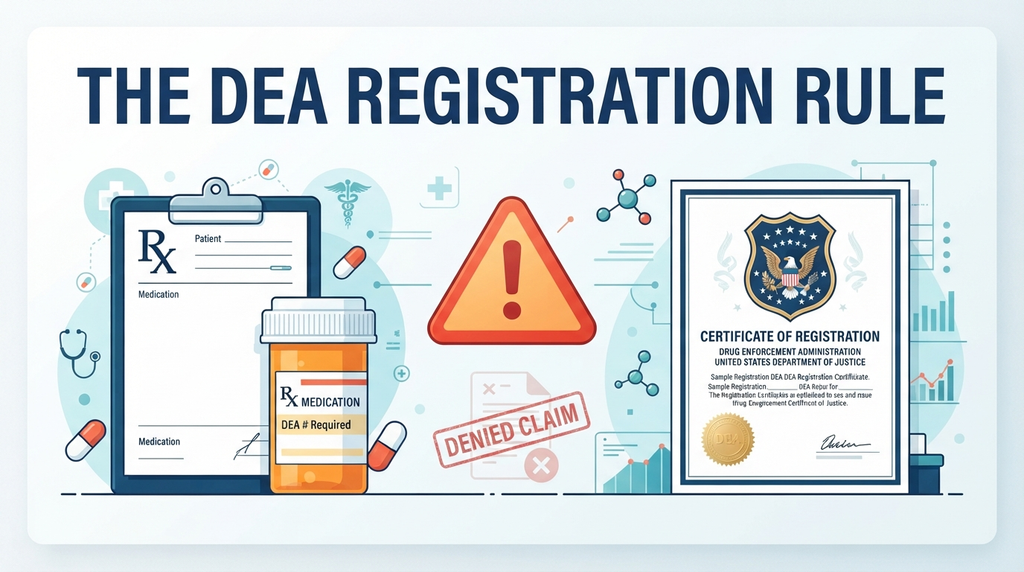
One of Alabama Medicaid’s most dangerous requirements receives virtually no attention in general provider enrollment guides, yet it results in widespread claim denials. Alabama Medicaid denies any claim for a controlled substance written by a prescriber whose DEA number is not registered with the state. The prescription still fills. The medication is dispensed. But the associated claim denies.
The Two-Step Registration Process
Physicians register their DEA number with the U.S. Department of Justice and maintain a copy with Alabama Medicaid. These are two separate steps, and completing the first does not accomplish the second. DEA licenses renew every three years on a schedule that does not necessarily align with your federal renewal date. Prescribers must re-register their DEA with Alabama every three years to maintain compliance.
How to File Your DEA Certificate
Upload your DEA Registration Certificate directly to the Medicaid Interactive Web Portal through the portal’s Forms workflow. Alternatively, fax the certificate to (334) 215-7416 with the barcode cover sheet generated by the portal. Include your provider name, NPI number, and license number on the certificate itself. Alabama applies the DEA to all of your service locations based on this NPI and license number, so you submit this information once rather than per site. Again, be careful with fax numbers: (334) 215-7416 is for DEA and document uploads, while (334) 215-4298 is for Gainwell.
Why These Denials Are Difficult to Trace
Your pharmacy dispenses the medication without issue. The patient walks out with their prescription filled. Nothing appears wrong at the point of care. But the associated claim denies. Your billing team codes it as a payer issue and resubmits. It denies again. Weeks pass before someone connects a pharmacy claim pattern to an expired Alabama DEA registration. Track your three-year Alabama re-registration cycle separately from your federal DEA renewal, as these dates will drift over time.
Alabama’s Risk-Based Screening: How Screening Intensity Affects Your Timeline
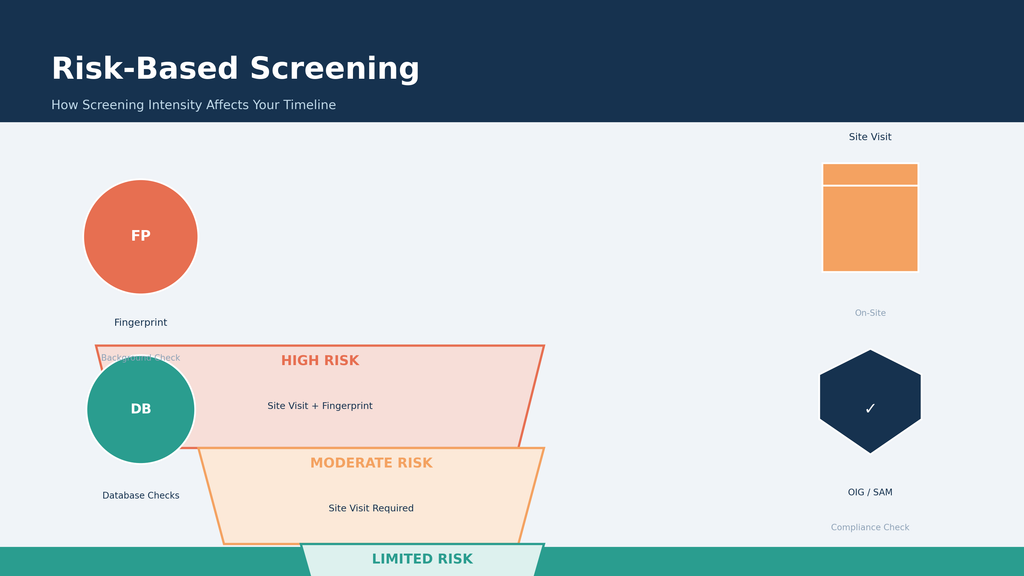
Alabama screens every Medicaid enrollment application at one of three risk levels. Your assigned risk level determines whether you receive a site visit, a fingerprint background check, or neither. Screening intensity is the single largest variable affecting your overall enrollment timeline.
Limited Risk Screening
The state verifies your license, runs database checks, screens you against the OIG List of Excluded Individuals and Entities, and checks SAM.gov for sanctions. Most physicians, mid-level practitioners, and OPR providers fall into this category. No site visit to your office is required.
Moderate Risk Screening
Everything in Limited Risk, plus a mandatory site visit. Site visits verify that the information you submitted is accurate and that you comply with all enrollment requirements. In practice, this means your registered address must actually operate as a working clinical location. A registered agent address or a mail-only suite will fail site visit inspection.
High Risk Screening
Everything in Moderate Risk, plus a fingerprint-based criminal background check covering the provider and anyone holding 5 percent or greater direct or indirect ownership interest. Fingerprinting adds real calendar time because scheduling and processing sit outside the state agency’s direct control.
Special Consideration: Skilled Nursing Facilities
CMS required Alabama to reclassify nursing homes to high or moderate risk levels. This reclassification carries two concrete consequences: a mandatory site visit at initial enrollment and at every five-year revalidation, plus a fingerprint background check at the high-risk level. Nursing facilities planning revalidation should prepare their physical facility for inspection: ensure proper signage, post hours clearly, and brief staff on the possibility of unannounced visits.
How Screening Extends Your Timeline
Screening intensity is the largest single variable in Alabama enrollment timelines. Two clean applications submitted the same day can finish weeks apart because one provider type triggers a site visit and fingerprinting while the other does not. You cannot negotiate your risk level it is determined by your provider type. Any vendor promising a 30-day enrollment turnaround for a high-risk provider type is quoting you a limited-risk timeline.
The Alabama Coordinated Health Network: Understanding the Seven ACHN Regions
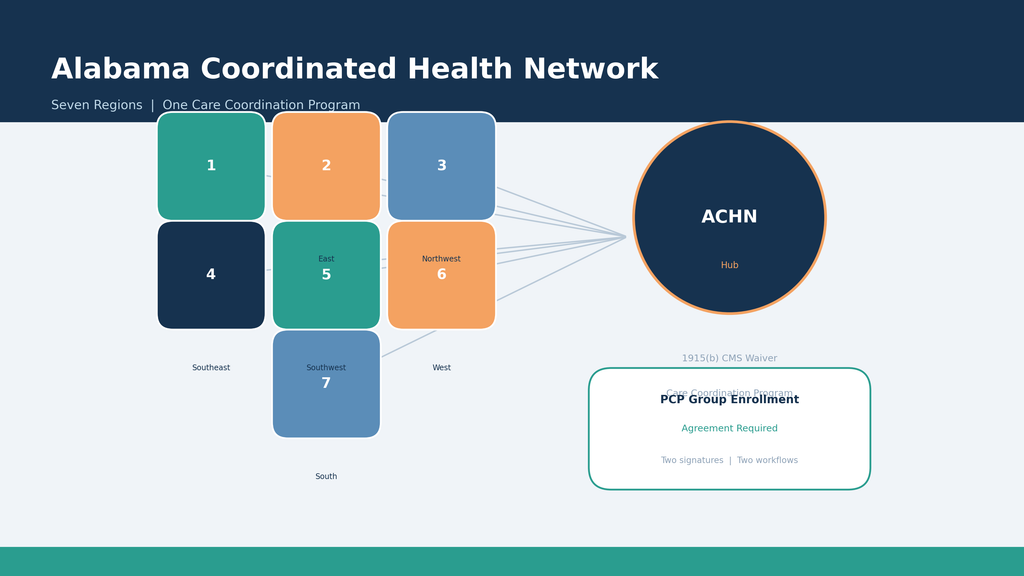
Alabama does not operate capitated Medicaid managed care organizations. Instead, it runs the Alabama Coordinated Health Network (ACHN), a care coordination program operating across seven regions under a 1915(b) CMS waiver. This distinction is critical to understanding how your billing actually processes.
Why This Matters for Your Enrollment
Portal approval from Alabama Medicaid gets you paid at base rates. However, to receive bonus and participation payments, you must complete a separate Primary Care Physician Group Enrollment Agreement with both Medicaid and your regional ACHN entity. This is two separate agreements requiring two separate signatures through two separate workflows. Many practices complete the first (Medicaid portal enrollment) and never complete the second (ACHN agreement), which means they remain at base rates permanently without realizing what they missed.
The Seven ACHN Regions
Alabama Administrative Code Rule 560-X-37-.07 establishes the ACHN program across seven regions and assigns specific counties to each. Verified region names include Central, East, Northwest, Southeast, and Southwest. Each region is served by a single Primary Care Case Management Entity (PCCM Entity). One ACHN entity can serve multiple regions. For example, My Care Alabama serves the Central, East, and Northwest Regions. This is why the number of ACHN entities does not always match the number of regions. Look up your specific county on the ACHN Interactive Map on the Alabama Medicaid website rather than trusting region lists from third-party articles.
The PCP Group Enrollment Agreement: October 2024 Through September 2029
The current Alabama Medicaid Primary Care Physician Group Enrollment Agreement runs from October 2024 through September 2029. The agreement includes Attachment A, which contains a 24/7 coverage requirement that sits far enough into the document that most practices sign without reading it. Emergency room coverage does not satisfy this requirement. Failure to comply may affect future participation opportunities.
Real Enrollment Timelines: What to Expect
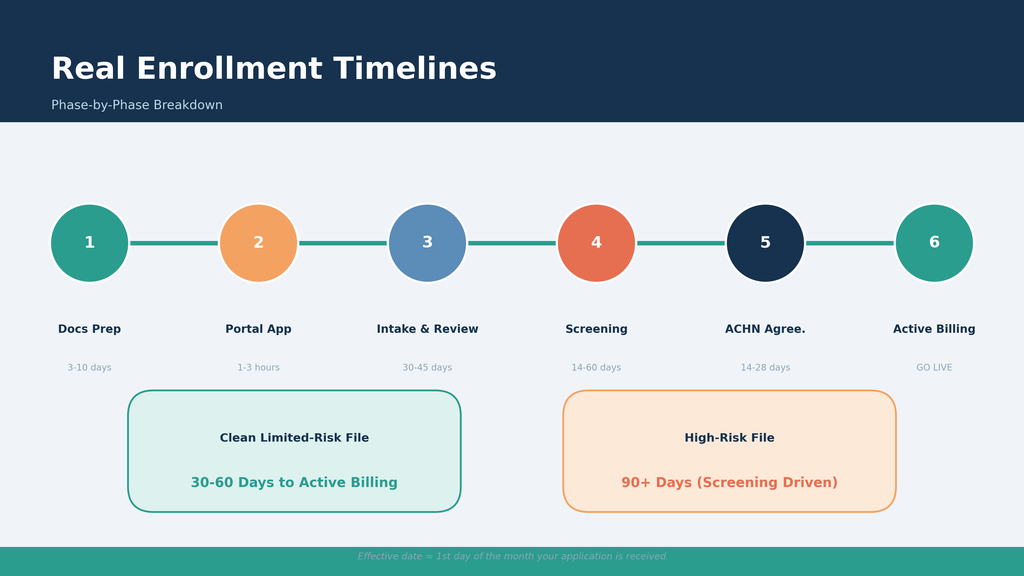
Phase-by-Phase Timeline Breakdown
| Phase | Duration | What Happens |
|---|---|---|
| Document preparation | 3 to 10 days | Gather credentials, verify NPPES match, resolve name inconsistencies |
| Portal application | 1 to 3 hours | Single-session completion required |
| Agency intake and review | 30 to 45 days | Standard processing for complete files |
| Screening (Limited risk) | Concurrent | Database checks only, no site visit |
| Screening (Moderate risk) | 14 to 45 days | Site visit required |
| Screening (High risk) | 30 to 60 days | Site visit plus fingerprinting |
| ACHN agreement execution | 14 to 28 days | Runs in parallel with Medicaid screening |
| Total for clean Limited-risk file | 30 to 60 days | To active billing status |
| Total for High-risk file | 90+ days | Driven by screening intensity, not paperwork |
The Critical Effective Date Rule
According to Alabama Medicaid’s Provider Billing Manual, your enrollment effective date is the first day of the month in which the state received your application. This single rule contains more financial impact than most providers realize. Submit your application on March 28, and your effective date is March 1. Submit on April 2, and your effective date is April 1. That five-day difference means you can bill back-dated services for an entire additional month versus getting lost forever. Treat application submission as a calendar strategy, not just a paperwork task. Confirm your actual effective date against your Welcome Letter before you submit your first claims.
The 2026 Off-Cycle Revalidation: Critical Deadlines Approaching
Alabama launched a 2026 off-cycle revalidation project under Provider Alert ID 16754. This project operates on two tracks: swift revalidation for high-risk provider types and a 24-month cycle for moderate and limited-risk types.
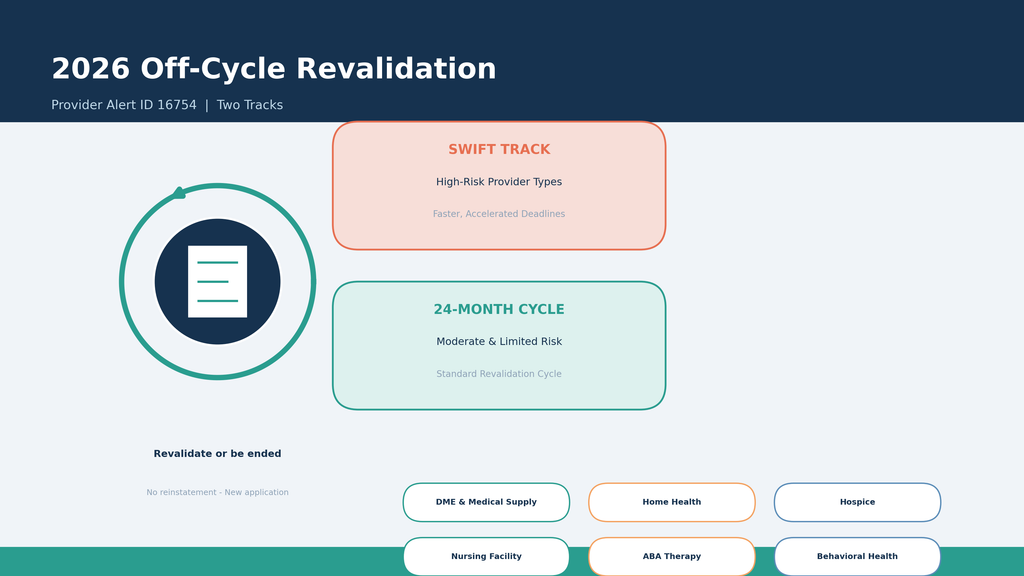
High-Risk Categories on Swift Revalidation
These six provider types face accelerated revalidation deadlines: DME and Medical Supply (including prosthetics, orthotics, and pedorthics), Home Health Agency, Hospice, Nursing Facility, Applied Behavior Analysis Therapy, and Behavioral Health. If your provider type appears in this list, you should expect a revalidation notice soon rather than sometime in 2027 or 2028.
The Consequence of Missing Revalidation
Failure to revalidate and provide appropriate documentation results in an end-date on your provider file. This is not a temporary suspension. Once your file is ended for failure to revalidate, you cannot reinstate it or appeal the decision. You must submit an entirely new enrollment application, which means a new effective date calculation, potential delays while screening completes again, and a complete gap in your billing history.
Where to Find the Monthly Revalidation Lists
Alabama publishes monthly lists of providers scheduled for revalidation. Search for your name on the current list rather than waiting for a notice to arrive in the mail. Notices are distributed in phases, mail can be lost, and a missed letter does not excuse a missed deadline. Finding your name on the published list takes two minutes.
Five Critical Mistakes That Most Providers Make
Mistake One: Name Mismatch Across Documents
The name on your application must match your licenses and certifications exactly. Middle initials, suffixes, maiden name versus married name, abbreviated practice names all of these trigger rejections. Alabama highlighted this issue in its December 19, 2023 enrollment alert. This check takes ten minutes before submission. Fixing it afterward takes weeks. For detailed guidance on credentialing-related documentation issues, explore our comprehensive COPD ICD-10 coding guide, which addresses the precision required in medical documentation.
Mistake Two: Missing Documents and Attachments
This is Alabama’s second-named leading cause of denial, and it is harder to catch because the state does not call to request missing documents. Your file simply stops moving. Check the conditional document table against your own service lines before submission. If you provide laboratory services, DEA-regulated prescriptions, or specialized services, verify that you include every required attachment.
Mistake Three: Taxonomy Mismatch
Your taxonomy code must align exactly with your NPPES registration. A mismatch is grounds for rejection, not a warning. Practices that shifted their specialty focus and never updated NPPES carry this issue silently for years. When enrollment or revalidation forces a comparison, you must fix both your federal NPPES record and your state application simultaneously.
Mistake Four: Treating Portal Approval as the Finish Line
Many practices believe enrollment is complete once Alabama approves their portal application. This is incorrect. Portal approval gets you to base rates. To receive bonus payments and participate in the ACHN program, you must complete a separate PCP Group Enrollment Agreement with your regional ACHN entity. This is a completely separate workflow with separate deadlines. Without this second agreement, you remain at base rates indefinitely, and no error message alerts you to this situation.
Mistake Five: Letting DEA Registration Lapse
Your DEA must be registered with Alabama every three years, on a schedule that does not align with your federal DEA renewal. Failure to re-register results in silent claim denials for controlled-substance prescriptions. The denial reason does not obviously point to a DEA registration issue. Weeks pass before your billing team connects the pattern of pharmacy claim denials to a lapsed registration.
How to Check Your Enrollment Status and What to Do If Your Application Stalls
You check your enrollment status through the Enrollment Status function on the provider portal, using three credentials: the tracking number issued at submission, your tax ID, and the password you created. Miss any one of these three and you cannot access your own application status. Store all three in your credentialing file the moment you submit your application.
The Four Portal Functions and Their Correct Uses
The enrollment portal offers exactly four functions, and providers regularly select the wrong one:
- Enrollment Application: Starts a brand new electronic application
- ERA Enrollment Application: Initiates Electronic Remittance Advice enrollment (separate from provider enrollment)
- Resume Enrollment: Reopens an application you started but have not yet submitted
- Enrollment Status: Checks the current state of an already-submitted application
Clicking Enrollment Application when you meant Resume Enrollment creates a duplicate file, which slows both applications while the state determines which is real.
When Status Has Not Moved in 10 Business Days
A status that has not advanced in 10 business days on a clean, complete file usually indicates a documentation gap that nobody told you about. Call Provider Enrollment directly at 1-888-223-3630 or (334) 215-0111 (Monday-Friday, 8 a.m. to 5 p.m. Central) rather than waiting for the status to resolve on its own. Stalled files do not unstall without intervention.
Your Complete Action Checklist for Alabama Medicaid Enrollment
Before you submit your enrollment application, work through this verification checklist:
- Verify your NPI matches your NPPES record exactly
- Verify your name matches your licenses and certifications exactly
- Verify your taxonomy code matches your NPPES registration
- Include email addresses for all four required field types
- Gather all conditional documents (DEA, CLIA, etc.) required by your services
- Prepare your W-9 if you are a group or facility
- Confirm your Provider Disclosure Form includes all owners and officers (5% or more)
- Prepare your EFT verification (voided check or bank letter)
- Set aside 90 uninterrupted minutes for the portal application
- Write down your tracking number, tax ID, and password immediately after submission
- Verify your effective date matches your Welcome Letter
- Plan your ACHN PCP Group Enrollment Agreement for after Medicaid approval
- Put your three-year Alabama DEA re-registration on your compliance calendar
Getting Help When You Need It
If you find yourself struggling with the complexity of Alabama Medicaid provider enrollment, or if your application has stalled without clear explanation, you are not alone. Many practices benefit from professional support through this process. Whether you choose to handle enrollment internally or work with credentialing professionals, the key is understanding that Alabama enrollment operates on two separate layers: state portal approval and ACHN regional participation. Both are necessary for full billing capability.
Conclusion: Start Your Alabama Medicaid Enrollment with Confidence
Enrolling with Alabama Medicaid has become significantly more complex since 2025, with mandatory email requirements, new screening standards for specific provider types, pending rule changes for DME providers, and accelerated revalidation timelines all creating overlapping deadlines for different practice types. The difference between understanding these requirements and missing them is often weeks of billing delays or even complete enrollment failure.
The key to successful enrollment is precision in three areas: matching your application exactly to your current credentials, gathering all required documentation before submission, and understanding that your effective date is the first day of the month your application is received—not the day your file is approved. Submit on the right calendar date, include every required attachment, and complete the second ACHN agreement after portal approval, and you will move through enrollment successfully.
Your practice depends on consistent, predictable revenue. Alabama Medicaid enrollment is the gateway to that revenue. Take these requirements seriously, verify every detail before submission, and confirm your effective date against your Welcome Letter before your first claim.
Additional Resources
For more information on credentialing complexities across different state programs, visit our comprehensive resource on insurance credentialing requirements. For specific guidance on managing medical coding precision for billing accuracy, explore our ICD-10 coding reference guide.
Need expert guidance on your specific provider type or enrollment situation? Visit Credex Health Solutions today to connect with credentialing and billing professionals who understand Alabama Medicaid requirements in depth.
About Credex Health Solutions
Credex Health Solutions is a full-service healthcare credentialing and medical billing company specializing in provider enrollment across all 50 states, including complex programs like Alabama Medicaid. Our team understands the nuances of state-specific requirements, including recent 2026 rule changes, and helps practices navigate enrollment, revalidation, and billing challenges. Whether you are a solo practitioner, group practice, facility, or specialized provider, we are here to help you get enrolled, stay compliant, and maximize your revenue.