Chronic obstructive pulmonary disease is one of the highest-volume respiratory diagnoses in outpatient and inpatient billing, and it’s also one of the easiest diagnoses to under-code. A single missed word in the assessment “exacerbation,” “infection,” or a named subtype is often the difference between a clean claim and a payer edit, a down coded visit, or a Medicare Advantage risk score that quietly under-represents how sick the patient actually is.
This guide walks through every billable COPD ICD-10 code for 2026, explains exactly how to choose between them, and covers the sequencing, comorbidity, and denial-prevention rules that keep pulmonology and primary care claims moving through the payer without a fight. It’s built for coders, billers, and practice owners who want a single reference instead of piecing the rules together from five different sources.
If you’re managing billing in-house and want a second set of eyes on how your claims are coded and submitted, Credexa Solutions works with practices to tighten up exactly this kind of coding accuracy issue before it turns into a denial.
Quick Answer: What Is the ICD-10 Code for COPD?
There isn’t a single ICD-10 code for COPD there are five billable ones, and all of them sit under category J44, Other chronic obstructive pulmonary disease:
- J44.9 — COPD, unspecified (no exacerbation, no infection, no named subtype)
- J44.1 — COPD with acute exacerbation
- J44.0 — COPD with acute lower respiratory infection
- J44.89 — Other specified COPD (chronic bronchitis or asthma documented alongside COPD)
- J44.81 — Bronchiolitis obliterans and bronchiolitis obliterans syndrome
Two related codes you will see referenced but should never submit: J44 itself (a category header) and J44.8 (a subcategory). Both are non-specific and will bounce at the clearinghouse before a payer ever reviews the claim.
The governing code set for dates of service through September 30, 2026 is FY2026 ICD-10-CM. FY2027 becomes effective October 1, 2026, so anything billed for a service on or after that date needs to be checked against the new release.
The J44 Code Family at a Glance
| Code | Meaning | Use it when the record shows… |
|---|---|---|
| J44.0 | COPD with acute lower respiratory infection | A diagnosed infection (pneumonia, acute bronchitis, RSV) on top of COPD always pair with a code identifying the infection |
| J44.1 | COPD with acute exacerbation | Documented worsening beyond the patient’s normal baseline, with or without an identified trigger |
| J44.81 | Bronchiolitis obliterans / BOS | Bronchiolitis obliterans, most common post lung or stem-cell transplant not a routine COPD presentation |
| J44.89 | Other specified COPD | COPD documented together with chronic bronchitis, asthma, or emphysematous bronchitis |
| J44.9 | COPD, unspecified | COPD alone, with nothing acute or subtype-specific documented anywhere in the note |
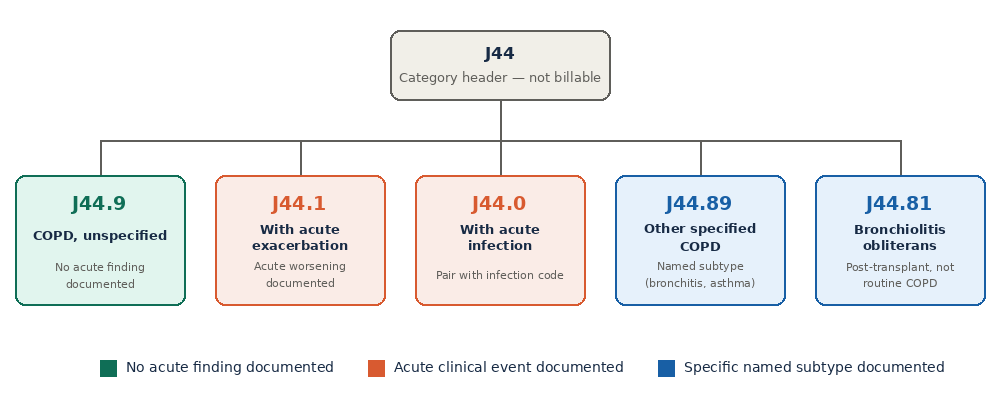
Everything below expands on how to pick correctly between these five, because the difference usually comes down to one sentence in the provider’s assessment.
J44.1 — Coding COPD With Acute Exacerbation
J44.1 is the code for an acute worsening of COPD beyond the patient’s usual day-to-day symptoms. It also covers what’s documented as “decompensated COPD.”
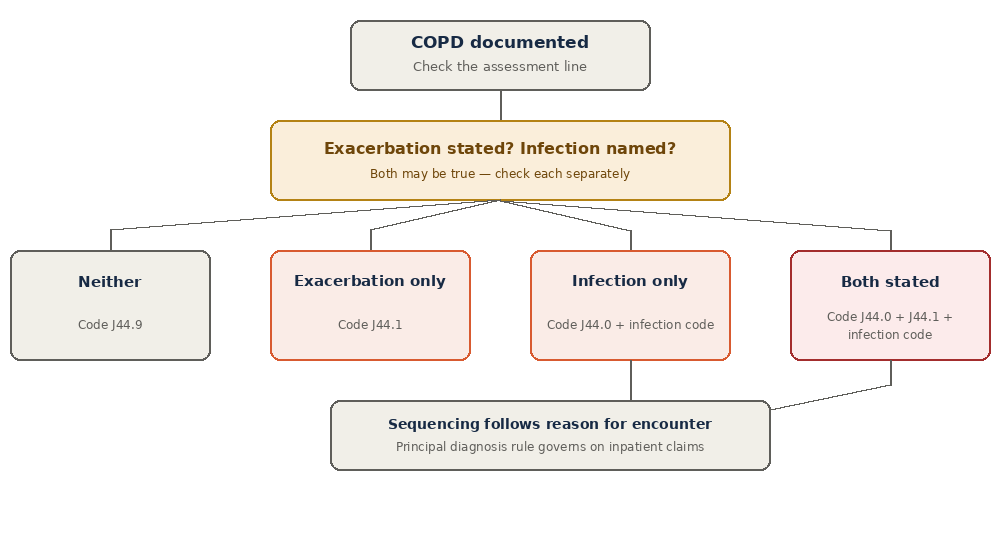
The rule that trips up the most claims: an exacerbation is not the same clinical fact as an infection. A respiratory infection can trigger an exacerbation, but documenting the infection alone doesn’t automatically establish that an exacerbation happened and vice versa. The chart needs to state both separately if both are true.
Supports J44.1:
- Dyspnea documented as worse than the patient’s stated baseline
- Increased sputum volume, thickness, or color change
- A new course of systemic steroids or antibiotics tied to acute worsening
- ED visit or admission specifically for COPD decompensation
- The word “exacerbation” or “AECOPD” actually written in the assessment
Does not support J44.1:
- A routine, stable follow-up visit
- COPD noted incidentally at a visit for an unrelated complaint
- “COPD, stable” or “COPD, well-controlled” both of these code to J44.9, not J44.1
A prescription for prednisone sitting in the medication list is not, by itself, a diagnosis of exacerbation. If treatment for worsening COPD is documented but the assessment line never says so, that’s a physician query, not a coding decision to make on your own.
J44.0 — Coding COPD With an Acute Lower Respiratory Infection
J44.0 tells the payer that a COPD patient also has a diagnosed acute lower respiratory infection most commonly pneumonia or acute bronchitis. What J44.0 does not do is name the infection, which means it should never be submitted alone.
Common secondary codes paired with J44.0:
| Infection documented | Secondary code |
|---|---|
| Pneumonia, organism unspecified | J18.9 |
| Acute bronchitis, unspecified | J20.9 |
| RSV identified as the causative organism | B97.4 |
Can J44.0 and J44.1 both be reported? Yes. J44.0 and J44.1 are not mutually exclusive a patient can have a documented exacerbation and a diagnosed infection at the same visit or admission. When both are clearly stated in the note, both codes go on the claim, along with the code naming the specific infection.
Sequencing: Which code leads depends on the reason for the encounter. If the infection is what drove the visit or admission, it may be sequenced first. If the COPD exacerbation with a secondary infection is the clinical focus, J44.0 leads. Inpatient claims follow the principal diagnosis rule the condition that, after study, was chiefly responsible for the admission.
J44.9 — COPD, Unspecified, and Why It’s the Most Overused Code in the Family
J44.9 applies when COPD is diagnosed and nothing else is documented: no exacerbation, no infection, no named subtype. It’s a completely valid, billable code plenty of encounters legitimately belong here, particularly stable maintenance visits.
The problem shows up when J44.9 is used on a chart that documents more than the code captures. Steroids started for acute worsening, a pneumonia diagnosis treated at the same visit, or exacerbation language scattered through a note that still gets coded as plain “COPD” these gaps between documentation and code selection are exactly what automated payer edits and HCC risk audits are built to catch.
One mismatched claim is a rounding error. A pattern of them across a panel is a measurable revenue leak: down coded visits, claim rework, and — for value-based and Medicare Advantage panels a risk adjustment factor score that understates how complex the patient population actually is.
If your practice has never actually pulled its J44.9 rate against a sample of chart notes, that’s usually the fastest way to find out whether the issue is coding accuracy or documentation capture. Credexa Solutions builds that comparison into onboarding for new pulmonology and primary care accounts it’s a quick way to see where the leak actually is before assuming it’s the coders’ fault.
J44.89 and J44.81 — The Two Codes Most Billing Guides Get Wrong
J44.89 and J44.81 replaced the old catch-all J44.8 code back on October 1, 2023. Any coding resource that doesn’t mention them was likely written before that date, and a surprising amount of guidance still in circulation hasn’t caught up.
J44.89 (other specified COPD) applies when the chart names a specific COPD subtype that isn’t an exacerbation or an infection most often chronic bronchitis or asthma documented together with COPD. The distinction from J44.9 comes down to specificity: named but not otherwise classifiable goes to J44.89; nothing named at all goes to J44.9.
J44.81 (bronchiolitis obliterans / BOS) describes a distinct clinical entity, most frequently seen after lung or stem-cell transplant and chronic rejection. This is not interchangeable with routine smoking-related COPD. When a clinician documents “obstructive lung disease” on a transplant patient and the coder defaults to J44.9, a serious post-transplant complication effectively disappears from the record which matters both clinically and for risk adjustment.
COPD With Chronic Bronchitis: One Chart, One Correct Answer
This is a spot where different reference sources genuinely disagree, and only one answer matches the current Alphabetic Index.
When chronic bronchitis is documented together with COPD (with no exacerbation or infection), the Index routes this to J44.89 not J44.9, and not J44.1 plus J42. The reasoning is the same logic used across ICD-10-CM generally: the more specific documented condition governs, and J42 (unspecified chronic bronchitis) carries a Type 1 Excludes note naming J44.9, meaning the two codes can never appear on the same claim under any circumstance.
| What’s documented | Correct code |
|---|---|
| COPD with chronic bronchitis, stable | J44.89 |
| COPD with chronic bronchitis, acute exacerbation stated | J44.1 |
| COPD with chronic bronchitis and a diagnosed acute infection | J44.0 + infection code |
| Emphysema documented, no chronic bronchitis mentioned | J43.- (outside the J44 family entirely) |
Can COPD and Asthma Be Coded Together?
Yes and the code most people reach for isn’t the correct one. Asthma documented together with COPD routes through the Alphabetic Index to J44.89, not J44.9. J45 (asthma) backs this up from the other direction with its own excludes note pointing back to J44.89.
When the record specifies asthma severity, add the matching J45 subcategory code alongside J44.89:
| Asthma severity documented | J45 subcategory |
|---|---|
| Mild intermittent | J45.2- |
| Mild persistent | J45.3- |
| Moderate persistent | J45.4- |
| Severe persistent | J45.5- |
| Unspecified/other | J45.9- |
One rule that gets missed constantly: each condition needs its own exacerbation documentation. A COPD exacerbation doesn’t automatically mean the asthma is exacerbating, and the reverse is equally true code only what’s separately stated. There is also no dedicated ICD-10-CM code for asthma-COPD overlap syndrome (ACOS); you simply code the documented COPD and the documented asthma using the rules above.
COPD and Emphysema: The Excludes Rule Most Coders Get Backward
A common misconception is that J43 (emphysema) and J44 (COPD) can never appear on the same claim. That’s not accurate. J44 carries a Type 2 Excludes note for emphysema without chronic bronchitis and a Type 2 Excludes means the two conditions can be reported together, as long as each is independently documented.
- Emphysema documented without chronic bronchitis → J43.-
- Emphysema documented with chronic obstructive bronchitis → J44 family
The same Type 2 logic applies to bronchiectasis (J47), which also sits under a Type 2 Excludes at J44 rather than a hard exclusion.
The actual Excludes1 barrier in this code family is narrower than most people assume: J42 (unspecified chronic bronchitis) cannot be reported with J44.9 or J44.81. That’s the pairing that will trigger a hard rejection, not the J43/J44 combination.
COPD With Respiratory Failure: Getting the Sequencing Right
When a COPD exacerbation decompensates into respiratory failure, that’s a separately reportable condition from the J96 series and on inpatient claims, it’s frequently the highest-value piece of documentation in the entire chart. It’s also one of the most commonly under-stated findings, since the ABG results and BiPAP orders are often in the record without the word “failure” ever appearing in the assessment.
| Clinical picture | Likely principal diagnosis | Secondary diagnosis |
|---|---|---|
| COPD exacerbation with acute hypoxic respiratory failure | J96.01 | J44.1 |
| COPD exacerbation with hypercapnic failure | J96.02 | J44.1 |
| Acute-on-chronic respiratory failure with hypoxia | J96.21 | J44.1 |
| Chronic respiratory failure at baseline, no acute change | J44 code per documentation | J96.1- |
| Exacerbation triggered by pneumonia | J44.0 | J18.9, then respiratory failure code if applicable |
For inpatient claims, sequencing follows the condition established after study as chiefly responsible for the admission not a fixed template. Two admissions with identical diagnosis codes can legitimately sequence differently depending on what actually drove the stay. Documented hypoxemia that doesn’t meet respiratory failure criteria is a different, lower-weight code entirely: R09.02.
Comorbidity and Add-On Codes That Belong on Almost Every COPD Claim
COPD claims rarely stand alone, and the codes riding alongside J44 carry real weight for medical necessity, for risk adjustment, and for quality reporting.
| Add-on code | What it captures |
|---|---|
| F17.- | Active tobacco dependence |
| Z87.891 | Personal history of nicotine dependence (former smoker) |
| Z72.0 | Tobacco use without dependence |
| Z77.22 | Secondhand smoke exposure |
| Z57.31 | Occupational tobacco smoke exposure |
| Z99.81 | Dependence on supplemental oxygen |
| I27.81 | Chronic cor pulmonale |
| R09.02 | Hypoxemia not meeting respiratory failure criteria |
Tobacco status specifically deserves its own line item — active, former, or exposure because it’s the single most consistently missed code on respiratory claims, and it takes seconds to add once it’s part of the workflow. Symptoms already implied by a confirmed COPD diagnosis (shortness of breath, chronic cough, wheeze) generally aren’t coded separately, since they’re already captured by the J44 code itself.
GOLD Severity Staging vs. ICD-10 Code Selection
ICD-10-CM has no severity axis for COPD. There’s no code for “mild,” “moderate,” or “severe” COPD J44 differentiates purely by exacerbation and infection status. A chart documenting “severe COPD, stable” still codes to J44.9.
That doesn’t mean severity is irrelevant it just does different work. GOLD staging (FEV1, GOLD A/B/E group, exacerbation history) is what justifies medical necessity for pulmonary rehabilitation, home oxygen, and higher-complexity visit levels. The 2026 GOLD Report updated its exacerbation criteria and the A/B/E grouping, and it’s worth checking your documentation templates aren’t still referencing the old four-stage numbering system, which GOLD retired some time ago.
MS-DRG Impact: Why the Same COPD Code Can Pay Three Different Amounts
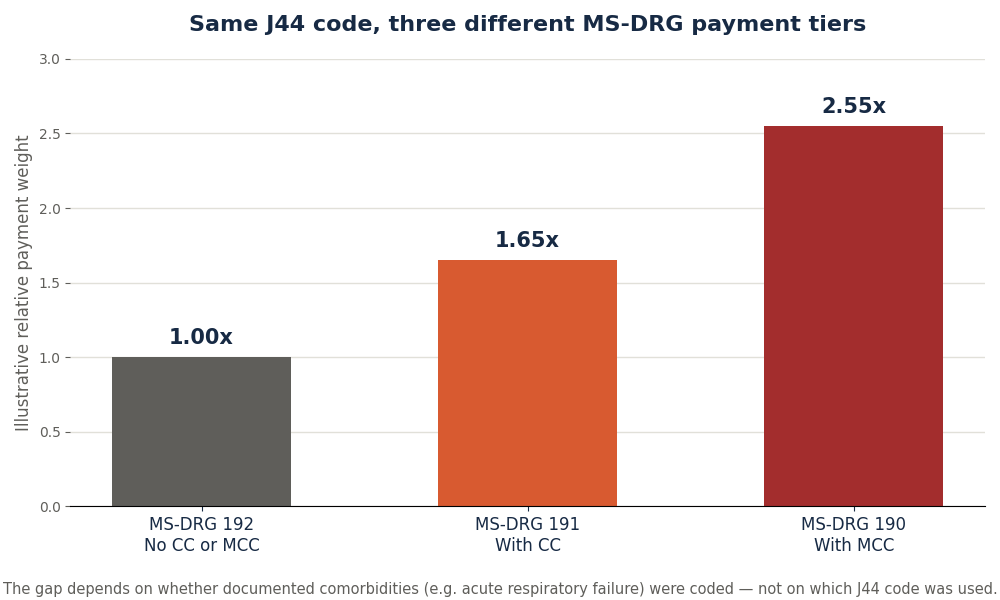
On inpatient claims, the J44 code itself doesn’t set the payment the MS-DRG does, and every code in the J44 family can group to three different DRGs depending on documented comorbidities:
- MS-DRG 190 — COPD with MCC (major complication/comorbidity)
- MS-DRG 191 — COPD with CC (complication/comorbidity)
- MS-DRG 192 — COPD without CC or MCC
Same patient, same J44 code, same length of stay and the reimbursement gap between 192 and 190 often comes down entirely to whether an already-present comorbidity (acute respiratory failure being the most common) was actually documented and coded, not left implied.
COPD Under HCC Risk Adjustment
For Medicare Advantage panels, COPD is a risk-adjusting condition under the CMS-HCC model, and how precisely it’s coded directly affects the risk adjustment factor score the plan is paid against. Version 28 became fully operative for payment year 2026, replacing the older V24 model and expanding the category count significantly so HCC category numbers pulled from older references may not map correctly under the current model.
Two things matter most here:
- Risk scores don’t carry forward. A COPD diagnosis coded last year contributes nothing to this year’s score unless it’s documented and coded again at a face-to-face encounter within the current year.
- MEAT documentation is required Monitor, Evaluate, Assess, or Treat for every condition captured. COPD sitting on a problem list with no supporting narrative reads as historical, not active, and won’t hold up under review.
Medical Necessity: Matching COPD Codes to the Services Billed Alongside Them
The diagnosis code is what anchors medical necessity for everything billed on the same claim. When the code can’t support the service, that’s a medical necessity denial waiting to happen.
| Service | CPT | Typical COPD pairing |
|---|---|---|
| Spirometry | 94010 | J44.9 or J44.1 |
| Spirometry with bronchodilator response | 94060 | J44.9 |
| Nebulizer treatment | 94640 | J44.1 |
| Pulmonary rehabilitation | G0424 | Per applicable coverage policy |
| Established visit, moderate complexity | 99214 | J44.1 |
| Home oxygen concentrator | E1390 | J44 code + Z99.81 |
Pulmonary rehabilitation coverage under G0424 has specific documentation requirements a physician referral, an individualized plan, and a severity threshold so it’s worth confirming against the current coverage determination rather than assuming last year’s criteria still apply. Z99.81 documents oxygen dependence but doesn’t substitute for the qualifying saturation or ABG result that has to be in the chart.
Why COPD Claims Get Denied — and How to Fix the Pattern
Most COPD denials repeat across a small number of root causes:
| Denial pattern | Root cause | Fix |
|---|---|---|
| Bare J44 or J44.8 submitted | Non-billable header/subcategory code used | Catch at charge entry, before submission |
| Service not supported by diagnosis | Unspecified code can’t anchor a specific service | Query the provider before coding, not after the denial |
| Diagnosis-procedure mismatch | Wrong diagnosis pointer on the claim line | Line-level review before submission |
| J44.0 with no infection code | Incomplete code pairing | Always pair the infection code at charge entry |
| J42 billed with J44.9 | Excludes1 violation | Build a Tabular check into the coding workflow |
Getting appeals right matters too pull the specific note that supports the code, cite the guideline or Index entry behind the assignment, and attach the documentation that anchors necessity (spirometry, saturation, or exacerbation narrative). An appeal built on documentation that isn’t actually in the chart won’t succeed regardless of how it’s written; at that point the right move is a provider query and a corrected claim, not a resubmission.
If your practice sees the same COPD denial resurface repeatedly under a new claim number, refiling alone won’t solve it — something upstream keeps generating it, and finding that root cause is exactly the kind of review Credexa Solutions runs for practices dealing with recurring denial patterns.
FY2027 ICD-10-CM: What Changes October 1, 2026
FY2026 ICD-10-CM governs dates of service through September 30, 2026. FY2027 takes effect October 1, 2026, and code set selection follows the date of service, not the date the claim is billed a claim for a September 29 encounter still uses FY2026 codes even if it’s submitted in November.
Before the transition:
- Update EHR favorites lists and encounter forms with the new code set
- Confirm your clearinghouse has loaded the FY2027 tables before the first claim goes out under the new codes
- Run a test claim in the first week of October and watch for rejections
- Review documentation templates for language tied to retired guidance
Related billing timelines matter here too payer-specific filing deadlines don’t reset just because a code set changes, so it’s worth keeping your BCBS timely filing limits reference current alongside your ICD-10 updates, especially for corrected claims that cross the October 1 boundary.
Documentation Checklist for Every COPD Encounter
A note that covers these eight points removes nearly every J44 coding decision from guesswork:
- COPD documented as the provider’s diagnosis for this encounter, not just carried forward
- Exacerbation status stated explicitly in the assessment, when present
- Any diagnosed respiratory infection named directly, not implied by symptoms alone
- Chronic bronchitis, asthma, or emphysema named explicitly when that’s what’s meant
- Tobacco status documented active, former, or exposure
- Oxygen dependence documented if the patient is on supplemental oxygen
- Spirometry or FEV1 result referenced when available
- Comorbidities actively addressed in the assessment and plan, not just listed on a problem list
Codes come from the assessment line, not the history section “exacerbation” mentioned only in the HPI and absent from the assessment leaves the coder without support to assign J44.1.
In-House Coding vs. Outsourced Billing: When It’s Worth the Switch
Not every practice needs to hand COPD coding off to a billing partner a low-volume panel with a coder who consistently applies specificity correctly may not gain much from outsourcing. But a few signals tend to show up together when it does make sense:
- COPD volume is high enough that a small specificity gap compounds into real dollars over a quarter
- No one on staff actively tracks the practice’s J44.9 rate, so drift goes unnoticed until a payer flags it
- The same denials keep reappearing under new claim numbers because refiling is replacing root-cause review
- Credentialing delays are keeping a provider from billing certain payers at all, independent of coding accuracy
Respiratory diagnoses are common enough COPD alone accounts for a meaningful share of chronic disease encounters in most primary care and pulmonology panels that even a small per-claim specificity gap adds up quickly across a quarter’s worth of visits. That’s usually the point where a practice benefits from a structured coding and denial audit rather than continuing to fix claims one at a time as they come back.
Related coding areas worth reviewing at the same time, since they tend to share the same underlying documentation gaps: claim timing rules like the BCBS timely filing limits by plan and state, and procedure-side accuracy issues covered in the radiology CPT codes and modifiers guide. Coding accuracy rarely lives in a single silo a practice with a J44.9 drift problem often has a matching pattern somewhere else in the chart.
Frequently Asked Questions
What is the ICD-10 code for COPD? There isn’t one single code. J44.9 covers COPD, unspecified. J44.1 covers COPD with acute exacerbation, J44.0 covers COPD with an acute lower respiratory infection, J44.89 covers other specified COPD, and J44.81 covers bronchiolitis obliterans syndrome. J44 and J44.8 are not billable on their own.
What is the ICD-10 code for a COPD exacerbation? J44.1. It applies whenever the provider documents acute worsening beyond the patient’s normal baseline, regardless of whether a specific trigger is identified.
Is J44.9 billable? Yes, it’s a valid, specific, billable code the issue is only when it’s used on charts that document more than “COPD” alone, such as exacerbation or infection language that should push the code to J44.1 or J44.0 instead.
Can J44.0 and J44.1 be coded on the same claim? Yes, when both an infection and an exacerbation are separately documented. A code identifying the specific infection is still required alongside J44.0.
Can COPD and asthma be coded together? Yes the Alphabetic Index routes this combination to J44.89, not J44.9, and a matching J45 severity code is added when asthma severity is documented.
Does COPD affect Medicare Advantage risk scores? Yes. COPD maps to a hierarchical condition category under the CMS-HCC model (Version 28 for payment year 2026), and it needs to be documented and coded again at a face-to-face encounter each year to continue contributing to the risk adjustment factor score.
Key Takeaways
- Only five J44 codes are billable: J44.0, J44.1, J44.81, J44.89, and J44.9. J44 and J44.8 are not.
- An exacerbation and an infection are two separate clinical facts document both if both are true, and both codes can be reported together.
- J44.89 covers COPD documented with chronic bronchitis or asthma; it’s frequently miscoded as J44.9 in outdated references.
- Severity (GOLD staging, FEV1) drives medical necessity for services like pulmonary rehab it never changes which J44 code applies.
- The gap between MS-DRG 192 and 190 on inpatient claims is almost always a documentation capture issue, not a coding error.
- FY2026 governs through September 30, 2026; FY2027 takes effect October 1, 2026, based on date of service.
Getting COPD coding right is a documentation problem disguised as a coding problem more often than not — and it compounds across a panel faster than most practices realize until someone actually pulls the numbers. If you want that review done for your practice, along with a broader look at where claims are leaking revenue, Credexa Solutions offers a practice billing review that covers exactly this kind of coding-to-documentation gap, alongside related coding areas like radiology CPT codes and modifiers.
This article is general medical coding education and does not replace payer-specific policy or clinical guidance. Confirm current rules against the ICD-10-CM Official Guidelines and your individual payer contracts before applying them to live claims.