
Getting credentialed with an insurance company in Pennsylvania is rarely a one-form process. Depending on where your practice sits, you may need separate applications with two or more Blue Cross Blue Shield licensees, a regional health plan like UPMC or Geisinger, and Pennsylvania’s Medicaid program through Promise before you’ve even touched Medicare. For a solo provider or a growing multi-specialty group, that complexity translates directly into delayed reimbursements, denied claims, and months of lost revenue.
At Credexa Solutions, we help physicians, therapists, and healthcare practices across the country manage the administrative side of getting paid from credentialing and payer enrollment to full medical billing support. This guide breaks down exactly how insurance credentialing works in Pennsylvania in 2026: which payers you’ll need to apply to, what documents they require, how long approval realistically takes, what it costs, and the mistakes that quietly stall the most applications.
Quick Answers Before You Start
| Question | Short answer |
|---|---|
| How many commercial applications might I need? | Up to four separate Blue-licensee applications, plus UPMC and/or Geisinger depending on your county |
| Is there a state-mandated decision deadline? | No. Several bills would create one, but none has passed as of this writing |
| Does a CAQH profile enroll me automatically? | No. It makes your data available; you still apply to each payer individually |
| Does Medicaid approval mean I’m in a managed care network? | No. PROMISe approval and MCO network contracting are two separate steps |
| Typical commercial timeline | 60–120 days, based on observed applications, not a published standard |
| Biggest avoidable delay | Filing payers one at a time instead of in parallel |
What Insurance Credentialing Actually Means
Credentialing is the process an insurance company uses to verify that a provider is qualified to treat its members and bill under its plan. The payer checks your license, education, board certification, malpractice history, and work record through primary-source verification before deciding whether to approve you.
It’s worth separating three terms that get used interchangeably but describe different stages of the same process:
| Stage | What it means | What it produces |
|---|---|---|
| Credentialing | The payer verifies your qualifications and history | A yes/no decision on whether you meet the plan’s standards |
| Enrollment | The payer loads your information into its claims system | Your NPI is recognized and claims stop rejecting at the provider-lookup stage |
| Contracting | You and the payer sign a participation agreement | A negotiated rate, an effective date, and in-network status |

A practice can pass credentialing and still not be billable, because enrollment or contracting hasn’t closed yet. Understanding where a provider sits inside this three-step sequence is the difference between a smooth go-live date and a stack of claims stuck in limbo.
Pennsylvania’s Payer Landscape Is More Fragmented Than Most States
This is where Pennsylvania trips up out-of-state billing teams and even local practice managers who assume “Blue Cross Blue Shield” means one application. It doesn’t.
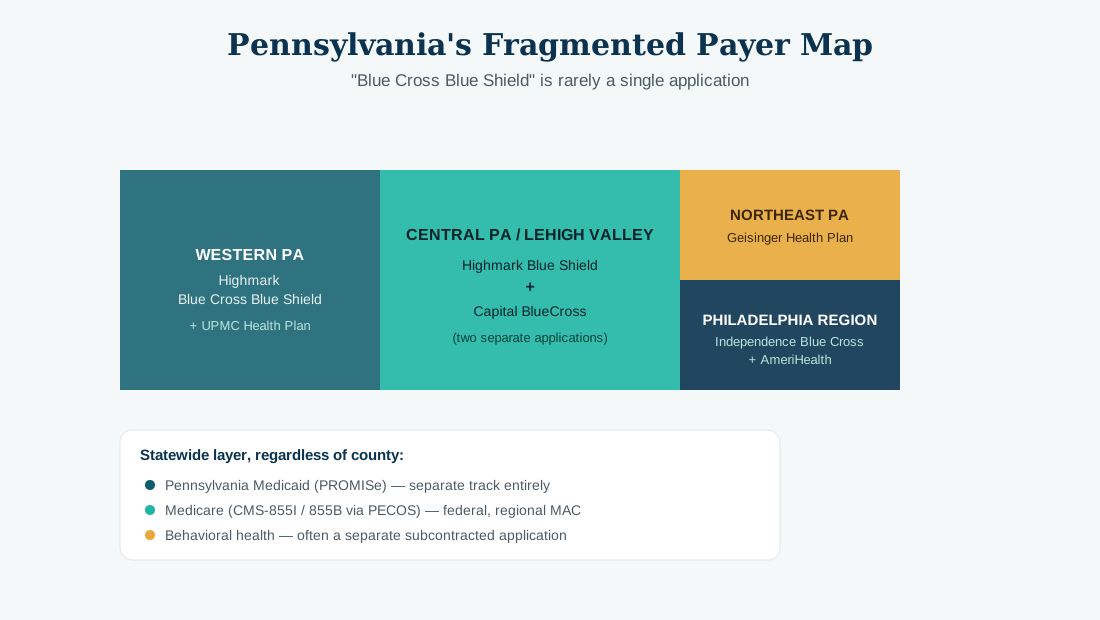
Highmark’s two identities
Highmark operates under two separate Blue licenses in the state. In western Pennsylvania it does business as Highmark Blue Cross Blue Shield, covering roughly two dozen counties. In central Pennsylvania and the Lehigh Valley, it operates as Highmark Blue Shield, covering a different set of counties. Following its acquisition of Blue Cross of Northeastern Pennsylvania, Highmark’s combined footprint now touches the large majority of counties statewide. Highmark relies on CAQH ProView for its credentialed networks, though its Participating Provider Network admits providers on licensure and a signed agreement without a full credentialing review a faster but functionally different track.
Why central Pennsylvania needs two separate applications
Capital BlueCross holds the Blue Cross license for the same central Pennsylvania and Lehigh Valley counties where Highmark holds the Blue Shield license. This is a legacy split from when the two organizations were distinct entities, and it means a practice in Harrisburg, Lancaster, or Allentown typically needs to file with both Highmark Blue Shield and Capital BlueCross to reach the full commercial market in that region.
Independence Blue Cross (Philadelphia region)
Independence Blue Cross, along with its subsidiary AmeriHealth, dominates the five-county Philadelphia service area Philadelphia, Bucks, Chester, Delaware, and Montgomery. Enrollment runs through a practitioner participation form combined with a CAQH profile that IBX is granted access to.
UPMC Health Plan and Geisinger Health Plan
Two regional plans carry significant commercial weight but get overlooked in generic national guides. UPMC Health Plan has strong penetration in western Pennsylvania, while Geisinger Health Plan covers much of central and northeastern Pennsylvania. Both should be evaluated alongside the Blues plans based on your location and referral patterns.
Pennsylvania Medicaid (PROMISe)
Pennsylvania’s Medicaid program runs through the Promise enrollment system, which is a separate track entirely from commercial credentialing. Approval through Promise does not automatically place you in a Health Choices managed care organization’s network that requires a second, separate contracting step with each MCO you want to bill.
If your specialty involves coding-heavy claims once you’re enrolled, it’s worth reviewing payer-specific documentation requirements early. For example, practices that treat chronic respiratory conditions should be familiar with correct diagnosis coding before claims start flowing our guide to COPD ICD-10 codes for 2026 covers the J44 code family in detail, which matters once you’re in-network and billing pulmonary visits.
What Pennsylvania Regulation Actually Requires of Payers
Pennsylvania’s insurance regulations set standards for how a health plan must run its credentialing process, but they don’t set a hard deadline for how fast a decision has to come back. That distinction matters more than almost anything else in this guide, because it’s the source of most of the frustration providers report.
Health plans operating in the state are required to:
- Maintain a documented credentialing and recredentialing system, with recredentialing occurring at least once every three years
- Disclose their credentialing criteria and procedures to any provider who submits a written request
- Provide a stated reason when a credentialing application is denied or not renewed
- Meet or exceed the standards of a nationally recognized accrediting body accepted by the state’s insurance regulator
There’s no statewide statutory clock forcing a payer to issue a decision within a set number of days. Several bills have been introduced in the state legislature over the past two sessions that would impose a defined turnaround window, but as of this writing none has been signed into law. Until one is, the practical answer to “how fast will this go” is an observed range based on real applications, not a published guarantee.
One provision worth knowing: health plans are generally not required to individually credential nonphysician staff who work for a facility, agency, or group whose own credentialing process already meets state standards. This can meaningfully reduce the paperwork load for behavioral health agencies, therapy groups, and similar organizations but it needs to be confirmed with each specific payer rather than assumed.
Documents Every Pennsylvania Credentialing File Needs
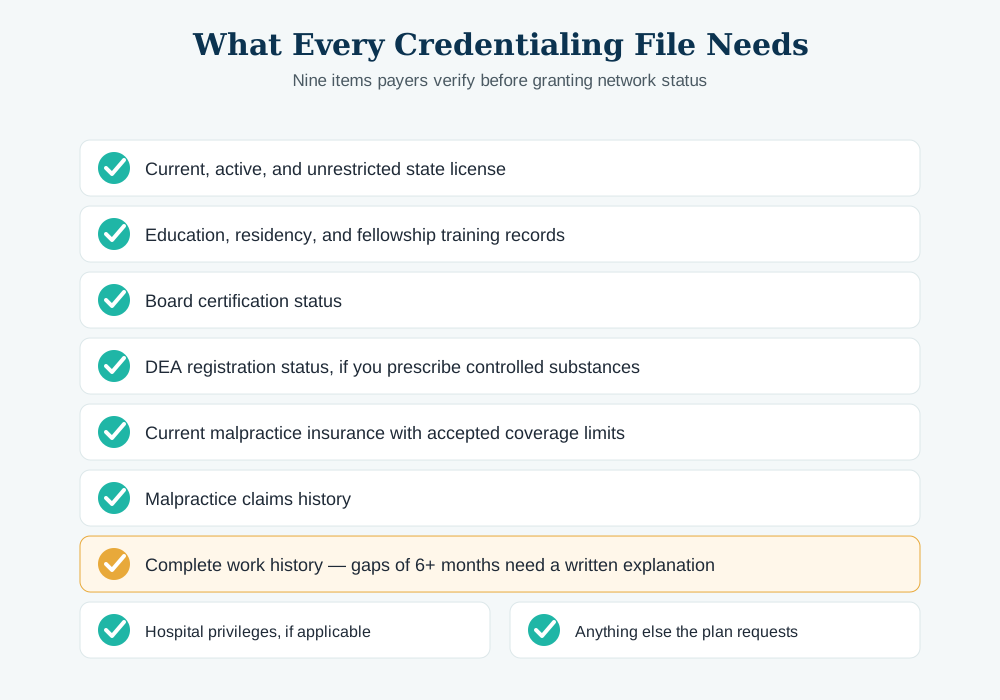
Payers in Pennsylvania are required to verify a defined set of information for primary care physicians and specialists before granting network status. At minimum, expect a request for:
- Current, active, and unrestricted state license
- Education, residency, and fellowship training records
- Board certification status
- DEA registration status, if you prescribe controlled substances
- Current malpractice insurance with coverage limits the plan accepts
- Malpractice claims history
- A complete and continuous work history, with any gap of six months or more explained in writing
- Hospital privileges, where applicable to your specialty
- Any additional information the plan or regulator specifically requests
Providers who fall outside the primary-care/specialist categories generally face a lighter verification standard usually just active licensure and proof of malpractice coverage.
The two issues that cause the most delays across nearly every Pennsylvania file we’ve seen are an expired malpractice certificate sitting unnoticed inside a CAQH profile, and an unexplained work-history gap. Neither is complicated to fix, but neither triggers a courtesy call from the payer you typically only find out once the application has already stalled for weeks.
Applying to Each Major Pennsylvania Payer
Because Pennsylvania doesn’t have a single centralized credentialing portal for commercial payers, the process is filed separately with each organization:
| Payer | Primary application | Credentialing data source |
|---|---|---|
| Highmark (BCBS / Blue Shield) | Credentialing application or Professional Agreement, depending on network | CAQH ProView |
| Independence Blue Cross | Practitioner Participation Form | CAQH ProView |
| AmeriHealth | Practitioner Participation Form | CAQH ProView |
| Capital BlueCross | Capital’s own provider-join packet | Capital’s internal process |
| UPMC Health Plan | Direct application through UPMC | Plan-specific |
| Geisinger Health Plan | Direct application through Geisinger | Plan-specific |
| PA Medical Assistance | Online enrollment | provider.enrollment.dhs.pa.gov |
| Medicare | CMS-855I or CMS-855B via PECOS | Processed regionally by the Medicare Administrative Contractor |
A properly attested and current CAQH ProView profile is the backbone of most of these applications, since Highmark, Independence Blue Cross, and AmeriHealth all pull directly from it. A stale or unattested profile CAQH requires re-attestation roughly every 120 days — can silently stall every commercial application tied to it at once.
Once you’re actively billing multiple payers, claim-filing deadlines become just as important as the initial approval. If Blue Cross Blue Shield plans are part of your payer mix, our breakdown of the BCBS timely filing limit by plan, state, and claim type for 2026 is worth bookmarking alongside your credentialing tracker, since a missed filing window can undo the revenue a successful credentialing application was supposed to protect.
Watch the contract signing window
Independence Blue Cross and AmeriHealth typically send the final participation agreement electronically once credentialing clears, with a limited window commonly around 30 calendar days to sign and return it. Miss that window and the file isn’t paused, it’s closed. You start over from the beginning. Assign someone specific to monitor that inbox during the final stage of your application.
Pennsylvania Medicaid: The PROMISe Track
If your practice sees any Medicaid patients, PROMISe enrollment runs independently of your commercial credentialing and needs to be filed in parallel rather than after.
A few points that trip practices up:
- Two separate portals. The enrollment application lives on one state system, while the claims and eligibility lookup lives on another. Older bookmarks and outdated blog posts sometimes point to a retired domain, so always confirm you’re on the current state portal before submitting anything.
- PROMISe approval is not MCO network access. Being approved for Pennsylvania Medical Assistance does not guarantee placement in any individual HealthChoices managed care organization’s network. Some MCO networks can be closed due to network adequacy limits in a given county. You have to contact each MCO directly after PROMISe approval.
- Data has to match exactly. Claims are matched using your NPI, taxonomy code, and nine-digit ZIP code. A mismatch on any one of these even a ZIP+4 discrepancy is enough to generate a rejection that looks like a coding error but is actually an enrollment mismatch.
- Every service location needs its own registration. A group billing from three locations under one umbrella application will generate denials at the two locations that were never separately registered.
Behavioral Health Runs on a Completely Separate Track
Pennsylvania administers Medicaid behavioral health benefits through county-level managed care organizations, not through the same plan that handles a patient’s physical health coverage. That means the entity that pays a behavioral health claim is determined by the patient’s county of residence not by the logo on their insurance card.
On the commercial side, several major payers route behavioral health credentialing through a separate subcontracted network entirely:
| Commercial payer | Behavioral health handled by |
|---|---|
| UPMC Health Plan | A dedicated behavioral health management partner |
| UnitedHealthcare | A separate behavioral health portal and application |
| Cigna | A separate behavioral health provider form |
| Highmark | Managed within the same plan |
| Independence Blue Cross | Managed within the same plan |
| Capital BlueCross | Managed within the same plan |
Skipping the behavioral health application because you’re already credentialed on the physical health side is one of the most common and most expensive oversights we see. If mental and behavioral health services are any part of your practice, budget for two separate application tracks, not one.
How Long Pennsylvania Credentialing Actually Takes
There’s no official, state-published timeline for commercial credentialing decisions in Pennsylvania. The ranges below reflect what practices typically experience, not a guaranteed service standard:
| Track | Typical range |
|---|---|
| PA Medical Assistance (PROMISe) initial review | 30–45 days |
| HealthChoices MCO contracting (after PROMISe) | 30–60 days |
| Medicare enrollment (PECOS) | 60–90 days |
| Independence Blue Cross / AmeriHealth | 60–120 days |
| Highmark credentialed networks | 60–120 days |
| Capital BlueCross | 60–120 days |
| Behavioral health carve-out (add-on) | +30–60 days |
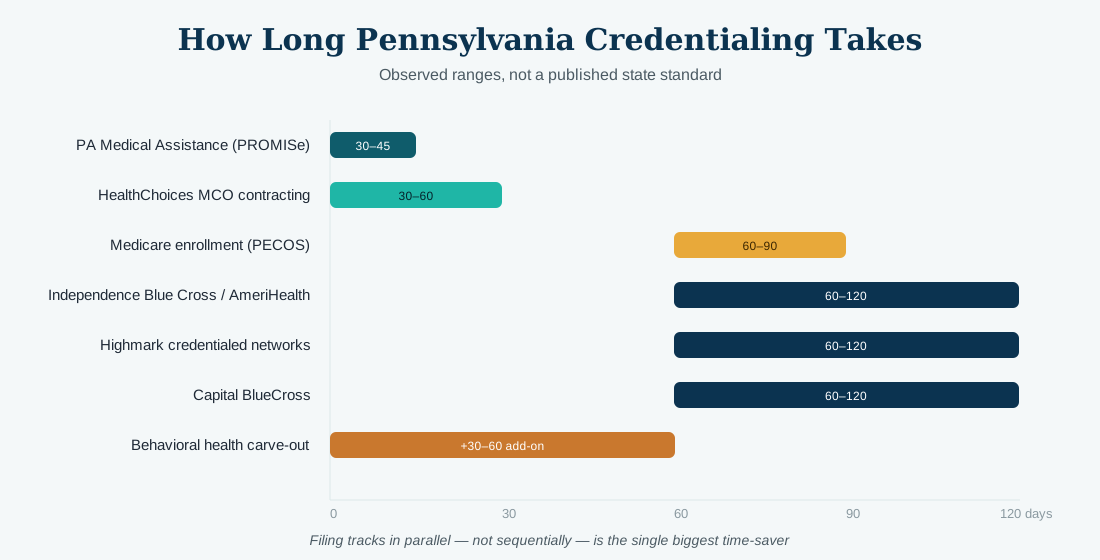
The single change that removes the most time from this process is running commercial credentialing, Medicaid enrollment, and Medicare enrollment in parallel rather than waiting for one to clear before starting the next. Sequencing them one after another can easily add 45–60 days of otherwise avoidable delay to your date of first billing.
Recredentialing: Four Separate Clocks Running at Once
Getting approved once isn’t the end of the process. Pennsylvania providers are subject to four distinct recurring cycles, tracked by four different organizations:
| Requirement | Frequency | Governing body |
|---|---|---|
| Commercial plan recredentialing | At least every 3 years | State insurance regulation |
| Medicaid revalidation (per service location) | Every 5 years | Federal Medicaid rule, administered by the state |
| Medicare revalidation | Every 5 years (3 years for DMEPOS suppliers) | CMS |
| CAQH ProView re-attestation | Roughly every 120 days | CAQH |
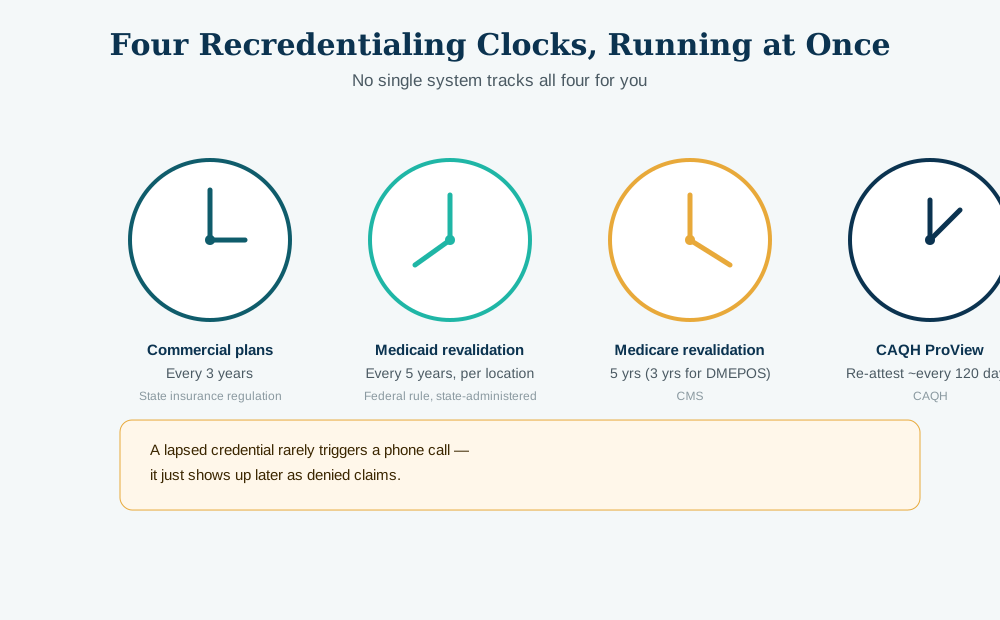
No single system tracks all four for you. A practice that calendars only one renewal date and assumes it covers everything is the most common way providers get quietly dropped from a network often without warning, since a lapsed credential doesn’t always trigger a phone call before claims start denying.
What Credentialing Costs in Pennsylvania
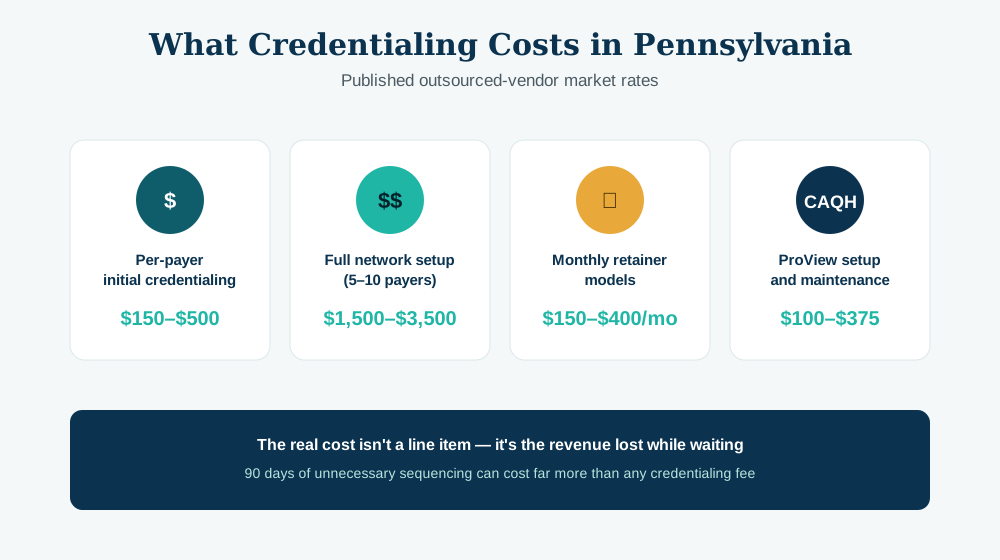
Vendor pricing for credentialing services generally isn’t tied to geography a payer application in Pennsylvania costs roughly the same to process as one in any other state. Published market rates for outsourced credentialing typically run:
- Per-payer initial credentialing: $150–$500
- Full network setup package (5–10 payers): $1,500–$3,500
- Monthly retainer models: $150–$400 per month
- CAQH ProView setup and maintenance: $100–$375 combined
Separately, be aware of fees that no vendor can waive because they’re owed directly to a government agency — most notably the CMS institutional provider enrollment application fee, which applies to certain organizational provider types but not to individual physicians or non-physician practitioners in most cases.
The real cost most practices underestimate isn’t a line item at all it’s the revenue lost while waiting. A provider who can’t bill in-network for 90 days because an application is unnecessarily sequenced instead of run in parallel loses far more than any credentialing fee on the table.
Why Applications Stall (And How to Prevent It)
Most stalled Pennsylvania credentialing files trace back to one of a handful of avoidable issues:
| Common stall point | Fix |
|---|---|
| CAQH profile not re-attested or not authorized for a specific payer | Re-attest and grant payer access before submitting, not after being asked |
| Expired malpractice certificate on file | Upload current declarations pages and verify effective dates |
| Unexplained gap in work history | Provide a written explanation for any gap over six months |
| NPI, taxonomy, or ZIP mismatch against Medicaid records | Confirm identical data across every system before submitting |
| Signed contract not returned within the payer’s deadline | Assign a single owner to monitor for the final agreement |
None of these require specialized expertise to fix they require someone actively watching the file on a weekly basis, since Pennsylvania sets no deadline that forces the payer to move on its own.
What Happens If You’re Not Yet Credentialed
Claims submitted before your effective date generally cannot be billed retroactively at Pennsylvania commercial payers once you’re credentialed the effective date on your contract is what matters, not the date your application was approved, and those two dates are frequently weeks apart.
There is one narrow protection worth knowing: Pennsylvania regulation includes a continuity-of-care provision that allows patients already in an active course of treatment with a provider to continue that care for a limited transitional period commonly up to 60 days — even if that provider isn’t yet (or is no longer) in-network. This protects the patient’s continuity of treatment; it isn’t a general workaround that lets an uncredentialed provider bill as if they were in-network.
A handful of specialties, including chiropractic and podiatry, have had closed panels with certain Pennsylvania payers at various points, meaning new applications aren’t being accepted outside specific exceptions (such as joining an existing participating group). Always confirm panel status before paying application fees or investing staff time in a submission.
Claims that end up denied or stuck out-of-network due to a credentialing gap still need to be worked and appealed before timely filing limits close the door on recovering that revenue. If your practice sees a backlog build during a credentialing transition particularly in fast-turnaround specialties like urgent care accurate coding matters just as much as the appeal itself. Our guide to urgent care billing and CPT codes for 2026 covers E/M leveling, S9083, place-of-service 20, and the modifier 25 denials that commonly compound a credentialing-related backlog.
Handling Credentialing In-House vs. Outsourcing
Doing it yourself makes sense when:
- You’re a solo provider applying to two or three payers
- Your CAQH profile is clean with no license or malpractice complications
- You have the staff time to dedicate roughly 15–40 hours per application, including document gathering, submission, and weekly follow-up
Outsourcing typically pays for itself when:
- You’re filing with multiple payers in parallel and sequencing decides your effective billing date
- Your practice operates across multiple service locations, each with its own Medicaid revalidation clock
- You’re adding new rendering providers to an existing group tax ID
- Behavioral health services mean managing two separate application tracks
- A central Pennsylvania location requires both Highmark Blue Shield and Capital BlueCross applications
- A file has already stalled and no one on staff can confirm where it currently sits
How Credexa Solutions can help
Credexa Solutions supports Pennsylvania practices through the entire revenue cycle not just credentialing, but the medical billing, denial management, and accounts receivable follow-up work that comes after you’re finally in-network. Because we handle both sides, we track your effective dates, payer IDs, and recredentialing deadlines inside the same system that processes your claims, instead of leaving that information split across two disconnected vendors.
If you’re planning to expand into radiology, cardiology, or another CPT-code-intensive specialty as part of your Pennsylvania growth, it’s worth reviewing coding requirements before your credentialing applications go out the door our radiology CPT codes, modifiers, and billing guide for 2026 is a useful reference for practices adding imaging services to their payer mix.
Visit credexasolution.com to see the full range of services we offer, or reach out for a review of exactly which Pennsylvania panels make sense for your specialty, county, and current payer mix before anything gets filed.

Nurse Practitioners and Other Advanced Practice Providers
Certified registered nurse practitioners applying for network status in Pennsylvania typically need a collaborative agreement on file with a participating physician who holds a current, unrestricted license, and whose training and scope of practice align with the CRNP’s own. This document is often requested alongside the standard credentialing packet, so gathering it early prevents a late-stage hold on an otherwise complete file.
Multistate licensure has also become more relevant for advanced practice providers who live outside Pennsylvania but treat patients across state lines. Nurses holding a valid multistate license through a licensure compact may, depending on current state policy, be able to enroll with Pennsylvania Medical Assistance without securing a separate Pennsylvania-specific license. Confirm current eligibility with the state Medicaid program before assuming this applies to your situation, since compact rules and state adoption can shift.
Facility and Group Credentialing Considerations
Multi-provider groups and facilities face a different set of variables than a solo practitioner filing alone. A few things worth planning around before you start submitting applications:
- Adding a provider to an existing tax ID is faster than a brand-new group enrollment, but each payer still requires its own individual credentialing file for the new clinician group status doesn’t waive individual verification.
- Facility-employed nonphysician staff may fall under the delegation exception described earlier, where the payer relies on the facility’s own credentialing standards rather than running a separate individual review. This has to be confirmed payer by payer; it isn’t automatic.
- Multiple service locations each carry their own Medicaid revalidation clock, so a three-location group is really managing three separate revalidation deadlines, not one.
- Labs, imaging centers, and other facility-type providers typically credential on an organizational track that includes certification and accreditation documentation in addition to the practitioner-level files for any physicians reading or interpreting results.
None of these are individually complicated, but they compound quickly for a growing group, which is usually the point where an internal spreadsheet stops being an adequate tracking system.
Frequently Asked Questions
How long does insurance credentialing take in Pennsylvania? There’s no statutory deadline, so timelines are observed ranges rather than guarantees. Commercial payers typically run 60–120 days, PA Medical Assistance runs 30–45 days for the state portion (plus additional time for MCO contracting), and Medicare enrollment through PECOS typically runs 60–90 days.
What documents do I need for Pennsylvania credentialing? At minimum: current license, education and training records, board certification status, DEA registration if applicable, malpractice insurance and claims history, complete work history, and hospital privileges where relevant. Requirements are lighter for providers outside the primary-care/specialist categories.
Do I need a separate application for Highmark and Capital BlueCross? In central Pennsylvania and the Lehigh Valley, yes. Highmark holds the Blue Shield license and Capital BlueCross holds the Blue Cross license for the same counties, so reaching the full commercial market there requires both applications.
Does PROMISe approval get me into a Medicaid MCO network? No. PROMISe enrollment is a separate step from HealthChoices MCO network contracting. You must contact each managed care organization directly after PROMISe approval, and some networks may be closed in certain counties.
How often do I need to renew my credentialing in Pennsylvania? Commercial plans recredential providers at least every three years. Medicaid and Medicare revalidation each run on a five-year cycle (three years for DMEPOS suppliers). CAQH ProView needs re-attestation roughly every 120 days. All four run independently.
Can I bill for services provided before my credentialing was approved? Generally no, at commercial payers. Your contract’s effective date — not your approval date — determines what’s billable, and those two dates are often weeks apart. A narrow continuity-of-care protection exists for patients already mid-treatment, but it doesn’t function as a general retroactive billing workaround.
Is it worth outsourcing credentialing for a solo practice? Often not immediately. A solo provider filing with two or three payers and holding a clean CAQH profile can typically manage the process directly. Outsourcing becomes more valuable once you’re filing with multiple payers in parallel, adding locations, or managing behavioral health’s separate application track.
Credexa Solutions provides medical billing, credentialing, and revenue cycle management support to healthcare providers. Learn more at credexasolution.com.