
Registered dietitian nutritionists and the billing teams behind them are facing a tighter enforcement environment in 2026. Since August 3, 2026, claims for medical nutrition therapy (MNT) that arrive without a qualifying diagnosis code attached are being rejected outright not because coverage rules changed, but because payers stopped looking the other way on thin diagnosis pairings.
If your practice bills 97802, 97803, 97804, or the HCPCS alternates G0270 and G0271, this guide walks through every piece of the puzzle: the codes themselves, who is legally allowed to bill them, Medicare’s coverage limits, ICD-10 pairing strategy, telehealth rules through 2027, and the specific denial patterns quietly draining revenue from nutrition practices this year.
Table of Contents
- Quick-Reference: 2026 MNT Coding Cheat Sheet
- What Actually Changed in MNT Billing for 2026
- CPT 97802, 97803, and 97804 Explained
- HCPCS Alternates: G0270, G0271, and S9470
- Who Is Legally Permitted to Bill MNT Codes
- Medicare Part B Coverage Rules for MNT
- ICD-10 Codes That Support MNT Reimbursement
- Documentation That Survives an Audit
- Telehealth Billing for MNT Through 2027
- Commercial Insurance and State Medicaid Variance
- MNT vs. Adjacent Benefits (DSMT, ACA Preventive, IBT, DPP)
- Top Denial Reasons for MNT Claims in 2026
- Frequently Asked Questions
- How Credexa Solutions Supports Nutrition Practices
1. Quick-Reference: 2026 MNT Coding Cheat Sheet
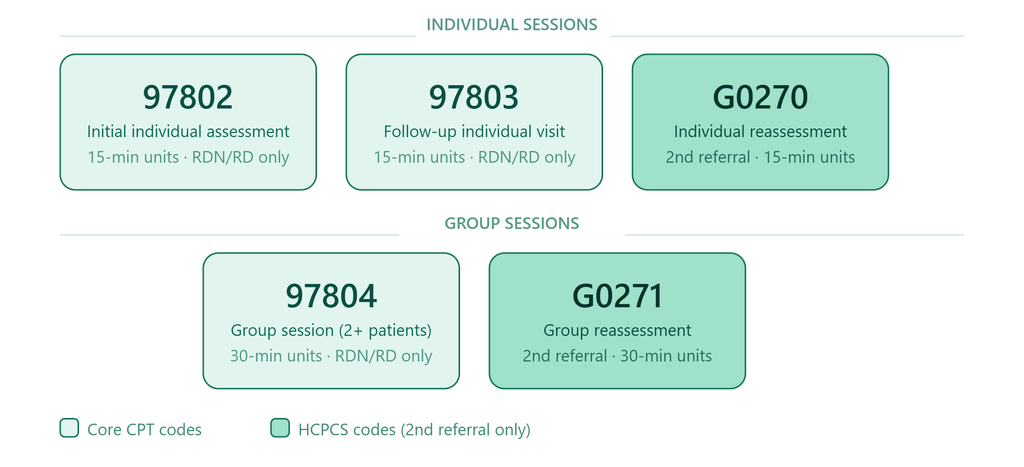
| Code | Use Case | Unit Length | Who Bills It |
|---|---|---|---|
| 97802 | Initial individual assessment | 15 minutes | RDN/RD only |
| 97803 | Follow-up individual visit | 15 minutes | RDN/RD only |
| 97804 | Group session (2+ patients) | 30 minutes | RDN/RD only |
| G0270 | Individual reassessment, 2nd referral | 15 minutes | RDN/RD only |
| G0271 | Group reassessment, 2nd referral | 30 minutes | RDN/RD only |
| S9470 | Legacy/commercial equivalent | Varies by payer | Non-Medicare only |
Keep this table pinned somewhere your front desk and billing staff can see it. A wrong code choice at intake is the single easiest error to prevent and one of the most common reasons a clean claim comes back unpaid.
2. What Actually Changed in MNT Billing for 2026

Nothing about who qualifies for medical nutrition therapy changed this year. Medicare’s coverage is still limited to diabetes, chronic kidney disease, and post-kidney-transplant care within a defined window. What changed is how strictly payers are checking the diagnosis field before releasing payment.
As of August 3, 2026, claims billed under 97802, 97803, 97804, G0270, or G0271 without a qualifying ICD-10 code attached are being denied at the point of adjudication rather than flagged for later review. This is confirmed independently by payer bulletins and state dietetic association updates, and it matches a broader trend across CMS-adjacent payers in 2026: automated pre-payment diagnosis matching instead of manual review.
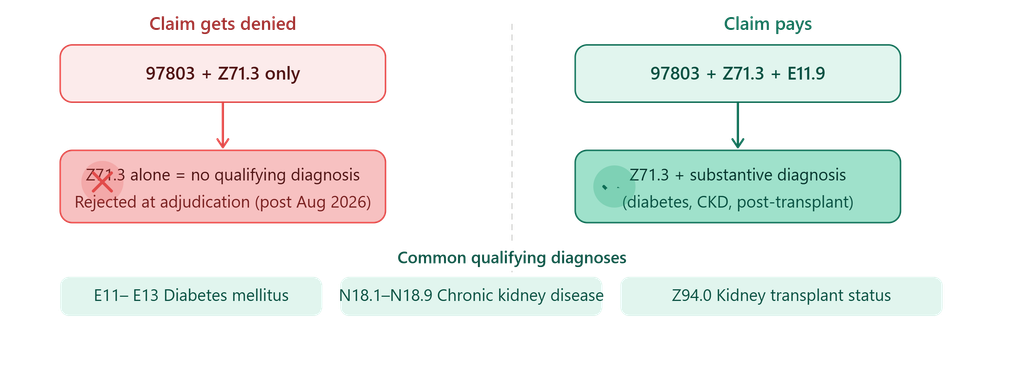
The practical effect: a dietitian seeing an established diabetes patient for a routine follow-up, billing 97803 with only a generic counseling code (Z71.3) and no diabetes-specific ICD-10 code attached, will now see that claim rejected. Before August, plenty of payers let that pairing through. They no longer do.
This single change is behind a noticeable spike in CO-16 missing-diagnosis denials and a related uptick in CO-97 bundling denials on remittance advices across the dietetics specialty this quarter. Neither is a coverage problem. Both are fixable before the claim ever leaves your office.
3. CPT 97802, 97803, and 97804 Explained
CPT 97802 — Initial Assessment
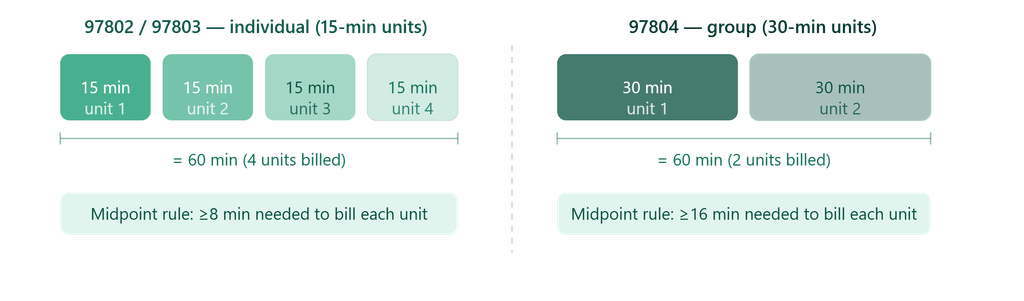
97802 is billed once, at the very start of a patient’s nutrition care, and covers the full face-to-face workup: diet history, current eating patterns, relevant labs, and an individualized nutrition care plan tied to the referring diagnosis. It’s billed in 15-minute units, with the standard midpoint rule applying you need to be at least 8 minutes into a unit to bill it. One unit covers 15 minutes, four units cover a full hour.
A frequent coding myth is that 97802 resets automatically every three years. It doesn’t. That three-year window belongs to Medicare’s kidney-transplant lookback rule, a completely separate provision. In practice, most payers treat roughly 12 months without a visit as grounds for a new initial assessment; a patient seen two months ago cannot be billed as a new initial visit again.
CPT 97803 — Follow-Up Visits
Every subsequent visit, for the life of that patient’s nutrition care with your practice, bills under 97803. Same 15-minute unit structure, same midpoint rule. The distinction between 97802 and 97803 is purely about the stage of care first visit versus every visit after not the content or length of the session.
CPT 97804 — Group Sessions
Group MNT, defined as two or more patients receiving nutrition education together, uses a 30-minute unit instead of 15. The midpoint shifts accordingly: roughly 16 minutes for one unit, 46 minutes for two. This code fits diabetes education groups, renal diet classes, and any format where shared discussion adds clinical value.
One trap worth flagging clearly: if a scheduled group session ends up with a single attendee, it cannot still be billed as 97804. It has to be re-billed as 97802 or 97803, whichever matches that patient’s actual stage of care. Billing 97804 for a session that only had one attendee creates a documentation mismatch that auditors catch quickly.
4. HCPCS Alternates: G0270, G0271, and S9470
Beyond the three core CPT codes, three HCPCS codes cover edge cases:
- G0270 — Individual reassessment following a second physician referral within the same calendar year, tied to a documented change in diagnosis, medical condition, or treatment plan. Billed in 15-minute units.
- G0271 — The group equivalent of G0270, billed in 30-minute units.
- S9470 — A legacy code that predates the current CPT set. Some commercial payers and certain state Medicaid programs still recognize S9470 in place of 97802–97804. Medicare does not reimburse it under any circumstance.
G0270 and G0271 exist specifically to authorize hours beyond Medicare’s standard annual allotment they’re not interchangeable with the core codes until that second referral is actually documented and on file. Practices billing across multiple payer types should confirm which code family each specific plan recognizes before submission, not after a denial arrives.
5. Who Is Legally Permitted to Bill MNT Codes
This is the section most billing guides skip past, and it’s where practices lose the most avoidable revenue.
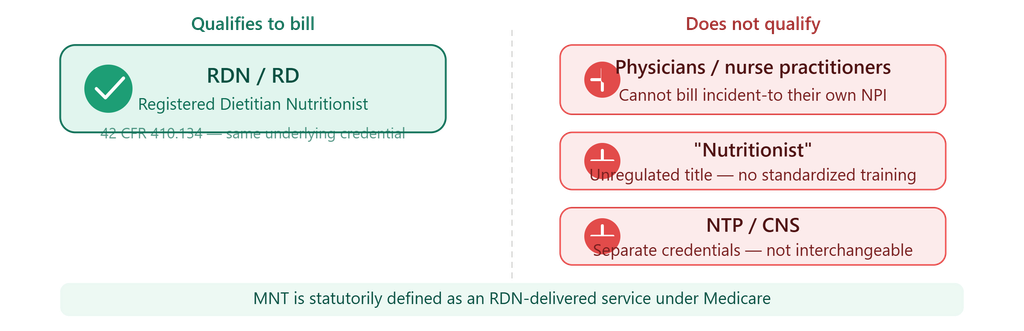
Under 42 CFR 410.134, Medicare requires the RDN (Registered Dietitian Nutritionist) or RD (Registered Dietitian) credential to bill 97802 through 97804. RD and RDN are the same underlying credential; RDN is simply the more current designation used by the Academy of Nutrition and Dietetics.
A few credentials that get confused with RDN status, but do not qualify:
- “Nutritionist” — an unregulated title with no standardized training requirement behind it in most states.
- Nutritional Therapy Practitioner (NTP) — a separate credential from the Nutritional Therapy Association, oriented around holistic wellness coaching, not clinical diagnosis or treatment.
- Certified Nutrition Specialist (CNS) — a distinct clinical nutrition credential, but not interchangeable with RDN for Medicare billing purposes.
Physicians and nurse practitioners cannot bill MNT codes directly, and critically, cannot bill them incident-to their own NPI. Medical nutrition therapy is statutorily defined as an RDN-delivered service. A claim submitted under a supervising physician’s NPI for an MNT visit is a structural error that will not survive scrutiny, regardless of how the documentation reads.
Getting a newly hired RDN properly credentialed with each individual payer is a completely separate process from the coding rules above and it’s often where a new hire’s first month of claims stalls out entirely. If your practice is expanding into a new state, our guide to the Wisconsin Medicaid provider enrollment and ForwardHealth Portal process walks through exactly what that state-level enrollment timeline looks like in practice.
6. Medicare Part B Coverage Rules for MNT
Physician Referral and NPI Requirements
Medicare requires a physician referral before MNT is covered, and the referring physician’s NPI must appear on the CMS-1500 claim form. A missing or mistyped referring NPI is one of the most common and most avoidable reasons a clean-looking claim comes back unprocessed rather than paid.
Annual Hour Limits
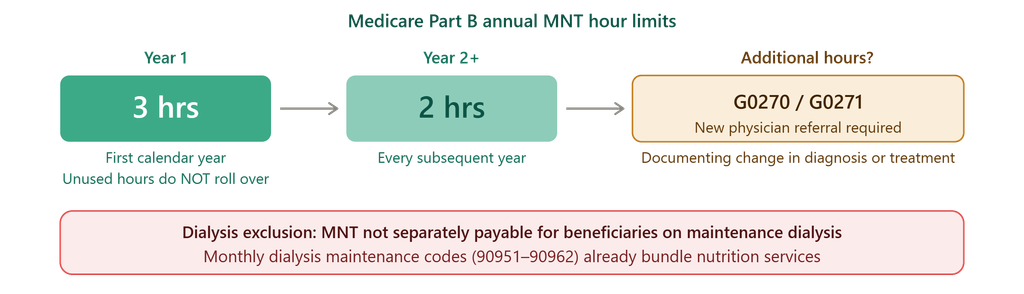
Medicare covers three hours of MNT in a patient’s first calendar year of care and two hours in every year after. Unused hours from year one do not roll over. Additional hours beyond that standard allotment require a new physician referral documenting a change in diagnosis, medical condition, or treatment plan billed under G0270 or G0271, not the core codes.
The Dialysis Exclusion
MNT is not separately payable for a beneficiary on maintenance dialysis, because the monthly dialysis maintenance codes (90951–90962) already bundle nutrition services. Billing both in the same calendar month for the same patient results in the MNT claim being denied the dialysis claim is unaffected.
One MNT Code Per Date of Service
Only one MNT code is payable per date of service. No modifier overrides this. Attempting to bill two MNT codes on the same day for the same patient is the single most common reason an MNT line bundles into a denial instead of paying independently.
7. ICD-10 Codes That Support MNT Reimbursement
Z71.3 — Dietary Counseling and Surveillance
Z71.3 is the code most frequently paired with 97802 and 97803 across payer bulletins. It typically needs to appear alongside a substantive diagnosis — a specific diabetes or cardiovascular-risk code, for example rather than standing alone as the sole justification for the claim.
Malnutrition and Nutrient-Deficiency Codes
| Code | Description |
|---|---|
| E40 | Kwashiorkor |
| E41 | Nutritional marasmus |
| E42 | Marasmic kwashiorkor |
| E43 | Unspecified severe protein-calorie malnutrition |
| E44.0 / E44.1 | Moderate / mild protein-calorie malnutrition |
| E45 | Retarded development following malnutrition |
| E46 | Unspecified protein-calorie malnutrition |
Adjacent ranges also support MNT claims: E50–E64 for vitamin and mineral deficiencies, and D50–D53 for nutritional anemias (iron, B12, and folate deficiency).
Food Insecurity and Diet-Related Codes
A less-discussed but increasingly relevant group: R63.8 (symptoms concerning food and fluid intake), R63.30 (unspecified feeding difficulties), Z72.4 (inappropriate diet and eating habits), and Z59.41 (food insecurity) a social determinants of health code drawing more payer attention as SDOH documentation becomes a bigger part of value-based reimbursement conversations. These codes describe a concern rather than a standalone qualifying condition, so pairing them with a substantive diagnosis remains the safer approach.
8. Documentation That Survives an Audit
The clinical note behind an MNT claim has to demonstrate what was billed, not just confirm a visit occurred. Five elements matter most:
- Exact date, start time, and stop time of the encounter
- Assessment detail history, dietary intake, nutritional status
- Specific nutrition goals set during that visit
- The intervention actually delivered, not merely planned
- Confirmation the patient received a written plan or summary
Billed units must match documented time, not the scheduled appointment slot. On the CMS-1500, the CPT code belongs in field 24D alongside the ICD-10 code establishing medical necessity.
Vague notes are the quiet cause behind a large share of MNT audit findings. A note that reads “counseled patient on diet” proves nothing not the time spent, not the goal addressed, not the medical necessity. A note documenting start and stop times, the specific topic covered (for example, portion control using the plate method), and a goal the patient agreed to, gives an auditor everything needed to uphold the claim without follow-up questions.
9. Telehealth Billing for MNT Through 2027
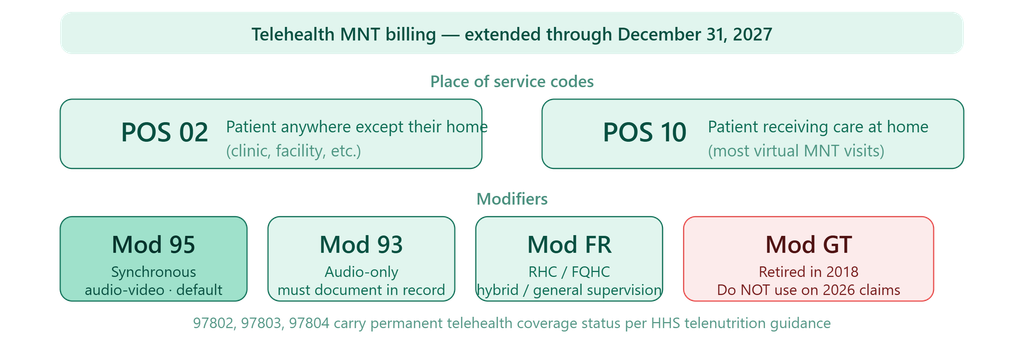
Medicare telehealth flexibilities briefly lapsed on January 30, 2026, during a federal funding gap. Congress passed the Consolidated Appropriations Act, 2026 (H.R. 7148), signed into law February 3, 2026, retroactively covering that gap and extending Medicare telehealth flexibilities through December 31, 2027. Telehealth-delivered MNT remains billable under current rules through the end of that year.
Place of service codes: POS 02 applies to telehealth delivered anywhere other than the patient’s home; POS 10 applies when the patient is at home. Per HHS telenutrition billing guidance, 97802, 97803, and 97804 all carry permanent telehealth coverage status.
Modifiers: Modifier 95 flags synchronous audio-video delivery, the default most payers expect. Modifier 93 applies to audio-only visits and must be clearly documented in the record, not assumed. Modifier FR applies to the hybrid/general-supervision scenario at a rural health clinic or FQHC. Modifier GT was retired for professional Medicare claims in 2018 and should not appear on a 2026 claim.
Payer conventions differ enough on this point that confirming a specific plan’s modifier expectation before the first virtual visit is worth the extra five minutes it’s cheaper than a resubmission cycle.
10. Commercial Insurance and State Medicaid Variance
Commercial payers do not follow a single standard the way Medicare does. Some recognize MNT under ACA preventive benefits with a broader qualifying diagnosis list — including obesity and eating disorders while others require prior authorization as a strict condition of payment, not a formality. Two patients with identical diagnoses and identical documentation can see completely different outcomes depending on which plan is on file.
State Medicaid coverage is even less consistent, because nutrition counseling doesn’t appear on the federal list of mandatory or optional Medicaid benefits. Some states cover MNT broadly for independently practicing RDNs; others recognize it only inside a hospital or clinic setting, or not at all outside one. This is exactly why state-specific enrollment guidance matters more for nutrition billing than almost any other specialty a rule that applies cleanly in one state can produce an automatic denial in the next.
If your practice is credentialing an RDN with a state Medicaid program, our breakdown of the Wisconsin ForwardHealth Portal enrollment process covers the documentation and timeline specifics that trip up new applicants most often.
11. MNT vs. Adjacent Benefits
It’s easy to confuse MNT with five nearby benefits that use different codes, different rules, and sometimes different billing providers entirely:
- Diabetes Self-Management Training (DSMT) — billed under G0108/G0109, deliverable by educators other than an RDN. Medicare won’t pay MNT and DSMT on the same date of service, though both can be used across the same year.
- ACA preventive nutrition counseling — sometimes billed under 99401–99404, tied to elevated BMI or cardiovascular risk rather than a diagnosed condition. MNT treats a diagnosis; preventive counseling addresses risk before one exists.
- Medicare Diabetes Prevention Program (MDPP) — a completely separate benefit for prediabetes. Medicare does not cover MNT for prediabetes at all.
- Intensive Behavioral Therapy (IBT) for obesity — billed under G0447 for a BMI of 30+, typically billed incident-to a physician rather than under an RDN’s own NPI, with a structured visit schedule and a combined session cap of 22 across G0447 and its group equivalent, G0473.
- Enteral and parenteral nutrition therapy — covered under its own separate Medicare coverage determination as durable medical equipment, using an entirely different HCPCS range, and applies mainly to home health, oncology, and post-surgical GI patients rather than outpatient dietitian visits.
Keeping these five distinct in your intake and coding workflow prevents a meaningful share of avoidable denials before they ever reach the claims stage.
12. Top Denial Reasons for MNT Claims in 2026
- Missing or non-qualifying diagnosis code on the claim face
- Two MNT codes billed for the same patient on the same date of service
- MNT billed in the same calendar month as maintenance dialysis
- Claim submitted under a physician’s NPI as incident-to, when MNT cannot legally be billed that way
- RDN not credentialed or enrolled with that specific payer, even if credentialed elsewhere
Nearly every item on this list is preventable with a pre-submission review rather than a post-denial appeal the difference between a claim that pays on the first pass and one that eats a week of staff time chasing a resubmission. Denial patterns like these aren’t unique to nutrition billing, either; specialties with equally strict code-pairing and modifier rules, such as the ones covered in our general surgery CPT codes, modifier, and global period guide and our lithotripsy CPT codes and denial-prevention guide, run into strikingly similar root causes.
13. Frequently Asked Questions
What’s the difference between CPT 97802 and 97803? 97802 is the initial individual assessment, billed once at the start of care. 97803 covers every individual follow-up visit after that. Both bill in 15-minute units; the difference is the stage of care, not the visit content.
Can a nurse practitioner bill medical nutrition therapy codes? No. MNT is statutorily defined as a service delivered by a registered dietitian nutritionist under 42 CFR 410.134. A nurse practitioner can refer a patient for MNT but cannot bill the codes directly or incident-to.
Does Medicare cover MNT for prediabetes? No. Medicare’s MNT benefit covers diabetes, chronic kidney disease, and post-transplant care only. A prediabetes diagnosis may instead qualify for the separate Medicare Diabetes Prevention Program.
How many units cover a 60-minute individual MNT session? Four 15-minute units under 97802 or 97803. A 60-minute group session under 97804 bills as two 30-minute units instead.
If a patient changes insurance, can I bill 97802 again as a new initial visit? Generally no. 97802 is tied to the initial assessment with your practice, not to which insurance is active. Re-billing it after a coverage change risks a denial or an audit finding.
Which ICD-10 code pairs most often with MNT claims? Z71.3, typically alongside a substantive diagnosis such as a specific diabetes or chronic kidney disease code, rather than standing alone.
Is nutrition counseling always considered preventive care? Not always. Under the ACA, nutrition counseling can qualify as a zero-cost preventive benefit for elevated BMI or cardiovascular risk. Nutrition services delivered to manage an already-diagnosed condition fall under MNT instead, with separate coverage rules.
14. How Credexa Solutions Supports Nutrition Practices
Getting medical nutrition therapy CPT codes right on paper is only part of getting paid for them consistently. The other part is payer-specific enrollment, clean claim submission, and catching denial patterns before they repeat across dozens of claims.
Credexa Solutions works with RDNs, dietetics practices, and multi-specialty groups that bill MNT alongside other services, handling the pieces that quietly determine whether these codes actually convert into revenue:
- Provider enrollment and credentialing — getting each RDN properly enrolled with Medicare, Medicaid, and commercial payers, including state-specific portals and documentation requirements, so a new hire’s first claims don’t stall out waiting on paperwork.
- Clean claim submission — making sure the referring physician’s NPI, the correct CPT/HCPCS code, and a qualifying ICD-10 diagnosis all appear correctly on the CMS-1500 before the claim ever leaves the building, particularly important under the tighter diagnosis-enforcement rules that took effect in August 2026.
- Denial management and appeals — identifying recurring denial patterns, whether that’s a missing diagnosis code, a dialysis-exclusion conflict, or an incident-to billing error, and fixing the root cause instead of resubmitting the same mistake.
- Eligibility and benefits verification — confirming a commercial plan’s prior authorization requirements and diagnosis coverage before the first visit, so practices aren’t discovering a payer’s rules after a claim has already been denied.
- Revenue cycle management across specialties — for practices billing MNT alongside general surgery, urology, or other specialties, coordinated RCM support that keeps every specialty’s coding rules aligned under one billing workflow.
Whether you’re a solo RDN in private practice or a multi-provider clinic adding a nutrition service line, Credexa Solutions handles the credentialing, coding accuracy, and denial-prevention work behind medical nutrition therapy billing so your practice can focus on patient care instead of chasing remittance advices.
Reach out to Credexa Solutions today to see how a dedicated billing and credentialing partner can help your nutrition practice reduce denials and get paid faster in 2026.