Oncology billing has one of the highest error rates in medical coding, and chemotherapy CPT codes sit at the center of most of it. A single infusion visit can generate five or six billable lines an administration code, one or more add-on codes, a drug line, a wastage modifier, and sometimes an E/M code and every one of those lines has its own rule about sequencing, timing, or documentation. Miss one, and the claim either down codes or denies outright.
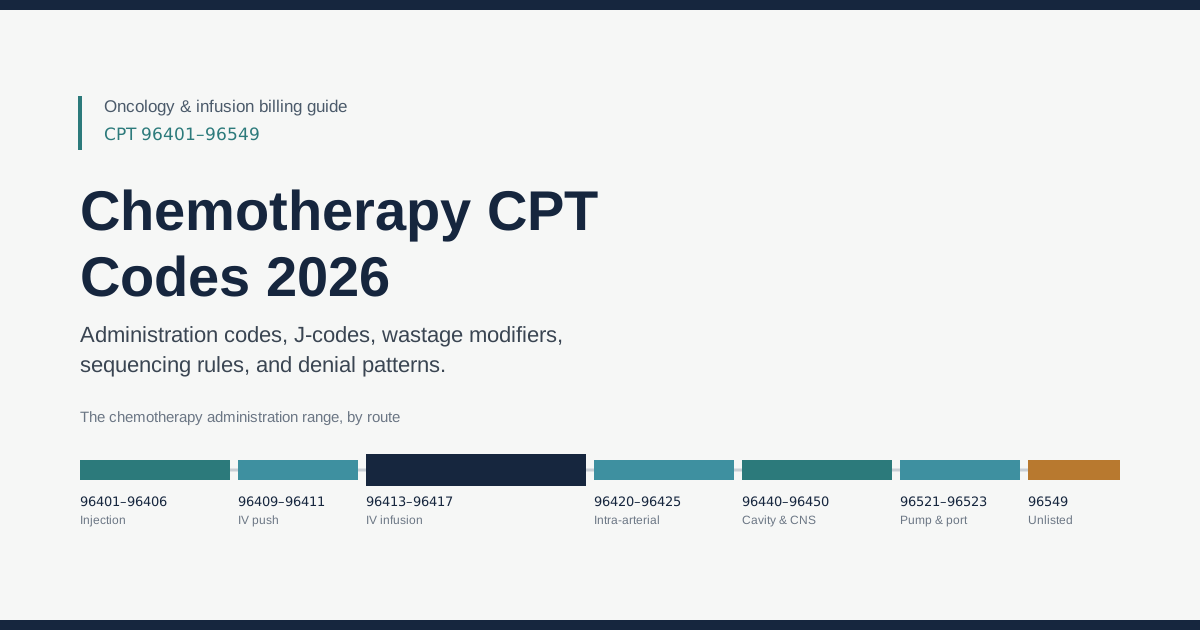
This guide breaks down the full chemotherapy CPT code range (96401–96549), explains how to tell a chemotherapy administration code apart from a therapeutic infusion code, walks through J-code drug billing and wastage modifiers, and covers the sequencing logic and denial patterns that determine whether an infusion suite gets paid for the work it actually performed.
At Credexa Solutions, we manage medical billing, coding audits, and revenue cycle operations for practices across specialties, including oncology and infusion-heavy practices where a single coding error on a high-cost biologic can mean thousands of dollars in lost reimbursement. This guide reflects the coding logic and payer rules our billing team applies to chemotherapy claims every day.
What Are Chemotherapy CPT Codes?
Chemotherapy CPT codes are the procedure codes that describe how a cancer drug or biologic agent was delivered to a patient not which drug was given. The drug itself is billed separately using an HCPCS J-code. The CPT code covers the clinical work of administering it: nursing time, monitoring for reaction, and the elevated risk that comes with infusing or injecting a cytotoxic or biologic agent.
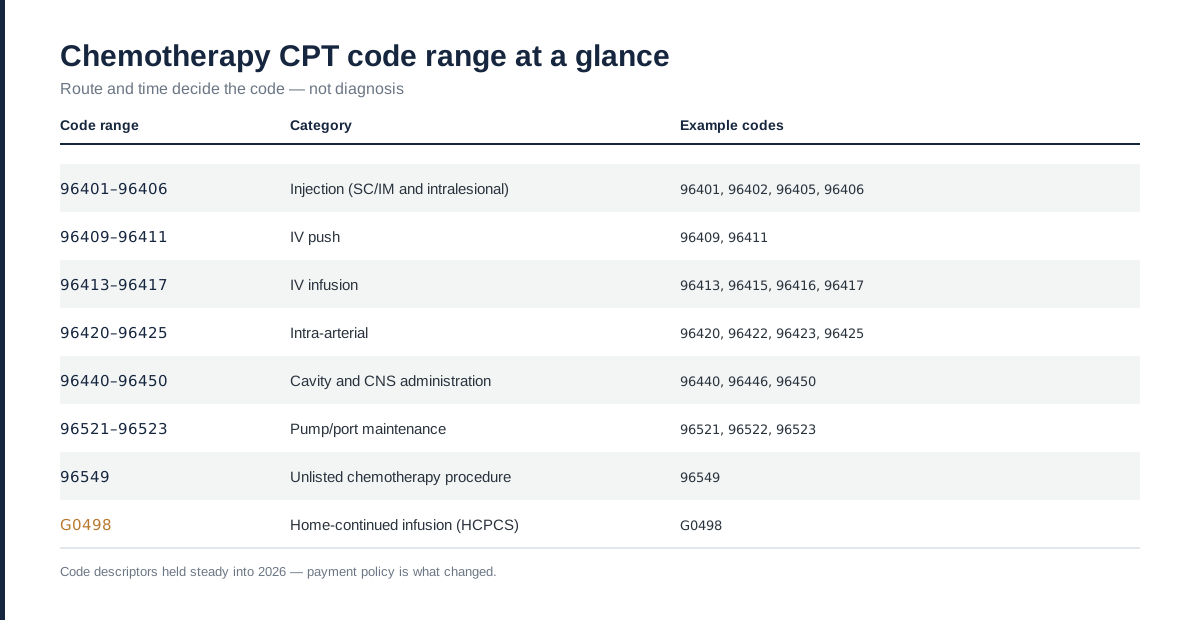
The chemotherapy administration family runs from CPT 96401 through CPT 96549, plus the HCPCS add-on code G0498 for home-continued infusions. These codes are organized by route of administration subcutaneous/intramuscular injection, intralesional injection, IV push, IV infusion, intra-arterial administration, and administration into a body cavity or the central nervous system.
Chemotherapy CPT Code Range at a Glance
| Code Range | Category | Example Codes |
|---|---|---|
| 96401–96406 | Injection (SC/IM and intralesional) | 96401, 96402, 96405, 96406 |
| 96409–96411 | IV push | 96409, 96411 |
| 96413–96417 | IV infusion | 96413, 96415, 96416, 96417 |
| 96420–96425 | Intra-arterial | 96420, 96422, 96423, 96425 |
| 96440–96450 | Cavity and CNS administration | 96440, 96446, 96450 |
| 96521–96523 | Pump/port maintenance | 96521, 96522, 96523 |
| 96549 | Unlisted chemotherapy procedure | 96549 |
| G0498 | Home-continued infusion (HCPCS) | G0498 |
Two things stayed consistent going into 2026: the code descriptors themselves and the underlying rule that route and time not diagnosis decide which code applies. What did change is payment policy, which we cover later in this guide.
Chemotherapy Codes vs. Therapeutic Infusion Codes: How to Tell Them Apart
This is the single most common coding error in infusion billing, and it goes in both directions. Practices bill supportive drugs like antiemetics under the chemotherapy family, and they bill monoclonal antibodies or biologics under the plain therapeutic infusion codes (96360–96379).
The rule payers actually apply is based on drug classification, not the patient’s diagnosis:
- If the drug is an antineoplastic agent, a monoclonal antibody, or a biologic response modifier, it’s billed under the chemotherapy administration family (964xx), regardless of whether the patient’s diagnosis is cancer. A monoclonal antibody infused for rheumatoid arthritis can still fall under 96413.
- If the drug is supportive care an antiemetic, an antibiotic, IV fluids, or an anti-anemia agent like an ESA or iron product it’s billed under the therapeutic, prophylactic, or diagnostic infusion codes (96360–96379), even if it’s given in the same chair, on the same day, as chemotherapy.
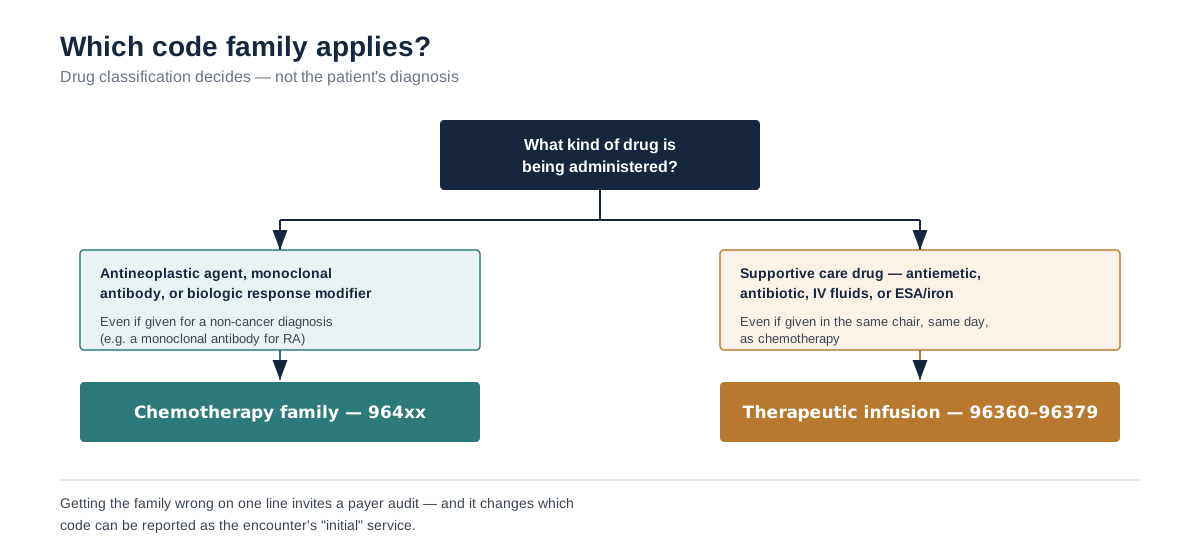
That distinction matters because oncology infusion suites administer both types of drugs constantly, often in the same visit. Getting the family wrong on even one line invites a payer audit, and it also affects which code can be reported as the “initial” service for the encounter (more on that below).
If your practice also bills standard injections outside the infusion suite vaccines, steroid injections, or antibiotic injections those follow an entirely different code, CPT 96372, and should never be confused with the chemotherapy injection codes covered next.
Chemotherapy Injection Codes: 96401, 96402, 96405, and 96406
Four codes describe chemotherapy delivered by needle rather than by line.
CPT 96401 — Non-Hormonal Antineoplastic, SC/IM
CPT 96401 covers subcutaneous or intramuscular administration of a non-hormonal antineoplastic agent methotrexate is the most common example, whether it’s used for an oncologic condition or an autoimmune one. It’s billed once per drug, per encounter, regardless of how many injection sites that single dose required.
CPT 96402 — Hormonal Antineoplastic, SC/IM
CPT 96402 covers the same route but for hormonal antineoplastic agents leuprolide (Lupron) and goserelin (Zoladex) are the two drugs coders see most often, typically for hormone-sensitive prostate or breast cancer. Coders who default to 96401 for anything oncology-related routinely misclassify Lupron and Zoladex injections, which creates a payment variance that often isn’t caught until a retrospective coding audit.
CPT 96405 and 96406 Intralesional Chemotherapy
These two codes split purely on lesion count:
- 96405 covers intralesional chemotherapy administration for up to and including 7 lesions, billed once per session.
- 96406 covers more than 7 lesions, also billed once per session.
If the clinical note doesn’t state an exact lesion count, coders default to 96405 a note that just says “multiple lesions treated” costs the practice the higher-paying code every time.
Chemotherapy IV Push Codes: 96409 and 96411
CPT 96409 covers IV push administration of a single or initial chemotherapy substance. CPT 96411 is the add-on code for each additional drug pushed in the same encounter it’s reported once per additional drug, not once per push of the same drug.
Medicare defines an IV push two ways: either the clinician remains present throughout the administration to monitor the patient, or the infusion runs 15 minutes or less. That 15-minute threshold is where documentation breaks down most often a nurse who fails to record a stop time leaves nothing in the chart to support an infusion code, and the claim defaults to a push, which typically reimburses less.
A push given after an initial infusion in the same session is a subsequent service and is reported with 96411, not as a second initial code.
Chemotherapy Infusion Codes: 96413, 96415, 96416, and 96417
These four codes carry the highest claim volume of the entire chemotherapy family, and 96413 is the single most frequently billed and most frequently audited chemotherapy code in outpatient oncology.
CPT 96413 — Initial Hour, IV Infusion
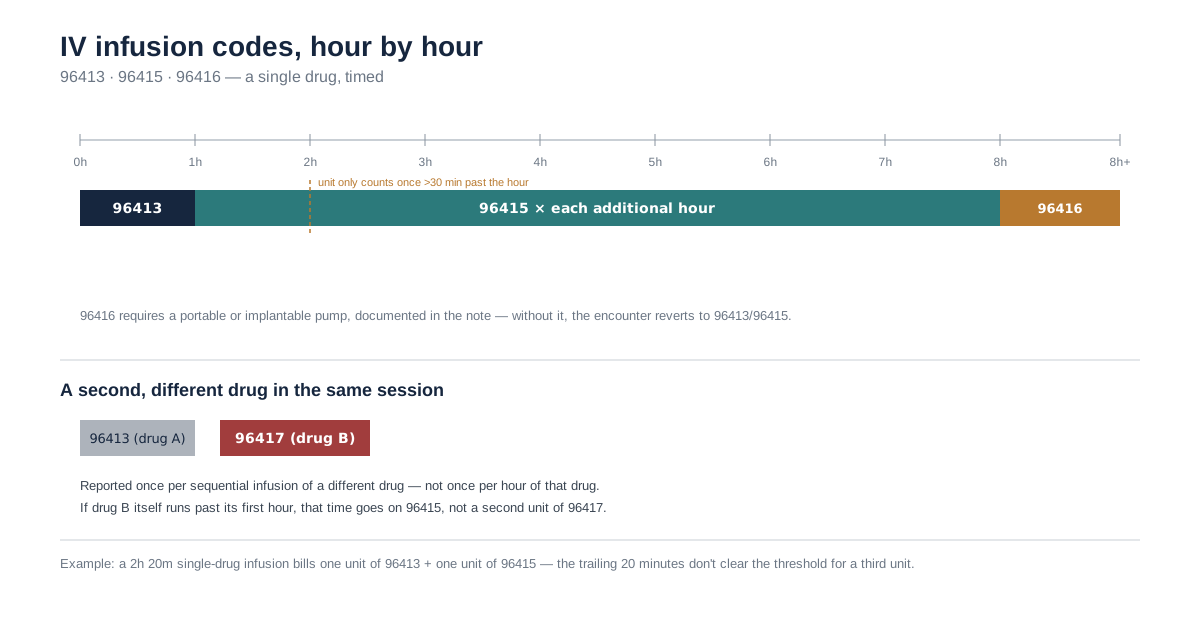
CPT 96413 covers the first hour of a chemotherapy IV infusion for a single or initial substance. It’s reported once per encounter, and the drug itself always bills separately on a J-code line. A common misconception is that 96413 requires a pump — it doesn’t. Pump-based prolonged infusion is a different code (96416, below).
CPT 96415 — Each Additional Hour
CPT 96415 is the add-on code for each additional hour beyond the first, reported alongside 96413. Under CMS guidance, an additional hour is only reportable once the infusion runs more than 30 minutes past each hourly increment. A 2-hour, 20-minute infusion of a single drug, for example, bills one unit of 96413 for the first hour and one unit of 96415 for the second hour the trailing 20 minutes don’t clear the 30-minute threshold for a third unit.
CPT 96416 — Prolonged Infusion With a Pump
CPT 96416 covers infusions running more than 8 hours, delivered through a portable or implantable pump. The pump has to be documented in the note; without it, the encounter defaults back to 96413/96415.
CPT 96417 — Additional Sequential Infusion, Different Drug
CPT 96417 is reported once per sequential infusion of a different drug in the same session not once per hour of that second drug. If the second drug itself runs past its first hour, that additional time goes on 96415, not on a second unit of 96417.
Regional and Cavity Chemotherapy Codes: 96420–96450
These six lower-volume codes cover chemotherapy delivered into an artery, a body cavity, or the central nervous system.
| Code | Description | Route |
|---|---|---|
| 96420 | IV push technique into an artery | Intra-arterial |
| 96422 | Infusion, up to 1 hour, into an artery | Intra-arterial |
| 96423 | Each additional hour, intra-arterial infusion | Intra-arterial (add-on) |
| 96425 | Prolonged intra-arterial infusion over 8 hours, with pump | Intra-arterial |
| 96440 | Administration into the pleural cavity, includes thoracentesis | Pleural cavity |
| 96446 | Administration into the peritoneal cavity via port or catheter | Peritoneal cavity |
CPT 96450 reported separately from the table above because it’s frequently confused with 96440 and 96446 is the code for intrathecal chemotherapy administration into the central nervous system, and it includes the spinal puncture as part of the service. Neither 96440 nor 96446 substitutes for 96450 on a CNS administration; each of those three codes reaches a different anatomical compartment.
Pump, Port, and Refill Maintenance Codes
Four codes cover maintenance rather than administration:
- 96521 — Refilling and maintenance of a portable pump.
- 96522 — Refilling and maintenance of an implantable pump or reservoir.
- 96523 — Irrigation of an implanted venous access device. This code is payable only when it’s the sole service reported that day — a flush performed immediately before or after a drug administration service is considered part of that service and isn’t separately billable.
- G0498 — A HCPCS code for chemotherapy infusion started in the clinic and continued at home on a clinic-supplied portable pump, which bundles in the closing follow-up visit.
The most common billing error on this group is appending 96523 to a visit that also includes an office visit or another administration service. Practices that build a dedicated “flush-only” visit type into their scheduling template avoid this denial entirely it’s a scheduling fix, not a coding fix.
Sequencing Rules: Only One Initial Code Per Encounter
More chemotherapy claims fail on sequencing than on code selection. The individual codes are right; the order in which they’re reported to the payer is wrong.
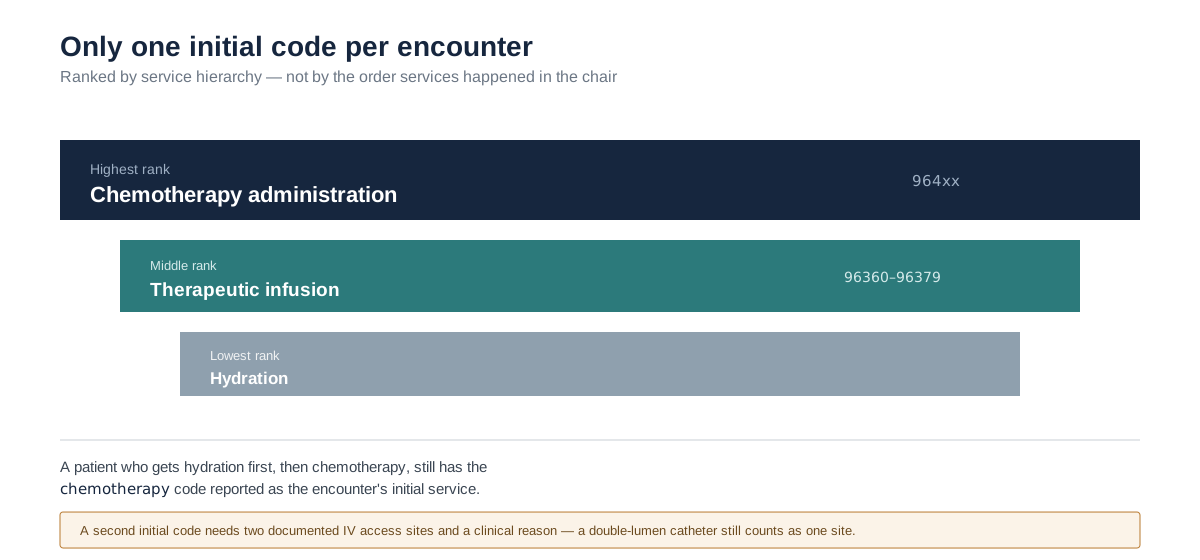
Payers rank the service hierarchy as: chemotherapy administration first, therapeutic infusion second, hydration third. The initial service code for the whole encounter comes from the highest-ranking service performed, regardless of the order those services actually happened in the chair. A patient who receives hydration first because they arrived dehydrated, followed by chemotherapy, still has the chemotherapy code reported as the initial service not the hydration code.
Only one initial code is reportable per encounter unless the clinical protocol genuinely required two separate IV access sites (both lumens of a single double-lumen catheter still count as one site, not two). Reporting a second initial code without two documented access sites and a documented clinical reason for both is one of the fastest routes to a denial.
HCPCS J-Codes: Billing the Drug Alongside the Administration
The administration code and the drug code live on two separate claim lines, and both are required for the encounter to be fully reimbursed. HCPCS J-codes (largely in the J9000–J9999 range for chemotherapy agents) report the drug itself, with units calculated against the dose defined in the code descriptor.
Some of the highest-volume chemotherapy and supportive-care J-codes include carboplatin, paclitaxel, docetaxel, cyclophosphamide, and supportive agents like pegfilgrastim and palonosetron. Unit definitions change on CMS’s annual HCPCS update, so a unit basis that was correct last year can silently underpay a claim this year if nobody rechecks it verify current unit definitions against the CMS HCPCS Quarterly Update before billing any high-volume drug.
JW and JZ Modifiers: Reporting Drug Wastage
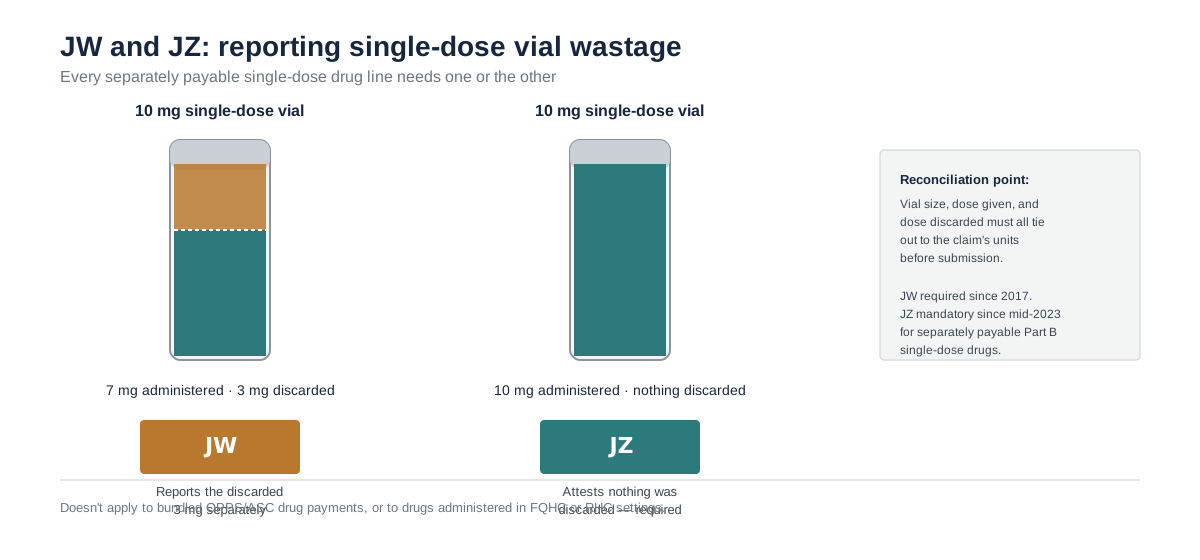
Two modifiers govern every separately payable single-dose drug line:
- JW reports the amount of drug that was discarded from a single-dose vial or package.
- JZ attests that nothing was discarded required on every applicable line where JW doesn’t apply.
CMS has required JW since 2017 and made JZ mandatory in mid-2023 for separately payable Part B drugs administered from single-dose containers. Full policy detail is available in CMS’s guidance on discarded drugs. Neither modifier applies to bundled OPPS/ASC drug payments or to drugs administered in FQHC or RHC settings.
The billing unit already covers the full vial in many cases if a 10 mg single-use vial is billed as one unit and 7 mg is administered with 3 mg discarded, that one unit already accounts for the full 10 mg, and adding a second JW-modified unit for the discarded 3 mg creates an overpayment. The reconciliation point sits in the medication administration record: vial size, dose given, and dose discarded all need to tie out to the units on the claim before it’s submitted.
Modifiers That Change How Chemotherapy Claims Pay
- Modifier 25 goes on the E/M code, never on the administration code, when a significant, separately identifiable evaluation and management service happens the same day as the infusion. A different diagnosis is not required to support modifier 25 a common misconception that causes practices to under-bill legitimate same-day visits.
- Modifier EJ identifies a subsequent dose in a sequential drug series, distinguishing it from the initial dose. It’s never appended to the first dose in the series.
- Modifier 59 (or the more specific X{EPSU} modifiers) is used when a second, distinct chemotherapy drug is administered at a separate site in the same encounter and would otherwise look like a duplicate line to the payer’s edit system.
Note that 99211 is not separately reportable alongside a chemotherapy administration code the work of that lowest-level E/M code is already built into the value of the administration codes themselves.
ICD-10 Codes That Support Chemotherapy Claims
A correctly selected CPT code linked to the wrong diagnosis denies just as fast as a wrong CPT code. Z51.11 (“encounter for antineoplastic chemotherapy”) is reported as the first-listed diagnosis for a chemotherapy administration encounter, sequenced alongside the active malignancy code (C00–D49 range) that establishes medical necessity for the specific agent given.
A few related codes matter for the surrounding encounter types:
- Z51.12 — encounter for antineoplastic immunotherapy
- Z51.0 — encounter for antineoplastic radiation therapy
- Z92.21 — personal history of antineoplastic chemotherapy (used only after active treatment ends, not during an active regimen)
Billing Z51.11 without a paired malignancy code is one of the most common medical-necessity denial triggers on chemotherapy claims, because the payer has nothing to evaluate the drug choice against.
Site-of-Service Billing: Who Reports the Administration Code
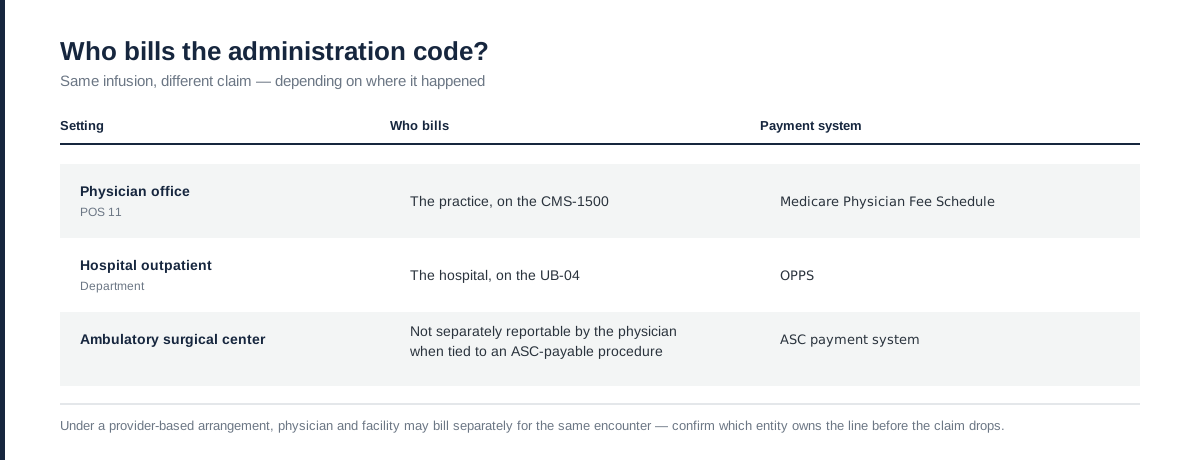
The same infusion generates a different claim depending on where it was performed and which entity employs the nurse who administered it.
| Setting | Who Bills the Administration Code | Payment System |
|---|---|---|
| Physician office (POS 11) | The practice, on the CMS-1500 | Medicare Physician Fee Schedule |
| Hospital outpatient department | The hospital, on the UB-04 | OPPS |
| Ambulatory surgical center | Not separately reportable by the physician when tied to an ASC-payable procedure | ASC payment system |
Practices operating under a provider-based arrangement where the physician and the facility bill separately for the same encounter see this trip up billing teams constantly. Confirming which entity owns the administration line, before the claim drops, prevents a clean denial on an otherwise correctly coded service.
Why Chemotherapy Claims Get Denied
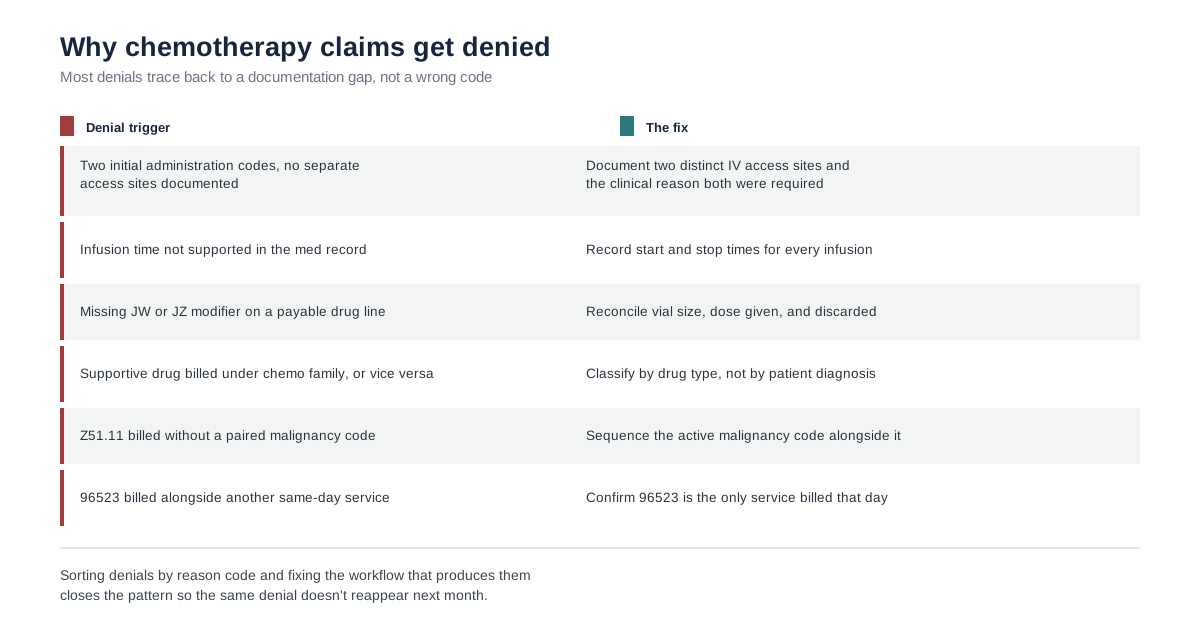
Most chemotherapy denials trace back to a documentation gap rather than an incorrect code. Here are the patterns that show up most often:
| Denial Trigger | The Fix |
|---|---|
| Two initial administration codes on one encounter, no separate access sites documented | Document two distinct IV access sites and the clinical reason both were required |
| Infusion time not supported in the medication record | Record start and stop times for every infusion, not just the total |
| Missing JW or JZ modifier on a separately payable drug line | Reconcile vial size, dose given, and dose discarded before the claim is submitted |
| Supportive drug billed under the chemotherapy family, or vice versa | Classify by drug type, not by patient diagnosis |
| Z51.11 billed without a paired malignancy code | Sequence the active malignancy code alongside Z51.11 on every chemotherapy encounter |
| 96523 billed alongside another same-day administration service | Confirm 96523 is the only service billed that day, or don’t bill it |
Working denials one at a time recovers individual claims. Sorting denials by reason code and fixing the workflow that produces them the nursing template, the scheduling process, the pre-submission checklist closes the pattern so the same denial doesn’t reappear next month.
Prior Authorization on High-Cost Chemotherapy and Biologics
Authorization denials are more expensive than coding denials because the drug has already been administered by the time the denial arrives. Commercial payers have expanded prepayment review on high-cost biologics, immunotherapy agents, and specialty infusions, and most authorization requests want the clinical note establishing diagnosis and stage, prior treatment history, and the specific drug, dose, and regimen.
The most common authorization gap isn’t a missing authorization at all it’s an authorization that no longer matches what’s actually being administered: the cycle count runs out mid-regimen, the authorization expires before the scheduled infusion date, or the regimen changes after cycle one without anyone updating the authorization on file.
Chemotherapy Billing Depends on Clean Payer Enrollment First
None of the coding accuracy in this guide matters if the practice isn’t correctly credentialed and enrolled with the payers it’s billing. A chemotherapy claim with perfect CPT selection, correct J-code units, and a properly applied JW modifier still denies outright if the rendering provider isn’t active with that payer on the date of service and oncology practices expanding into new states or adding infusion capacity run into credentialing timelines that are just as detailed as the coding rules above.
If your practice is expanding into Pennsylvania, our guide to insurance credentialing in Pennsylvania walks through the state’s fragmented Blue Cross Blue Shield landscape, PROMISe Medicaid enrollment, and the documentation that most commonly stalls a commercial application. For practices enrolling with Alabama Medicaid including infusion and specialty practices that need to track ordering, prescribing, and referring (OPR) enrollment separately from billing enrollment our Alabama Medicaid provider enrollment guide covers the 2026 rule changes, documentation requirements, and revalidation deadlines that directly affect whether an infusion claim is even payable.
Both credentialing status and coding accuracy have to be right at the same time for a chemotherapy claim to clear one doesn’t compensate for the other.
In-House vs. Outsourced Oncology Billing
Chemotherapy billing carries more failure points per claim than almost any other specialty: time-based administration codes, a separate drug line with its own unit logic, wastage modifiers, sequencing rules that ignore the actual order of services, and authorization tracking against a regimen that can change mid-cycle.
In-house billing carries fixed costs salary, benefits, training, software, and the coverage gap when a biller is out regardless of whether collections rise or fall that month. Outsourced billing converts that fixed cost into a percentage of what’s actually collected, which is why most growing infusion practices eventually run the numbers on both models side by side.
Credexa Solutions supports oncology and infusion practices across the full revenue cycle coding accuracy on chemotherapy administration and J-code lines, JW/JZ modifier reconciliation, denial management, AR follow-up, prior authorization tracking, and payer credentialing so that a claim’s coding accuracy and its payer enrollment status are managed inside the same system rather than by two disconnected vendors. If your practice is evaluating whether to bring chemotherapy billing in-house or hand it to a dedicated team, reach out to Credexa Solutions for a review of your current claim denial patterns before deciding.
Chemotherapy CPT Code FAQs
When do you use 96413 instead of 96365? Use 96413 when the infused drug is an antineoplastic agent, a monoclonal antibody, or another highly complex biologic regardless of the patient’s diagnosis. Use 96365 for antibiotics, antiemetics, and other therapeutic or diagnostic drugs. Drug classification decides the family, not the reason the patient is in the chair.
What does CPT code 96450 cover? CPT 96450 covers chemotherapy administration into the central nervous system, including intrathecal administration, and it includes the spinal puncture as part of the same service the puncture isn’t billed separately. The drug still bills on its own J-code line.
Is CPT 96413 always chemotherapy? Yes. CPT 96413 covers the initial hour of an IV chemotherapy infusion, and it also applies to monoclonal antibodies and other highly complex biologics, including when those drugs are given for non-cancer diagnoses.
Does 96413 require a pump? No. A pump is not required for 96413 or 96415. Pump-based prolonged infusions over 8 hours are billed under 96416 instead.
What’s the difference between 96401 and 96402? Both cover subcutaneous or intramuscular chemotherapy injections. 96401 is for non-hormonal antineoplastic agents like methotrexate; 96402 is for hormonal antineoplastic agents like leuprolide (Lupron) and goserelin (Zoladex). Both are billed once per drug per encounter, regardless of injection site count.
How many units of 96401 can be billed in one encounter? Once per drug per encounter, even if that dose required multiple injection sites. Two distinct non-hormonal antineoplastic drugs given in the same visit can support a second unit with an appropriate distinct-service modifier, subject to current NCCI edits and payer-specific policy.
What is the JW modifier used for in chemotherapy billing? JW reports the portion of a single-dose vial that was drawn up but not administered to the patient the discarded amount. It’s required on separately payable Part B drug lines where wastage occurred, and JZ is required on those same lines when nothing was discarded.
Do chemotherapy CPT codes require prior authorization? Most high-cost chemotherapy drugs and biologics require prior authorization from commercial payers, though the administration code itself is typically not separately authorized — the authorization attaches to the drug (the J-code) and the specific regimen, cycle count, and dose.
Who bills the chemotherapy administration code the physician or the facility? In a physician office (POS 11), the practice bills the administration code on the CMS-1500. In a hospital outpatient department, the hospital bills it on the UB-04 under OPPS. In an ambulatory surgical center, it’s generally not separately reportable by the physician when tied to an ASC-payable procedure.
Final Thoughts
Chemotherapy CPT codes reward precision and punish shortcuts. The codes themselves are a relatively small, stable range, but the rules layered on top of them sequencing hierarchy, time thresholds, wastage modifiers, and drug classification — are where claims actually succeed or fail. Getting the coding right starts with a documentation workflow that captures start and stop times, lesion counts, drug classification, and wastage amounts at the point of care, not after the claim has already been submitted.
If chemotherapy denials, J-code underpayments, or stalled payer credentialing are cutting into your infusion suite’s revenue, Credexa Solutions can review your current claims and identify exactly where the gaps sit. Contact our team to get started.
Credexa Solutions provides medical billing, coding, credentialing, and revenue cycle management support to healthcare practices nationwide, including oncology and infusion-heavy specialties. Learn more at credexasolution.com.