Ask ten billers “what’s the ICD-10 code for ADHD?” and nine will say F90.9. That answer is technically true and practically dangerous. F90.9 is only one code inside a five-code family, and it’s the one payers scrutinize hardest because it says the least.
Here’s the pattern that shows up in almost every behavioral health, pediatric, and primary care claims audit we run: the provider documents a specific ADHD presentation in the note, the coder defaults to F90.9 out of habit, and the claim either underpays, gets flagged for records, or denies outright when it’s bundled with a CPT code the diagnosis doesn’t fully support.
None of that is a coding mystery. It’s a workflow gap between what the chart says and what lands on the claim. This guide closes that gap. It covers the full F90 family, when each code applies, how ADHD pairs with CPT codes for evaluations, therapy, testing, and medication management, what documentation actually needs to say to survive payer review, how “rule out ADHD” should be handled on outpatient claims, comorbidity coding under Excludes2 rules, and the specific things changing ADHD billing in 2026 including stimulant access and telehealth prescribing rules that are quietly affecting medical necessity documentation for medication management visits.
This is written for billing managers, coders, and behavioral health, pediatric, and primary care practices who want the ADHD claim to be right the first time, not fixed after a denial.
Key Takeaways
- ADHD is classified under ICD-10-CM category F90.-, with five billable codes: F90.0, F90.1, F90.2, F90.8, and F90.9.
- F90.9 (unspecified type) is valid only when ADHD is confirmed but the provider hasn’t documented a specific presentation it is not a default.
- F90.2 (combined type) is the most commonly billed ADHD code because it’s the most common clinical presentation in both children and adults.
- Outpatient claims should never code “rule out ADHD” as confirmed ADHD code the presenting symptoms instead until the diagnosis is confirmed.
- ADHD frequently carries Excludes2 relationships with anxiety, mood disorders, and pervasive developmental disorders meaning both conditions can often be coded together when documented and clinically relevant.
- CPT codes for evaluation (90791/90792), testing (96130-96139), therapy (90832/90834/90837), and E/M medication management (99213-99215) all have to align with the F90.x code selected mismatches are one of the top ADHD denial triggers.
- 2026 brings real operational pressure on ADHD medication management visits: the DEA’s telehealth flexibility for controlled substances runs through December 31, 2026, and stimulant supply constraints mean refill and access documentation now carries more billing weight than it used to.
- Getting ADHD claims paid cleanly is a documentation-to-claim workflow problem, not a single-code problem which is where a dedicated RCM partner like Credexa Solutions earns its keep.
What Is the ADHD ICD-10 Code?
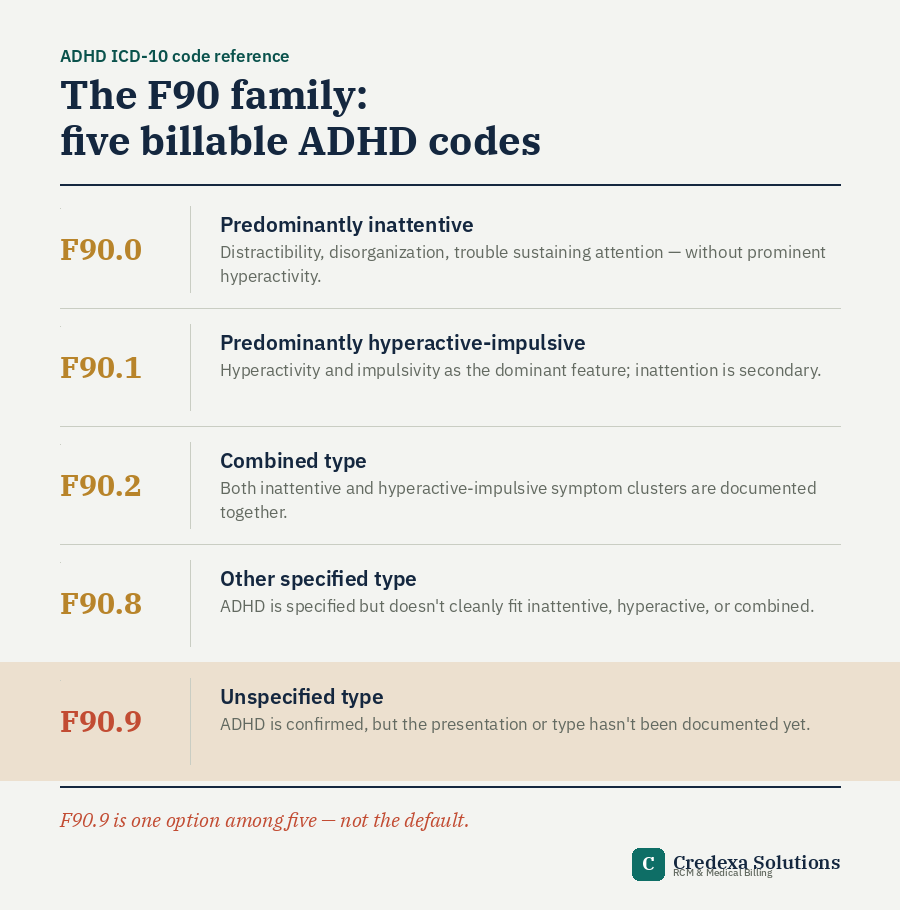
ADHD sits in ICD-10-CM under category F90 Attention-deficit hyperactivity disorders, inside the broader mental, behavioral, and neurodevelopmental disorders chapter. F90 itself is a category header, not something you can bill directly. To submit a clean claim, you need one of the five billable subcodes under it:
| Code | Official Description |
|---|---|
| F90.0 | ADHD, predominantly inattentive type |
| F90.1 | ADHD, predominantly hyperactive type |
| F90.2 | ADHD, combined type |
| F90.8 | ADHD, other type |
| F90.9 | ADHD, unspecified type |
Every one of these is billable and payer-recognized, but they are not interchangeable. Each represents a different clinical presentation, and payers increasingly expect the note to support the specific one chosen not just the diagnosis in general.
The confusion around F90.9 being “the” ADHD code is understandable. It’s the code most people can recall, it shows up in the most search results, and it’s genuinely the right code in a specific, narrower situation: when ADHD is confirmed but the type has not yet been determined or documented. It was never meant to be the house default for every ADHD chart that crosses a coder’s desk.
The Full F90 Code Table: When Each ADHD Code Applies
Coders, EHR templates, and answer engines all want this in one clean reference. Here it is, matched to the clinical documentation that should be behind each code.
| ICD-10 Code | Clinical Presentation | Use When the Note Documents | Common Billing Pitfall |
|---|---|---|---|
| F90.0 | Predominantly inattentive | Difficulty sustaining attention, distractibility, disorganization, without prominent hyperactivity | Legacy “ADD” documentation gets coded correctly here, not overlooked |
| F90.1 | Predominantly hyperactive-impulsive | Hyperactivity, impulsivity, restlessness as the dominant feature, inattention secondary | Rarely billed in isolation often mistakenly coded as combined type |
| F90.2 | Combined type | Both inattentive and hyperactive-impulsive symptom clusters documented together | Most frequently billed ADHD code also the one payers audit most for specificity |
| F90.8 | Other specified type | ADHD is specified but doesn’t cleanly fit F90.0, F90.1, or F90.2 | Under-used because coders default to F90.9 instead of reading the note closely |
| F90.9 | Unspecified type | ADHD confirmed, but presentation/type not yet documented | Overused as a default rather than reserved for genuinely unspecified cases |
F90.0 ADHD, Predominantly Inattentive Type
This is the code for patients whose primary struggle is attention regulation rather than hyperactivity: missed details, trouble following through, losing track of tasks, and disorganization. A lot of providers still write “ADD” in the note out of habit from pre-DSM-IV-TR terminology. That’s fine clinically, but coding should still follow the documented presentation an inattentive picture, however it’s labeled in the note, maps to F90.0.
F90.1 ADHD, Predominantly Hyperactive-Impulsive Type
This is the least common billed code in the family, largely because pure hyperactive-impulsive presentation without any inattentive component is clinically less frequent, especially in adults. When it is documented, though, it needs its own code not a default to combined type just because “ADHD” is in the note.
F90.2 ADHD, Combined Type
Combined type is the workhorse of ADHD coding. It applies when the note documents both inattentive and hyperactive-impulsive symptom clusters, which is the most common presentation across pediatric and adult populations. Because it’s billed so often, it also draws the most payer attention the record needs to actually show both symptom domains, not just state “ADHD, combined” without support.
F90.8 ADHD, Other Type
This code exists for a real clinical gap: ADHD that’s specified in the note but doesn’t map cleanly to inattentive, hyperactive, or combined presentation. It’s underused in practice, mostly because coders reach for F90.9 by reflex rather than reading closely enough to see that the provider actually specified something just not one of the three main types.
F90.9 ADHD, Unspecified Type
F90.9 belongs on a claim when ADHD is confirmed and the type genuinely isn’t documented often true early in a diagnostic workup, or when a note simply says “ADHD” without further detail. It is a legitimate, billable code. The problem isn’t that F90.9 exists; it’s that it gets used as the path of least resistance even when the chart supports something more specific.
When Should F90.9 Actually Be Used?
Quick answer: Use F90.9 only when the provider has confirmed an ADHD diagnosis but hasn’t documented which presentation applies. If the note supports inattentive, hyperactive, combined, or another specified type, code to that level of detail instead.
F90.9 Is Correct When the Chart Doesn’t Specify a Type
If a provider’s note reads “ADHD, confirmed” with no further breakdown, F90.9 is the honest code. It reflects exactly what’s known nothing more, nothing padded. There’s no penalty for using it correctly.
F90.9 Becomes a Problem When It Replaces a Specific Code
The trouble starts when F90.9 gets used as a shortcut even though the note clearly documents inattentive, hyperactive, or combined symptoms. That’s not a neutral choice it understates what the provider actually recorded, and it’s exactly the pattern payers are trained to notice on ADHD claims, since F90.9 volume has become a known auditing signal in behavioral health billing.
Why Overreliance on F90.9 Creates Downstream RCM Problems
When unspecified codes climb as a share of a practice’s ADHD claims, a few things tend to follow: medical record requests increase, medical necessity reviews slow claims down, and comorbidities that should be riding along on the claim get dropped because nobody went back to the note to check. None of this is guaranteed on any single claim but the pattern compounds across volume, and it’s one of the more fixable sources of aging AR in behavioral health practices.
The fix isn’t complicated: before F90.9 goes on a claim, a quick check of whether the note actually supports a more specific F90.x code catches most of this at the source, rather than after a denial or records request arrives.
Can You Code “Rule Out ADHD” on an Outpatient Claim?
Direct answer: No. For outpatient encounters, a suspected or “rule out” diagnosis should not be coded as if it were confirmed. Code the symptoms, signs, or reason for the visit instead, until the provider documents a confirmed ADHD diagnosis.
This is one of the more common and more avoidable coding mistakes in behavioral health and pediatric billing. Inpatient coding rules allow coding to the highest degree of certainty even for uncertain diagnoses. Outpatient rules work differently: a “rule out,” “possible,” “probable,” or “working diagnosis” of ADHD is not the same as a confirmed one, and it shouldn’t be billed as F90.9 or any other F90.x code just because ADHD is the word in the note.
What to Document Instead
While the diagnostic picture is still open, the note should capture the presenting symptoms, the reason for the visit, any screening tools used (rating scales, structured interviews), the current assessment status, and the plan for follow-up. That’s a complete, honest, billable encounter on its own it just isn’t an ADHD diagnosis claim yet.
Why This Matters for Revenue, Not Just Compliance
Coding a suspected diagnosis as confirmed doesn’t just create a compliance question it creates rework. A claim submitted with a premature F90.x code is more likely to draw a records request, get flagged for medical necessity review, or require a corrected claim once the actual diagnosis lands. All of that costs more staff time than getting the initial claim right, and it’s entirely avoidable with a documentation review step before submission something worth building into intake workflow for any practice doing ADHD evaluations, which our broader revenue cycle management guide covers in more depth for practices building or tightening a front-end claims process.
ADHD Documentation That Actually Supports Billing and Medical Necessity
Coding accuracy is downstream of documentation quality. A well-documented ADHD note makes the code choice obvious and makes the claim defend itself if a payer asks questions. A thin note leaves even a correctly chosen code exposed. Five elements do most of the work:
1. A Clearly Stated ADHD Diagnosis
Coders cannot infer a diagnosis from symptoms, screening scores, or a parent’s or patient’s complaint alone. The provider has to state that ADHD is the diagnosis. Rating scale results and reported symptoms support the picture but don’t substitute for a documented diagnostic statement.
2. The Specific Presentation or Type
The note needs to say which presentation applies inattentive, hyperactive, combined, other, or genuinely unspecified. When this is unclear, the right move for a coder is a provider query, not an automatic drop into F90.9. One clarifying question protects both the specificity of the code and the amount the claim ultimately collects.
3. Functional Impairment
Claims hold up better when the record shows how ADHD is actually affecting the patient’s life school performance, workplace function, relationships, daily task completion. This is the backbone of medical necessity, and it’s usually what a payer looks for first if a claim gets a second look.
4. Comorbid Conditions That Affect Care
Anxiety, depression, learning disorders, sleep disorders, autism spectrum disorder, tic disorders, and substance use disorders frequently co-occur with ADHD. When the provider documents them and they influence the treatment plan, they belong on the claim not as padding, but because they’re part of the clinical picture the payer needs to understand what’s being treated.
5. Medication Management Detail
For medication visits, the note should capture treatment response, side effects, dose changes, and increasingly relevant in 2026 refill and access barriers. This isn’t a minor documentation nicety anymore. National data has shown a large share of adults on stimulant medication reporting difficulty filling prescriptions due to supply issues, and documenting that barrier is now a meaningful part of showing what actually happened at a medication management visit, not an afterthought.
2026 Update: What’s Actually Changing in ADHD Billing This Year
The F90 code family itself hasn’t changed in FY2026 there are no new ADHD subcodes and none have been retired. But three things are shifting the ground underneath ADHD claims this year, and none of them show up if you’re only looking at the code set.
Stimulant Supply Constraints Are Still Affecting Medication Management Visits
The ADHD stimulant shortage that began in 2022 has not fully resolved. Several stimulant formulations, including generic immediate-release amphetamine salts and generic lisdexamfetamine, remain intermittently short in 2026 even as production quotas have been raised. For billing, this means medication management encounters increasingly involve non-stimulant bridging, formulation switches, and pharmacy coordination all of which should be reflected in the note if the visit’s complexity is going to be reflected in the E/M level billed.
Telehealth Prescribing Flexibility Runs Through the End of 2026
The DEA’s telehealth flexibility allowing controlled substance prescribing including ADHD stimulants without a prior in-person visit has been extended for a fourth time and currently runs through December 31, 2026. No permanent telemedicine prescribing rule has been finalized as of this year. For practices delivering ADHD medication management via telehealth, this means the current flexibility is real but not indefinite, and documentation should still reflect real-time audio-visual encounters rather than audio-only visits, since audio-only doesn’t satisfy the requirement for Schedule II prescribing.
Specificity Discipline Is the Actual 2026 Priority
With no code changes to chase, the real 2026 task for ADHD billing teams is process discipline: confirming you’re working from the current ICD-10-CM code set for the applicable date of service, and holding the line on picking the most specific F90.x code the documentation supports rather than defaulting to F90.9. That’s not a glamorous update, but it’s the one that actually moves denial rates.
ADHD Comorbidities, Excludes2 Notes, and Code Specificity
ADHD rarely appears in isolation, and coding it well means understanding how it interacts with commonly co-occurring conditions.
Excludes2 Doesn’t Mean “Never Code Together”
This is one of the more misunderstood conventions in ICD-10-CM. An Excludes2 note means the excluded condition is not part of the condition being coded but the patient can still have both, and both can often be coded together when documented and clinically relevant. Several ADHD-adjacent code blocks carry Excludes2 relationships worth knowing:
- Anxiety disorders (F40.-, F41.-)
- Mood disorders (F30–F39)
- Pervasive developmental disorders (F84.-)
- Schizophrenia and related disorders (F20.-)
Treating an Excludes2 note as a blanket “never code together” rule is a quiet way to drop a valid, clinically relevant second diagnosis from a claim.
Common ADHD Comorbidities and Their Billing Relevance
| Comorbidity | Why It Matters for the Claim |
|---|---|
| Anxiety disorders | Affects treatment planning, medical necessity, and visit complexity |
| Depression / mood disorders | Requires its own documented diagnosis and often changes the treatment plan |
| Autism spectrum disorder | Affects evaluation type, therapy planning, and payer review |
| Learning disorders | Supports need for assessment, coordination, or therapy services |
| Sleep disorders | May mimic or worsen ADHD symptoms and affect clinical assessment |
| Substance use disorders | Affects medication management approach and risk documentation |
| Tic disorders / Tourette syndrome | Affects medication choice and monitoring frequency |
The coding principle here is simple: comorbidity capture is a documentation-follows-provider issue, not something a coder adds independently. When a comorbid condition is documented and it’s shaping the visit, it should ride along on the claim leaving it off understates the actual complexity of the encounter.
CPT Codes Commonly Paired With ADHD ICD-10 Codes
The ICD-10 code explains why a patient is being treated. The CPT code explains what service happened. For a clean ADHD claim, the note has to support both and the two have to make sense together.
| CPT Code | Service | ADHD Billing Context |
|---|---|---|
| 90791 | Psychiatric diagnostic evaluation | Common for the initial behavioral health evaluation without medical services |
| 90792 | Psychiatric diagnostic evaluation with medical services | Used when the initial evaluation includes a medical/prescribing component |
| 96127 | Brief emotional/behavioral assessment | Frequently tied to ADHD screening or rating-scale administration |
| 96130–96131 | Psychological testing evaluation services | Applies when formal psychological testing evaluation is documented |
| 96136–96137 | Test administration and scoring | Applies when standardized ADHD testing is administered and scored |
| 90832 | Psychotherapy, 30 minutes | For shorter, medically necessary therapy sessions |
| 90834 | Psychotherapy, 45 minutes | The most common behavioral health therapy visit length |
| 90837 | Psychotherapy, 60 minutes | Longer sessions when time documentation supports it |
| 99213–99215 | E/M follow-up visit | Common for medication management and follow-up when documentation supports the level billed |
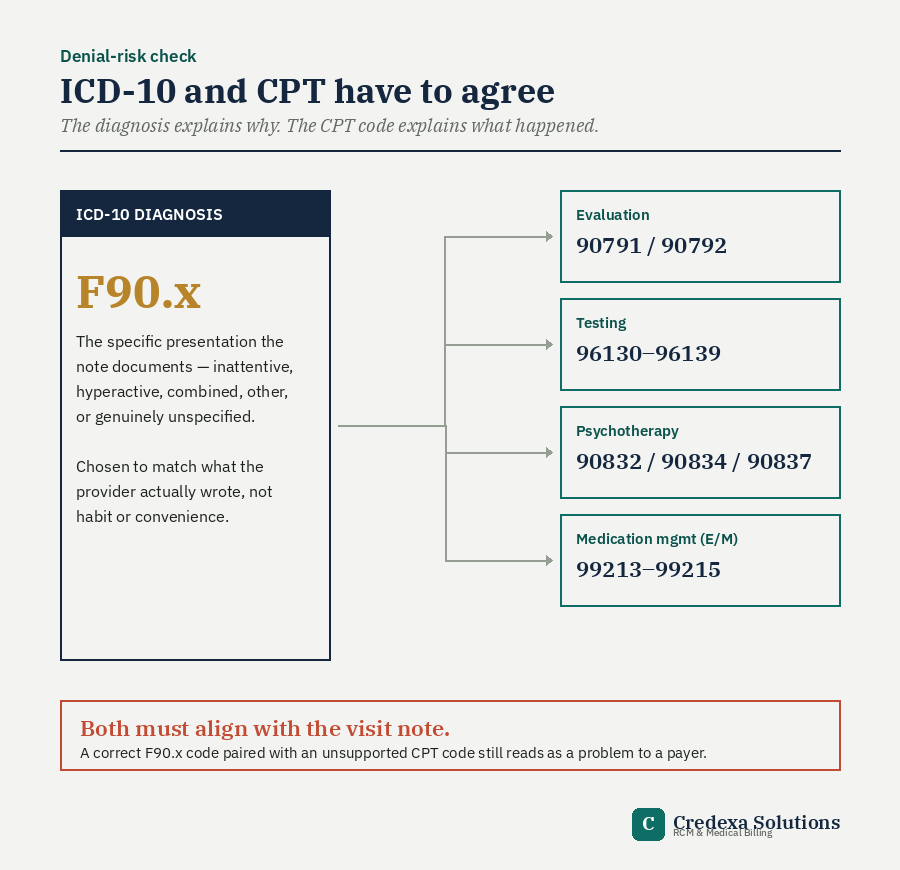
Why CPT and ICD-10 Alignment Is the Actual Denial Risk
A technically correct F90.x code paired with a CPT code the note doesn’t support still reads as a problem to a payer. Diagnosis coding supports medical necessity; it doesn’t automatically guarantee coverage on its own the service billed still has to be reasonable, necessary, and consistent with what the payer’s coverage policy requires for that CPT code. This is exactly where imaging, lab, and specialty claims run into the same structural issue our radiology CPT codes and modifiers guide breaks down how the same diagnosis-to-service alignment problem plays out in a completely different specialty, if you’re comparing denial patterns across service lines.
Adult ADHD: Why Documentation Habits Built for Pediatrics Don’t Transfer Cleanly
A lot of ADHD documentation and coding habits were built around pediatric practice, where the diagnostic pathway is more standardized and the presentation is usually caught earlier. Adult ADHD billing has quietly become a much bigger share of behavioral health and primary care volume, and it doesn’t always fit the same template.
Adult patients are more likely to present with an established pattern of impairment across years rather than a single triggering incident, more likely to have a comorbid anxiety, mood, or substance use diagnosis already on the chart, and more likely to be starting ADHD treatment for the first time well into adulthood rather than transferring a childhood diagnosis. None of that changes which F90.x code applies, but it does change what the note needs to say to support medical necessity functional impairment has to be described in adult terms (job performance, financial management, relationship strain) rather than the school-based language that dominates pediatric templates.
It also changes the CPT mix. Adult ADHD evaluations lean more heavily on structured self-report and collateral history than on classroom observation, and medication management follow-ups tend to run longer given the higher rate of comorbid conditions being managed at the same visit. Billing teams that only tune their ADHD workflow around pediatric documentation patterns are the ones most likely to see thin notes and downcoded E/M visits on the adult side of their panel.
ICD-11 and ADHD: Does It Change Anything for U.S. Billing Right Now?
Short answer: no, not yet. ICD-11 exists and is used internationally, but the United States continues to bill under ICD-10-CM for all current claims. There’s no active transition timeline that changes how ADHD should be coded today. The practical guidance here is simple use ICD-10-CM for every current claim, and treat any future ICD-11 transition announcement as a separate project to plan for when it’s actually scheduled, not something to anticipate in today’s documentation or code selection.
Common ADHD Claim Denials and How to Prevent Them
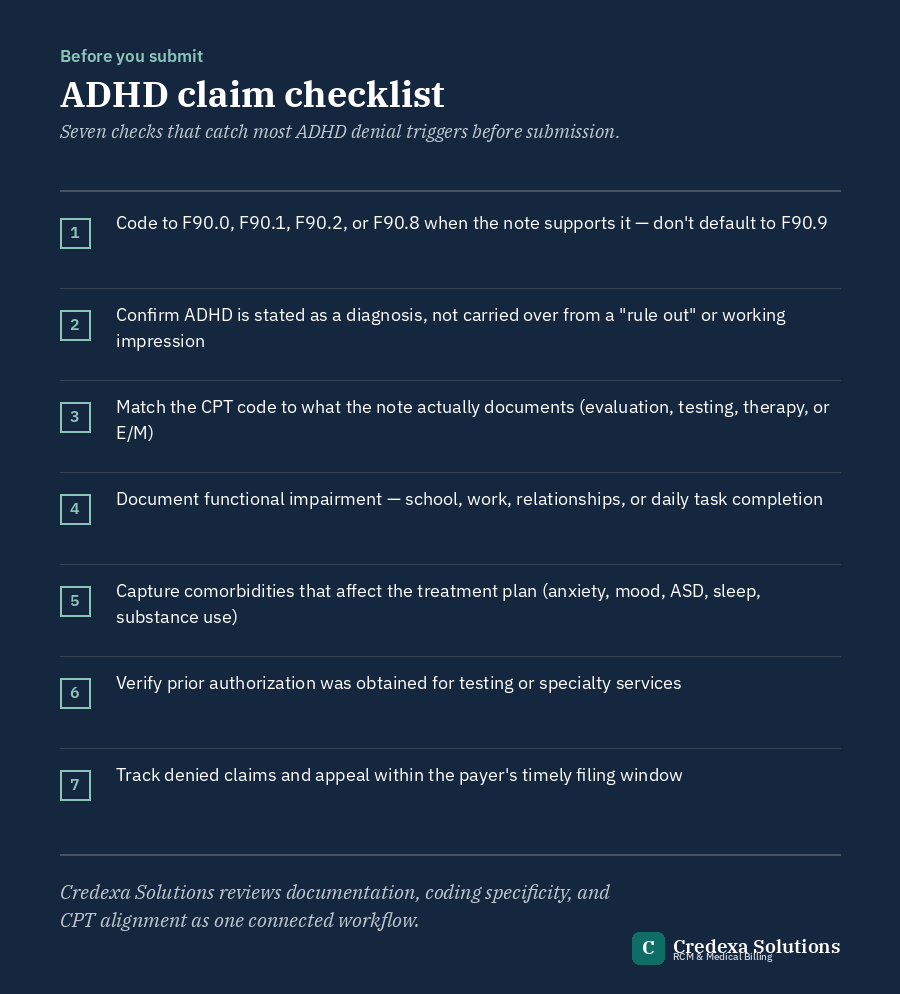
Most ADHD denials cluster around a short, predictable list of triggers.
| Denial or Delay Trigger | Why It Happens | Prevention Step |
|---|---|---|
| F90.9 used when a specific type is documented | Missing code specificity | Code to F90.0, F90.1, F90.2, or F90.8 when the note supports it |
| Rule-out ADHD coded as confirmed | Diagnosis wasn’t actually confirmed at the encounter | Code to the highest certainty actually known for that visit |
| CPT and ICD-10 mismatch | The billed service doesn’t align with the diagnosis on record | Cross-check note, diagnosis, and CPT code before submission |
| Missing functional impairment documentation | Medical necessity reads unclear | Document impact on school, work, home, or daily functioning |
| Missing comorbidity capture | Patient complexity is understated on the claim | Code documented conditions that affect the treatment plan |
| Prior authorization not obtained | Payer required authorization for testing or a specific service | Verify benefits and authorization requirements before the visit |
| Denied claim left unresolved | No follow-up before the payer’s appeal window closes | Track and appeal within the payer’s specific timely filing rules |
Front-End Review Beats Back-End Appeals
Nearly every one of these triggers is preventable before submission a documentation gap, a vague code, a missed authorization, or a mismatched CPT pairing are all catchable at intake or coding review. Catching them there costs minutes. Catching them after a denial costs weeks, and it puts the claim on the clock against the payer’s appeal deadline which varies significantly by payer and plan type, something our BCBS timely filing limit guide walks through in detail if ADHD claims from Blue Cross Blue Shield plans are part of what’s sitting in your denial queue.
Frequently Asked Questions About ADHD ICD-10 Codes
What is the ICD-10 code for ADHD? ADHD is coded under the F90.- family in ICD-10-CM. The five billable codes are F90.0, F90.1, F90.2, F90.8, and F90.9. F90.9 is the unspecified code it’s one option among five, not the default answer.
Is F90.9 the main ADHD diagnosis code? No. F90.9 is the unspecified-type code, appropriate only when ADHD is confirmed but the presentation hasn’t been documented. When the chart supports a specific type, that more specific F90.x code is the correct choice.
What’s the difference between F90.2 and F90.9? F90.2 is combined-type ADHD, used when both inattentive and hyperactive-impulsive features are documented. F90.9 is unspecified type, used only when the presentation isn’t documented at all. When the note supports the detail, F90.2 is the more defensible code.
Can rule-out ADHD be billed as ADHD? Not on outpatient claims. A suspected, probable, or “rule out” ADHD diagnosis should be coded to the presenting symptoms or reason for the visit until the provider confirms the diagnosis.
Can ADHD be coded alongside anxiety or depression? Yes, when both conditions are documented by the provider and both affect the treatment plan. Excludes2 notes on adjacent code blocks don’t prevent coding both conditions together they simply clarify that one isn’t inherently part of the other.
What CPT codes commonly pair with ADHD ICD-10 codes? Common pairings include 90791/90792 for evaluation, 96127 and 96130–96137 for screening and testing, 90832/90834/90837 for psychotherapy, and 99213–99215 for medication management follow-up. The correct pairing always depends on the documented service, not the diagnosis alone.
Does the ADHD stimulant shortage affect billing? Indirectly, yes. It affects what medication management visits actually involve non-stimulant bridging, formulation changes, pharmacy coordination and that added complexity should be reflected in the note supporting the E/M level billed.
Who can help a practice clean up ADHD coding and denial patterns? An RCM partner that reviews documentation, coding specificity, CPT pairing, and denial follow-up as one connected workflow rather than treating ADHD coding as an isolated task is generally the fastest way to reduce recurring denials on ADHD claims. That’s the kind of end-to-end review Credexa Solutions works through with behavioral health, pediatric, and primary care practices.
Final Takeaway
ADHD billing isn’t hard because the codes are complicated five codes in one family is a short list by ICD-10 standards. It’s hard because the discipline required is easy to skip under volume: reaching for F90.9 instead of reading the note, coding a suspected diagnosis as confirmed, or letting a CPT code go out that the diagnosis doesn’t quite support.
Fix the workflow documentation review, specific code selection, CPT alignment, and fast denial follow-up and the ADHD claim mostly takes care of itself. That’s the piece worth auditing before the next denial report shows the pattern again, not after.
If ADHD claims are showing up in your denial or aging AR reports more than they should, Credexa Solutions can walk through your current documentation and coding workflow and show exactly where the gap is.