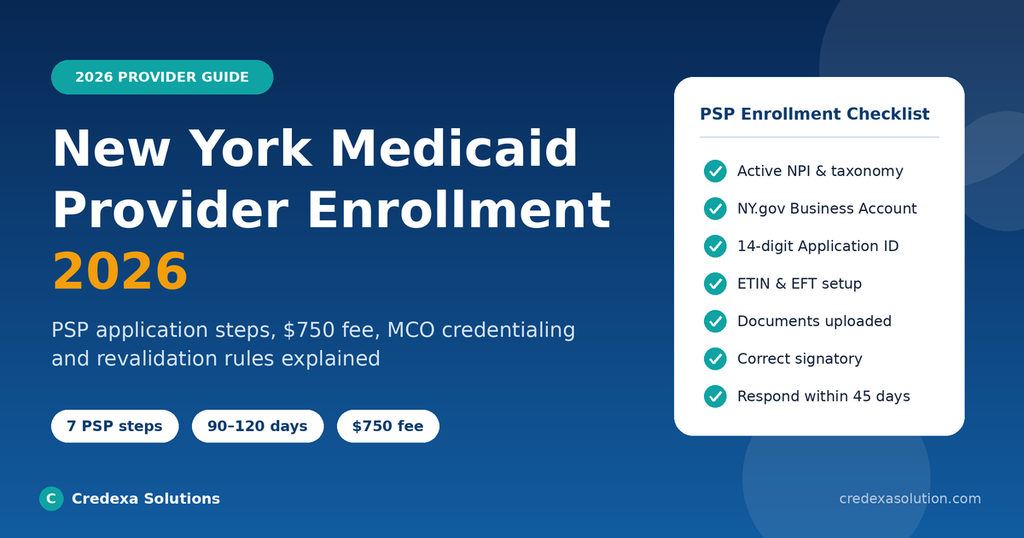
New York Medicaid provider enrollment has changed more in the last twelve months than in the previous decade. Every new provider now applies through a single online system, the Provider Services Portal (PSP), and the paper pathway that many practices relied on closed in July 2026. If your application contains a wrong signature, an outdated form, or a missed deadline, the state does not quietly fix it. It returns, withdraws, or deletes the file, and you start again.
That matters because enrollment is a cash-flow event. A provider who cannot bill NYS Medicaid cannot get paid for Medicaid patients, and a restart commonly adds three to four months to the timeline. This guide explains how NY Medicaid provider enrollment works in 2026: the three enrollment tracks, the seven-step PSP process, required documents, the three internal timers that cancel applications, the fee, how to check your enrollment status, MCO credentialing, revalidation, and the compliance rules that apply after you are approved.
Use it as a working checklist before you open the portal.
NY Medicaid Provider Enrollment at a Glance (2026)
| Topic | What to know |
|---|---|
| Where to apply | NYS Provider Services Portal (PSP) |
| Access requirement | NY.gov Business Account |
| Application fee | $750 for institutional providers; physicians and non-physician practitioners are exempt |
| Typical review time | 90 to 120 days from a complete submission |
| Paper applications | Closed as of July 2026 |
| Revalidation | Every five years, filed through PSP since May 1, 2026 |
| State help line | eMedNY Call Center, (800) 343-9000 |
| Enrollment email | providerenrollment@health.ny.gov |
Why New York Medicaid Enrollment Changed in 2026
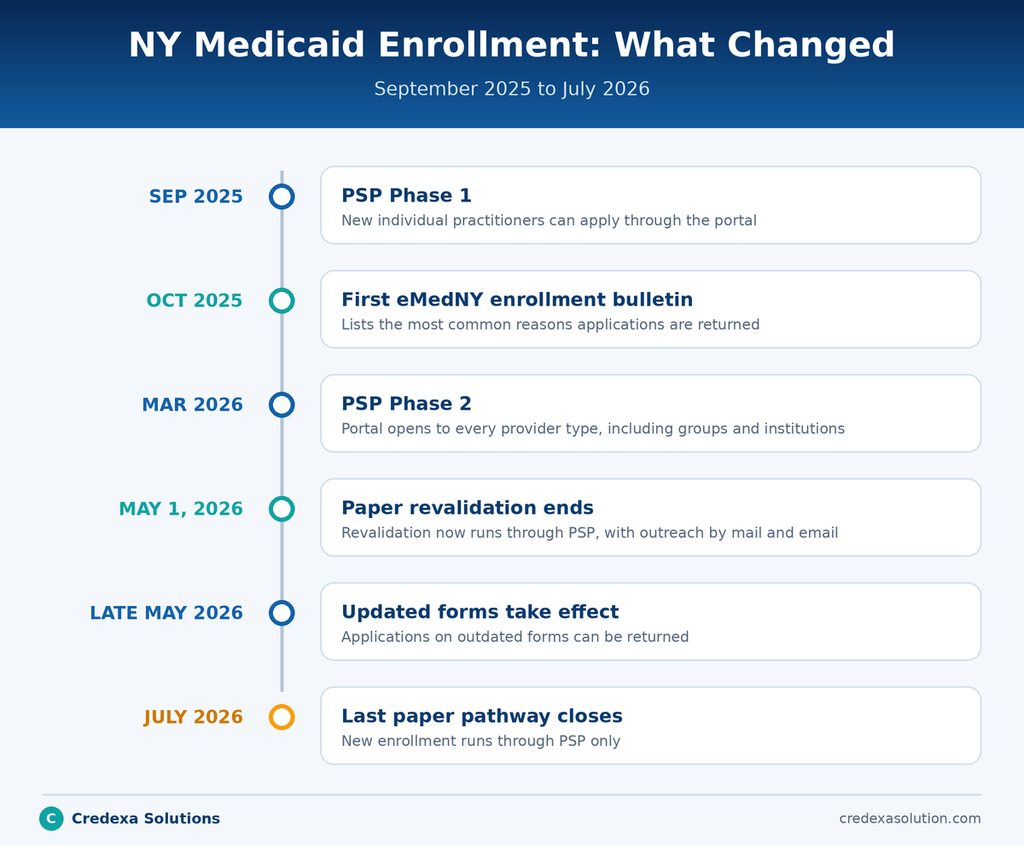
New York rebuilt its Medicaid enrollment system in stages. Understanding the sequence explains why older advice, including advice on many provider forums, no longer works.
- September 2025: PSP Phase 1 opened to new individual practitioners who had never enrolled in NYS Medicaid.
- October 2025: eMedNY published its first enrollment bulletin listing the most common reasons applications were returned.
- March 2026: PSP Phase 2 opened to every provider type, including groups, institutions, and businesses.
- May 1, 2026: Paper revalidation ended. Providers now wait for PSP outreach by mail and email.
- Late May 2026: Updated forms took effect, and applications on outdated versions can be returned.
- July 2026: The last paper enrollment pathway closed.
The state documents these milestones in the NYS Medicaid Update bulletins, including the September 2025 issue and the April 2026 issue. Because managed care plans screen their networks against the state enrollment database, a gap at the state level can ripple into every Medicaid managed care contract you hold.
Step Zero: Pick the Right Enrollment Track
Before you open PSP, decide which of three tracks fits your role. The wrong choice can delay billing or force a full re-enrollment.
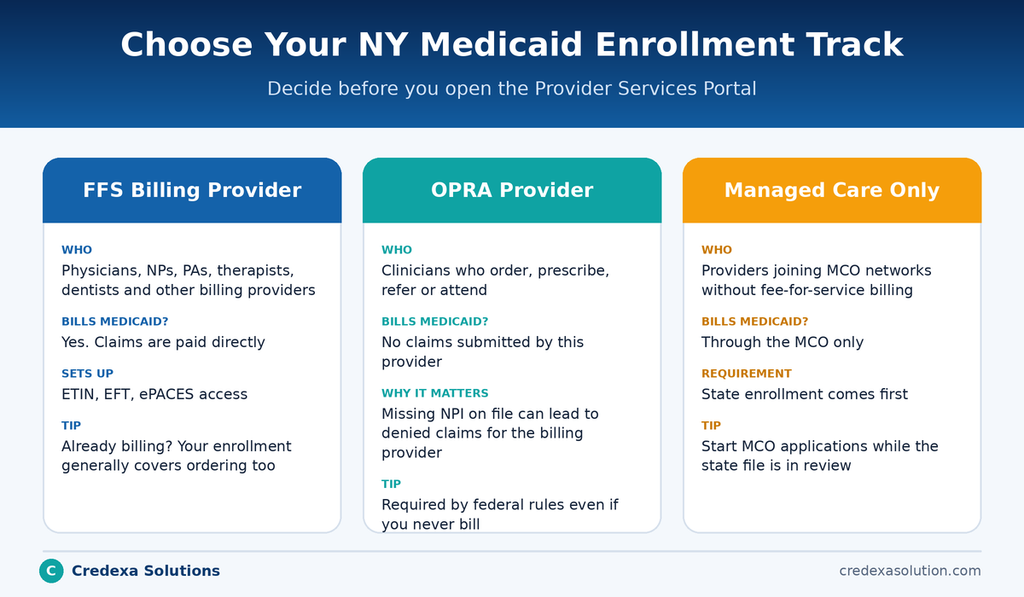
1. Fee-for-service (FFS) billing provider. This is the standard track for physicians, nurse practitioners, physician assistants, therapists, dentists, and other clinicians who submit claims to NYS Medicaid and get paid directly. FFS enrollment also sets up your electronic transmitter identification number (ETIN), electronic funds transfer (EFT), and ePACES access.
2. OPRA provider (ordering, prescribing, referring, attending). Federal rules require clinicians who write orders, prescriptions, or referrals for Medicaid members to be enrolled even if they never bill Medicaid themselves. If an ordering provider’s NPI is missing from the state file, the billing provider’s claims for that service can be denied. A provider who already enrolls as a billing provider generally does not need to file a second OPRA enrollment.
3. Managed care only. Some providers join a Medicaid managed care organization (MCO) network without billing fee-for-service. This track still requires state enrollment first, because MCO credentialing is built on top of it.
If you are unsure, confirm the track with the eMedNY Call Center before you start. A ten-minute call is cheaper than a restart.
Documents You Need Before You Log In
Gather everything first. PSP returns incomplete applications without processing them, and the portal specifications are published on the eMedNY Provider Services Portal page.
All provider types
- An active NPI from NPPES, Type 1 for individuals and Type 2 for organizations, with a taxonomy code that matches the specialty you plan to bill
- Active New York professional license or registration
- W-9 or IRS EIN confirmation
- EFT authorization (new enrollees)
- ETIN Certification Statement (Form 490602 for new enrollees, Form 490501 for providers joining an existing group)
Provider-specific items
- DEA certificate for providers who prescribe, administer, or dispense controlled substances; providers who do not need one complete the state’s no-DEA attestation form
- Prior conduct questionnaire when you answer yes to any conduct disclosure
- Group member affiliation form for group practice members
- Ownership and control disclosures for institutional providers, including identifying details for every disclosed owner
- Pharmacy, hospital, nursing home, or clinic-specific questionnaires where they apply
Download every form from eMedNY on the day you submit. Outdated versions are one of the easiest ways to get an application returned.
How to Enroll in NY Medicaid Through PSP: 7 Steps
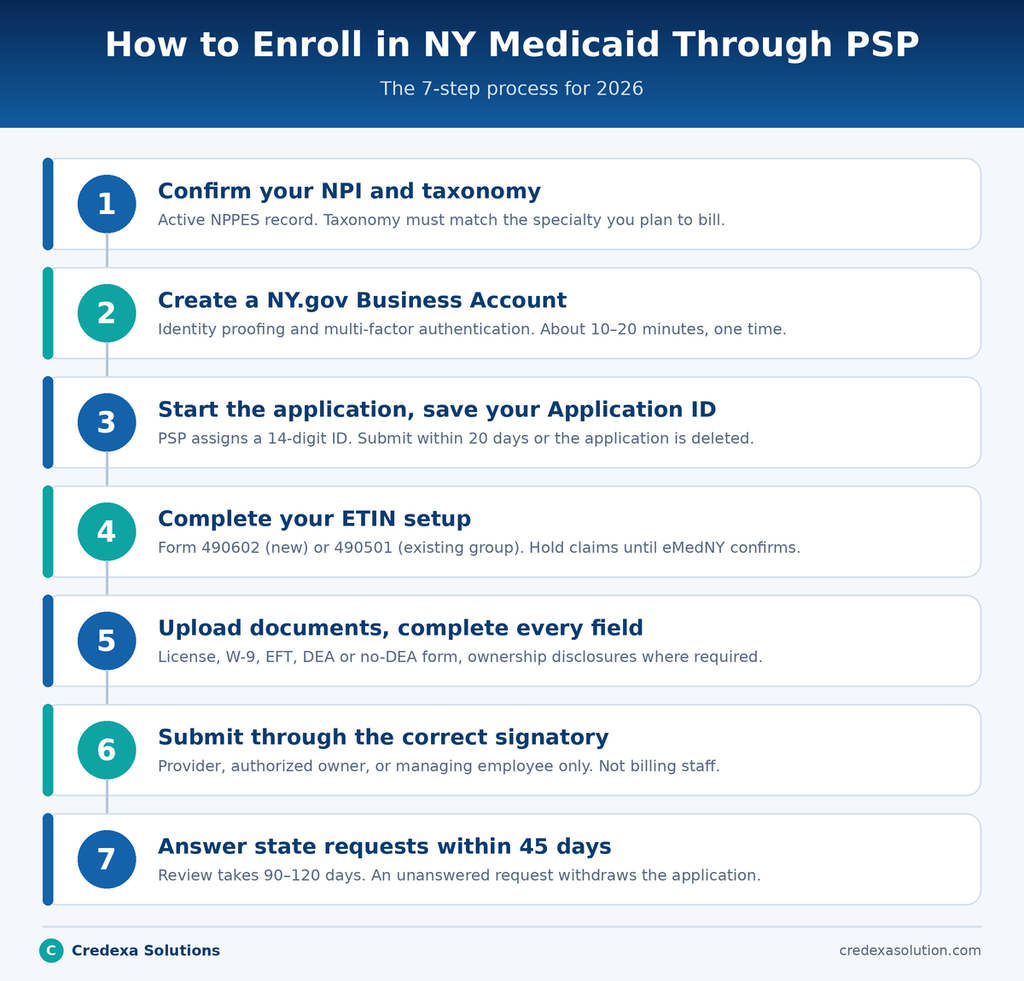
Step 1: Confirm your NPI and taxonomy
Your NPI record must be active and your taxonomy code must match the specialty on your application. A mismatch is a quiet, avoidable rejection. Check NPPES before you do anything else.
Step 2: Create a NY.gov Business Account
PSP access runs through a NY.gov Business Account, not a personal login. Setup involves identity proofing, multi-factor authentication, and email verification, and typically takes 10 to 20 minutes. You only do it once.
Step 3: Start the application and record your Application ID
When you begin an application, PSP assigns a 14-digit Application ID. Write it down and share it with whoever supports you. It is the only reliable way to track progress, respond to state requests, and recover a session that drops.
Step 4: Complete your ETIN setup
The ETIN authorizes you to submit claims through eMedNY. Hold every Medicaid claim until the state confirms your ETIN is active. Claims sent too early are denied, and each resubmission cycle can add 30 to 60 days to payment. The eMedNY Provider Enrollment Guide lists the forms and instructions.
Step 5: Upload documents and complete every required field
Fill every mandatory field and upload each required document. Ownership sections and EFT details are where most incomplete applications fail, so slow down here.
Step 6: Submit through the correct signatory
The provider, authorized owner, or a managing employee must submit the application. If a billing agent or office staffer clicks submit on your behalf, the signature can be rejected. Once submitted, track progress using your Application ID.
Step 7: Answer every state request within 45 days
If the Department of Health asks for more information, you have 45 days to respond inside PSP. Check the portal inbox and the registered email daily during the 90 to 120 day review window.
Three PSP Timers That Can Cancel Your Application
Most providers learn about these timers only after they have lost an application.
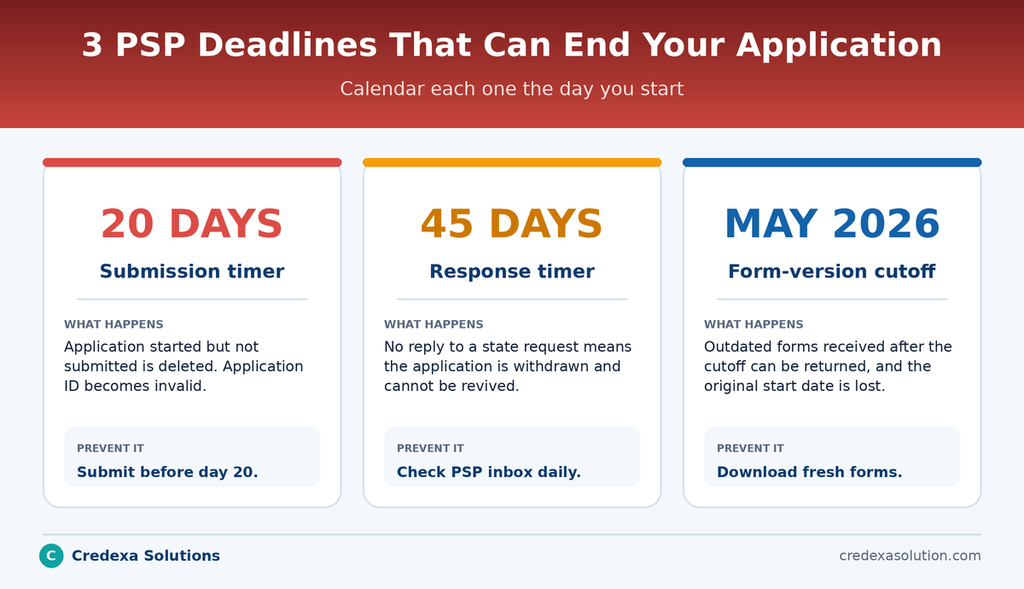
The 20-day submission timer. An application that is started but not submitted within 20 days is deleted. The Application ID becomes invalid and you begin again. The clock starts when you open the application, not when you upload your first document.
The 45-day response timer. If the state requests information and you do not respond in time, the application is withdrawn. A withdrawn file cannot be revived. You file a new application and restart the full review window.
The form-version deadline. Applications on outdated paper forms received after the late-May 2026 cutoff can be returned unprocessed, and a returned application does not keep its original start date.
The practical lesson is the same for all three: assign one named person to own the application, and calendar every deadline the day you start.
NY Medicaid Application Fee in 2026: $750, Exemptions, and Waivers
The application fee for institutional providers is $750 in 2026, up from $730 the year before. CMS adjusts the figure annually under 42 CFR 455.460, and PSP prompts you when the fee applies. It applies to institutional providers who enroll, revalidate, or add a location.
Exemptions apply to:
- Physicians and non-physician practitioners, including nurse practitioners and physician assistants
- Providers already enrolled in Medicare or in another state’s Medicaid or CHIP program, with proof
Providers facing financial hardship can request a waiver in writing through eMedNY, which forwards it to CMS. A waiver is not automatic and not guaranteed. Confirm the current amount on the eMedNY enrollment fee page before you pay. Also remember that if your application is returned for an avoidable error, you may pay the fee again on resubmission.
How to Check Your NY Medicaid Enrollment Status
There are three ways to check Medicaid provider enrollment status in New York:
- PSP. Sign in with your NY.gov Business Account and open the tracking screen with your 14-digit Application ID. Statuses include In Process, Pending, Active, Denied, and Withdrawn.
- Medicaid Pending Provider Listing. A searchable public directory, updated weekly, shows providers under review. MCOs use it to see who is in process.
- eMedNY Call Center. Call (800) 343-9000. Expect longer waits after major announcements.
A Pending status means your application is in the review queue. You can see patients, but you cannot bill fee-for-service Medicaid until the status changes to Active. If an application is denied, you receive a written determination that names the reason, and you can reapply once it is corrected.
NY Medicaid MCO Credentialing: The Second Enrollment
This is the step many practices miss. State enrollment through PSP lets you bill fee-for-service Medicaid. It does not put you in any managed care network.
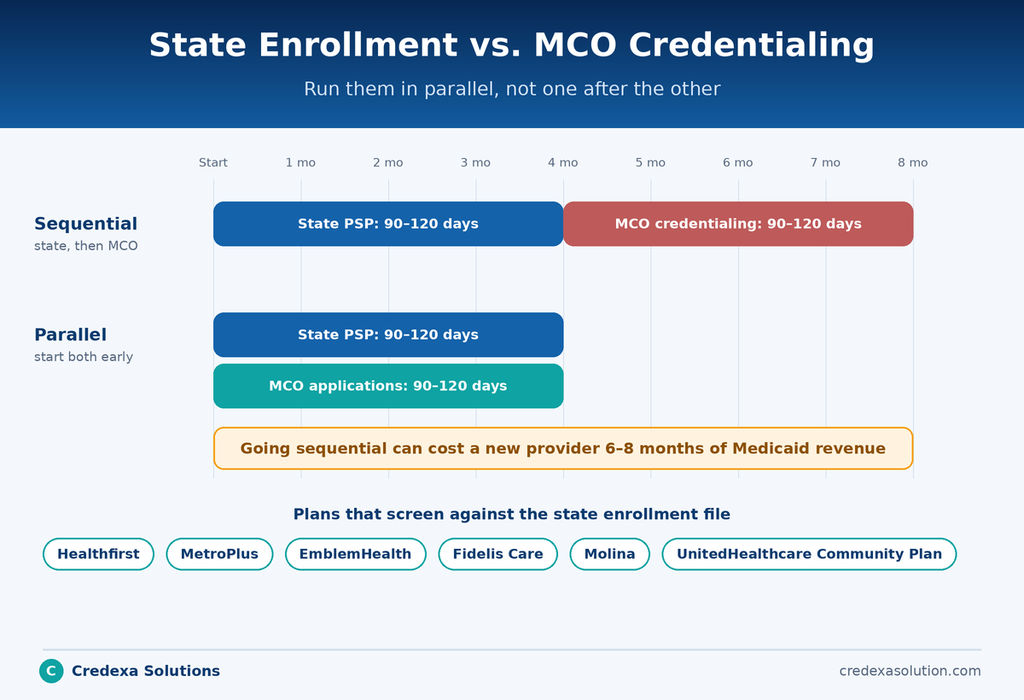
Most New York Medicaid members are served by managed care organizations, including plans such as Healthfirst, MetroPlus, EmblemHealth, Fidelis Care, Molina, and UnitedHealthcare Community Plan. Each plan runs its own credentialing application on its own timeline, often 90 to 120 days, and each requires that you are enrolled with the state. Under federal rules, plans screen network providers against the state database, so a provider who is not properly enrolled can lose a network slot even when the plan’s own credentialing is complete.
Running state enrollment and MCO credentialing one after the other can cost a new provider six to eight months of Medicaid revenue. The smarter approach is to start MCO applications while the state application is in review, and to keep CAQH and your practice details consistent everywhere.
Payer processes differ widely by state and portal. If you are comparing, Credexa’s guide to Wisconsin Medicaid provider enrollment and the ForwardHealth portal shows how a different state structures its portal, documents, and revalidation. If you also plan to join marketplace networks, read how to become an Ambetter provider in 2026 so your commercial and Medicaid credentialing do not collide.
NY Medicaid Revalidation: What Changed on May 1, 2026
Federal rules under 42 CFR 455.414 require Medicaid programs to revalidate enrolled providers at least every five years. In New York, the cycle is tied to your enrollment anniversary rather than a fixed calendar date, and since May 1, 2026 it runs through PSP.
What to do:
- Keep your correspondence address and email current on your enrollment file, because notices arrive by mail and email
- Treat any revalidation outreach as urgent and respond inside the stated window
- Do not rely on the estimated date shown on provider listings, which can shift as files update
The stakes are high. A missed revalidation deadline can terminate your enrollment, which means you cannot bill fee-for-service Medicaid, cannot order services for members, and may be removed from MCO networks that screen against the state file.
Why PSP Applications Get Returned and How to Prevent It
The state’s own bulletins point to a short list of repeat errors. Each one can trigger a restart that costs weeks.
- Wrong signatory. Someone other than the provider, owner, or managing employee submitted the application. Confirm the person logged in is the person authorized to sign.
- Incomplete ownership section. Missing identifying details for a disclosed owner. Complete every ownership field before you upload documents.
- EFT mistakes. An outdated EFT form or an unacceptable bank letter. Use the EFT step built into PSP and upload supporting items only when asked.
- Missing DEA documentation. Prescribers must upload the certificate; non-prescribers complete the no-DEA attestation.
- Outdated forms. Content can be perfect and the application still comes back. Download forms the day you submit.
A short internal review before you click submit, performed by someone who did not prepare the file, catches most of these.
Compliance After Approval: OMIG Rules and Offshore Restrictions
Enrollment is not the finish line. The Office of the Medicaid Inspector General (OMIG) requires certain providers to maintain a compliance program under Social Services Law Section 363-d and 18 NYCRR Subpart 521-1. That includes hospitals, nursing homes, home care agencies, providers of developmental or mental disability services, and any provider claiming or receiving at least $1 million in Medicaid in a 12-month period. OMIG’s compliance program requirements page includes a self-assessment to help you determine whether you are covered.
Certification is now handled through the annual Certification Statement for Provider Billing Medicaid, filed on your enrollment anniversary, rather than through a separate December filing. Details are on OMIG’s compliance certification page.
One more rule catches outsourcing arrangements: NYS Department of Health policy prohibits offshore staff from accessing State systems tied to provider enrollment and Medicaid billing. If you use a credentialing or billing vendor, confirm in writing where their staff work and who touches your PSP access.
Beyond Enrollment: Getting Paid Cleanly After You Go Active
Approval gets you in the door. Revenue depends on what happens to your first claims.
Before you bill, confirm that your ETIN is active, your EFT is verified, your NPI and taxonomy match the specialty on the claim, and your front desk is verifying eligibility for every Medicaid visit. Then focus on code accuracy. Specialty practices in particular lose money to modifier and documentation errors that look small and cost real revenue. A urology group, for example, can see how precise coding affects reimbursement in Credexa’s lithotripsy CPT codes 2026 billing and denial prevention guide.
For a broader view of how enrollment connects to the rest of the revenue cycle, the federal Medicaid program overview on Medicaid.gov is a useful reference for the rules that sit behind every state’s program.
How Credexa Solutions Helps With New York Medicaid Enrollment and Medical Billing
New York’s system rewards providers who are organized and punishes those who are not. That is where Credexa Solutions fits in. Credexa supports practices on both sides of the revenue equation: getting enrolled and credentialed, then getting paid correctly.
- Enrollment and credentialing support. Credexa helps prepare, review, and track provider enrollment and credentialing applications so the details payers check, such as NPI, taxonomy, ownership, and signatory information, are consistent before submission.
- Medical billing. From clean claim submission to follow-up on unpaid claims, Credexa’s billing support is built to keep claims moving and cash flowing.
- Denial management with accurate coding. Many denials are preventable. Credexa focuses on coding accuracy, documentation alignment, and root-cause denial analysis so the same errors do not repeat.
- A single partner across the cycle. When enrollment, credentialing, and billing are handled together, a payer enrollment gap does not turn into a claims problem months later.
If you are preparing a New York Medicaid application, adding MCO networks, or tired of chasing denials, visit Credexa Solutions to talk with a team that handles both enrollment and medical billing.
Frequently Asked Questions About New York Medicaid Provider Enrollment
How do I enroll as a New York Medicaid provider in 2026?
Apply through the Provider Services Portal. You need an active NPI, a NY.gov Business Account, and the required documents for your provider type. PSP assigns a 14-digit Application ID that you use to track progress. Paper applications are no longer available.
How long does NY Medicaid provider enrollment take?
Plan for 90 to 120 days from a complete submission to an Active determination. Missing documents or unanswered state requests can restart the clock, so respond quickly and completely.
How much does NY Medicaid enrollment cost?
The 2026 application fee is $750 for institutional providers. Physicians and non-physician practitioners are exempt, as are providers already enrolled in Medicare or another state’s Medicaid or CHIP program. Verify the amount on eMedNY before paying.
Can I still apply on paper?
No. The last paper pathway closed in July 2026, so new enrollment runs through PSP.
What does Pending mean for NY Medicaid enrollment?
It means your application is in the review queue. You can treat patients, but you cannot bill fee-for-service Medicaid until your status is Active.
Do I need to credential with Medicaid managed care plans separately?
Yes. State enrollment covers fee-for-service billing only. Each MCO has its own application and timeline, so start those applications while your state file is in review.
What is the NY Medicaid provider enrollment phone number?
Call the eMedNY Call Center at (800) 343-9000 or email providerenrollment@health.ny.gov. Have your 14-digit Application ID ready.
Key Contacts and Resources
| Resource | Detail |
|---|---|
| eMedNY Call Center | (800) 343-9000 |
| Provider enrollment email | providerenrollment@health.ny.gov |
| General Medicaid inquiries | Medicaid@health.ny.gov |
| PSP portal | nysproviderportal.health.ny.gov |
| OMIG compliance | omig.ny.gov |
Always confirm deadlines, forms, and fees on eMedNY and the NYS Department of Health website before you submit, because requirements can change.