
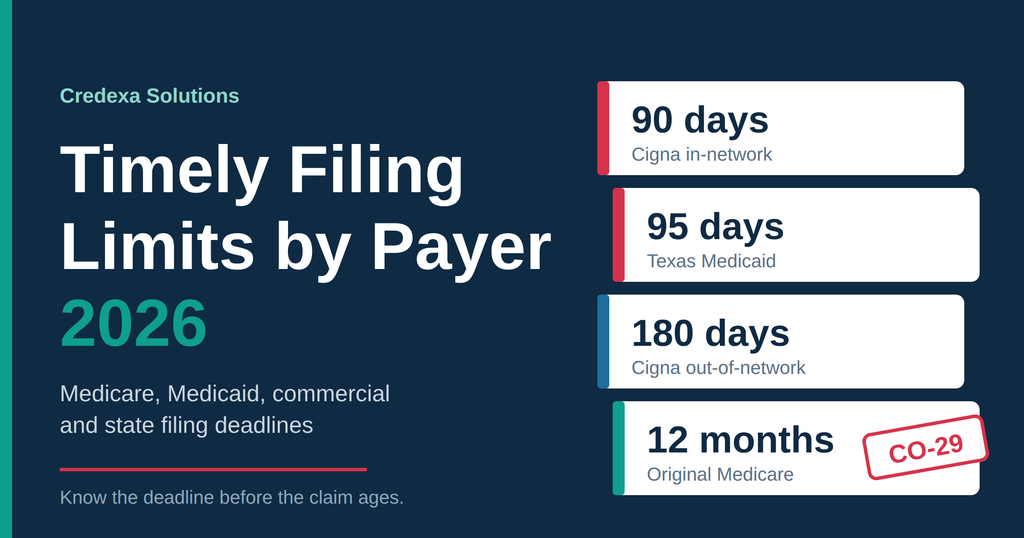
A clean claim with perfect coding can still earn you nothing. If it reaches the payer one day after the deadline, the payer denies it, and in most cases your practice absorbs the loss. That deadline is the timely filing limit, and it is one of the most preventable causes of lost revenue in medical billing.
This guide explains what the timely filing limit is, how each major payer sets it, how the clock is counted, what to do after a CO-29 denial, and how to build a workflow that stops late claims before they happen.
What Is the Timely Filing Limit in Medical Billing?
The timely filing limit is the maximum time a payer allows between the date of service (or discharge date for inpatient care) and the date it receives your initial claim. Payers treat it as a hard stop. They don’t ask whether the care was necessary or the coding was accurate. They check the receipt date against the window and deny the claim if it falls outside.
Three details matter right away:
- The payer’s receipt date is what counts. The day your biller clicked “send” doesn’t start or stop anything.
- There is no single national limit. Federal rules, state law, payer manuals, and your signed contract all play a role.
- Your contract usually wins. For in-network claims, the participation agreement can shorten or extend the published default.
“TFL” is the shorthand billers use for the timely filing limit. Be careful when searching it, because TFL also stands for TRICARE For Life, a separate wraparound program for military retirees with Medicare.
Timely Filing Limit vs. Appeal Deadline vs. Prompt Pay
Billing teams often blur three different clocks. Mixing them up leads to missed deadlines.
| Clock | What it controls | Who it binds |
|---|---|---|
| Timely filing limit | How long you have to get the initial claim to the payer | The provider |
| Appeal deadline | How long you have to dispute a decision the payer already made | The provider |
| Prompt pay | How fast the payer must pay a clean claim | The payer |
For example, 42 CFR 447.45 includes prompt-pay standards for state Medicaid agencies, and 42 CFR 422.520 covers prompt payment in Medicare Advantage. Neither tells you when you must file. Quoting them as filing deadlines is a common mistake.
Why Timely Filing Limits Differ by Payer
Four sources set the deadline that applies to a given claim:
- Federal regulation for Medicare, Medicaid fee-for-service, TRICARE, and CHAMPVA.
- State law for state Medicaid programs and many fully insured commercial plans.
- Payer manuals and policies, which publish the default window.
- Your participation agreement, which can override the default.
When these conflict, check them in that order and let the signed contract settle it for in-network claims. A grid copied from the internet won’t hold up in a payment dispute. Your contract will.
Self-funded employer plans add another wrinkle. Third-party administrators process them, and the employer’s plan document often sets the window. State insurance filing laws generally don’t reach these ERISA plans, so confirm the funding type on the member’s ID card or eligibility response.
Medicare Timely Filing Limit: 12 Months
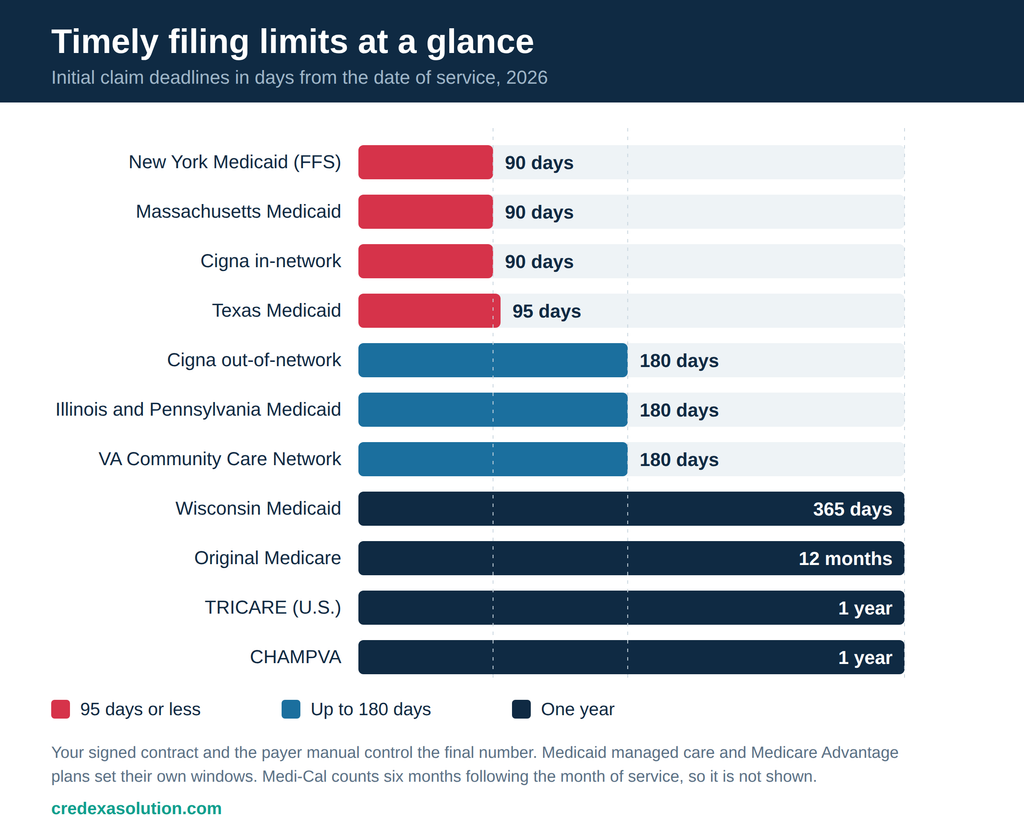
Under 42 CFR 424.44, Original Medicare requires claims to reach the correct Medicare Administrative Contractor (MAC) within one calendar year of the date of service. The Affordable Care Act set this 12-month standard for services on or after January 1, 2010. Before that, providers had anywhere from 15 to 27 months depending on when the service occurred.
The CMS Claims Processing Manual, Chapter 1 explains how the clock is counted:
- Part B professional claims count from the line-item “From” date.
- Part A institutional claims with span dates count from the “Through” date.
- A deadline that falls on a weekend or federal holiday moves to the next workday, which is the Medicare roll-forward rule.
Four Exceptions That Extend the Medicare Deadline
Medicare allows extensions in four narrow situations under 42 CFR 424.44(b), and each requires documentation:
- Administrative error by a Medicare employee, contractor, or agent.
- Retroactive Medicare entitlement for the beneficiary.
- Retroactive entitlement combined with Medicaid recoupment six months or more after the service.
- Retroactive Medicare Advantage or PACE disenrollment with plan recoupment six months or more after the service.
The extension generally runs through the last day of the sixth calendar month after the triggering event, and your MAC decides whether you qualify. Natural disasters are not one of the four exceptions. Relief comes only through separate CMS waivers when they are issued.
Medicare Secondary Claims Don’t Get Extra Time
When Medicare is secondary, the 12-month clock still runs from the date of service. A slow primary payer doesn’t extend it. Bill the primary payer within days of the visit so its decision arrives with plenty of time left to file with Medicare.
Why You Can’t Appeal a Late Medicare Claim
A failure-to-file determination isn’t an initial determination under 42 CFR 405.926(n), so the standard appeal process never opens. Your only route is a reopening request supported by one of the four exceptions.
Medicare Advantage Timely Filing: Your Contract Controls
Medicare Advantage (Part C) plans don’t follow Original Medicare’s 12-month rule. Contracted providers follow the participation agreement, which commonly runs 90 to 180 days. Non-contracted providers follow the plan’s published policy.
Some guides claim a 365-day CMS floor for Medicare Advantage. There isn’t one. The regulation people cite is a prompt-payment rule for plans, and it says nothing about provider filing deadlines. A practice that believes the floor exists and holds claims for a plan with a 90-day contract will lose them in month four.
Track network status per plan, per provider, and per product. The same physician can be in-network for a plan’s HMO and out-of-network for its PPO, and the two windows may not match.
Medicaid Timely Filing Limit by State
42 CFR 447.45 requires state Medicaid agencies to set a filing deadline of no later than 12 months from the date of service. That’s a ceiling, not a guarantee. States can set shorter windows, and many do. Federal rules set no minimum.
Medicaid Fee-for-Service Examples
| State | Initial claim limit | Notes |
|---|---|---|
| Texas | 95 days | Counted from the date TMHP receives the claim |
| New York | 90 days | Delay reason codes allow later filing in qualifying cases |
| Massachusetts | 90 days | Final deadline of 12 months |
| California (Medi-Cal) | Six months following the month of service | Late claims may be paid at reduced rates for a time |
| Georgia | Six months | Counted from the month of service |
| Illinois | 180 days | Inpatient counts from discharge |
| Pennsylvania | 180 days | |
| Florida | 12 months | Crossover rules differ |
| Wisconsin | 365 days | Date of service |
| Colorado | 365 days |
State rules change and are renumbered often, so always confirm against the state’s current manual or administrative code before putting a date on your calendar.
Texas Medicaid is a useful example of how local rules work. The TMHP claims filing manual sets a 95-day window and a 120-day appeal window measured from the remittance report. New York’s eMedNY Guide to Timely Billing explains the 90-day rule and how delay reason codes work.
Medicaid Managed Care Plans Set Their Own Windows
Managed care organizations get their limits from the state contract and their own provider manuals, so two plans in the same state can give you different windows for the same service. TennCare MCOs, for instance, use 120 days, while Fidelis Care in New York uses 90.
If you bill Wisconsin Medicaid, enrollment and portal setup come before any filing deadline matters. Our Wisconsin Medicaid provider enrollment 2026 Forward Health portal guide walks through that process step by step. An unenrolled provider can’t bill, yet the filing clock keeps running from the date of service.
Commercial Insurance Timely Filing Limits
Commercial payers cluster between 90 and 180 days, but network status often changes the number.
- Cigna allows 90 days for in-network providers and 180 days for out-of-network providers, per the Cigna claims submission policy. Consecutive-day services count from the last date.
- UnitedHealthcare points providers to their participation agreement.
- Aetna refers to “contractual timeframes,” which means your contract.
- Blue Cross Blue Shield isn’t one payer. Each independent Blue company sets its own window, from roughly 90 days to a year.
- Anthem uses 90 days for Medicare Advantage professional claims, and its commercial windows vary by state.
When a website lists a flat number for Aetna or UnitedHealthcare, treat it as a guess until you’ve checked your contract.
Marketplace Plans: Ambetter Example
Marketplace plans add state-level variation. Ambetter windows differ by state, and participating providers in many states get 180 days, while others are shorter. Before billing, confirm the exact window for your state and product. If you’re not yet in the network, our guide on how to become an Ambetter provider in 2026 covers enrollment and credentialing, so your claims aren’t denied for a status problem on top of a deadline problem.
State Laws That Set Minimum Commercial Windows
Some states protect providers with minimum filing windows for fully insured plans:
- California (28 CCR 1300.71) bars deadlines shorter than 90 days for contracted providers and 180 days for non-contracted providers on DMHC-regulated plans.
- Texas (28 TAC 21.2806) requires managed care carriers to allow at least 95 days.
- New York Insurance Law 3224-a gives 120 days for initial commercial claims.
These are floors. A contract can give you more time, and self-funded plans generally fall outside them.
Military and Veterans Programs
- TRICARE: One year in the U.S. and three years overseas under 32 CFR 199.7(d).
- CHAMPVA: One year from the date of service, or from discharge for inpatient care, under 38 CFR 17.276.
- VA Community Care Network: 180 days from the date the care was furnished.
CHAMPVA pays after other health insurance issues its explanation of benefits. The VA can grant exceptions when a primary payer’s delay wasn’t the beneficiary’s fault, but delays inside your own billing process don’t qualify.
How the Timely Filing Clock Is Counted
Each limit has a start event and an end event. Get either one wrong and your calendar is wrong too.
| Claim situation | Where the clock usually starts |
|---|---|
| Professional claim (CMS-1500/837P) | Line-item date of service |
| Institutional claim (UB-04/837I) | Discharge or “Through” date |
| Consecutive-day services | Last date of service (payer-specific) |
| Commercial secondary claim | Often the primary payer’s EOB date, depending on contract and state law |
| Medi-Cal | End of the month of service, plus six months |
Three counting traps cause most late claims:
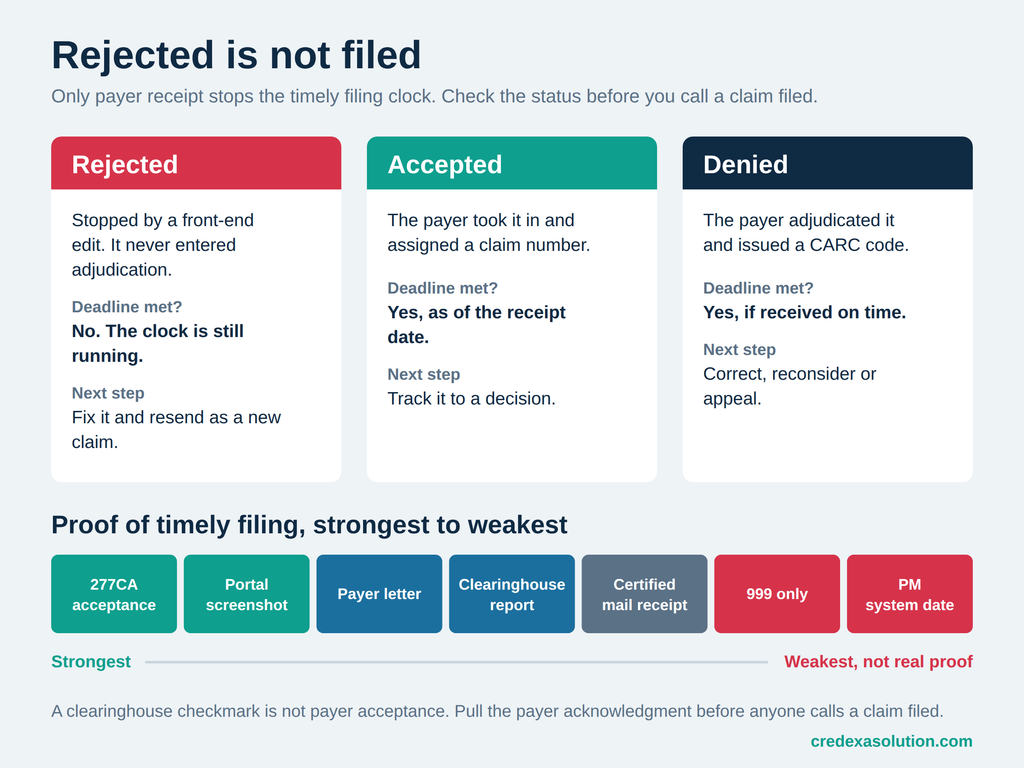
- Received means received. If your clearinghouse accepts a claim but the payer rejects it, the claim was never filed. Look for the payer’s 277CA acknowledgment, not just a green checkmark from the clearinghouse.
- Weekends and holidays. Medicare rolls a weekend or holiday deadline to the next workday. Many commercial payers don’t, so file before the weekend.
- Wrong payer or wrong MAC. A claim sent to the wrong contractor doesn’t count until the correct one receives it.
CO-29 Denial: What It Means and What to Do
When a claim misses the window, the payer denies it with CARC 29, which the X12 claim adjustment reason code list defines as “the time limit for filing has expired.” On your remittance it appears as CO-29. The “CO” group code means contractual obligation, so the write-off stays with the provider.
Can You Bill the Patient?
In most cases, no. In-network contracts treat a timely filing denial as a provider write-off, and Medicaid providers must accept Medicaid payment as payment in full. Out-of-network commercial claims depend on state balance billing law. A narrow exception can apply when a patient withheld insurance information, but document that carefully before sending any statement.
What Recovery Looks Like
- Original Medicare: No appeal. Submit a reopening request only if one of the four exceptions applies.
- Medicaid: Use state delay reason codes or retroactive eligibility rules where they exist.
- Commercial payers: Request reconsideration with proof of timely filing or a documented exception, such as payer error, a primary payer’s delay, or incorrect insurance information from the patient.
Proof of Timely Filing: What Actually Works
If you believe a CO-29 denial is wrong, your evidence decides the outcome. From strongest to weakest:
- A payer 277CA acceptance showing the claim number and date.
- A payer portal screenshot showing receipt date and claim number.
- Written payer correspondence acknowledging receipt.
- A clearinghouse report showing payer acceptance.
- Certified mail or courier receipt with a copy of the claim, for paper claims.
- A 999 acknowledgment, which only shows file syntax passed.
- Your practice management system’s “billed” date, which is not proof.
Accepted, rejected, and denied are three different statuses. A rejected claim never entered adjudication, so your deadline is still running. An accepted claim is on file as of its receipt date. A denied claim was adjudicated, which means it was received.
Corrected Claims and Secondary Claims
Corrected Claims
Under CMS Change Request 12909 (effective November 26, 2024), Original Medicare no longer applies a timely filing period to adjustments. Administrative finality rules apply instead. Commercial payers set their own corrected claim windows, and many tie them to the original filing limit. UnitedHealthcare, for example, keeps corrected claims inside the original window.
Use frequency code 7 for a replacement claim and frequency code 8 for a void. Both require the payer’s original claim number. A rejected claim goes back as a new claim with frequency code 1.
Secondary Claims
Original Medicare doesn’t restart the clock for secondary claims. Many commercial payers do start the clock at the primary payer’s EOB or remittance, but contracts differ. Post primary remittances the same day you receive them so the secondary claim goes out immediately.
A CO-22 denial signals a coordination of benefits problem. Fix it with the patient and both payers before the window closes.
Specialty Billing and Filing Deadlines
Specialties with high-dollar, procedure-heavy claims lose the most when a deadline slips. Urology is a good example. Lithotripsy claims depend on correct CPT selection, modifiers, and place-of-service details, and a coding correction after a denial eats into the same filing window. Our lithotripsy CPT codes 2026 billing, reimbursement, and denial prevention guide shows how to get these claims right the first time, so you’re not racing a deadline to fix them later.
What Changed in 2026
- Original Medicare’s 12-month rule is unchanged. CMS did publish a request for information in early 2026 asking whether to shorten timely filing for certain high-risk items such as DMEPOS. An RFI isn’t a rule, and a change would need a proposed rule, a comment period, and a final rule.
- Payers keep changing brands, payer IDs, and corrected-claim windows. Several payers adjusted corrected claim timeframes or payer IDs this year, so recheck your matrix against current manuals.
- State rules get renumbered and updated. Medicaid manuals and administrative codes change yearly, which is why quarterly reviews matter.
Always confirm current figures with the payer’s latest manual before relying on any table, including the ones in this guide.
A Seven-Step Workflow to Prevent Timely Filing Denials
- Verify eligibility and coordination of benefits at scheduling and again at check-in.
- Confirm credentialing and effective dates before a provider sees patients.
- Build a payer filing matrix from your executed contracts, by plan, product, and provider. Use the shortest window when unsure.
- Set a charge lag target. Getting claims out within a few days of the visit is the cheapest protection you have.
- Work rejections daily. A rejection sitting in a queue is a claim the payer hasn’t received.
- Sort your AR by days left on the filing clock, then by dollars. A $90 claim with nine days left should come before a $900 claim with 70.
- Track prior authorizations alongside claims, so a late authorization doesn’t push a claim past its window.
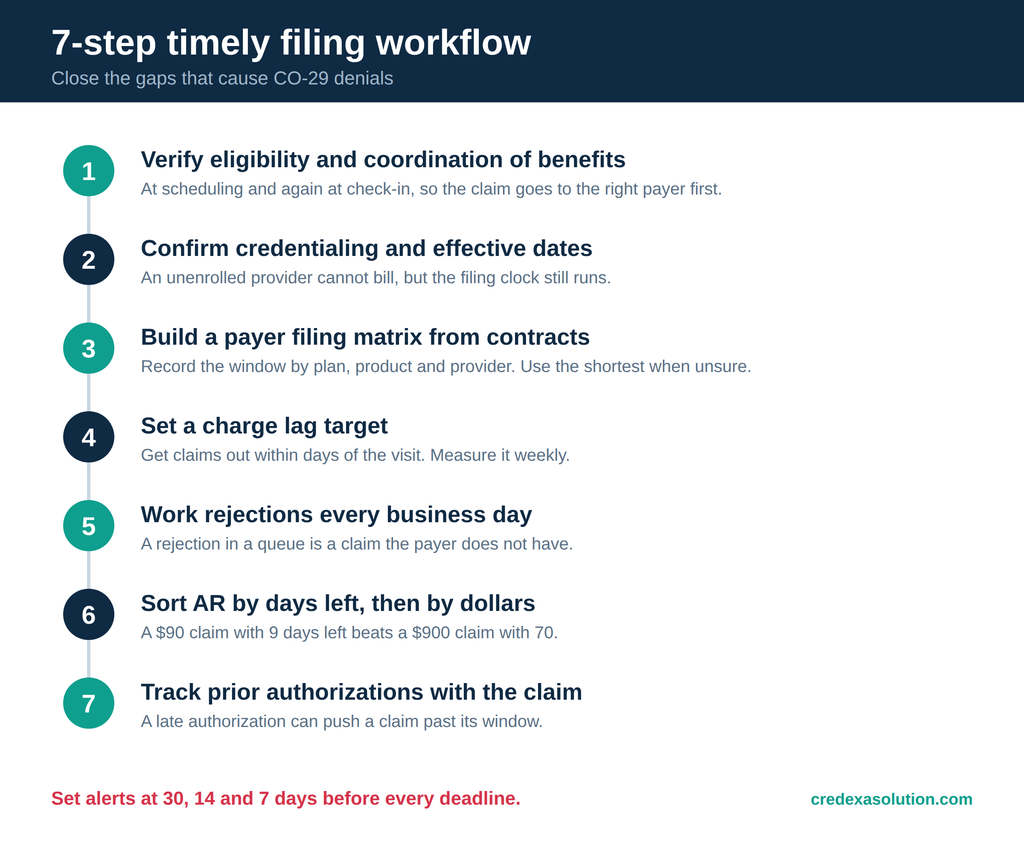
Set alerts at 30, 14, and 7 days before each deadline. Track two monthly numbers: the count of CO-29 denials and the dollars written off for timely filing. Put them on the same dashboard as days in AR.
Timely Filing Limit FAQs
What is timely filing in medical billing?
It’s the rule that a claim must reach the payer within a set number of days after the date of service. Each payer sets its own window.
What is the timely filing limit for Medicare?
One calendar year from the date of service for Original Medicare, with four documented exceptions.
Is there a federal timely filing minimum for Medicaid?
No. Federal rules set a 12-month ceiling, and states choose any shorter window they like.
What does CO-29 mean?
The time limit for filing has expired. The provider bears the loss.
Does the clock restart for corrected claims?
It depends on the payer. Original Medicare removed the timely filing period for adjustments, while many commercial payers keep corrections inside the original window.
Can I bill the patient after a timely filing denial?
Usually not, especially for in-network and Medicaid claims.
Does clearinghouse acceptance count as filing?
No. Only payer receipt counts, so look for the 277CA.
Why do two plans from the same payer have different limits?
Plan type, state, network status, and contract terms each change the window.
How Credexa Solutions Helps You Beat Timely Filing Deadlines
Knowing the rules is half the job. The other half is building a billing operation that applies them to every claim, every day, across every payer. That’s where Credexa Solutions comes in.
Credexa Solutions helps practices protect revenue from the first patient contact to the final payment:
- Payer-by-payer deadline tracking. We map filing windows to your actual contracts and payer manuals, not generic grids, and flag claims approaching their limits.
- Credentialing and enrollment support. We get providers enrolled and active with Medicare, Medicaid, and commercial payers, so claims aren’t stuck behind a status problem while the clock runs.
- Clean claim submission. Accurate coding, correct payer IDs, and eligibility checks cut rejections that quietly burn through your filing window.
- Rejection and denial management. We work rejections daily and handle CO-29 and other denials with the right proof and documentation.
- AR follow-up by days remaining. Aging claims are prioritized by the time left on the clock, not just the dollar amount.
- Transparent reporting. You see your timely filing write-offs, denial trends, and days in AR, so problems surface before they cost you.
If late claims are costing your practice money, or you simply want someone to own the deadlines, Credexa Solutions can take that work off your team. Visit credexasolution.com to learn how Credexa Solutions can strengthen your medical billing and keep every claim inside its window.