
A denied claim is never just a paperwork problem. It’s a hole in your practice’s cash flow that someone on your team has to notice, investigate, correct, and resubmit usually while three other tasks are waiting in line. Multiply that by dozens of denials a week, and it’s easy to see why revenue cycle leaders rank denials among their top financial threats every single year.
The good news: most denials are predictable, and predictable problems can be engineered out of a workflow. That’s what a denial management process actually is not a reactive scramble every time a payer says no, but a structured system that catches errors before submission, resolves the ones that slip through, and feeds what it learns back into the front desk so the same mistake doesn’t repeat next month.
The stakes have also gotten bigger. Denials aren’t a shrinking problem industry tracking shows the national initial-denial rate has climbed steadily since 2020, driven by more complex payer policies, thinner administrative staffing, and expanding prior-authorization requirements. That means a denial management process that was “good enough” a few years ago is quietly losing more ground every year it isn’t updated.
This guide walks through what a denial management process in medical billing looks like in practice, why claims really get rejected in 2026, and a step-by-step framework your billing team can start using this week. We’ll also look at when it makes more sense to hand the whole function to a specialized partner like Credexa Solutions.
Table of Contents
- What Is a Denial Management Process?
- Denial Management by the Numbers: 2026 Benchmarks
- Hard Denials vs. Soft Denials and Why the Distinction Matters
- The Seven Most Common Reasons Claims Get Denied
- An 8-Step Denial Management Workflow That Actually Works
- Building vs. Outsourcing Your Denial Management Process
- Frequently Asked Questions
- Final Takeaway
1. What Is a Denial Management Process?
A denial management process is the repeatable system a billing department uses to identify why claims are rejected, correct and resubmit the ones that can be saved, appeal the ones worth fighting for, and most importantly stop the same denial reason from recurring. It sits at the intersection of medical coding, front-desk registration, payer policy, and revenue cycle reporting.
Done well, it has two halves that work together:

- Denial prevention the front-end controls (eligibility checks, authorization tracking, clean-claim scrubbing) that stop a claim from ever being denied.
- Denial recovery the back-end workflow (tracking, appealing, escalating) that gets paid on the claims that were denied anyway.
A practice that only does recovery is always fighting yesterday’s fire. A practice that only does prevention still needs a plan for the denials that will inevitably happen, because no payer relationship runs at zero. A real denial management process in medical billing does both, on a schedule, with someone accountable for each piece.
2. Denial Management by the Numbers: 2026 Benchmarks
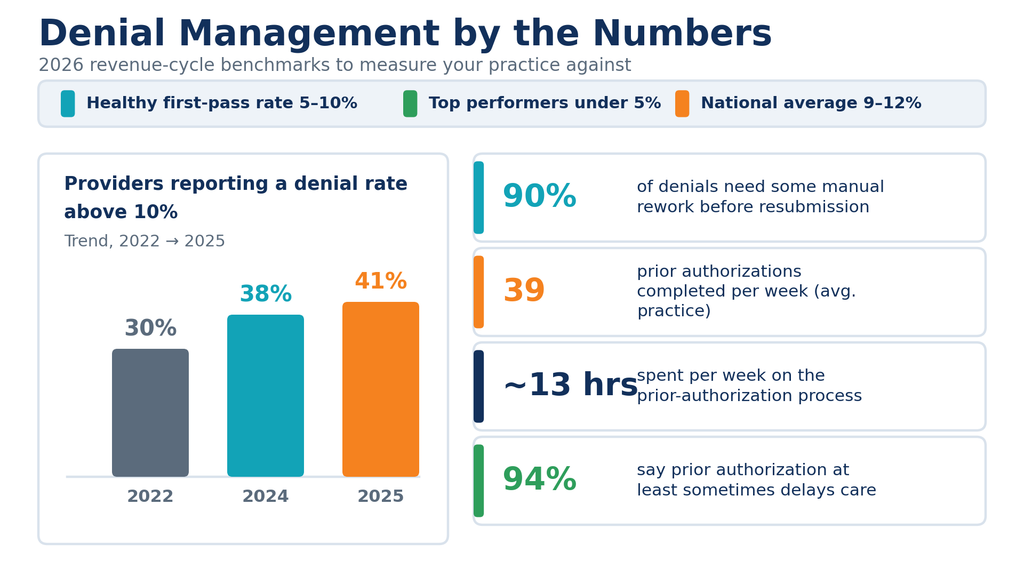
It helps to know where your practice stands against the field. According to Experian Health’s State of Claims research, a 2025 survey of 250 healthcare revenue cycle leaders found that 41% of providers now report denial rates above 10%, up from 38% the year before and roughly 30% in 2022 a trend that has moved in one direction for three straight years. The same research found that 90% of denials require at least some manual rework before resubmission, which is the real cost most practices underestimate: it isn’t just the lost claim, it’s the staff hours spent re-touching it.
A few more data points worth knowing as you benchmark your own numbers:
- The commonly cited “healthy” first-pass denial rate sits between 5% and 10%, with top-performing practices tracked by HFMA and MGMA landing under 5%, and the current national average running closer to 9–12%.
- Denial rates vary sharply by payer. Medicare fee-for-service tends to run in the 4–6% range, while several large commercial and Medicare Advantage plans run into the mid-teens a gap that makes payer-specific prevention strategies more valuable than a one-size-fits-all approach.
- Denial rates also vary by specialty, with behavioral health, orthopedics, and physical therapy typically running well above primary care because of heavier prior-authorization and modifier requirements.
- Prior authorization remains one of the single biggest friction points in the system. In the AMA’s most recent Prior Authorization Physician Survey, physicians and their staff reported completing an average of 39 prior authorizations per week and spending roughly 13 hours on the process, and 94% said prior authorization at least sometimes delays a patient’s access to necessary care.
None of these numbers are meant to be discouraging they’re a baseline. If your practice’s denial rate is above 10%, you’re in good company, but you also have room to close a gap that’s costing you real revenue every single month.
3. Hard Denials vs. Soft Denials and Why the Distinction Matters
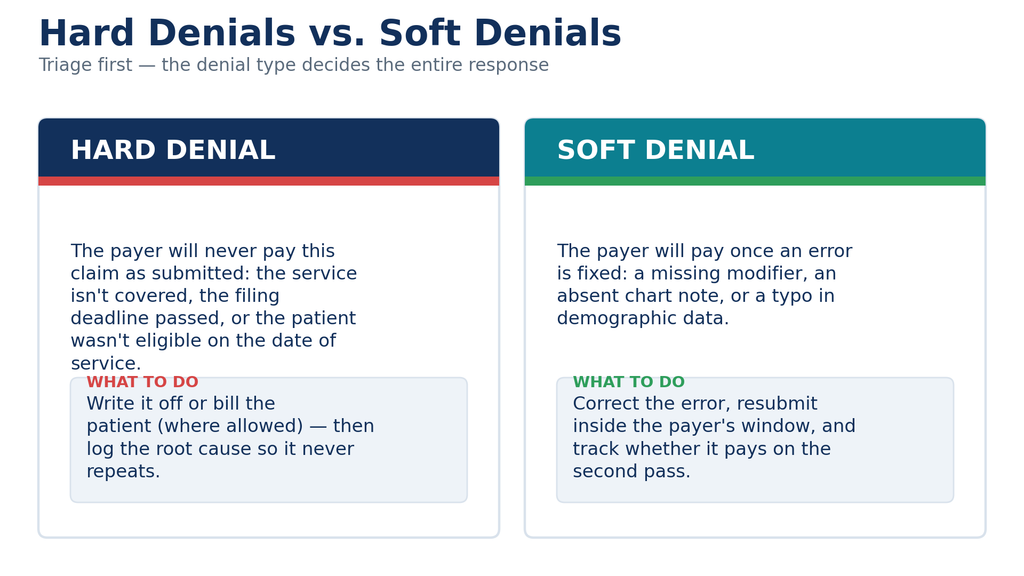
Every denial your team sees falls into one of two buckets, and knowing which bucket you’re in should be the very first triage step in your denial management process.
| Denial Type | What It Means | What To Do |
|---|---|---|
| Hard denial | The payer will never pay this claim as submitted the service isn’t covered, the filing deadline passed, or the patient wasn’t eligible on the date of service. | Write it off or bill the patient (where allowed), and log the root cause so it doesn’t happen again. |
| Soft denial | The payer will pay once an error is fixed a missing modifier, an absent chart note, a typo in demographic data. | Correct the error, resubmit within the payer’s window, and track whether it pays on the second pass. |
Treating a soft denial like a hard one means writing off money you could have collected. Treating a hard denial like a soft one wastes staff hours chasing a claim that was never going to pay. A five-minute triage step at intake before any resubmission work begins saves far more time than it costs.
A quick example. A practice bills CPT 99214 for an established-patient visit, and the payer denies it citing “documentation insufficient no progress note on file.” That’s a textbook soft denial: the biller classifies it, attaches the missing note, resubmits inside the timely-filing window, and logs the reason code so the front desk can flag it before it happens to the next 99214 claim. The claim pays on the second submission, and the practice has one fewer repeat error going forward.
4. The Seven Most Common Reasons Claims Get Denied
Understanding the “why” behind a denial is what separates a reactive billing team from one running a real denial management process. Here are the causes that show up most often across specialties, and what tends to drive each one.
4.1 Patient Eligibility Problems
If a payer’s system shows a patient had no active coverage on the date of service, the claim stops before it’s even reviewed. This usually happens because coverage lapsed or changed between when the appointment was scheduled and when it happened, the plan doesn’t cover the specific service billed, or the provider is out-of-network for that particular plan.
Eligibility problems are especially common with patients who switch jobs, age into Medicare, or move between marketplace plans at open enrollment none of which your practice management system knows about unless you check. A same-day eligibility check catches most of this before the patient is even seen, and it’s one of the cheapest fixes on this entire list relative to the revenue it protects.
4.2 Incorrect or Missing Patient Information
Payer systems match claims against member records almost letter-for-letter. A misspelled last name, a wrong date of birth, a transposed digit in a member ID any of these can trigger an automatic rejection. These errors are almost always a front-desk data-entry issue rather than a clinical or coding one, which is exactly why registration deserves as much attention in a denial management process as coding does.
4.3 Missing Prior Authorization
Many imaging studies, procedures, and specialty medications require advance approval before a payer will reimburse for them. When the authorization request was never filed, expired before the visit, or didn’t cover every service ultimately billed, the claim denies regardless of whether the care itself was appropriate. Given how heavily prior authorization burdens practices today (see the AMA figures above), this is often the single highest-leverage area to tighten.
4.4 Medical Necessity Not Established
Payers want documentation that clearly connects the diagnosis to the service billed. If the chart notes don’t spell out clinical findings that justify the CPT or HCPCS code, or the diagnosis code on the claim doesn’t logically support the procedure, the payer can deny on medical-necessity grounds even when the care itself was reasonable. This is also where correct, current diagnosis coding matters most. For example, a pulmonology practice billing for a chronic obstructive pulmonary disease patient needs the ICD-10 code to precisely reflect the clinical picture; our companion guide on COPD ICD-10 codes for 2026 — covering J44.0, J44.1, J44.9, J44.81, and J44.89 breaks down exactly which code applies to which clinical presentation, which is the kind of specificity payers are checking for.
4.5 Coding Errors
Wrong or outdated CPT/ICD-10 codes, missing or incorrect modifiers, and code pairs that can’t be billed together are among the most common reasons a clean-looking claim still gets kicked back. Coding errors tend to cluster around two causes: staff working from outdated references after the annual ICD-10 (October) and CPT (January) update cycles, or EHR auto-fill suggesting a code that doesn’t actually match what’s documented in the note.
4.6 Duplicate Claims
A claim gets flagged as a duplicate when the payer receives what looks like the same service, same patient, same date more than once. This usually traces back to a claim being resubmitted before anyone confirmed the first one actually failed, or a batch resending itself after a system glitch. A single, shared, live claim log where every submission’s status is visible to the whole team is the simplest fix.
4.7 Timely Filing Limits
Most payers give a defined window (commonly 90 to 180 days from the date of service, though it varies by plan) to submit a claim. Miss it by even a day and the claim is dead no amount of medical necessity or clean coding will bring it back. Filing delays are usually caused by a chart waiting on a physician addendum, a coder’s backlog, or simply no one tracking each payer’s specific deadline on a shared calendar.
The frustrating part about timely-filing denials is that they’re almost entirely process failures rather than clinical or coding ones which also makes them among the easiest to eliminate once a practice puts a deadline-tracking system in place. A shared dashboard that flags any claim approaching 75% of its filing window, well before the hard cutoff, removes the guesswork entirely.
5. An 8-Step Denial Management Workflow That Actually Works
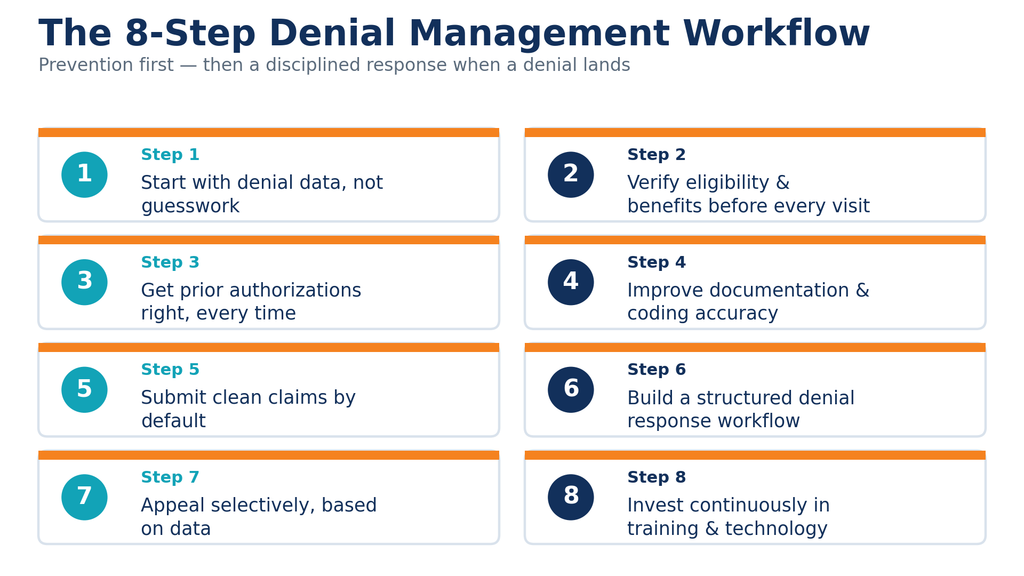
This is the operational core of any denial management process in medical billing. Each step below builds on the one before it prevention first, then clean submission, then a disciplined response when a denial does land.
Step 1: Start With Denial Data, Not Guesswork
Before changing anything, measure what’s actually happening. Calculate your denial rate monthly (total denied claims ÷ total claims submitted) and compare it against the 5–10% healthy benchmark referenced earlier. Break denials down by payer, reason code, and provider patterns that are invisible in aggregate numbers often jump out immediately once sorted. Rank issues by dollars lost, not just claim count, since a handful of high-value denials can outweigh dozens of small ones. A denial-management dashboard inside your practice management or clearinghouse software makes this a five-minute weekly habit instead of a monthly fire drill.
It’s worth resisting the urge to fix the loudest problem instead of the costliest one. A denial reason that shows up fifty times a month at $40 each is real money, but a denial reason that shows up five times a month at $800 each is often bigger and easier to fix, since it’s usually tied to one payer, one service line, or one provider rather than a systemic issue across the whole practice.
Step 2: Verify Eligibility and Benefits Before Every Visit
Run a real-time eligibility check when the appointment is booked and again the day before the visit coverage can change in that window more often than people expect. For recurring patients (chronic care, physical therapy, behavioral health), re-verify at least every 30 days, since plans change mid-year without much warning. Train front-desk staff to confirm three things at check-in every time: Is the plan active today? What’s left on the deductible or copay? Does this visit need a referral or prior authorization? Documenting the check date, response, staff initials also gives you a paper trail if a denial slips through anyway.
Step 3: Get Prior Authorizations Right, Every Time
Maintain a payer-by-payer quick-reference list of which services need prior approval, and keep it visible to schedulers, not buried in a policy binder. Assign ownership of prior-authorization requests to one specific person or role so nothing falls into a gap between two people who each assumed the other handled it. Check the status of pending authorizations 48 hours before the appointment, record the approval number directly in the claim, and set a reminder before any authorization’s expiration date or visit-count limit runs out.
Step 4: Improve Documentation and Coding Accuracy
Encourage providers to document the clinical “why” behind a service, not just the “what” a note that clearly ties symptoms to the diagnosis code and the diagnosis to the procedure code is far more likely to survive a medical-necessity review. Run a quarterly internal coding audit on a small random sample of charts per provider, and use certified coders (CPC or CCS credentialed) who stay current with payer-specific edits. Set a recurring reminder for the annual code-set updates ICD-10 changes take effect October 1, CPT changes take effect January 1 so your team is never coding against a stale reference.
Step 5: Submit Clean Claims by Default
Run every claim through a scrubber that checks for missing fields, invalid modifiers, and payer-specific edit rules before submission most clearinghouses include this, and it should be turned on and treated as non-negotiable. A quick pre-submission checklist covering patient demographics, procedure codes, diagnosis codes, modifiers, and provider NPI catches the small errors that cause outsized rework. Pulling patient data directly from the EHR instead of retyping it also eliminates a large share of the transcription errors that trigger denials in the first place. Medicare’s Medically Unlikely Edits (MUEs) which cap how many units of a given code can be billed for one patient on one day are a good example of a rule that’s easy to miss manually but simple for a scrubber to catch automatically.
Step 6: Build a Structured Denial Response Workflow
Even a well-tuned prevention process won’t stop every denial, so speed and structure matter once one lands. Keep a single, shared denial log recording the date, payer, reason code, dollar amount, and current status of every denial. Assign each denial category to a specific owner (for example, timely-filing issues to one person, coding-related denials to another) so accountability is never ambiguous. Track appeal deadlines actively most payers allow 30 to 60 days and set alerts well before the cutoff, since a missed appeal window turns a winnable claim into a permanent loss.
Step 7: Appeal Selectively, Based on Data
Not every denial is worth appealing the labor cost of an appeal can exceed the value of a small claim. Set a clear internal threshold (many practices use a dollar amount, like $250, or a pattern that’s likely to recur) for what gets appealed automatically. Review your own historical win rates by payer and denial reason before committing staff time; if a particular denial type from a particular payer almost never overturns, that effort is often better spent fixing the root cause than repeating a losing appeal. When you do appeal, use the payer’s own template where one exists and attach the strongest available evidence chart notes, the authorization number, an eligibility screenshot, or the specific payer policy that supports the claim.
If an appeal stalls with Medicare specifically, it helps to know the formal path forward: Medicare’s fee-for-service appeals process runs through five defined levels starting with redetermination by a Medicare Administrative Contractor, then reconsideration by a Qualified Independent Contractor, a hearing before the Office of Medicare Hearings and Appeals, review by the Medicare Appeals Council, and finally judicial review in federal court, as outlined on the official CMS Medicare appeals page. Knowing which level you’re at and its specific deadline keeps an appeal from dying in the wrong queue.
Step 8: Invest Continuously in Training and Technology
Short, frequent training beats a long annual session a 15-to-20-minute monthly huddle covering a recent code change, a payer’s new edit, or a real denial the team just resolved tends to stick better than a once-a-year refresher. Make sure staff understand payer-specific quirks (a particular plan’s modifier rules, a specific Medicaid MCO’s authorization windows) since these are where repeat denials tend to cluster. Where possible, connect your EHR, billing system, and clearinghouse so patient data flows through without manual re-entry most transcription-related denials disappear when a system stops asking a human to retype the same information twice.
It’s also worth running periodic drills rather than relying only on live claims to train new staff. Pull a handful of past denials each quarter and have a newer biller walk through classifying, correcting, and resubmitting them while a senior team member observes. That hands-on repetition builds pattern recognition faster than any policy document, and it catches gaps in understanding before they turn into a live denial on a real claim.
6. Building vs. Outsourcing Your Denial Management Process
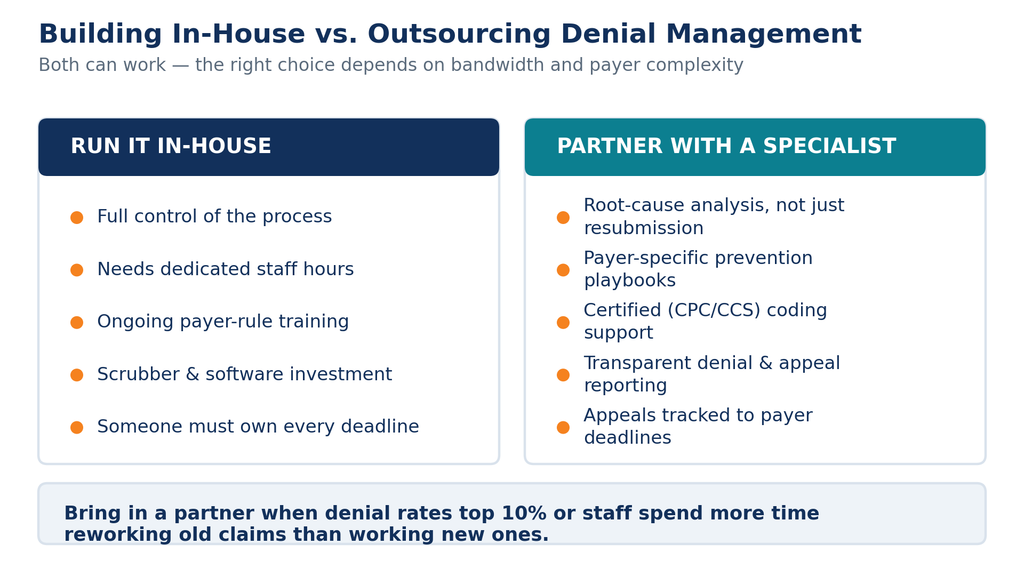
Every step above can be run in-house, and many practices do it well. But building a truly proactive denial management process takes dedicated staff time, ongoing training on payer rule changes, and software that most small-to-mid-size practices don’t already own. That’s the gap a specialized billing partner is built to close.
At Credexa Solutions, denial management isn’t an add-on to general billing it’s a defined workflow with its own accountability:
- Root-cause analysis, not just resubmission. We track every denial back to its source eligibility, authorization, coding, or documentation so the same error doesn’t repeat next month.
- Payer-specific playbooks. Because denial patterns differ so much by payer (a gap that can run 8 points or more between your best and worst payer relationship), we build prevention and appeal strategies around each plan’s actual behavior instead of a generic checklist.
- Certified coding support. Specialty-specific coding accuracy including complex chronic-condition coding, like the ICD-10 specificity required for COPD documentation covered in our COPD coding guide reduces medical-necessity and coding-related denials at the source.
- Transparent reporting. You see denial counts, dollars at risk, and appeal outcomes on a regular cadence, so there’s never a guessing game about where revenue is leaking.
- Appeals handled on your behalf, tracked against payer-specific deadlines so winnable claims never die from a missed clock.
If your practice’s denial rate sits above the 10% mark, or your staff is spending more hours reworking claims than seeing new ones, that’s usually the clearest sign it’s time to bring in a dedicated denial management partner rather than adding the load to an already-stretched billing team.
7. Frequently Asked Questions
What is a good denial rate for a medical practice? Most revenue cycle benchmarks put a healthy first-pass denial rate between 5% and 10%, with top-performing practices tracked by organizations like HFMA landing under 5%. The current national average sits closer to 9–12%, and roughly four in ten practices now report rates above 10%.
What’s the difference between denial management and denial prevention? Denial prevention is everything done before a claim is submitted eligibility checks, authorization tracking, clean-claim scrubbing to stop a denial from happening. Denial management is the broader process that includes prevention plus the back-end work of tracking, correcting, and appealing the denials that occur anyway. A complete denial management process in medical billing includes both.
How long do I have to appeal a denied claim? It depends entirely on the payer. Commercial plans commonly allow 30 to 60 days from the denial date. Medicare’s process has its own structured timeline across five appeal levels, detailed on the official CMS appeals page. Always confirm the specific deadline on the denial notice itself rather than assuming a standard window.
Should every denied claim be appealed? No. Appeals consume staff time, so many practices set a dollar threshold or check their historical win rate for that specific payer and denial reason before committing to an appeal. Claims that are unlikely to overturn are often better addressed by fixing the root cause so they don’t recur.
What’s the most common reason claims get denied? Industry-wide, missing or inaccurate data patient demographics, eligibility details, and authorization information is consistently cited as the leading cause, ahead of coding errors and medical-necessity disputes.
Can outsourcing denial management actually lower my denial rate, or does it just speed up appeals? Both, when done properly. A billing partner focused on denial management should be doing front-end prevention work eligibility verification, authorization tracking, and coding accuracy not just chasing appeals after the fact. Prevention is what actually moves the denial rate down over time; faster appeals just recover more of what’s already been lost.
How often should a practice review its denial data? Weekly is ideal for spotting emerging patterns before they become expensive, with a more thorough monthly review to track trends by payer, provider, and denial reason. Practices that only look at denials quarterly tend to have already absorbed months of a preventable, recurring error before anyone notices.
8. Final Takeaway
A denial management process in medical billing isn’t a single tool or a single hire it’s a habit built from consistent, small checks: verifying eligibility before the visit, confirming authorization before the procedure, coding to match the documentation, scrubbing every claim before it leaves the building, and responding to the denials that still happen with speed and data instead of guesswork.
Practices that treat denial management this way tend to see the same result: fewer denials over time, faster payment on the ones that occur, and a billing team that spends more time preventing problems than chasing them. If your in-house team doesn’t have the bandwidth to run this cycle consistently, Credexa Solutions can take on the process end-to-end from front-end prevention to back-end appeals so your practice keeps more of what it earns.