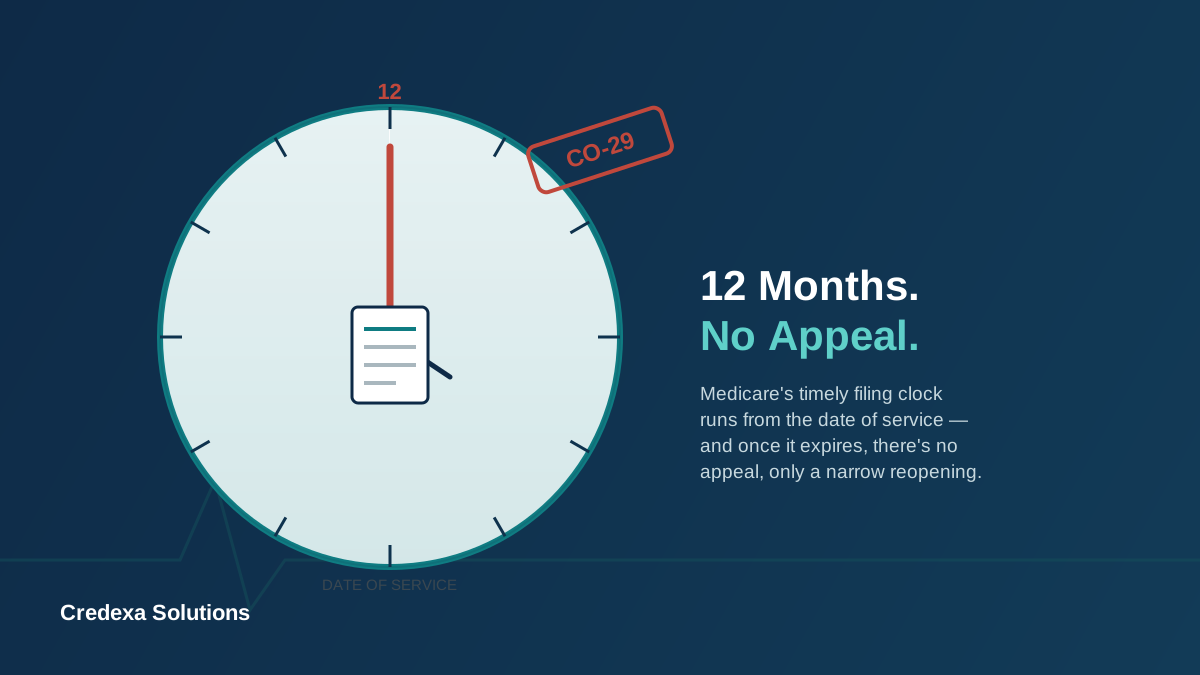
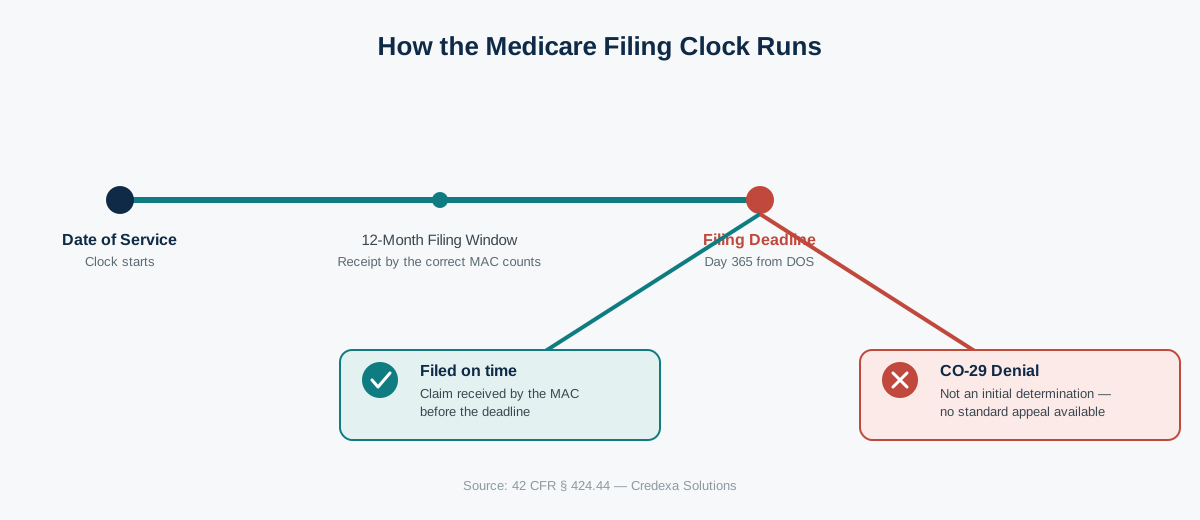
Medicare gives providers exactly 12 months from the date of service to get a claim in front of the correct Medicare Administrative Contractor (MAC). Miss that window by even a single day, and the claim comes back with a CO-29 denial a code that carries no appeal rights and, in most cases, no way back.
At Credexa Solutions, timely filing denials are one of the most common and most avoidable sources of permanent revenue loss we see when we audit a new client’s aging AR report. This guide walks through exactly how the Medicare timely filing clock works, why the 12-month rule catches so many experienced billing teams off guard, the four narrow exceptions CMS actually allows, and the operational habits that keep your practice from writing off earned revenue.
Quick Answer: What Is the Medicare Timely Filing Limit?
| Question | Answer |
|---|---|
| How long do you have to file? | 12 months (1 calendar year) from the date of service |
| Legal authority | 42 CFR § 424.44 |
| What date counts? | The date the correct MAC receives the claim — not when you submitted it |
| Denial code if missed | CO-29 (Part B); N390 (Part A institutional) |
| Can you appeal a CO-29? | No it’s not an initial determination |
| Only remedy | A reopening request, and only if one of 4 CMS exceptions applies |
| Can you bill the patient? | No, beyond normal deductible/coinsurance, if the provider caused the delay |
| Does Medicare Advantage follow the same rule? | No MA plans set their own window, often 90–180 days |
Where the 12-Month Rule Comes From
The current filing deadline isn’t new it’s been in effect for every date of service on or after January 1, 2010, established under Section 6404 of the Affordable Care Act. Before that change, providers often had 15 to 27 months to file, depending on participation status and date of service.
That older window is long gone, but it still circulates in outdated training materials, which is why billing staff sometimes insist Medicare allows “two years” to file. It doesn’t, and hasn’t for well over a decade. You can review the current regulation directly at 42 CFR § 424.44 on eCFR, and CMS confirms the same standard in its official guidance.
Importantly, this 12-month rule applies only to Original Medicare Part A and Part B fee-for-service claims. Medicare Advantage (Part C) plans operate under an entirely different framework, which we cover further down.
The Detail That Trips Up Even Experienced Billers: Receipt Date, Not Submission Date
Here’s where a lot of “timely” claims quietly become “untimely” claims: Medicare doesn’t care when you hit submit. It cares about the date your claim actually arrives at the correct MAC.
That means:
- Your billing software’s timestamp doesn’t count.
- A clearinghouse acceptance doesn’t automatically count either, unless it reflects the payer accepting the claim.
- A postmark on a paper claim doesn’t count.
- A claim sent to the wrong MAC isn’t considered filed at all until the correct contractor receives it this is a common trap for practices that recently changed states, merged with another group, or shifted jurisdictions.
There is one small cushion: if the 12-month deadline lands on a Saturday, Sunday, or federal holiday, it rolls forward to the next business day. That’s helpful, but it doesn’t rescue a paper claim mailed on day 364 that simply doesn’t arrive in time.
Part A vs. Part B: Two Different Starting Lines
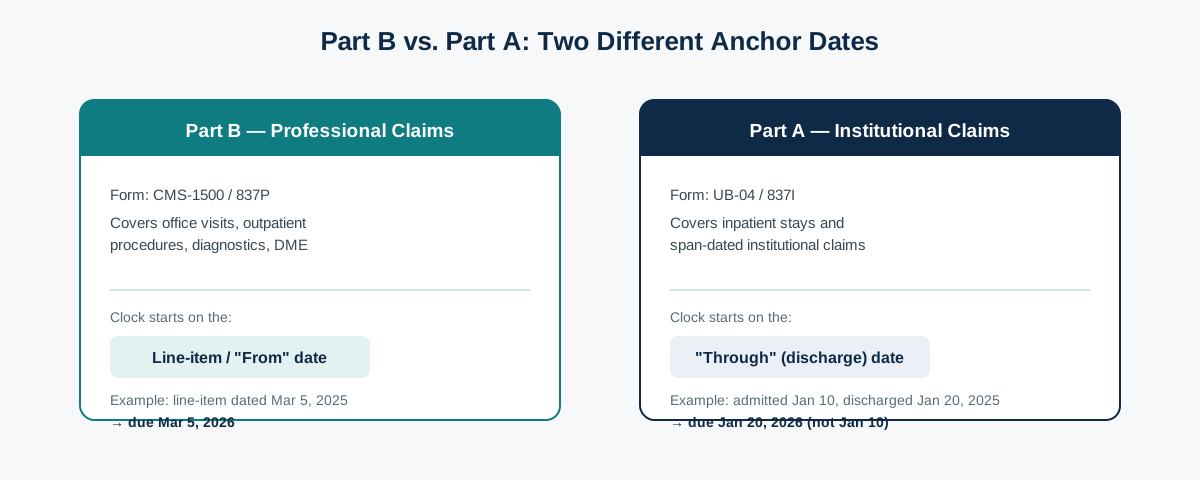
This is one of the more overlooked details in Medicare timely filing, and it’s a frequent cause of confusing, partially denied claims.
| Claim Type | Form / Format | Filing Clock Starts On |
|---|---|---|
| Part B professional (office visits, outpatient services) | CMS-1500 / 837P | The line-item date or the claim’s “From” date |
| Part A institutional with span dates | UB-04 / 837I | The claim’s “Through” (discharge) date |
| Inpatient hospital | UB-04 / 837I | Discharge date on the claim span |
| DME and rental items | CMS-1500 / 837P | Line-item “From” date |
So a patient admitted on January 10 and discharged January 20 gives your billing team until January 20 of the following year not January 10. On the flip side, a professional claim spanning a date range can have some line items expire while others are still within the window, resulting in a claim that’s partly paid and partly denied on the same remittance.
Services spanning two calendar years (for example, a claim crossing December 31) also can’t be billed on a single claim form they need to be split, which adds one more place for the clock to get miscalculated.
Rejected, Returned, or Denied? The Distinction Matters More Than People Think
A claim leaving your system is not the same as a claim being “filed” with Medicare. Understanding which bucket a claim falls into changes how you should respond:
- Rejected claims never actually enter Medicare’s processing system. They don’t appear on a remittance advice, and they carry no appeal rights because there was never a decision to appeal. You correct the data and resubmit, inside the original window.
- Returned to Provider (RTP) claims also don’t count as filed. If nobody corrects them in time, they can be purged with no trace that they were ever submitted.
- Denials are different Medicare actually made a payment decision, the claim shows up on your remittance, and most denial reasons (aside from timely filing) do carry appeal rights.
The clock keeps running through all three. A rejected claim sitting untouched in a work queue for six weeks has burned six weeks of your filing window a claim doesn’t get an extension just because it bounced.
What Happens After the Deadline Passes: CO-29 and Why There’s No Appeal
Once a claim misses the window, it comes back with:
- CO-29 on Part B professional claims
- N390 (sometimes displayed as N39011) on Part A institutional claims
- Reason code 29 paired with remark code N211 on many DME claims
Here’s the part that surprises newer billing staff: a timely filing denial is legally not an initial determination, under 42 CFR § 405.926(n). Because there’s no initial determination, the entire five-level Medicare appeals ladder never actually opens. Submitting a redetermination request against a CO-29 is effectively wasted effort it will come back unresolved because the appeals department has no authority to override a timely filing denial.
There’s also no patient billing workaround. Where the provider is responsible for the late filing, federal rules prohibit charging the beneficiary beyond the deductible and coinsurance that would have applied had Medicare paid. The loss sits entirely with the practice.
The only real path forward is a reopening request, and it only succeeds if one of four narrow CMS exceptions genuinely applies.
The 4 CMS Exceptions to the Medicare Timely Filing Limit
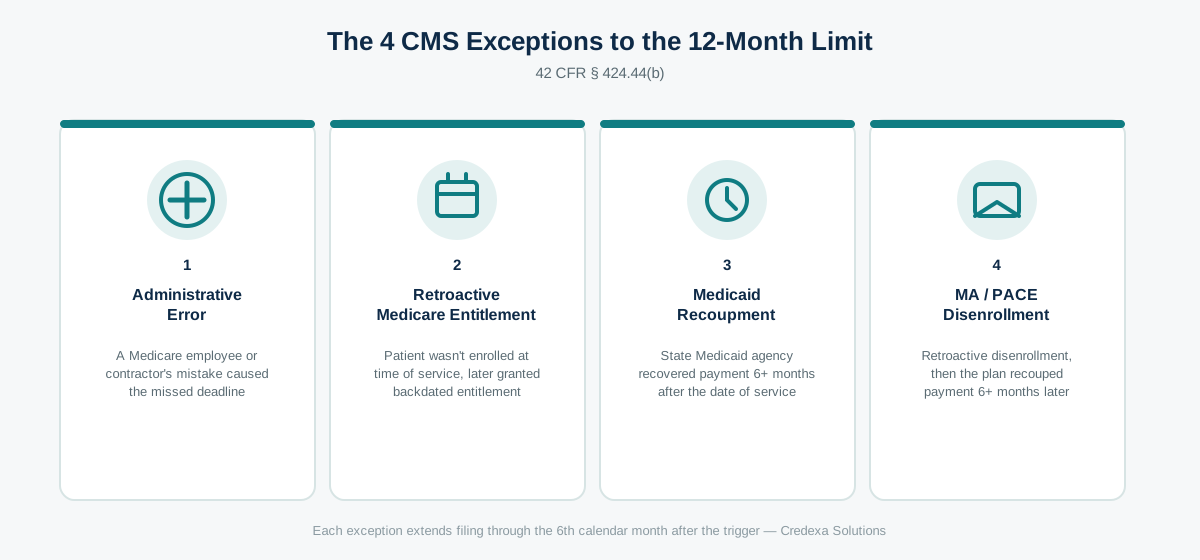
These exceptions live at 42 CFR § 424.44(b), and there really are only four not five, despite what some billing guides claim after mixing in unofficial disaster-relief provisions.
- Administrative error A Medicare employee, contractor, or agent gave incorrect information or made an error that directly caused the missed deadline.
- Retroactive Medicare entitlement The patient wasn’t yet enrolled in Medicare at the time of service, but later received retroactive entitlement effective on or before that date.
- Retroactive entitlement with Medicaid recoupment Medicaid paid for the service, Medicare entitlement was later granted retroactively, and the state Medicaid agency recouped its payment six months or more after the date of service.
- Retroactive disenrollment from a Medicare Advantage or PACE plan The patient was enrolled in an MA plan or PACE organization at the time of service, was later disenrolled retroactively, and the plan recouped payment six months or more afterward.
| Exception | Extension Trigger | Extension Runs Through |
|---|---|---|
| Administrative error | Month you were notified the error was corrected | Last day of the 6th calendar month after that month |
| Retroactive Medicare entitlement | Month of notification of retroactive entitlement | Last day of the 6th calendar month after that month |
| Retroactive entitlement + Medicaid recoupment | Month the state Medicaid agency recovered payment | Last day of the 6th calendar month after that month |
| Retroactive MA/PACE disenrollment | Month the plan recovered payment | Last day of the 6th calendar month after that month |
Two hard ceilings apply on top of these: administrative error claims generally can’t be pursued past four years from the date of service, and no exception can push a filing deadline beyond December 31 of the third calendar year after the year services were furnished (fourth year for services rendered October to December).
Notably absent from this list: natural disasters. CMS and individual MACs sometimes issue separate emergency waivers during declared disasters, but that’s a distinct mechanism not one of the four standing exceptions.
How to Actually Request an Exception (Reopening, Not an Appeal)
Because a CO-29 isn’t appealable, the correct move is a reopening request, submitted directly to your MAC:
- Confirm the exact denial code (CO-29, N390, or reason code 29/N211).
- Determine which of the four exceptions genuinely applies if none does, the claim is a write off, and further effort is wasted labor.
- Gather documentation specific to that exception (entitlement letters, Medicaid recoupment notices, written proof of administrative error, etc.).
- Submit the reopening through your MAC’s designated process institutional claims typically use a type of bill ending in Q.
- Track the reopening separately from your normal claim-status workflow, since it doesn’t move through the standard processing queue.
That last step is where a lot of practices lose visibility a reopening request needs its own follow up cadence, or it simply disappears into a queue nobody is watching.
Do Corrected Claims Reset the 12-Month Clock?
This is one of the most misunderstood areas in Medicare billing, largely because two seemingly contradictory rules are both true at once, depending on what’s being changed.
- Adding a charge or service that was left off the original claim is not permitted once the 12-month window has closed. This is treated as a new filing, not a correction.
- Correcting or supplementing information already on a timely-filed claim is governed by administrative finality and reopening rules not the one-year filing rule.
In practice: if you’re adding something new, you’re bound by the original deadline. If you’re fixing something that was already submitted on time, a reopening (type of bill ending in Q for institutional claims) is generally the right route, even after the 12-month window closes.
One narrow carve-out: an adjustment that produces a higher-weighted DRG on an inpatient claim must reach Medicare within 60 days of the original remittance.
Medicare Advantage Timely Filing: A Completely Different Rulebook
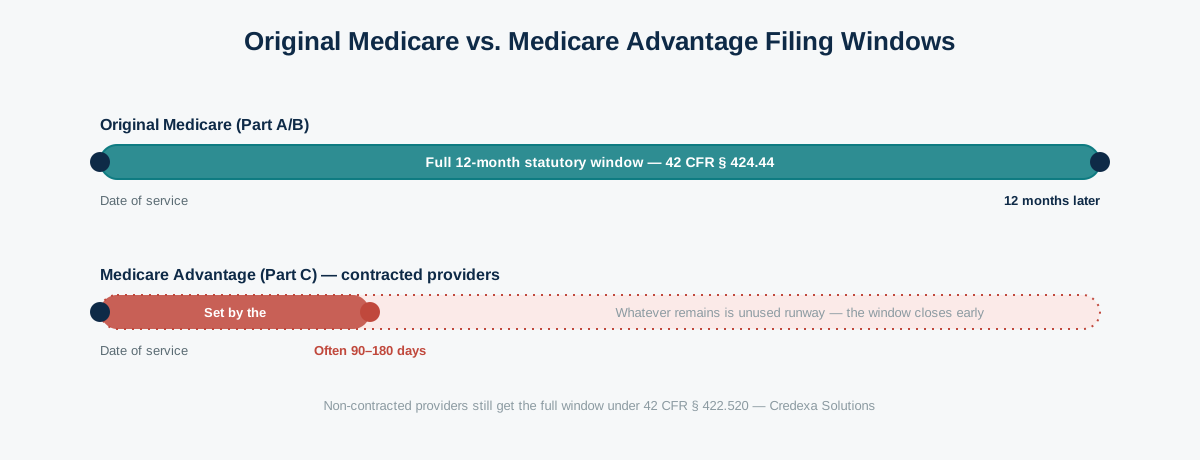
This is where a lot of avoidable denials happen, because billing teams sometimes apply Original Medicare’s 12-month logic to Medicare Advantage claims — and it doesn’t transfer.
MA plans operate under 42 CFR § 422.520, which sets only a minimum filing window that plans must honor for non-contracted providers (who are paid under Original Medicare rules). Contracted providers, however, are bound by whatever their participation agreement specifies commonly 90 or 180 days, sometimes shorter.
| Original Medicare (Part A/B) | Medicare Advantage (Part C) | |
|---|---|---|
| Governing rule | 42 CFR § 424.44 | 42 CFR § 422.520 + participation agreement |
| Standard window | 12 months from DOS | Contract-specific, often 90–180 days |
| Non-contracted providers | 12 months | Paid under Original Medicare rules |
| Late-filing remedy | Reopening only, with a valid exception | Plan’s internal reconsideration process |
| Who enforces it | The MAC | The individual health plan |
Practical takeaway: never assume a claim caught six months late is still recoverable just because that would be true under Original Medicare. Under a contracted 90-day MA agreement, that same claim is often a permanent write-off with no CMS exception process to fall back on. Always verify the signed contract before writing anything off or before assuming it’s still submittable.
Timely Filing Limit vs. Appeal Filing Limit — Don’t Confuse the Two Clocks
The timely filing limit governs your original claim submission. A completely separate clock the appeal filing limit governs how long you have to challenge a denial once one is issued. These deadlines cover coverage and payment denials; a CO-29 timely filing denial never enters this ladder, since it isn’t an initial determination.
| Level | Reviewed By | Deadline |
|---|---|---|
| 1. Redetermination | MAC | 120 days from receipt of the initial determination |
| 2. Reconsideration | Qualified Independent Contractor | 180 days from the redetermination |
| 3. ALJ Hearing | Office of Medicare Hearings and Appeals | 60 days from the reconsideration |
| 4. Appeals Council | Medicare Appeals Council | 60 days from the ALJ decision |
| 5. Judicial Review | Federal District Court | 60 days from the Council decision |
One quiet detail that eats into your window: Medicare presumes you received the initial determination five calendar days after the notice date, unless you can prove otherwise so your effective window for a redetermination is closer to 115 usable days, not a full 120.
What Counts as Proof of Timely Filing
Sometimes a CO-29 is simply wrong a claim that was actually filed on time gets denied because of a transmission or logging failure somewhere in the chain. When that happens, documentation quality determines whether the denial gets overturned.
Strongest evidence: a 277CA claim acknowledgment showing the payer accepted the claim, with a date. Also useful: EDI submission timestamps matched to payer acceptance, internal transmission logs, or a payer portal record showing receipt before the deadline. Not sufficient alone: a 999 functional acknowledgment (which only confirms your clearinghouse received the file not that the payer did), or a mailing postmark, since Medicare measures receipt rather than dispatch.
If your clearinghouse transmitted on time but the claim never reached the MAC, get that failure documented in writing that letter can support an administrative error argument under the exceptions above.
Timely Filing When Medicare Is the Secondary Payer
Waiting on a primary payer’s determination doesn’t pause Medicare’s 12-month clock. It started on the date of service and keeps running regardless of how long the primary insurer takes to adjudicate. A primary payer that takes eight months to respond has already used up two-thirds of your Medicare filing window track the deadline against the original date of service, not the date the primary EOB finally arrives.
Building a Workflow That Doesn’t Lose Claims to the Calendar
Practices rarely lose Medicare revenue to timely filing because someone was careless they lose it because nobody had the bandwidth to track multiple payer-specific clocks at once. A few habits make an outsized difference:
- Set an internal deadline well before the legal one. Treat 12 months as the outer boundary, not the target.
- Work acceptance reports daily, not just submission reports knowing what went out tells you nothing about what actually arrived.
- Clear RTP claims within days. An aged RTP effectively becomes a brand-new late filing.
- Track deadlines per payer and per contract, especially for practices juggling Original Medicare alongside multiple Medicare Advantage agreements with different windows.
- Verify eligibility before every encounter a large share of “late” claims actually started as claims sent to the wrong payer, discovered months too late.
This is exactly the kind of front-end discipline we talk about in our complete guide to revenue cycle management for healthcare providers — timely filing failures are almost always a front-end or workflow problem showing up as a back-end write-off. And if you’re not currently tracking filing-deadline exposure as a KPI on your AR dashboard, our breakdown of RCM reporting and what actually drives better collections and cash flow is a useful next read visibility is usually the missing piece.
How Credexa Solutions Protects Your Filing Windows
At Credexa Solutions, we treat Medicare timely filing as a proactive tracking problem, not a reactive appeals problem. Our approach includes:
- Payer-specific and contract-specific deadline tracking, rather than a single generic aging report
- Daily review of acceptance reports (277CA) not just submission logs so a claim that silently fails to reach the MAC gets caught in days, not months
- Fast RTP resolution, so returned claims don’t quietly become new late filings
- Honest triage on CO-29 denials: we tell clients immediately whether a claim genuinely qualifies for a CMS exception, rather than billing time against a reopening that has no real chance of succeeding
If Medicare and Medicare Advantage claims are aging past 300 days in your system right now, that’s worth a second look before those dollars become permanent write-offs.
Frequently Asked Questions

What is the Medicare timely filing limit in 2026? 12 months (one calendar year) from the date of service, under 42 CFR § 424.44, for Part A and Part B fee-for-service claims.
Is it based on when I submit the claim or when Medicare receives it? Receipt by the correct MAC. Submission dates, clearinghouse timestamps, and postmarks carry no legal weight.
Can a CO-29 denial be appealed? No. A timely filing denial isn’t an initial determination, so the standard five-level appeal process never opens. A reopening request is the only option, and only with a valid CMS exception.
What are the exceptions to the 12-month rule? Administrative error, retroactive Medicare entitlement, retroactive entitlement with Medicaid recoupment, and retroactive disenrollment from a Medicare Advantage or PACE plan.
Do Medicare Advantage plans follow the same 12-month rule? No. MA plans set their own filing windows under 42 CFR § 422.520 and their provider contracts, often 90 to 180 days for contracted providers.
Can I bill the patient if a claim is denied for timely filing? No, beyond the deductible and coinsurance that would have applied had Medicare paid if the provider is responsible for the delay.
This article is provided for general informational purposes and reflects publicly available CMS regulations as of 2026. It is not a substitute for guidance from your Medicare Administrative Contractor or legal counsel. For claim-specific questions, contact Credexa Solutions for a complimentary AR and denial review.
Sources: CMS — 42 CFR § 424.44 (eCFR) · Medicaid.gov — Medicare Timely Filing FAQ · CMS Claims Processing Manual · HHS Guidance on Untimely Claims