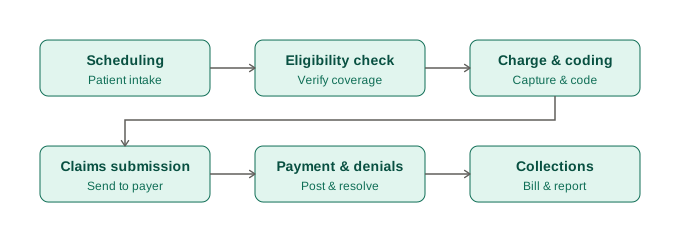
Every healthcare organization exists to deliver quality patient care — but without a healthy financial engine running in the background, even the best clinical operations can struggle to survive. That financial engine is called Revenue Cycle Management (RCM), and it is the single most important operational function determining whether a hospital, clinic, or private practice remains financially sustainable.
From the moment a patient books an appointment to the moment the final balance is collected, dozens of administrative, clinical, and financial touchpoints determine how much revenue a healthcare provider actually keeps. Mismanage any one of these touchpoints — a missed insurance verification, an incorrect medical code, a delayed claim submission — and providers lose revenue that they have already earned by delivering care.
In this complete guide, we’ll break down everything healthcare providers, practice managers, and billing teams need to know about Revenue Cycle Management: what it is, why it matters, the step-by-step process, common challenges, best practices, the role of technology, and how outsourcing RCM can transform a practice’s financial performance.
What Is Revenue Cycle Management (RCM)?
Revenue Cycle Management refers to the complete financial process healthcare organizations use to track patient care episodes — from initial appointment scheduling and registration to the final payment of a balance. It encompasses every administrative and clinical function that contributes to the capture, management, and collection of patient service revenue.
In simple terms, RCM answers one core question: “How does a healthcare provider get paid for the care it delivers, accurately and on time?”
RCM sits at the intersection of clinical documentation, medical coding, insurance billing, compliance, and patient financial engagement. A well-managed revenue cycle ensures that:
- Patient information and insurance eligibility are verified before service delivery
- Services rendered are documented and coded correctly
- Claims are submitted cleanly and promptly to payers
- Denials and rejections are identified and resolved quickly
- Patients understand and pay their financial responsibility
- Providers maintain a predictable, healthy cash flow
Without effective RCM, healthcare organizations face delayed reimbursements, high claim denial rates, compliance risks, and mounting administrative costs — all of which directly threaten the ability to reinvest in patient care.
Why Revenue Cycle Management Matters More Than Ever
Healthcare reimbursement has become increasingly complex. Providers today are managing multiple payer contracts, shifting regulatory requirements, value-based care models, high-deductible health plans, and rising patient financial responsibility — all at once.
Here’s why RCM has become a strategic priority rather than a back-office afterthought:
1. Rising Claim Denials
Denial rates continue to climb across the industry, driven by coding errors, eligibility issues, authorization gaps, and payer-specific rules. Every denied claim represents delayed — or lost — revenue.
2. Increasing Patient Financial Responsibility
With the growth of high-deductible health plans, patients now shoulder a larger share of healthcare costs. Providers must have systems in place to estimate costs, communicate clearly, and collect efficiently — without damaging the patient relationship.
3. Regulatory and Compliance Pressure
Coding standards (ICD-10, CPT, HCPCS), payer policies, and federal regulations change frequently. Non-compliance can trigger audits, penalties, and revenue clawbacks.
4. Staffing Shortages
Many healthcare organizations struggle to find and retain skilled billing and coding staff, creating bottlenecks throughout the revenue cycle.
5. Margin Pressure
Operating margins in healthcare remain thin. An optimized revenue cycle directly improves the bottom line without requiring an increase in patient volume.
Given these pressures, providers who invest in strong RCM processes — whether in-house or through a specialized partner — consistently outperform those who treat billing as a purely administrative task.
The Complete Revenue Cycle Management Process: Step-by-Step
RCM is not a single task — it’s an interconnected chain of processes. A weakness in any one stage creates a ripple effect across the entire cycle. Below is a detailed breakdown of each stage.
Step 1: Pre-Registration and Scheduling
The revenue cycle begins before the patient even walks through the door. During scheduling, front-office staff collect demographic information, insurance details, and the reason for the visit. This is the foundation for everything that follows — errors here (a misspelled name, wrong date of birth, incorrect insurance ID) can cause claim denials weeks later.
Best practice: Use scheduling software that integrates directly with your practice management and EHR systems to reduce manual data entry errors.
Step 2: Patient Registration
At check-in, staff confirm and update patient demographic and insurance information, collect consent forms, and record the reason for the visit. Accurate registration data is critical because it feeds directly into insurance verification and claims submission.
Step 3: Insurance Eligibility and Benefits Verification
Before a service is rendered, staff must verify that the patient’s insurance is active and confirm what services are covered, what the co-pay or deductible will be, and whether prior authorization is required. Skipping or rushing this step is one of the leading causes of claim denials and patient billing disputes.
Best practice: Automate real-time eligibility checks through clearinghouse integrations rather than relying on manual phone verification.
Step 4: Prior Authorization
Many procedures, imaging studies, and specialty medications require payer pre-approval. Failing to obtain authorization before service delivery is one of the top reasons claims get denied outright — and these denials are often not appealable.
Step 5: Charge Capture
Once care is delivered, every billable service, procedure, and supply must be accurately recorded. Missed charges represent pure lost revenue, since the service was performed but never billed.
Step 6: Medical Coding
Certified coders translate clinical documentation into standardized codes (ICD-10-CM for diagnoses, CPT/HCPCS for procedures). Coding accuracy directly affects reimbursement amounts and compliance risk. Under-coding leaves money on the table; over-coding or mismatched codes can trigger audits.
Step 7: Claims Submission
Coded claims are scrubbed for errors and submitted electronically to payers, typically through a clearinghouse. A “clean claim” — one submitted correctly the first time, with no errors — is the goal, since clean claims are reimbursed significantly faster than claims requiring correction and resubmission.
Step 8: Claims Adjudication
The payer reviews the claim and determines whether to approve, deny, or partially pay it based on the patient’s coverage, medical necessity, and contract terms. Providers should track claim status proactively rather than waiting for payer notifications.
Step 9: Denial Management and Appeals
When claims are denied, providers must quickly identify the root cause — coding errors, missing documentation, eligibility issues, or authorization gaps — correct the issue, and resubmit or appeal within the payer’s filing deadline. Timely, systematic denial management is one of the highest-impact areas in the entire revenue cycle, since a large share of denied claims are recoverable if addressed quickly.
Step 10: Payment Posting
Once a claim is paid, the payment must be posted accurately to the patient account, and any contractual adjustments must be applied correctly. Discrepancies between the expected and actual reimbursement should be flagged immediately for follow-up.
Step 11: Patient Billing and Collections
After insurance has paid its portion, the remaining patient balance is billed. Clear, upfront communication about costs — combined with convenient payment options like online portals and payment plans — significantly improves patient collection rates and satisfaction.
Step 12: Reporting and Analytics
The final (and often most overlooked) stage of RCM is measurement. Tracking key performance indicators allows organizations to identify bottlenecks, forecast cash flow, and continuously improve the revenue cycle. We go deeper into exactly how this works — and why it’s the real driver behind stronger collections — in our detailed breakdown of RCM reporting and its impact on cash flow, which is a great next read after this guide.
Front-End, Mid-Cycle, and Back-End RCM: Understanding the Three Phases
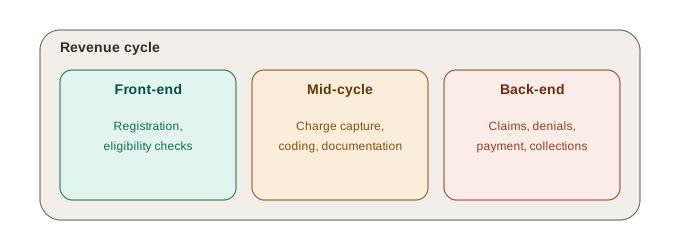
To manage the revenue cycle effectively, it helps to think of it in three broad phases. Each phase has a different focus, different owners, and different risks — and weaknesses in one phase inevitably show up as revenue leakage in the next.
Front-End RCM
This phase covers everything that happens before and during the patient visit: scheduling, pre-registration, eligibility verification, and prior authorization. Front-end RCM is where most preventable denials originate. Studies across the industry consistently show that a large share of denials trace back to registration and eligibility errors — problems that are far cheaper to fix before a claim is ever submitted than after it’s denied.
Mid-Cycle RCM
Mid-cycle activities include clinical documentation, charge capture, and medical coding. This is where clinical care is translated into billable, compliant data. Strong clinical documentation improvement (CDI) programs and coder training directly reduce downstream denials and support accurate reimbursement.
Back-End RCM
The back end covers claims submission, adjudication, denial management, payment posting, and patient collections. This is where cash actually comes in the door — and where a proactive, well-staffed denial management function makes the biggest measurable difference to net revenue.
Organizations that treat RCM as three disconnected departments — front desk, coding, and billing — tend to underperform. The highest-performing revenue cycles are managed as a single, continuous workflow with shared accountability and shared data.
Specialty-Specific RCM Considerations
Not all revenue cycles look the same. Billing complexity varies significantly by specialty, and providers benefit from RCM processes tailored to their unique payer mix and service lines.
- Primary Care: High patient volume with frequent, lower-dollar claims makes clean claim submission and efficient eligibility verification especially important.
- Behavioral Health: Frequent prior authorization requirements and visit-limit tracking make proactive authorization management essential.
- Specialty and Surgical Practices: Higher-dollar claims with complex coding (multiple CPT codes, modifiers, bundling rules) increase the risk — and financial impact — of coding errors.
- Durable Medical Equipment (DME) and Home Health: Documentation requirements are especially strict, and claims are frequently denied for missing certificates of medical necessity.
- Multi-Specialty Groups: Coordinating RCM across multiple specialties and payer contracts requires centralized reporting to avoid inconsistent performance across departments.
Understanding where your specialty’s specific risk points lie allows you to focus improvement efforts where they’ll have the greatest financial impact, rather than applying a generic approach across the board.
Common Revenue Cycle Management Challenges
Even well-run healthcare organizations face persistent RCM challenges. Understanding these pain points is the first step toward solving them.
High Claim Denial Rates
Denials caused by coding errors, missing authorizations, or eligibility issues remain one of the biggest drains on provider revenue. Many organizations never even rework a meaningful share of their denied claims, leaving significant revenue unrecovered.
Slow Reimbursement Cycles
Manual processes, incomplete documentation, and payer backlogs extend the time between service delivery and payment, straining cash flow.
Coding and Compliance Complexity
With frequent updates to coding standards and payer-specific rules, keeping billing staff current is a constant challenge — and errors carry real financial and legal risk.
Rising Patient Responsibility
Collecting directly from patients is harder and more expensive than collecting from insurers. Without transparent cost estimates and flexible payment options, patient collections suffer.
Staffing and Training Gaps
Experienced medical billers and certified coders are in short supply, and turnover disrupts continuity across the revenue cycle.
Fragmented Technology
Many practices still rely on disconnected systems for scheduling, EHR, billing, and reporting — creating data silos, duplicate entry, and missed charges.
Lack of Real-Time Visibility
Without integrated dashboards and analytics, leadership often can’t see revenue cycle bottlenecks until they’ve already caused significant financial damage.
Payer Contract Complexity
Each payer contract carries its own fee schedules, timely filing limits, and documentation requirements. Without a system to track contract terms, providers often under-collect on services without realizing it, or miss appeal deadlines entirely.
Bad Debt and Write-Offs
When patient collections processes are weak, unpaid balances eventually get written off as bad debt. Over time, this quietly erodes margins in a way that’s easy to overlook until it shows up clearly in year-end financials.
Signs Your Practice Needs to Improve Its Revenue Cycle Management
It’s not always obvious that a revenue cycle needs attention — problems often build gradually. Watch for these warning signs:
- Days in Accounts Receivable steadily increasing quarter over quarter
- A denial rate that exceeds industry benchmarks, or that keeps climbing
- Billing staff spending more time on rework than on new claims
- Patients confused or frustrated by unclear bills
- No consistent, real-time reporting on revenue cycle performance
- Growing gap between charges billed and revenue actually collected
- Frequent staff turnover in billing and coding roles
If two or more of these sound familiar, it’s a strong signal that your revenue cycle processes — whether people, technology, or workflow — need a closer look.
Best Practices to Optimize Revenue Cycle Management
Improving RCM performance doesn’t require a complete overhaul overnight. Providers can make measurable progress by focusing on these best practices:
1. Verify Eligibility Before Every Visit
Real-time insurance verification prevents a large share of downstream denials. Make it a non-negotiable step for every scheduled visit, not just new patients.
2. Focus on Clean Claim Submission
Invest in claim-scrubbing technology that flags errors before submission. The goal should be a clean claim rate in the high 90s, since every reworked claim adds cost and delays payment.
3. Build a Proactive Denial Management Process
Don’t just track denials — categorize them by root cause, assign accountability, and set strict turnaround times for appeals. The fastest-recovering organizations treat denial management as a daily workflow, not a monthly cleanup task.
4. Standardize Documentation and Coding Practices
Regular coder training and periodic internal audits catch errors before they become compliance risks or revenue losses.
5. Improve Patient Financial Communication
Provide upfront cost estimates, clear billing statements, and multiple payment options (online portals, payment plans, text-to-pay). Patients who understand their bills are more likely to pay them promptly.
6. Automate Where Possible
Automation in eligibility verification, claim scrubbing, payment posting, and denial routing reduces manual errors and frees staff to focus on complex, high-value cases.
7. Monitor KPIs Continuously
Revenue cycle performance should be visible on a dashboard, not buried in month-end spreadsheets. Real-time visibility allows teams to catch problems while they’re still small.
8. Conduct Regular Revenue Cycle Audits
Periodic audits of the entire cycle — from registration to collections — help identify systemic weaknesses before they compound.
9. Align Front-Office and Back-Office Teams
RCM breaks down when scheduling, clinical, and billing teams operate in silos. Cross-functional accountability and shared performance goals improve outcomes across the board.
10. Consider Specialized RCM Expertise
Given the complexity of modern billing and payer rules, many providers find that partnering with dedicated RCM specialists delivers stronger, more consistent results than trying to manage everything internally.
The Role of Technology and Automation in Modern RCM
Technology has fundamentally reshaped what’s possible in revenue cycle management. Where manual, paper-based processes once dominated, today’s leading organizations rely on integrated digital ecosystems.
Practice Management and EHR Integration
Seamless data flow between clinical documentation and billing systems reduces duplicate entry and minimizes charge capture errors.
Automated Eligibility and Benefits Verification
Real-time API connections to payer systems allow front-office staff to confirm coverage instantly, rather than relying on time-consuming phone calls.
AI-Assisted Medical Coding
Computer-assisted coding tools analyze clinical documentation and suggest accurate codes, improving both speed and accuracy while flagging documentation gaps for coders to review.
Claim Scrubbing Software
Automated rule-based engines check claims against payer-specific requirements before submission, dramatically increasing first-pass clean claim rates.
Denial Analytics and Workflow Automation
Modern RCM platforms automatically categorize denials by reason code and route them to the right team member, cutting resolution time significantly.
Patient Payment Portals
Self-service portals with transparent cost estimates, digital statements, and flexible payment plans improve both patient satisfaction and collection rates.
Predictive Analytics and Reporting Dashboards
Advanced analytics tools forecast cash flow, identify at-risk claims before submission, and highlight underperforming areas across the revenue cycle — turning RCM from a reactive process into a proactive, data-driven strategy.
While technology is a powerful enabler, it’s important to remember that tools alone don’t fix a broken process. The organizations that see the biggest gains combine the right technology with skilled billing professionals and well-designed workflows.
In-House vs. Outsourced Revenue Cycle Management
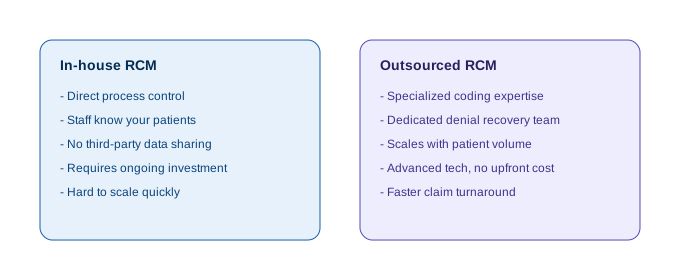
One of the biggest strategic decisions healthcare providers face is whether to manage RCM internally or partner with an external specialist. Both approaches can work — the right choice depends on the organization’s size, resources, and growth goals.
In-House RCM
Advantages:
- Direct oversight and control over processes
- Staff familiarity with organizational culture and patient base
- No third-party data-sharing concerns
Challenges:
- Requires ongoing investment in staffing, training, and technology
- Vulnerable to staff turnover and coverage gaps
- Difficult to keep pace with constantly changing payer rules and coding standards
- Scaling billing operations alongside patient volume growth can be costly
Outsourced RCM
Advantages:
- Access to specialized billing and coding expertise across multiple specialties
- Dedicated denial management teams focused solely on recovering revenue
- Scalable capacity that grows with the practice, without new hires
- Advanced technology and analytics platforms, without the upfront investment
- Faster claim turnaround and improved cash flow, since RCM is the partner’s core focus rather than a secondary administrative function
Considerations:
- Requires choosing a trustworthy, experienced partner
- Clear communication and reporting structures must be established
For many practices — especially small to mid-sized providers without the resources to build a large in-house billing department — outsourcing RCM to a specialized partner delivers stronger financial results while freeing internal staff to focus on patient care.
Key RCM Metrics and KPIs Every Provider Should Track
You can’t improve what you don’t measure. These are the core KPIs that reveal the true health of a revenue cycle:
| KPI | What It Measures |
|---|---|
| Days in Accounts Receivable (AR) | Average time it takes to collect payment after service |
| Clean Claim Rate | Percentage of claims accepted by payers without correction |
| First-Pass Resolution Rate | Percentage of claims paid on the first submission |
| Denial Rate | Percentage of claims denied by payers |
| Net Collection Rate | Percentage of collectible revenue actually collected |
| Cost to Collect | Administrative cost of collecting each dollar of revenue |
| Patient Collection Rate | Percentage of patient-owed balances successfully collected |
| Aging AR Percentage (90+ days) | Share of receivables that are significantly overdue |
Tracking these metrics consistently — ideally through a real-time dashboard rather than static monthly reports — allows leadership to spot problems early and measure the impact of process improvements. If you want a deeper dive into how strong reporting practices directly translate into better collections and healthier cash flow, our recent post on RCM reporting explained breaks it down in detail.
The Future of Revenue Cycle Management
RCM continues to evolve alongside the broader healthcare landscape. Several trends are shaping where the industry is headed:
- Value-Based Care Integration: As reimbursement models shift from fee-for-service to value-based arrangements, RCM systems must track quality metrics and outcomes alongside traditional billing data.
- AI and Machine Learning: Predictive analytics will increasingly flag high-risk claims before submission, reducing denials proactively rather than reactively.
- Price Transparency Requirements: Regulatory pressure for upfront cost estimates will push providers toward more sophisticated patient financial engagement tools.
- Interoperability: Greater data-sharing standards between EHRs, payers, and billing systems will reduce administrative friction industry-wide.
- Consumer-Driven Healthcare: As patients behave more like consumers, RCM must adapt with retail-style billing experiences — transparent pricing, digital payments, and self-service tools.
Providers who stay ahead of these trends — by investing in the right technology, processes, and partnerships today — will be far better positioned for long-term financial stability.
How Credexa Solutions Helps Healthcare Providers Strengthen Their Revenue Cycle
At Credexa Solutions, we specialize exclusively in end-to-end Revenue Cycle Management for healthcare providers of all sizes — from independent practices to multi-specialty groups. We understand that every denied claim, every delayed payment, and every uncollected patient balance represents care you’ve already delivered but haven’t yet been paid for.
Our team combines certified coding and billing expertise with modern RCM technology to help providers:
- Increase clean claim rates and reduce first-pass denials
- Accelerate reimbursement timelines and improve cash flow predictability
- Recover revenue through proactive, root-cause-driven denial management
- Improve patient collections through transparent billing and flexible payment options
- Gain real-time visibility into revenue cycle performance through detailed reporting and analytics
Whether you’re looking to fully outsource your billing operations or simply need support strengthening a specific stage of your revenue cycle, Credexa Solutions builds a strategy tailored to your specialty, patient volume, and financial goals — so you can spend less time chasing payments and more time focused on patient care.
If you’d like to see how strong reporting directly drives stronger collections, don’t miss our companion article: RCM Reporting Explained — The Real Driver Behind Better Collections and Cash Flow.
Frequently Asked Questions About Revenue Cycle Management
1. What are the main stages of revenue cycle management? The core stages include pre-registration, patient registration, insurance verification, prior authorization, charge capture, medical coding, claims submission, claims adjudication, denial management, payment posting, patient collections, and reporting.
2. What is the difference between medical billing and revenue cycle management? Medical billing is one component of RCM, focused specifically on submitting claims and collecting payments. RCM is the broader, end-to-end process encompassing every financial touchpoint from scheduling through final collection.
3. Why do healthcare providers outsource RCM? Providers outsource RCM to access specialized billing expertise, reduce administrative overhead, improve claim accuracy, accelerate reimbursement, and scale billing operations without expanding internal staff.
4. What is a good clean claim rate? Most high-performing organizations aim for a clean claim rate in the mid-to-high 90th percentile, meaning the vast majority of claims are accepted by payers without requiring correction or resubmission.
5. How can providers reduce claim denials? Reducing denials requires accurate eligibility verification, complete documentation, correct coding, timely prior authorizations, and a proactive process for identifying and correcting denial trends before they recur.
6. How long does the revenue cycle typically take, from service to final payment? Timelines vary by payer and claim complexity, but a well-managed revenue cycle typically collects the majority of insurance payments within 30 to 45 days of claim submission. Poorly managed cycles can stretch payment timelines to 90 days or more, straining cash flow.
7. What is the difference between a claim denial and a claim rejection? A rejection occurs when a claim fails basic formatting or data checks and is never actually processed by the payer — it must be corrected and resubmitted. A denial occurs when the payer processes the claim but declines to pay, usually requiring an appeal along with supporting documentation.
8. Can small practices benefit from professional RCM support as much as large hospitals? Yes — in many cases, small and mid-sized practices see an even greater relative benefit, since they typically lack the staffing depth to manage denial follow-up, coding audits, and patient collections in-house alongside day-to-day operations.
9. What role does clinical documentation play in revenue cycle management? Clinical documentation is the foundation for accurate coding and billing. Incomplete or ambiguous documentation leads directly to coding errors, under-billing, or claims that lack the medical necessity support required for reimbursement.
Final Thoughts

Revenue Cycle Management is far more than a back-office billing function — it’s the financial backbone that determines whether a healthcare organization can sustain and grow its ability to deliver quality care. From the first patient scheduling call to the final collected payment, every step in the cycle carries real financial weight.
Providers who invest in strong RCM processes — through the right combination of people, technology, and (where appropriate) specialized outsourcing partners — consistently see fewer denials, faster reimbursements, and healthier, more predictable cash flow.
If your organization is ready to strengthen its revenue cycle and stop leaving earned revenue on the table, Credexa Solutions is here to help. Get in touch with our RCM specialists to discuss a tailored strategy for your practice, and be sure to explore our related guide on how RCM reporting drives better collections and cash flow for a deeper look at turning data into revenue.
Sources and further reading: Centers for Medicare & Medicaid Services (CMS), Healthcare Financial Management Association (HFMA), Medical Group Management Association (MGMA), AAPC (American Academy of Professional Coders).