

Billing teams often search for one number: the AARP timely filing limit. Unfortunately, no single number exists, and treating one as universal is how practices end up with CO-29 write-offs.
AARP is a membership organization, not an insurer. UnitedHealthcare insures the AARP-branded Medicare plans, so UnitedHealthcare’s rules, portals, and contracts decide when your claim is late. Which rule applies depends on two facts: which AARP product the patient has, and, for Medicare Advantage, whether you’re contracted with UnitedHealthcare.
This guide covers each deadline, how the clock runs on secondary and corrected claims, appeal windows, what counts as proof of timely filing, and the exceptions that can rescue a late claim.
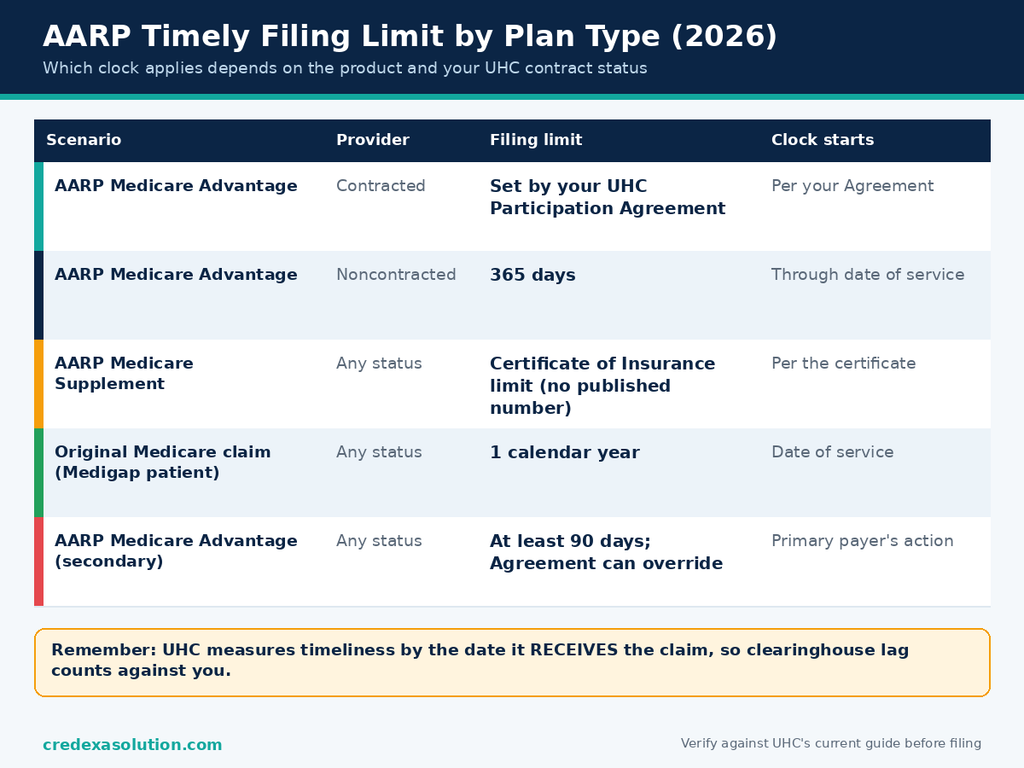
Quick Answer: AARP Timely Filing Limit by Plan Type
| Scenario | Filing limit | Where the deadline comes from |
|---|---|---|
| AARP Medicare Advantage, contracted provider | Whatever your UHC Participation Agreement says | Your contract |
| AARP Medicare Advantage, noncontracted provider | 365 days from the through date of service | UHC’s 2026 Administrative Guide |
| AARP Medicare Supplement (Medigap) | The limit in the member’s Certificate of Insurance (UHC publishes no number) | The certificate |
| Original Medicare claim behind a Medigap claim | 1 calendar year from the date of service | 42 CFR 424.44 |
| AARP Medicare Advantage as secondary payer | At least 90 days from the primary payer’s action; your contract may override | UHC’s 2026 Administrative Guide |
Two patients with AARP cards can carry different deadlines on the same morning schedule. That’s why the card alone is never enough.
Who Actually Processes AARP Claims?
UnitedHealthcare Insurance Company or one of its affiliates underwrites AARP-branded Medicare plans. AARP licenses its name to UnitedHealthcare and doesn’t pay claims. Your eligibility checks, payer IDs, and appeals all go through UnitedHealthcare.
Three AARP-branded product lines exist, and they follow different billing rules:
- AARP Medicare Advantage (Part C): a private plan that delivers Part A and Part B benefits. Older payer lists may still call it AARP MedicareComplete.
- AARP Medicare Supplement (Medigap): pays some costs Original Medicare leaves behind, such as deductibles, copays, and coinsurance. Medicare pays first.
- AARP Medicare Rx: Part D prescription drug coverage, which is billed through pharmacy channels and not covered here.
Because the logo appears on all three, front-desk staff need a quick way to tell them apart.
How to identify the AARP plan at check-in
- Look for the Medicare card. A Medigap patient carries a separate Original Medicare card alongside the AARP supplement card. A Medicare Advantage patient typically uses the AARP plan card as their primary Medicare coverage.
- Check the plan ID and payer ID. Medicare Advantage cards carry a plan identifier tied to CMS filings.
- Run eligibility in the UnitedHealthcare Provider Portal. If the card is unclear, the portal tells you what product the member has.
- Record the product in your practice management system. Store the plan type, not just “AARP,” so deadline rules can trigger automatically.
Verifying the product before the visit prevents most timely filing surprises. A solid eligibility and benefits verification process captures this at scheduling instead of at claim time.
AARP Medicare Advantage Timely Filing Limit
Contracted providers: your Participation Agreement controls
For contracted providers, no universal AARP Medicare Advantage filing number exists. Your UnitedHealthcare Participation Agreement sets the window, and UHC’s own guide says the Agreement controls when the two conflict. Pull the timely filing clause from your contract, record its effective date, and store it where your billers can see it.
Do not borrow the 365-day figure for contracted claims. UHC’s 365-day statement applies to noncontracted providers.
Network status also varies by product. A group can be contracted for one UnitedHealthcare product and out of network for another, and eligibility responses don’t return network status. Confirm it plan by plan. If you aren’t contracted and want to be, our guide on UnitedHealthcare credentialing explains the enrollment path.
Noncontracted providers: 365 days from the through date
According to UnitedHealthcare’s 2026 Administrative Guide, its Medicare Advantage plans, AARP plans included, must allow noncontracted providers 365 days from the through date of service. On a span or inpatient claim, count from the last date billed.
Here’s a worked example:
- Through date of service: March 10, 2026
- Receipt deadline: March 10, 2027
- Claim sent on day 364 but logged by UHC on day 366: late
UHC measures timeliness by the date it receives a claim. Mail transit, clearinghouse lag, and rejected submissions all count against you.
A common myth: 42 CFR 422.520
Some billing guides link the 365-day Medicare Advantage figure to 42 CFR 422.520. That regulation covers prompt payment. It requires plans to pay 95% of clean noncontracted claims within 30 days and to pay or deny other noncontracted claims within 60 calendar days. It sets no filing deadline for providers. The 365-day figure comes from UHC’s own guide.
AARP Medicare Supplement Timely Filing Limit
AARP Medicare Supplement claims follow the time limit written in the member’s UnitedHealthcare Certificate of Insurance. UHC’s AARP Medicare Supplement provider page says late claims may be declined but doesn’t publish a number.
Two clocks run on every Medigap claim
- Clock one (Original Medicare): Under 42 CFR 424.44, the Medicare claim must be filed within one calendar year of the date of service. See our breakdown of Medicare’s 12-month filing rule for the exceptions.
- Clock two (the supplement): The certificate’s own limit applies to the secondary claim.
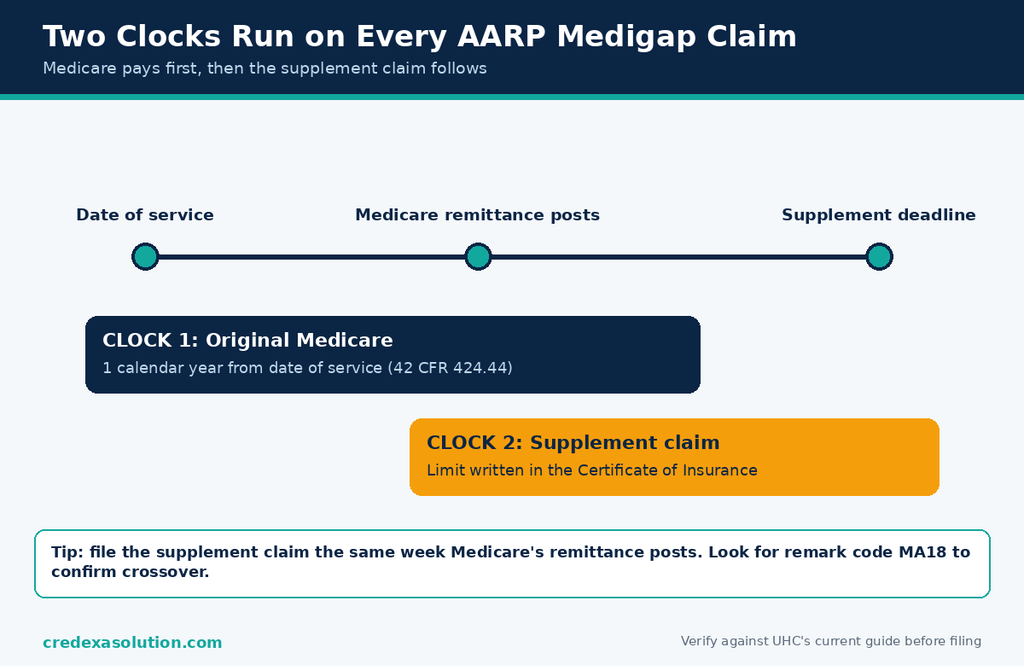
The practical rule is to treat the supplement claim as same-week work once Medicare’s remittance posts. Don’t wait to find out how long the certificate allows.
Which Medigap claims cross over automatically, and which don’t
Medicare forwards many Part B claims to UnitedHealthcare through crossover. These claims typically don’t cross over:
- Institutional claims
- Claims with incorrect member data (name, date of birth, Medicare number)
- Adjustment claims
- Claims Medicare paid in full
- Claims Medicare denied
Check the Medicare remittance for remark code MA18, which indicates Medicare forwarded the claim to the supplemental insurer. If MA18 is absent and a patient balance remains, file the supplement claim yourself.
How to file an AARP Medicare Supplement claim
| Item | Detail |
|---|---|
| Electronic payer ID | 36273 |
| Paper claims address | UnitedHealthcare Claims Division, P.O. Box 1878, Southampton, PA 18966-9998 |
| Typical processing | About 10 to 14 days from receipt |
| Portal | UnitedHealthcare Provider Portal (the older AARP Healthcare Options provider site was retired in 2025) |
| Provider phone line | Provider Express, 800-227-7789 |
| Attachments on paper | Include the Medicare remittance |
UHC changed the AARP claims mailing address in 2025, and member ID cards may still show the old one. Use the address in UHC’s claims address notice, not the card. If a member participates in UHC’s EZ Claim Pay program, UHC sends the Part B deductible payment to you separately, so don’t bill the patient for it.
Crossover gaps cost practices real money, because a claim that never left Medicare won’t appear on any UHC denial report. A dedicated medical billing partner that reconciles Medicare remittances against supplement balances will catch these.
The “15-Month AARP Timely Filing Limit”: Fact or Myth?
Search for the AARP timely filing limit and you’ll see payer charts listing 15 months. We found no UnitedHealthcare guidance that sets that number, and UHC’s published sources point elsewhere:
- For Medicare Advantage, UHC’s guide gives 365 days (noncontracted) or defers to your contract.
- For Medigap, UHC defers to the Certificate of Insurance.
One plausible origin is a standard proof-of-loss clause found in many state insurance laws. Those provisions typically require written proof within 90 days, with an outer limit of one year after that, which adds up to 15 months. That’s an explanation for where the figure may come from, not evidence that it governs AARP claims.
The safe approach is to treat any chart as a lead, not a source. Verify the actual deadline this way:
- Ask the patient for the claims provision in their Certificate of Insurance.
- Call Provider Express at 800-227-7789 and log the date, the representative’s name, and any reference number.
- Avoid the question entirely by filing the supplement claim as soon as Medicare adjudicates.
Keep the confirming document in the claim file. A chart is not proof in a dispute.
AARP Secondary Claims: When Does the Clock Start?
On AARP Medicare Advantage secondary claims, UHC’s 2026 guide sets a floor of at least 90 days from the primary payer’s payment, contest, denial, or notice. A contracted provider’s Agreement can set a different period.
| Secondary scenario | Clock starts | Window |
|---|---|---|
| AARP Medicare Supplement after Original Medicare | Per the certificate | Certificate of Insurance limit |
| AARP Medicare Advantage paying second | Primary payer’s payment, contest, denial, or notice | At least 90 days; Agreement can override |
Count from the action date on the primary payer’s EOB or 835, and keep that remittance with the claim, because it’s your evidence of when the secondary clock began.
An electronic secondary 837 should carry the primary payer’s paid amount and the CAS adjustment group, reason codes, and amounts from its 835. Billing the wrong payer first often triggers a coordination of benefits denial, which our CO-22 denial code guide explains.
Secondary deadlines work the same way at other payers, with different numbers. If you also bill Kaiser, Healthfirst, or CHAMPVA, compare the rules in our Kaiser Permanente timely filing limit guide, our Healthfirst timely filing limit guide, and our CHAMPVA timely filing limit guide.
AARP Corrected Claim Timely Filing Limit
A corrected claim does not restart the filing clock. Under a UHC Agreement, UHC’s claim correction guidance says corrections must arrive within the Agreement’s filing period, measured from the date of service, discharge, or final outpatient visit, not from the remittance date.
UHC’s own example: with a May 1 last date of service and a 90-day Agreement, every correction must reach UHC by July 30. Filing the original on day 30 doesn’t earn the correction extra time.
If you’re noncontracted, plan to complete corrections inside the original 365 days from the through date of service.
How to submit a corrected AARP claim
- Wait for adjudication of the original. Corrections sent too early can come back as duplicates.
- Use frequency code 7 on electronic claims (Loop 2300, CLM05-03, or the last digit of an institutional bill type).
- On paper, enter code 7 in Box 22 with the original claim number in the reference field.
- Keep the original bill type. A different bill type isn’t treated as a correction.
On Medigap claims, Medicare’s adjustment claims don’t cross over. After Medicare reprocesses a corrected claim, send the updated supplement claim to payer ID 36273 yourself.
The best way to protect correction deadlines is to submit fewer corrections. Payer-specific scrubbing before the first submission, like the edits in our claim submission services, catches errors while there’s still time.
AARP Appeal and Reconsideration Deadlines
For noncontracted providers on AARP Medicare Advantage claims, UHC splits disputes into two tracks, per its noncontracted provider appeal guide:
| Track | Use it when | Deadline | UHC response time |
|---|---|---|---|
| Payment reconsideration | UHC denied the claim or paid for a different service or level | 60 calendar days from the remittance notification date | 60 calendar days |
| Claim payment dispute | You believe Original Medicare would have paid a different amount | 120 calendar days from the initial payment | 30 calendar days |
A reconsideration request requires a Waiver of Liability Statement, which holds the member harmless, plus your reasoning and supporting records. If UHC upholds the denial in whole or in part, the case goes to the CMS Independent Review Entity.
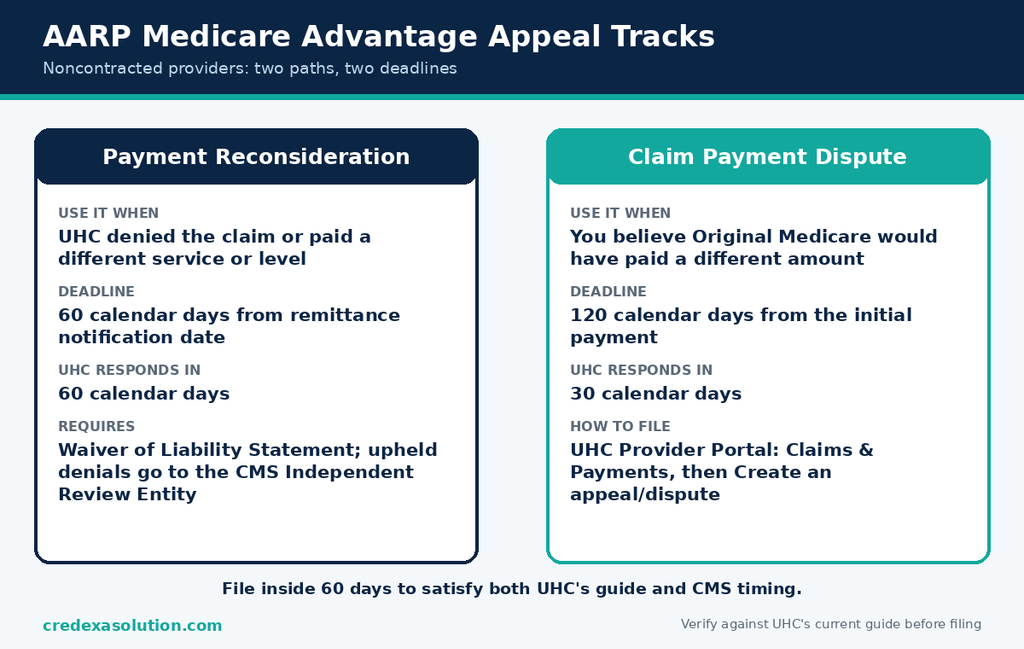
CMS materials describe 65 days for some Part C requests, while UHC’s guide says 60. Filing inside 60 days satisfies both.
Contracted providers begin with a claim reconsideration and then appeal, under the timing in their Agreement. Member appeals follow a separate track under CMS’s Part C reconsideration rules. For Medigap, if Medicare denies the underlying claim, appeal through Medicare’s levels first.
Decide which track applies on the day the denial posts. A team that spends a week deciding has already burned part of the 60-day window. Our denial management services triage each denial by reason code on day one.
Proof of Timely Filing That UnitedHealthcare Accepts
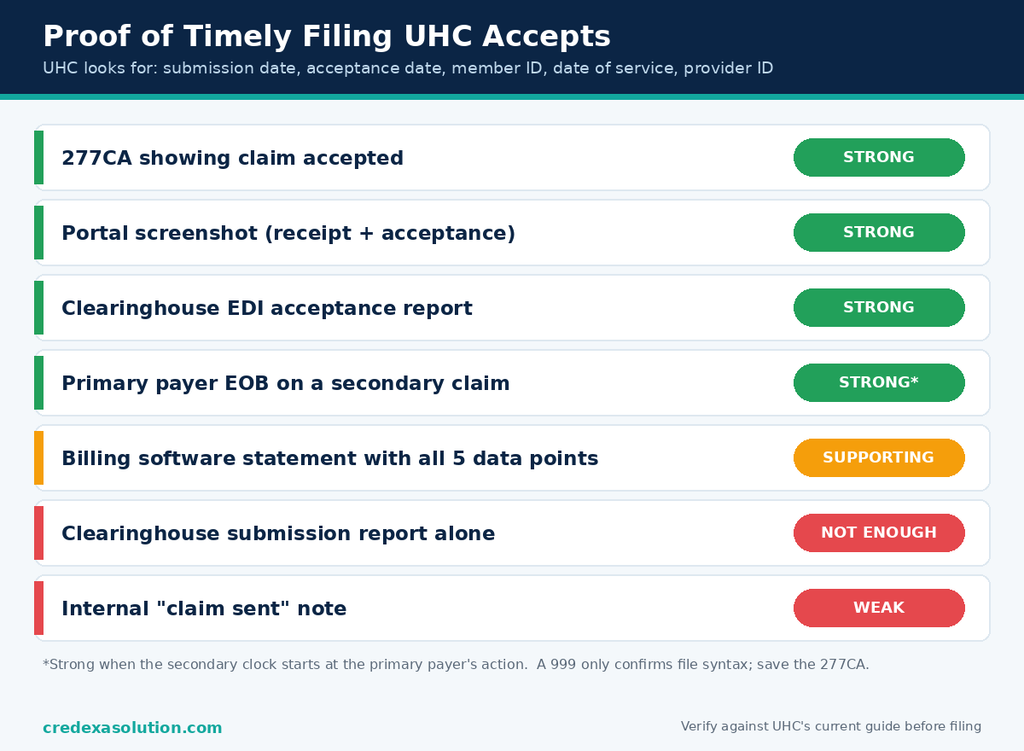
Proof must show UHC received and accepted the right claim inside your window. UHC looks for five data points: submission date, acceptance date, member identification, date of service, and provider identification.
Rejected claims don’t count. A rejection means the claim never entered adjudication. A clearinghouse submission report alone isn’t enough either, and UHC wants acceptance evidence.
| Evidence | Strength |
|---|---|
| 277CA showing the claim accepted | Strong |
| Portal screenshot with receipt and acceptance, plus member, provider, and service date | Strong |
| Clearinghouse EDI acceptance report | Strong |
| Primary payer’s EOB on a secondary claim | Strong when the secondary clock starts there |
| Billing software statement carrying all five data points | Supporting |
| Clearinghouse submission report alone | Insufficient on its own |
| Internal “claim sent” note | Weak |
Know the difference between your acknowledgments. A 999 tells you the file passed syntax checks. A 277CA tells you whether each claim inside it was accepted or rejected. Save the 277CA, because a 999 alone won’t carry a dispute.
A timely filing denial carries CARC 29 (the time limit for filing has expired), usually as CO-29. Build the proof packet the day a CO-29 posts, while the reconsideration window is open.
When a Late AARP Claim Can Still Get Paid
We found no UHC rule that extends the 365-day limit on AARP Medicare Advantage claims. Original Medicare, however, has four exceptions under 42 CFR 424.44(b):
- An error or misrepresentation by a Medicare contractor or an HHS employee or agent
- Retroactive Medicare entitlement
- Retroactive entitlement where a state Medicaid agency recovered its payment six months or more after the service
- Retroactive disenrollment from a Medicare Advantage plan or PACE organization where the plan recovered its payment six months or more after the service
Each extension runs through the last day of the sixth calendar month after the triggering notice or recovery. Error-based requests made more than four years after the date of service don’t qualify, and deadlines that fall on a nonworkday move to the next workday.
The fourth exception matters most for AARP practices. If a patient’s Medicare Advantage enrollment ends retroactively and the plan recovers its payment six months or more after the service, you may have an extended window to bill Original Medicare.
Can you bill the patient after a timely filing denial?
Rarely. Contracted providers agree to member hold-harmless terms with UHC, so a late Medicare Advantage claim usually becomes a write-off. Noncontracted reconsiderations also waive member liability. Check your Agreement and state rules before any statement goes out.
A Practical Workflow to Never Miss an AARP Deadline
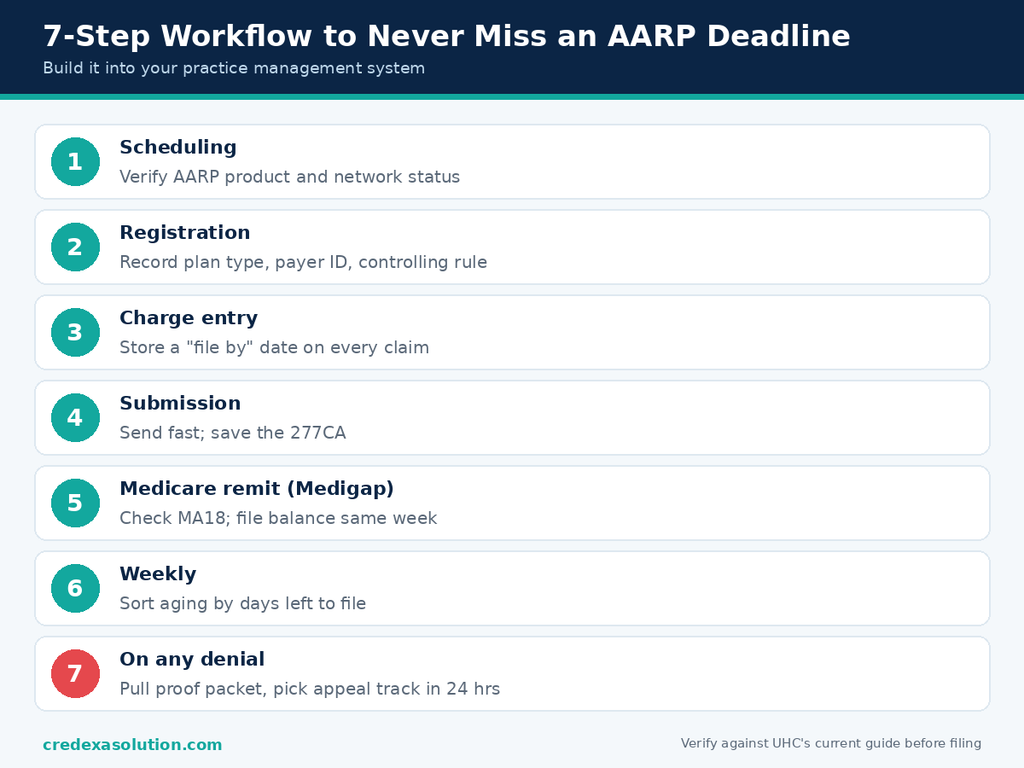
Knowing the rules isn’t enough without a process. Here’s a workflow your team can adopt this week:
- At scheduling: Verify the AARP product and your network status for that product.
- At registration: Record the plan type, payer ID, and the controlling filing rule in a dedicated field.
- At charge entry: Calculate and store a “file by” date on every AARP claim.
- At submission: Send within days, not weeks. Save the 277CA when it arrives.
- On Medicare remittance (Medigap): Check for MA18. If it’s absent and a balance remains, file the supplement claim the same week.
- Weekly: Sort the aging report by days remaining to file, not just days in AR.
- On any denial: Pull the proof packet and choose the appeal track within 24 hours.
AARP Pre-Submission Checklist
- Patient’s AARP product confirmed (Medicare Advantage vs. Supplement)
- Network status confirmed for that specific UHC product
- Correct payer ID (36273 for Medigap) or card-specific payer ID
- Medicare remittance attached or EOB data loaded on secondary claims
- Frequency code 7 and original claim number on corrections
- “File by” date entered and visible in the billing system
- 277CA saved to the claim file
How Credexa Solutions Helps Practices Stay Inside the Filing Window
Timely filing denials are among the most preventable losses in the revenue cycle, and also the hardest to recover. At Credexa Solutions, our medical billing and credentialing teams build deadline controls into every claim: payer-specific filing rules, accurate coding before submission, clean secondary billing, and fast, well-documented appeals when denials do occur.
Many timely filing problems begin before the first claim goes out. If you aren’t properly enrolled with a payer, claims stall or deny. Our credentialing work, covered in guides like our North Dakota Medicaid provider enrollment guide, gets providers into networks correctly so billing starts without avoidable delays.
If AARP and UnitedHealthcare claims are aging in your AR, reach out to Credexa Solutions for a review of your denial patterns, filing workflows, and credentialing status.

AARP Timely Filing Limit FAQs
What is the AARP timely filing limit?
It depends on the plan and your contract status. Noncontracted providers have 365 days from the through date of service on AARP Medicare Advantage claims. Contracted providers follow their UHC Participation Agreement. Medicare Supplement claims follow the member’s Certificate of Insurance, and the Original Medicare claim has one calendar year.
Is the AARP timely filing limit 15 months?
Payer charts often list 15 months, but we found no UnitedHealthcare document that sets it. Verify against the member’s certificate or by calling Provider Express, and keep documentation.
What is the AARP Medicare Advantage timely filing limit?
365 days from the through date of service for noncontracted providers, per UHC’s 2026 guide. Contracted providers follow their Agreement.
What is the payer ID for AARP Medicare Supplement claims?
- Electronic submission with this ID is UHC’s preferred route.
What is the AARP Medicare Supplement claims address?
UnitedHealthcare Claims Division, P.O. Box 1878, Southampton, PA 18966-9998. Don’t use older addresses printed on ID cards.
How long do I have to submit a corrected AARP claim?
Corrections must arrive within the original filing period. They don’t get a new window from the remittance date.
What’s the AARP appeal deadline?
For noncontracted providers on Medicare Advantage claims, 60 calendar days from the remittance notification date for payment reconsideration, or 120 calendar days from the initial payment for a payment dispute.
Is AARP the same as UnitedHealthcare?
AARP plans are UnitedHealthcare products carrying the AARP name. UHC insures them and processes the claims.
Can I bill the patient after a timely filing denial?
Usually not. Hold-harmless terms generally make it a write-off.