
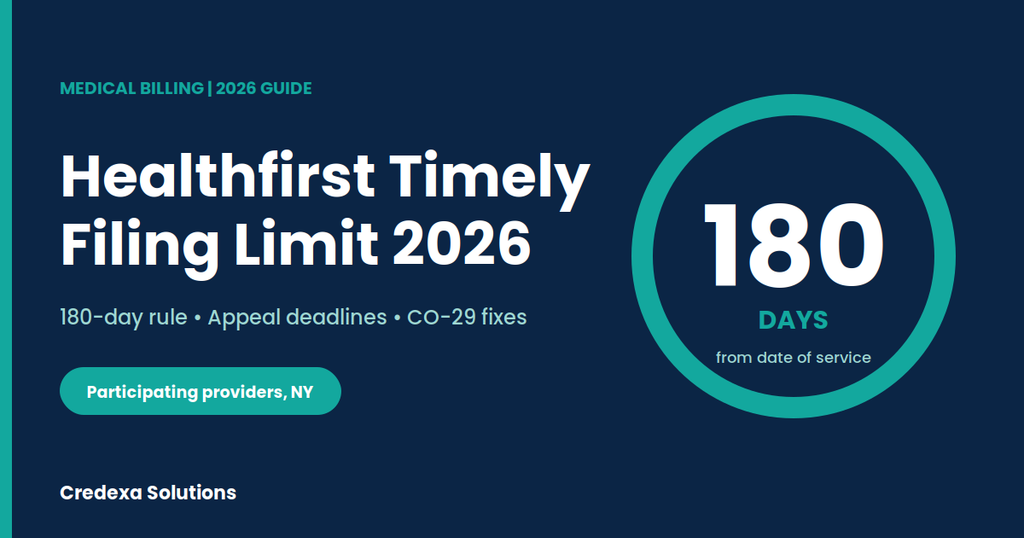
The Healthfirst timely filing limit is 180 calendar days from the date of service for participating providers in Healthfirst’s New York plans. Corrected claims run on that same clock. After Healthfirst processes a claim, two separate appeal windows open: 90 days to request reconsideration (counted from the paid date on the Explanation of Payment) and 60 days to file a formal dispute (counted from the reconsideration letter).
Most practices that lose money to Healthfirst timely filing denials did not forget the deadline. They lost the claim somewhere inside the 180 days: a rejection nobody read, a wrong member ID, a correction that came back as a duplicate, or a coding error that triggered a denial and burned weeks of the clock before anyone noticed.
This guide covers every Healthfirst deadline in plain language, explains where the numbers people confuse actually come from, and shows how accurate coding and fast denial work protect your revenue. It also explains how Credexa Solutions helps practices manage denials with the right codes, so a fixable problem never turns into a CO-29 write-off.
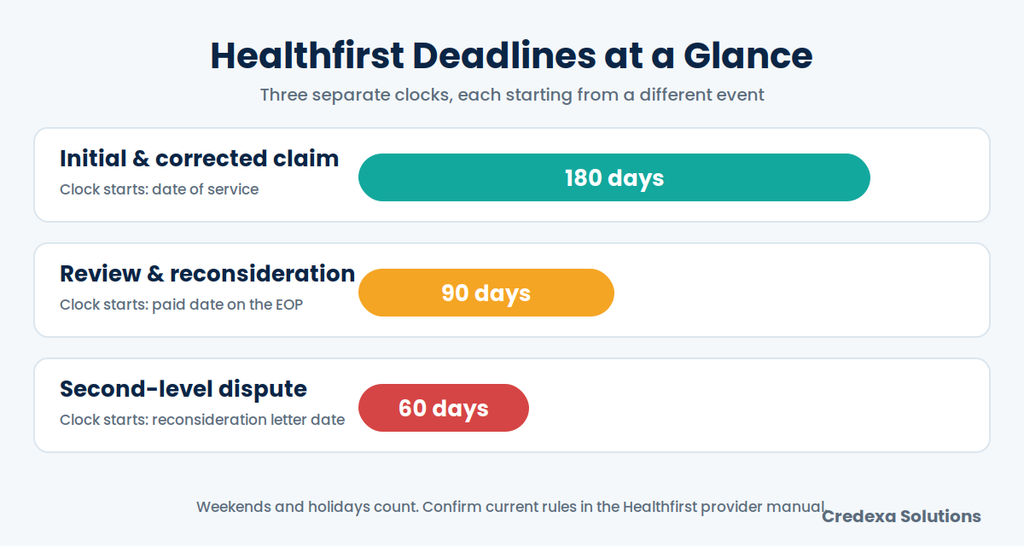
Healthfirst Deadlines at a Glance
Healthfirst billers deal with several clocks, and each one starts from a different event. Keep them on separate trackers.
| Deadline | Time limit | Clock starts on | Who it applies to |
|---|---|---|---|
| Initial claim | 180 calendar days | Date of service | Participating providers |
| Corrected claim | 180 calendar days | Date of service | Participating providers |
| Review and reconsideration | 90 calendar days | Paid date on the EOP | Providers disputing a payment or denial |
| Second-level dispute | 60 calendar days | Date on the reconsideration letter | Providers who disagree with the reconsideration result |
| Medicare member appeal | 65 days | Date on the coverage decision notice | Members, not provider claims |
Weekends and holidays count. Healthfirst may update its rules, so confirm any deadline against the current Healthfirst provider manual and the Healthfirst for Providers claims and billing page before you rely on it for a specific claim.
What “Timely Filing” Means in Medical Billing
A timely filing limit (often shortened to TFL) is the window a payer gives you to get a claim in front of it. If the claim arrives after that window, the payer can deny it for lateness alone, even when the service was medically necessary, covered, and coded perfectly.
The denial shows up on your remittance as CARC 29: “The time limit for filing has expired,” usually written CO-29. The “CO” prefix is the group code for contractual obligation, which signals that the provider, not the patient, bears the loss.
Industry surveys of payer rules put the median filing window around 180 days, with 90, 180, and 365 days the most common figures. That makes Healthfirst’s 180 days fairly standard. The danger is not the length of the window. The danger is that it is easy to burn half of it on avoidable problems before you realize the claim never got paid.
If you want the broader picture, our guide to timely filing limits for every major payer walks through how filing windows are set, where to find them in provider manuals, and how to build a tracking process.
Healthfirst vs. Health First: Don’t Mix Up the Payers
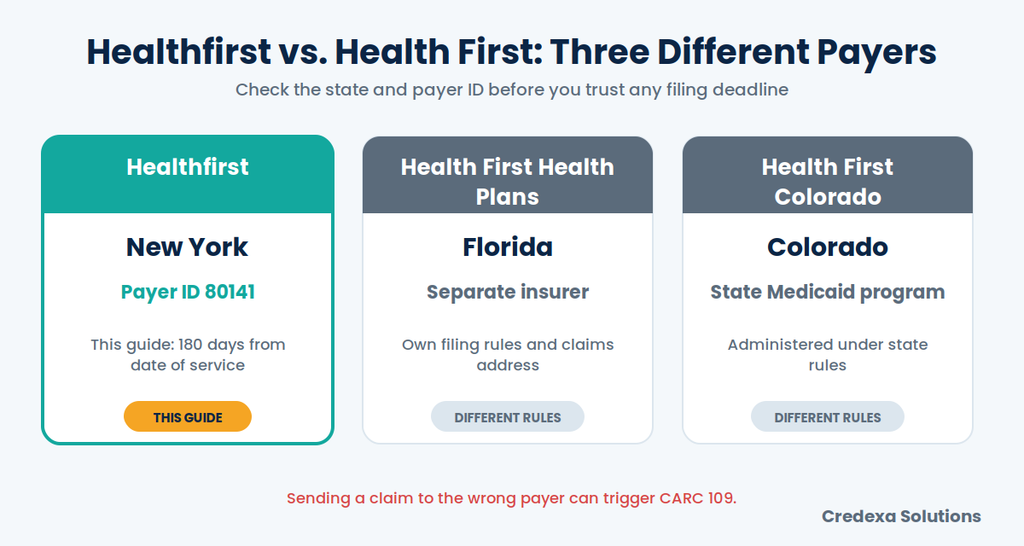
Three unrelated organizations use nearly identical names, and a surprising number of denied claims start with a biller reading the wrong payer’s rules.
| Payer | State | Notes |
|---|---|---|
| Healthfirst (one word) | New York | Not-for-profit health plan. The subject of this guide. Electronic payer ID 80141. |
| Health First Health Plans | Florida | A separate insurer with its own filing rules and claims address. |
| Health First Colorado | Colorado | The state’s Medicaid program, administered under state rules. |
If a deadline you found online lists a different payer ID or a different state, it is not the Healthfirst New York rule. Verify the payer ID printed next to any number before you trust it. Sending a New York claim to a Florida or Colorado address wastes days you cannot recover, and it can also produce CARC 109 (“claim not covered by this payer; must be sent to the correct payer”).
Why You See 60, 90, 120, and 365 Days Online
Search for Healthfirst’s filing deadline and you will see several competing numbers. Each comes from a real rule, but none replaces the 180-day limit in Healthfirst’s participating provider terms.
- 60 days is the second-level dispute window, counted from the reconsideration letter.
- 90 days is the filing limit for New York Medicaid fee-for-service claims billed through eMedNY (see the state’s Guide to Timely Billing), and also Healthfirst’s reconsideration window. Fee-for-service claims are paid by the state, not by Healthfirst.
- 120 days is the default window in New York’s prompt pay statute, Insurance Law Section 3224-a, unless the provider contract allows longer.
- 12 months is the Original Medicare standard under 42 CFR 424.44 (see the CMS transmittal). It does not apply to Healthfirst Medicare Advantage claims.
Before you write off an aging balance, identify which deadline you are counting against and what event started it.
Healthfirst Timely Filing Limit by Plan Type
Healthfirst sells Medicaid managed care, Child Health Plus, Essential Plan, commercial, Medicare Advantage, and managed long-term care products. For participating providers, the filing limit is described as 180 days across these lines. What changes is enrollment, authorization rules, and claim format.
Healthfirst Medicaid timely filing limit. Medicaid managed care claims go to Healthfirst, not eMedNY, so count 180 days and do not let an eMedNY habit cut your window to 90. Make sure the NPI you bill under has an active Medicaid enrollment record, because an inactive record denies claims no matter when you file. That fix belongs with credentialing, not the billing queue.
Essential Plan, Leaf, and EPO plans. A “commercial” label does not automatically mean a shorter window. Check your contract before assuming 90 or 120 days.
Healthfirst Medicare timely filing limit. Medicare Advantage claims are billed to Healthfirst under your Healthfirst contract, so do not apply the Original Medicare 12-month rule. Out-of-network providers may face different terms, so confirm with Provider Services.
Long-term care and facility claims. These follow the contract’s filing window too, and one late institutional claim can represent a full month of care.
When the Clock Starts, and What Stops It
The Healthfirst timely filing limit starts on the date of service and is met when Healthfirst receives a claim within 180 days. Your software’s “sent” date is not proof of receipt. What matters is a record showing the payer actually took the claim in.
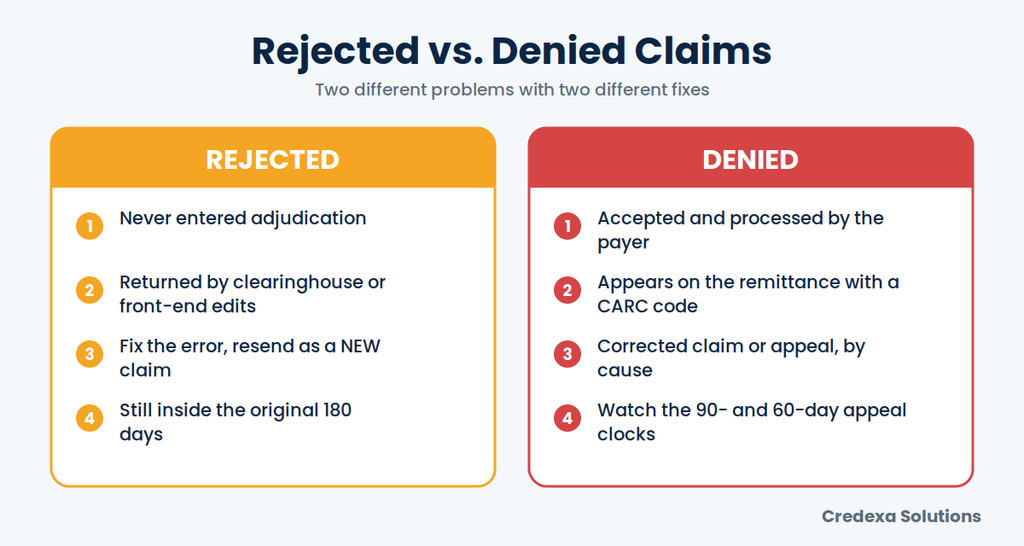
Rejected claims versus denied claims
A rejected claim never entered adjudication. The clearinghouse or the payer’s front-end edits sent it back because of a formatting or data problem such as an invalid member ID, a missing NPI, or a bad payer ID. Nothing exists in the payer’s system to pay or deny. You fix the error and submit again as a new claim, still inside the original 180 days.
A denied claim was accepted, processed, and refused. It appears on a remittance with a reason code. Denials are handled through corrected claims or appeals, depending on what went wrong.
A clean file acknowledgment is not claim acceptance
A 999 acknowledgment tells you the file passed basic format checks. It does not tell you what happened to each claim inside it. The claim-level answer comes back on the 277CA report, which lists accepted and rejected claims individually.
Reading the 277CA every business day is one of the cheapest ways to protect your Healthfirst revenue.
Healthfirst Corrected Claim Timely Filing
Corrected claims are tied to the same 180 days as new claims, counted from the date of service. A correction does not restart the clock. If you discover a coding error on day 170, you have ten days to get the replacement claim in.
Corrected claim, new claim, or reconsideration?
Choosing the wrong route costs days and usually earns a second denial.
- Corrected claim: Healthfirst accepted the claim, but something on it was wrong, such as a CPT code, diagnosis pointer, modifier, unit count, or date.
- New claim: The original claim was rejected and never loaded, so you fix it and resend.
- Reconsideration: Your claim data was correct, and you disagree with how Healthfirst paid or denied it.
Submitting a corrected claim electronically
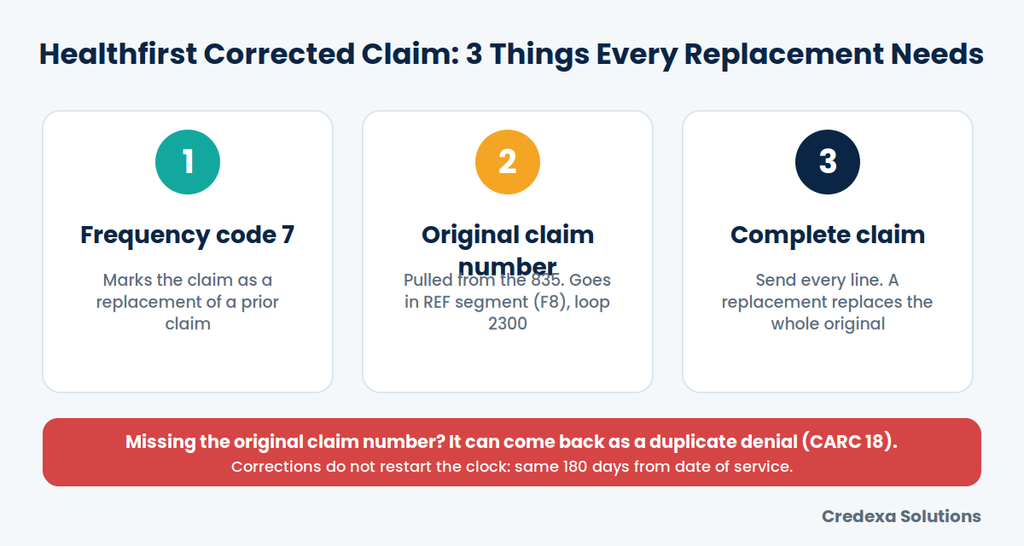
On a standard 837 professional claim, a replacement claim needs three things:
- A claim frequency code of 7 (replacement of a prior claim).
- The original payer claim control number from the remittance, placed in the REF segment (F8 qualifier) of loop 2300.
- The complete claim with every line, because a replacement replaces the entire original, not just the line you changed.
On paper, mark the claim as corrected and include the original claim number, using resubmission code 7 in Box 22 of the CMS-1500 or a type of bill ending in 7 on the UB-04.
Why corrected claims come back as duplicates
The most common cause is a missing or mistyped original claim number. Without it, the payer sees what looks like a second submission for the same service and denies it as a duplicate (CARC 18). The 180 days keep running while you sort it out.
Pull the claim number from the 835 remittance instead of retyping it, send one correction per claim, and confirm acceptance on the 277CA. Credexa’s claims scrubbing and submission process validates the frequency code and original claim reference before any correction goes out, which is far cheaper than discovering the problem on a remittance three weeks later.
Healthfirst Appeal Deadlines
Healthfirst’s appeal windows are separate from its filing limit. Winning an appeal does not extend the 180 days, and the appeal clocks start from Healthfirst’s paperwork, not from your date of service.
Level 1: Review and reconsideration (90 days)
You have 90 calendar days from the paid date printed on the EOP to request review and reconsideration. The day the EOP reaches your desk does not move the deadline. Requests can be submitted through the provider portal or by mail. Confirm current submission channels in the Healthfirst provider manual or with Provider Services.
Send a complete packet the first time. Healthfirst decides based on what you provide, and a thin packet that gets upheld leaves you arguing the same claim at the next level with a shorter clock. A strong packet includes:
- A copy of the EOP and the claim
- A written explanation of what you dispute and why
- Healthfirst claim number, member ID, and date of service
- Supporting documentation (medical records, contract rate, eligibility proof, or proof of timely filing)
- A contact name and phone number for follow-up
Level 2: Formal dispute (60 days)
If reconsideration goes against you, file a written dispute within 60 calendar days of the date on the reconsideration letter. Include the decision letter, a clear statement of why it is wrong, and any tracking number from your first request.
What a CO-29 Denial Means, and Whether You Can Recover It
When Healthfirst receives a first-time claim after the filing window, the remittance returns CARC 29. The claim is denied for lateness regardless of coding quality or medical necessity.
Can you bill the patient? In most cases, no. Participating providers generally cannot balance bill members for covered services denied because of the provider’s own late filing. Check your Healthfirst agreement’s hold harmless language first. For most CO-29 denials on covered services, the result is a contractual write-off.
Check whether the claim was actually late. Review the claim history for an earlier submission that was rejected, or a clearinghouse report showing the claim reached the payer inside 180 days. If you have proof of an on-time attempt, request reconsideration within 90 days of the EOP paid date and attach it.
New York’s unusual-occurrence provision. Under Insurance Law Section 3224-a, a participating provider can ask a plan to reconsider a claim denied solely for late filing by showing an unusual occurrence caused the delay and a pattern of on-time filing. The plan may pay, possibly with a reduction, and the provision has limits. The NY DFS consumer health insurance pages give an overview. Confirm with your contract and counsel before relying on it.
Fix the cause, not just the claim. Recurring CO-29 denials usually mean something upstream is broken: late charge entry, claims stuck in a hold queue, unread rejection reports, or enrollment problems. Credexa’s denial work starts by finding which one is draining your claims.
Proof of Timely Filing Healthfirst Accepts
When a claim is questioned, the burden of proof is yours. Strong proof is claim-specific. A batch-level confirmation proves a file arrived but not that a particular claim was in it.
Strong evidence generally includes:
- A payer or clearinghouse rejection report showing the original on-time attempt
- A claim-level acceptance report such as a 277CA or an Availity submission confirmation
- A clearinghouse claim summary or claim-for-review report listing the specific claim
Weak evidence includes screenshots from your own billing software, delivery receipts not tied to a specific claim, and 999 acknowledgments by themselves.
File proof by claim number, not by batch, and save it the day you receive it. Confirm with Healthfirst Provider Services which reports are currently accepted, because payers change their requirements. If your clearinghouse cannot produce claim-level reports on demand, that is a risk worth fixing now. Our clearinghouse selection guide compares what to look for.
The Denial Codes That Quietly Eat Your 180 Days
Timely filing denials grab attention, but the more common problem is a different denial that uses up the filing window before anyone corrects it. A claim denied for a coding issue on day 40 and not worked until day 150 can no longer be corrected in time.
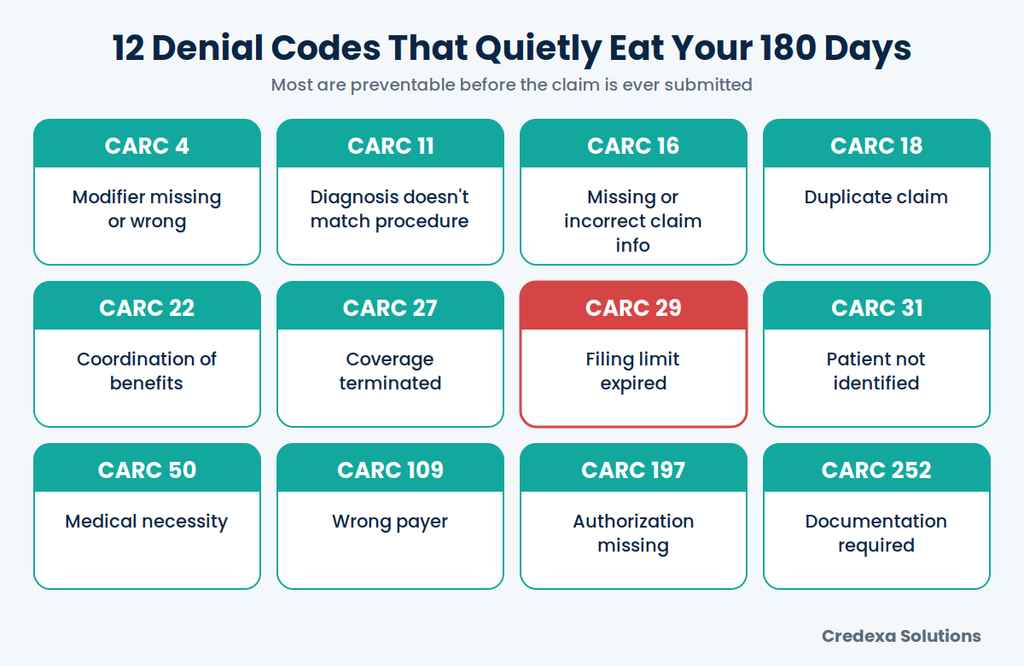
Here are the denial reason codes that most often put Healthfirst claims at risk, what they mean, and the usual fix.
| CARC | What it means | Typical cause | Usual fix |
|---|---|---|---|
| 4 | Procedure code inconsistent with the modifier used, or a required modifier is missing | Missing or incorrect modifier (25, 59, 76, 91, LT/RT, etc.) | Review documentation, add or correct the modifier, submit a corrected claim |
| 11 | Diagnosis is inconsistent with the procedure | ICD-10 code does not support the CPT/HCPCS code billed | Re-check the diagnosis pointer and code selection against the note |
| 16 | Claim lacks information or has billing errors | Missing NPI, taxonomy, referring provider, or incomplete fields | Add the missing data and resubmit (read the RARC for the exact field) |
| 18 | Exact duplicate claim or service | Resubmission without frequency code 7 or original claim number | Verify whether the original was paid; send a proper corrected claim if needed |
| 22 | Care may be covered by another payer per coordination of benefits | Wrong primary/secondary order or outdated coverage | Verify coverage, update COB, bill the correct primary first |
| 27 | Expenses incurred after coverage terminated | Eligibility not verified for the date of service | Confirm eligibility history; bill the correct payer or the patient where allowed |
| 31 | Patient cannot be identified as our insured | Wrong member ID, name, or date of birth | Correct demographics and resubmit |
| 50 | Not deemed a medical necessity by the payer | Diagnosis does not meet policy criteria, or documentation is weak | Appeal with clinical documentation, or correct the diagnosis if it was coded wrong |
| 109 | Claim not covered by this payer; send to correct payer | Wrong payer or wrong plan | Identify the right payer and file there |
| 197 | Precertification, authorization, or notification absent | Service required prior authorization that was not obtained | Request retro-authorization if available; appeal with supporting records |
| 252 | An attachment or other documentation is required | Records not included with the claim | Submit the requested documentation promptly |
| 29 | The time limit for filing has expired | Late first submission, or unread rejections | Gather proof of timely filing; request reconsideration if you have it |
The full list of reason codes is maintained in the X12 Claim Adjustment Reason Code reference. Pair each CARC with its remittance advice remark code (RARC), because the RARC usually names the exact field or document that triggered the denial.
Notice how many of these are errors a coder or front-end team could prevent. Codes 4, 11, 16, 18, 22, 27, and 31 are all fixable before the claim is ever submitted, and every one of them costs you filing days when it slips through.
How Accurate Coding Protects Your Filing Window
Coding accuracy and timely filing are the same problem from two angles. A claim coded correctly the first time is paid once, on schedule. A claim with a coding problem is denied, waits in a queue, gets corrected, and runs the clock down.
- Match diagnosis to procedure. Payers check that the ICD-10-CM diagnosis supports the CPT or HCPCS service. A mismatch triggers CARC 11 or 50.
- Use modifiers deliberately. Modifier 25, modifier 59 and the X-modifiers, and laterality modifiers are frequent denial triggers when applied loosely or omitted.
- Watch bundling edits. Payers apply NCCI-style edits to catch unbundled services, so review code pairs before submission, not after denial.
- Track Healthfirst policy changes. Healthfirst’s provider alerts announced a Cotiviti claim pattern review program for select professional claims starting August 1, 2026, new genetic and molecular coding validation effective May 1, 2026, and new prior authorization requirements on several dates in late 2026. Check the Healthfirst provider alerts page regularly.
- Verify eligibility and authorization before the visit. Many “coding” denials are really front-end failures. Credexa’s eligibility and benefit verification step prevents CARC 22, 27, 31, and 197 at the source.
How Credexa Solutions Manages Healthfirst Denials with Accurate Codes
Credexa Solutions helps healthcare practices keep Healthfirst claims inside their filing windows and keep denials from piling up. The approach combines accurate coding, disciplined follow-up, and clear reporting, so each denial is treated as a problem to solve rather than a balance to age.
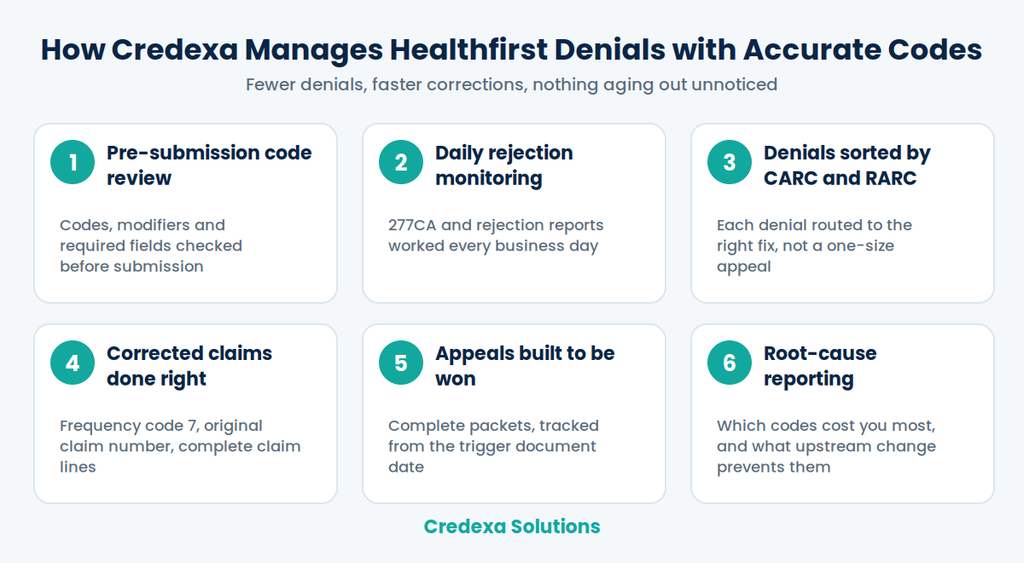
1. Pre-submission code review. Claims are checked for diagnosis-to-procedure consistency, modifier use, units, and required fields before they leave the building. Catching a CARC 4, 11, or 16 problem on day 3 instead of day 63 keeps the correction well inside the 180-day window.
2. Daily rejection and acceptance monitoring. Credexa works the 277CA and clearinghouse rejection reports each business day. Rejected claims are fixed and resubmitted quickly, and the proof of the original attempt is filed by claim number in case it is ever needed.
3. Denial categorization by reason code. Every denial is sorted by CARC and RARC, then routed to the right fix: a coding correction, a corrected claim, an eligibility update, a records request, or an appeal. This keeps teams from sending an appeal when a corrected claim is the right answer, or the reverse.
4. Corrected claims done right. Frequency code 7, original claim number, complete claim lines, and 277CA confirmation. Credexa’s team verifies each element so corrections do not come back as duplicate denials.
5. Appeals built to be won. Reconsideration and dispute packets are assembled with the EOP, claim copy, clinical documentation, and a concise written argument tied to the payer’s own policy and your contract. Deadlines are tracked from the trigger document, not from the day the paperwork was opened.
6. Root-cause reporting. Credexa reports which denial codes are costing you the most, which providers or visit types generate them, and what upstream change would prevent them. The goal is fewer denials next quarter, not just cleaner work on this quarter’s.
The result for a practice is predictable: fewer denials, faster corrections, a smaller aging bucket past 90 days, and far fewer balances reaching the point where a CO-29 write-off is the only option.
Want to know how much of your Healthfirst A/R is still recoverable? Request a free denial and A/R review from Credexa. Send a recent Healthfirst aging report, and we will show you which balances can still be worked and which deadlines are closest.
Learn more about our denial management services, medical coding support, and accounts receivable follow-up.
An Internal Deadline System That Works
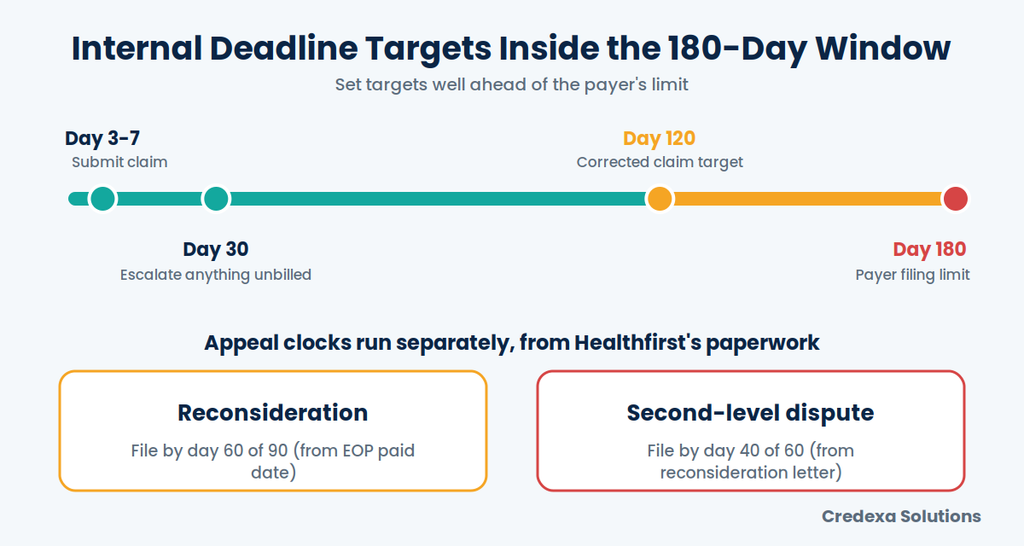
Claims that miss the 180-day window usually stall early and sit unnoticed. Internal targets set ahead of the payer’s deadline give you room to recover.
| Task | Payer window | Suggested internal target |
|---|---|---|
| Initial claim submission | 180 days from date of service | Within 3 to 7 days of the visit; escalate anything unbilled at day 30 |
| Rejected claim | Inside the original 180 days | Fix and resend within 2 business days |
| Denied claim needing correction | 180 days from date of service | Resubmit within 10 business days |
| Corrected claim (outer limit) | 180 days from date of service | Send by day 120 |
| Reconsideration request | 90 days from EOP paid date | File by day 60 |
| Second-level dispute | 60 days from reconsideration letter | File by day 40 |
Review 277CA reports daily, keep rejections and denials in separate queues, track each deadline from its own trigger date, and file proof of timely filing under the claim number the day you receive it.
Healthfirst Payer ID and Provider Contacts
Details change, so confirm them on the Healthfirst provider site before building them into a workflow.
| Item | Detail |
|---|---|
| Electronic payer ID | 80141 |
| Provider Services | 1-888-801-1660 (confirm hours with Healthfirst) |
| Provider portal | Availity Essentials, via the Healthfirst for Providers site |
| Provider manual | Healthfirst NY Provider Manual |