
If your practice bills Presbyterian Health Plan in New Mexico, one question decides whether a claim gets paid or written off: how many days do you have to file?
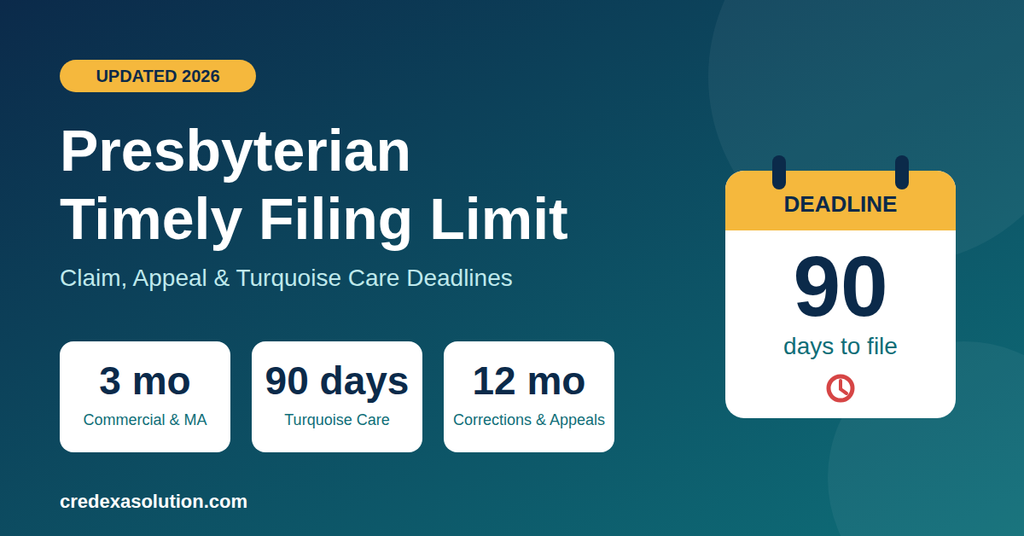
The Presbyterian timely filing limit is three months from the date of service for in-network commercial and Medicare Advantage claims, and 90 days from the date of service for Turquoise Care (New Mexico Medicaid) claims. Corrected claims, appeals, and proof of timely filing each get 12 months from the date of service, as long as the original claim met its first-submission deadline.
That split is where most billing teams get hurt. A payer lookup chart says “12 months,” a biller schedules submissions against that number, and a first-time claim lands nine months past Presbyterian’s real deadline. The result is a CO-29 denial that no amount of coding skill can fix.
This guide breaks down every Presbyterian Health Plan filing window for 2026, explains when each clock starts, what proof Presbyterian accepts, how Turquoise Care changes your workflow, and what to do after a timely filing denial. If you manage claims for a multi-payer practice, bookmark it next to your payer matrix.
Scope note: This article covers Presbyterian Health Plan, Inc. and Presbyterian Insurance Company, Inc. of Albuquerque, New Mexico. NewYork-Presbyterian, Texas Health Presbyterian, and PEHP are separate organizations with their own rules. Do not apply these deadlines to their claims.
Presbyterian Timely Filing Limit at a Glance (2026)
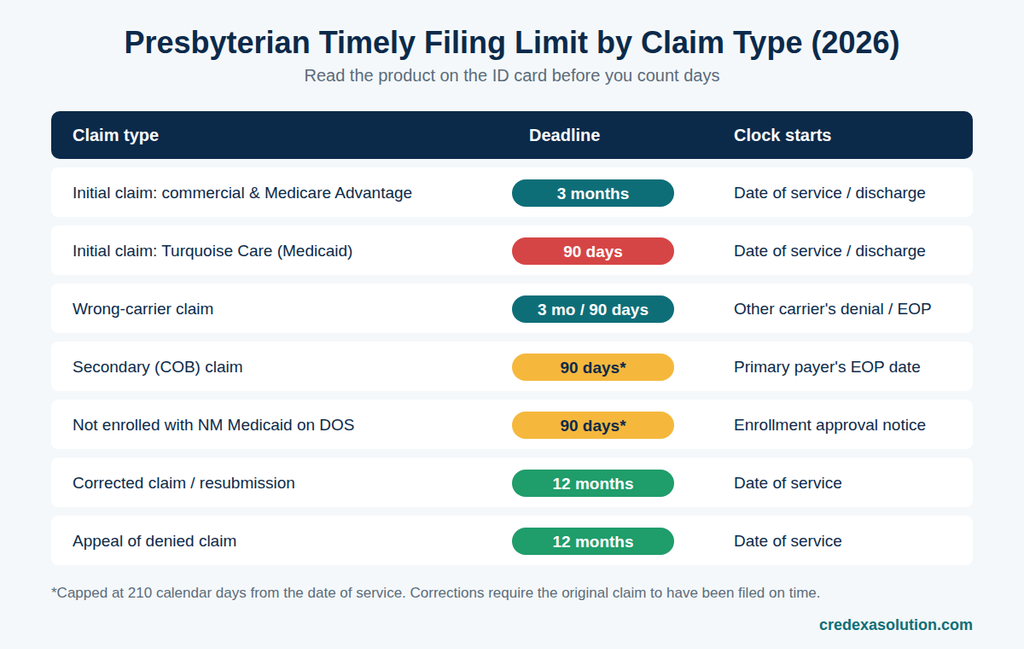
Always read the product on the member’s ID card before you count days. Presbyterian’s Universal Practitioner and Provider Manual governs commercial and Medicare Advantage plans, while the Turquoise Care Practitioner and Provider Manual governs Medicaid.
| Claim type | Deadline | Clock starts |
|---|---|---|
| Initial claim, commercial HMO, POS, PPO (in-network) | 3 months | Date of service (discharge date for inpatient) |
| Initial claim, Medicare Advantage (in-network) | 3 months | Date of service (discharge date for inpatient) |
| Initial claim, Turquoise Care (Medicaid) | 90 days | Date of service (discharge date for inpatient) |
| Claim first sent to the wrong carrier | 3 months (90 days Turquoise Care) | Date of the other carrier’s denial letter or EOP |
| Secondary / COB claim | 90 days from primary EOP, capped at 210 days from date of service | Primary payer’s EOP date |
| Provider not yet enrolled with NM Medicaid on date of service | 90 days from approval notice, capped at 210 days from date of service | Medicaid enrollment approval notice |
| Corrected claim or resubmission | 12 months | Date of service |
| Appeal of a denied claim | 12 months | Date of service |
| Proof of timely filing | 12 months | Date of service |
Figures reflect Presbyterian’s 2026 provider manuals. Confirm against the current manual revision and your signed provider agreement before you build a workflow around them.
What Does “Timely Filing” Mean With Presbyterian?
A timely filing limit is the maximum time a payer gives you to submit a claim after the service. Miss it, and the payer can deny the claim as untimely, usually with CARC 29 (“The time limit for filing has expired”), and in most cases you cannot bill the patient to make up the difference.
Three details matter for Presbyterian:
- Presbyterian counts receipt, not mailing or “sent” dates. The manual language is that the plan must receive the claim within the window. A paper claim mailed on day 88 may arrive after the deadline.
- Clearinghouse rejections do not pause the clock. If a front-end rejection bounces your claim on day 70 of a 90-day Turquoise Care window, you have 20 days to fix and resend it.
- The window depends on the product, not the practice. One patient schedule can contain commercial, Medicare Advantage, and Medicaid members, each with a different filing deadline.
For a deeper look at how payer rules differ, see Credexa’s guides on Kaiser Permanente timely filing limits and Healthfirst timely filing limits, which show how widely these windows vary from payer to payer.
Presbyterian Health Plan Timely Filing Limit by Line of Business
Commercial HMO, POS and PPO Claims: Three Months
Presbyterian must receive in-network commercial HMO, POS, and PPO claims within three months of the date of service, according to its 2026 Universal Practitioner and Provider Manual. Presbyterian Health Plan, Inc. offers the HMO, POS, and ASO products, and Presbyterian Insurance Company, Inc. offers the group PPO. All follow the same initial filing window.
For inpatient facility claims, the three-month clock begins at discharge, not admission.
Medicare Advantage Claims: Three Months
The Presbyterian Medicare Advantage timely filing limit for contracted providers is also three months from the date of service. This covers Presbyterian Senior Care (HMO and HMO-POS) and Presbyterian Dual Plus (HMO D-SNP).
A common mistake is to apply Original Medicare’s 12-month rule to these claims. That 12-month window applies to fee-for-service Medicare claims sent to a Medicare Administrative Contractor. Medicare Advantage claims follow your payer contract and the plan’s provider manual. If you also bill government programs, compare how these deadlines differ from federal programs such as CHAMPVA in Credexa’s CHAMPVA timely filing limit guide.
Turquoise Care (Medicaid) Claims: 90 Days
The Presbyterian Turquoise Care timely filing limit is 90 days from the date of service, per Presbyterian’s 2026 Turquoise Care Practitioner and Provider Manual. New Mexico’s Medicaid billing rule, 8.302.2.11 NMAC, sets the same 90 calendar days, so the plan’s deadline mirrors state law.
Older Presbyterian documents still refer to Centennial Care and the Human Services Department. Turquoise Care replaced Centennial Care on July 1, 2024, and the Health Care Authority (HCA) now runs the program. If you search for the old program name, you may land on outdated PDFs. Work from the 2026 Turquoise Care manual.
Member-Submitted and Out-of-Network Claims
Presbyterian’s claims payment policies give members 90 days from the date of service to send written proof of an in-network claim, and one year for out-of-network claims. Those deadlines apply to members. A contracted practice filing its own claims uses the provider-side windows above.
When the Presbyterian Filing Clock Starts, Restarts and Stops
Professional Claims vs. Inpatient Facility Claims
Presbyterian counts a CMS-1500 professional claim from the date of service and a UB-04 inpatient claim from the discharge date. If a coder parks a Turquoise Care claim on a documentation query until day 80, only 10 days remain to submit it.
Claims First Sent to the Wrong Carrier
If you billed the wrong payer first, Presbyterian gives you three months (90 days for Turquoise Care) from the date of the other carrier’s denial letter or explanation of payment (EOP). Send that denial with the claim. CARC 109 on the other payer’s remittance flags a claim that belongs with another payer.
If the patient failed to disclose coverage, Presbyterian requires proof, such as a patient information sheet showing no insurance or written communication from the member. Staff turnover in your billing office does not qualify as an exception. The simplest prevention is verifying coverage at check-in. That is the core of any solid eligibility and benefits verification workflow.
Secondary (COB) Claims
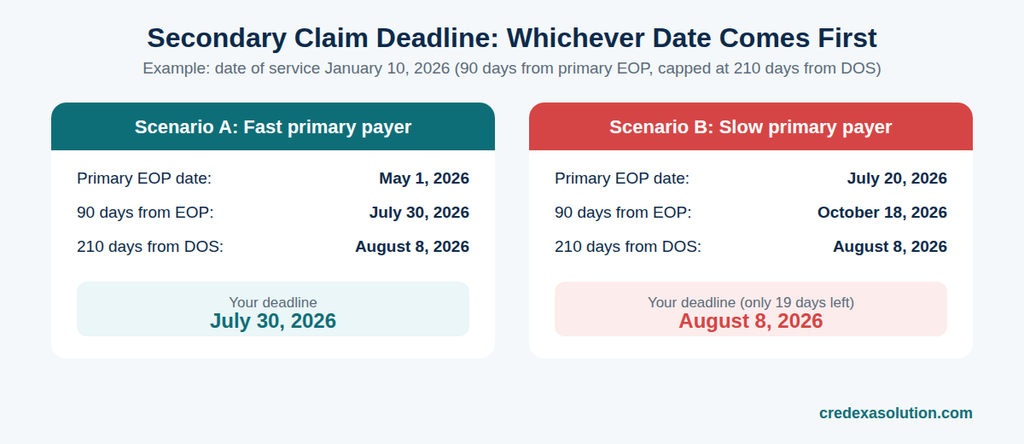
When Presbyterian pays second, you have 90 days from the primary carrier’s EOP date, capped at 210 days from the date of service. Attach the primary EOP or denial, because claims without one are denied. Your real deadline is whichever date comes first.
Worked example (date of service January 10, 2026):
| Primary EOP date | 90 days from EOP | 210 days from DOS | Your deadline |
|---|---|---|---|
| May 1, 2026 | July 30, 2026 | August 8, 2026 | July 30, 2026 |
| July 20, 2026 | October 18, 2026 | August 8, 2026 | August 8, 2026 |
In the second row, a slow primary payer left only 19 days to file with Presbyterian. Calendar both dates the day the primary EOP arrives.
Retroactive Eligibility and Late Medicaid Enrollment
If you were not enrolled with New Mexico Medicaid on the date of service, Presbyterian allows 90 calendar days from the date of your Medicaid enrollment approval notice, capped at 210 calendar days from the date of service. For retroactive member eligibility, 8.302.2.11 NMAC allows 90 days from the date the state adds eligibility to its record. Ask Presbyterian how it applies that date and what documentation it wants attached.
Enrollment is a filing-deadline issue as much as a credentialing one. For a look at how state Medicaid enrollment works end to end, see Credexa’s North Dakota Medicaid provider enrollment guide, which covers the same kind of portal, documentation, and revalidation steps providers face in every state.
Presbyterian Corrected Claim Timely Filing Limit: 12 Months
The Presbyterian corrected claim timely filing limit is 12 months from the date of service for resubmissions, corrections, and adjustment requests. There is one critical condition: the original claim must have met its own first-submission deadline.
A correction cannot cure a late first claim. If your resubmission arrives after the three-month or 90-day window, include proof that the original was filed on time. A regenerated claim is not proof. For electronic claims, keep the exception report from Presbyterian or your clearinghouse.
How to Send a Corrected Claim
- Rebill every line from the original claim, along with the corrected line.
- Use the correct frequency code. Use resubmission code 7 to replace a claim or 8 to void one, in Loop 2300 of the 837 or box 22 of the CMS-1500. Do not create a brand-new claim.
- Enter the original claim number in the “Original Ref. No.” field.
- Attach the primary EOP for COB corrections.
Presbyterian’s own documents are not perfectly consistent about corrected claim format. One section of the Universal manual describes resubmissions as paper-only, while another allows electronic corrections, and Presbyterian’s claims processing tips call for electronic resubmission. Confirm the format with your Provider Network Operations (PNO) representative before sending a batch.
Two Corrected-Claim Traps
- Member not found: A frequency 7 claim has nothing to replace if Presbyterian cannot match the member. Verify the member ID and date of birth, then file a new original claim.
- Taxonomy mismatch: Multispecialty groups need the correct 10-character taxonomy code on every claim, corrected claims included. If the same denial keeps repeating, check the provider setup in your billing system.
Presbyterian Appeal Timely Filing Limit: 12 Months
The Presbyterian appeal timely filing limit is 12 months from the date of service. The 2026 manuals apply it to appeals of a denial, an adjudication, or an unanswered submission or resubmission. Presbyterian resolves provider appeals within 30 calendar days, and it can request a 14-day extension.
Why Some Sources Say 60 Days
Older Presbyterian notices gave contracted providers 60 days from the denial date to appeal. Those PDFs still rank in search results. The 2026 manuals and Presbyterian’s provider appeals page both use 12 months from the date of service. If a specific denial letter prints an earlier deadline, appeal by that date and note it in the claim record.
Overpayment Appeals Use a Second Clock
Overpayment appeals get 12 months from the date of service or 65 days from notification (60 days for Turquoise Care), whichever is later. Date-stamp every overpayment notice the day it arrives.
Provider Appeals vs. Member Appeals
A member’s own appeal must reach Presbyterian within 60 days of the action. If you appeal on a member’s behalf, Presbyterian requires the member’s written consent, with a limited exception for expedited utilization management appeals.
Commercial Plan Grievances
For commercial plans, providers have 90 days from an incident to file a grievance about payment amount, payment timing, or submission requirements. Presbyterian decides within 45 calendar days once its committee has everything it needs, and you can ask the New Mexico superintendent of insurance for review within 30 days of the written decision.
Where to Send Provider Appeals
- Mail: Presbyterian Health Plan, Attn: Provider Grievance Coordinator, P.O. Box 27489, Albuquerque, NM 87125-7489
- Phone: 1-800-356-2219
- Fax: (505) 923-6111
- Online: the appeals and grievances page on phs.org
State the reason for reconsideration and attach supporting documents such as operative reports for coding disputes. Keep a dated copy of everything you send.
Proof of Timely Filing Presbyterian Accepts
When Presbyterian denies a claim as untimely, the burden of proof falls on you. Presbyterian’s 2026 manuals accept:
- Computer ledgers or written logs showing the member, charges, date of service, and original billed date
- Dated call records that name the Presbyterian representative
- For electronic claims, an exception report from Presbyterian or your clearinghouse
Your documentation must be legible and must tie directly to the claim. A ledger screenshot with no claim number will not carry much weight.
Phone Calls: Log the Name and the Date
Per Presbyterian’s proof of timely filing notice, the Customer Service Center stopped issuing confirmation or reference numbers for claim status calls in 2016. Record the representative’s name and the call date every time, or the call will not count as proof.
Which Clearinghouse Reports to Keep
- 277CA: Reports claim-level acceptance or rejection. This is your strongest electronic evidence.
- 999: Confirms the X12 batch file format only.
- Exception report: The report type Presbyterian names for electronic proof. Ask your clearinghouse which of its reports qualifies and how long it retains them.
Check Claim Status on a Schedule
Presbyterian recommends checking claim status in the myPRES provider portal every 30 to 45 days. If the portal shows no payment or denial by then, call the Provider Claims CARE Unit at (505) 923-5757 or 1-888-923-5757.
Keep these five items in every claim file for at least 12 months from the date of service:
- The exception report with the claim number
- The 277CA showing acceptance
- A ledger or log entry with member, charges, date of service, and original billed date
- Your call log with representative names and dates
- Any EOP or denial letter from Presbyterian or another carrier
Turquoise Care in 2026: What Changed for Presbyterian Medicaid Claims
Turquoise Claims and Payer ID 77048
Presbyterian’s Turquoise Care claims use payer ID 77048 in GS03 and NMPHP in Loop 2010BB, NM109. Since March 23, 2026, Medicaid claims route through Turquoise Claims, the HCA’s single point of entry. Claims submitted with legacy IDs are denied, and the transition period has ended.
Presbyterian’s Turquoise Claims page says the member’s last name and date of birth on each claim must match the HCA member portal. Submit through PROVIDERConnect or an approved clearinghouse, and confirm your clearinghouse has the required connection before sending Medicaid claims.
Watch taxonomy on Medicaid claims too. If a provider has more than one registered HCA provider type, the claim needs the taxonomy that matches the service.
The ORP Enrollment Rule
Since October 1, 2026, payers deny Medicaid claims when an unenrolled provider rendered, ordered, referred, or prescribed the service, under the HCA’s ORP requirements. Presbyterian’s Medicaid enrollment guidelines say it rejects or denies claims for providers who are not enrolled or are enrolled under the wrong provider type, and it can recoup payments made to unenrolled providers.
The practical takeaway: confirm Medicaid enrollment for every provider named on a claim before you bill. Credentialing gaps quietly become timely filing denials when a rejected claim burns days you do not have.
Why Rejections Eat Your 90 Days
Because rejections do not pause the Turquoise Care clock, a wrong payer ID, a name mismatch, or a missing taxonomy can push a clean claim past day 90. Update your clearinghouse payer setup to 77048 and NMPHP, check the first batch’s acknowledgments the same day, and watch the first remits for repeating denial codes. One setup error repeats across an entire batch.
Presbyterian Medicare Advantage Changes: Run-Out Claims After December 31, 2026
Presbyterian is ending its Senior Care HMO and HMO-POS Medicare Advantage plans on December 31, 2026, according to its Medicare Advantage changes page. Presbyterian Dual Plus (HMO D-SNP) continues into 2027. Confirm the 2027 status of any other plan, such as Presbyterian MediCare PPO, with Presbyterian directly.
What this means for your billing office:
- Claims with 2026 dates of service stay with Presbyterian and follow the three-month rule. For a visit on December 31, 2026, Presbyterian must receive the claim by March 31, 2027.
- Under 42 CFR 422.318, a Medicare Advantage organization generally stays responsible for covered inpatient services through discharge when coverage ends mid-stay. A patient admitted December 28, 2026 and discharged January 5, 2027 would be billed to Presbyterian, with the three-month clock starting at discharge.
- Former Senior Care members need a new eligibility check at their first 2027 visit. A stale Presbyterian card sends 2027 claims to the wrong carrier and starts a wrong-carrier clock.
Presbyterian Payer IDs, Mailing Address and Contacts
Presbyterian’s payer ID depends on your clearinghouse. Always verify against page 18 of the current Universal manual before updating your payer table.
| Clearinghouse | Commercial | Medicare Advantage | Turquoise Care |
|---|---|---|---|
| Availity | PREHP | PRESA | 77048 / NMPHP |
| nThrive | Z0003 | Z0077 | 77048 / NMPHP |
| Change Healthcare | 05003 | 05003 | 77048 / NMPHP |
| Claim.MD | PRESB | PRESB | 77048 / NMPHP |
Paper claims: Presbyterian Health Plan, P.O. Box 27489, Albuquerque, NM 87125-7489. Use the CMS-1500 (02-12) for professional claims and the UB-04 for facilities. Presbyterian pays clean electronic claims within 30 days of receipt and clean paper claims within 45 days. Mail time counts against your filing limit.
Key contacts:
- Provider Claims CARE Unit: (505) 923-5757 or 1-888-923-5757
- Electronic claims and FastClaim support: (505) 923-6154
- myPRES provider portal: available 24/7 for claim status and eligibility
- ePayment Center (EFT and 835 setup): 1-855-774-4392
What to Do After a Presbyterian Timely Filing Denial (CO-29)
The X12 claim adjustment reason code for timely filing is CARC 29. With group code CO, it means the provider is financially responsible. Sort each denial into one of three paths:
- You have proof of on-time filing: Appeal within 12 months of the date of service and attach the exception report, 277CA, or call log.
- An exception clock applies: Refile with the wrong-carrier EOP, Medicaid approval notice, or primary EOP. Remember the 210-day cap on COB and late-enrollment claims.
- Neither applies: Adjust the balance off as a timely filing write-off, then trace the root cause so it does not repeat.
Can You Bill the Patient?
For Turquoise Care members, no. Subsection G of 8.302.2.11 NMAC bars billing the member when a claim is denied for missing a timely filing requirement. For commercial and Medicare Advantage members, check the hold-harmless language in your provider agreement and the relevant chapter of the Universal manual. Unless your contract clearly says otherwise, treat the balance as a loss.
Are Waivers Possible?
Rarely. New Mexico’s Office of Superintendent of Insurance issued Order 2024-0015 in March 2024 requiring major medical insurers to waive timely filing deadlines after the Change Healthcare disruption, but that was a one-time emergency measure. Do not expect a waiver for a routine late claim.
A Day 0 to Day 90 Workflow That Keeps Presbyterian Claims Safe
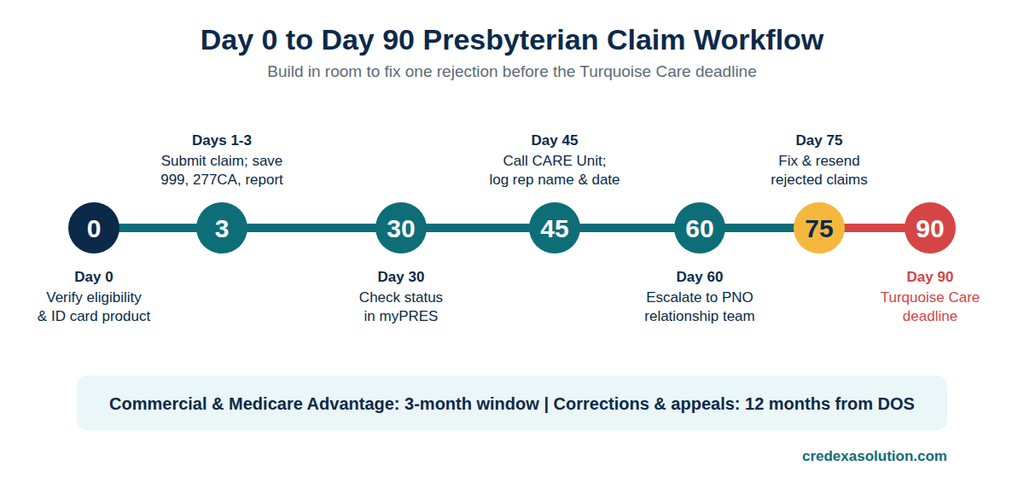
Practices that stay inside Presbyterian’s deadlines work a fixed schedule:
- Day 0: Confirm eligibility and read the product on the ID card before the visit.
- Days 1 to 3: Submit the claim and save the 999, the 277CA, and the exception report.
- Day 30: Check claim status in myPRES.
- Day 45: Call the CARE Unit if nothing has posted, and log the representative’s name and date.
- Day 60: Escalate any undecided claim to your PNO relationship team.
- Day 75: Fix and resend any rejected Turquoise Care claim before the 90-day limit.
- Secondary claims: Calendar the 90-day EOP date and the 210-day cap the moment the primary EOP arrives.
On this schedule, you can absorb one rejection and still file on time. Without it, a single wrong payer ID can erase an entire window.
Signs Your Workflow Needs Help
If more than a handful of Presbyterian claims age past day 60 each month, look at your process before adding staff hours. In many practices, one person is juggling front desk duties, payment posting, and follow-up, so the day-30 and day-45 checks are the first to slip.
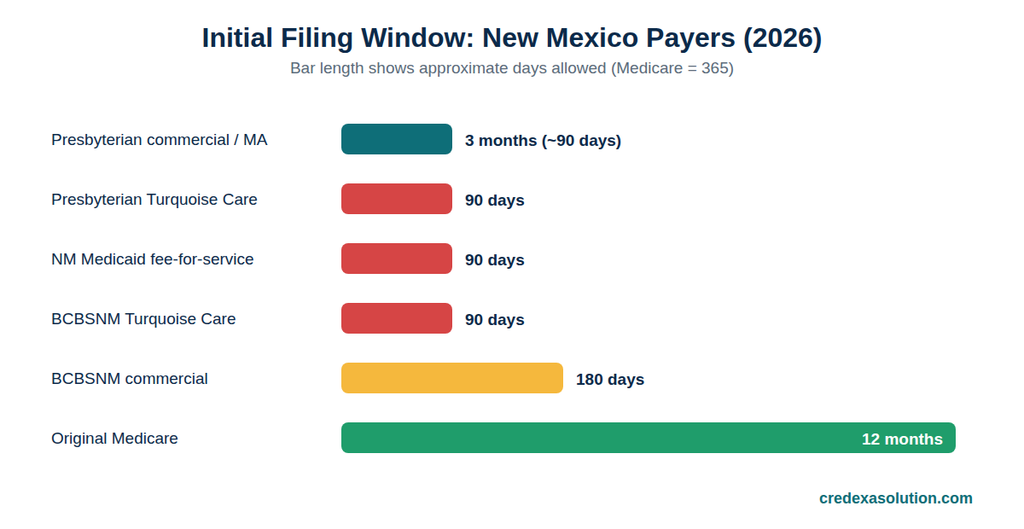
How Presbyterian Compares With Other Payers
| Payer / product | Initial filing window |
|---|---|
| Presbyterian commercial and Medicare Advantage | 3 months |
| Presbyterian Turquoise Care | 90 days |
| New Mexico Medicaid fee-for-service | 90 calendar days |
| BCBSNM Turquoise Care (participating) | 90 days |
| BCBSNM commercial | 180 days |
| Original Medicare | 12 months |
Presbyterian’s commercial window is half of BCBSNM’s 180 days and a quarter of Original Medicare’s 12 months. Federal rules at 42 CFR 447.45 cap any state Medicaid timely filing limit at 12 months, and Medicare’s own rules are published by your jurisdiction’s MAC, such as Novitas Solutions.
A practice billing four New Mexico payers needs four separate clocks. Build the payer, product, and filing window directly into your claim aging report so no claim relies on memory.
If your patient mix includes other regional and government payers, these Credexa Solutions deadline guides are useful side-by-side references:
- Kaiser Permanente timely filing limit 2026
- Healthfirst timely filing limit 2026
- CHAMPVA timely filing limit 2026
Presbyterian Timely Filing Limit: Frequently Asked Questions
What is the timely filing limit for Presbyterian Health Plan?
Three months from the date of service for in-network commercial and Medicare Advantage claims, and 90 days for Turquoise Care. Inpatient claims count from discharge. Corrected claims and appeals get 12 months from the date of service.
What is the Presbyterian Medicare Advantage timely filing limit?
Three months from the date of service for contracted providers, per the 2026 Universal manual. Do not use Original Medicare’s 12-month rule.
What is the Presbyterian Turquoise Care timely filing limit?
90 days from the date of service, matching New Mexico’s Medicaid billing rule, 8.302.2.11 NMAC.
What is the Presbyterian corrected claim timely filing limit?
12 months from the date of service, provided the original claim was filed within its own deadline.
What is the Presbyterian appeal timely filing limit?
12 months from the date of service. Always check the denial letter in case it prints an earlier deadline.
Is Presbyterian a New Mexico Medicaid plan?
Presbyterian Health Plan is one of the managed care organizations in New Mexico’s Turquoise Care program, which replaced Centennial Care on July 1, 2024.
What is the payer ID for Presbyterian Turquoise Care?
Payer ID 77048 in GS03 and NMPHP in Loop 2010BB, NM109, through PROVIDERConnect or an approved clearinghouse.
What proof of timely filing does Presbyterian accept?
Computer ledgers, written logs, dated call records naming the representative, and, for electronic claims, an exception report from Presbyterian or your clearinghouse.
Can I bill a patient for a Presbyterian timely filing denial?
Not for Turquoise Care members. For commercial and Medicare Advantage members, review your provider agreement. In most cases the balance is a write-off.
Is Presbyterian dropping Medicare Advantage?
Presbyterian is ending its Senior Care HMO and HMO-POS plans on December 31, 2026. Dual Plus (HMO D-SNP) continues. Claims with 2026 dates of service still follow the three-month filing rule.
How Credexa Solutions Helps You Beat Payer Filing Deadlines

Timely filing denials are the most preventable losses in revenue cycle management. They rarely come from complicated coding. They come from missing eligibility checks, unmonitored rejections, and denials that nobody owns.
At Credexa Solutions, we help practices protect revenue across the full billing cycle:
- Medical billing and claim submission with clean-claim scrubbing, payer ID and taxonomy checks, and same-week submission so you never start the clock behind
- Denial management with accurate coding that identifies CO-29 patterns, builds the proof file, and files appeals before the 12-month window closes
- Provider enrollment and credentialing so every rendering, ordering, and referring provider is enrolled before the claim goes out, avoiding enrollment-driven rejections
- AR follow-up with day-30 and day-45 status checks on every payer, including Presbyterian
Whether you bill Presbyterian, Medicaid, Medicare Advantage, or a mix of regional plans, a disciplined workflow turns payer deadlines from a risk into a routine. To see where your claims are aging and which payer clocks are costing you money, visit Credexa Solutions and request a billing review.
Sources and Verification
Deadlines in this guide are drawn from Presbyterian Health Plan’s 2026 provider manuals and public provider pages, New Mexico administrative code, and federal regulations. Payer rules change, so confirm against your current contract and the latest manual revision before relying on any single figure.
- 2026 Universal Practitioner and Provider Manual, Presbyterian Health Plan
- 2026 Turquoise Care Practitioner and Provider Manual, Presbyterian Health Plan
- Turquoise Claims, Presbyterian Health Plan
- Provider Appeals and Grievances, Presbyterian Health Plan
- Changes to Presbyterian Medicare Advantage Plans, Presbyterian Health Plan
- 8.302.2.11 NMAC, New Mexico Administrative Code
- ORP Requirements, New Mexico Health Care Authority
- 42 CFR 447.45 and 42 CFR 422.318, eCFR
- Claim Adjustment Reason Codes, X12