Getting in-network with Blue Cross and Blue Shield of Oklahoma (BCBSOK) used to have a shortcut. In 2026, it does not. As of July 1, 2026, BCBSOK no longer grants provisional credentialing to professional providers, which means every physician, nurse practitioner, therapist, and group must finish the full process before joining a network. If your hiring plan, your launch date, or your revenue forecast depended on the old fast track, it needs to be rebuilt today.
This guide walks through BCBS Oklahoma provider enrollment from the first form to the first in-network claim. You will see what BCBSOK actually requires, which documents to prepare, how CAQH fits in, what changed this year, and the mistakes that quietly stall applications for weeks. Everything here is checked against BCBSOK’s own provider pages, which are linked throughout so you can confirm each point yourself.
Quick Answer: How Do You Enroll With BCBS Oklahoma?
To enroll with BCBSOK, you submit the online Provider Onboarding Form with your required documents, wait for a network review, sign the contract BCBSOK sends, complete credentialing through CAQH ProView, and then receive a welcome letter that states your network effective date. Until that date, your claims are treated as out-of-network. Completing the form alone does not make you a participating provider, and BCBSOK states that it does not guarantee a contract offer.
BCBS Oklahoma Enrollment at a Glance
| Item | Detail |
|---|---|
| Payer | Blue Cross and Blue Shield of Oklahoma, a division of Health Care Service Corporation (HCSC) |
| How to apply | Online Provider Onboarding Form |
| Credentialing data source | CAQH ProView (collected through CAQH’s Universal Provider Datasource) |
| Primary source verification | Verisys, working on BCBSOK’s behalf |
| Provisional credentialing | Discontinued for professional providers on July 1, 2026 |
| New W-9 rule | Effective August 1, 2026 for new providers |
| Status tools | Case Status Checker and Credentialing Status Checker |
| Application cost | CAQH’s service is free for providers; BCBSOK’s How to Join page does not list an application fee |
Enrollment, Credentialing, and Contracting: Three Different Things
Most delays start with a simple misunderstanding. People say “enrollment” as if it were one event, but with BCBSOK it is really three connected approvals.
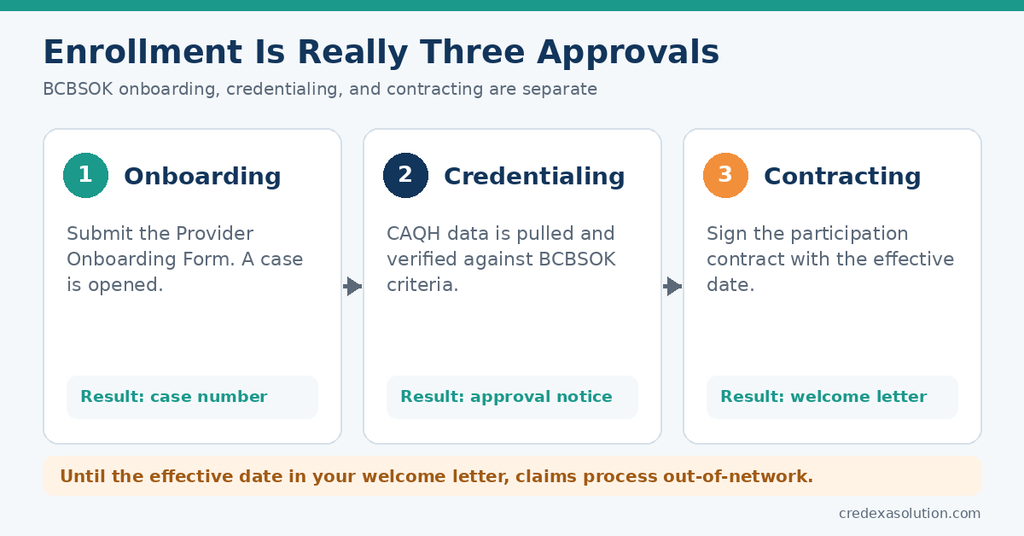
Onboarding is the intake step. You submit the form, BCBSOK opens a case, and your provider information enters the system.
Credentialing is verification. BCBSOK pulls your CAQH profile, Verisys checks the data against primary sources, and the credentialing team measures you against BCBSOK’s criteria.
Contracting is what makes you in-network. The contract sets which networks you join and when your participation begins.
You can clear the first two and still be paid as an out-of-network provider if the contract and effective date are not finalized. That is the trap practices fall into most often: a confirmation email or a provider record gets mistaken for approval, and claims go out for weeks at the wrong rate before anyone notices.
BCBSOK Credentialing Does Not Transfer From Other Blue Plans
BCBSOK is a division of HCSC, the same company that operates Blue Cross plans in Illinois, Texas, New Mexico, and Montana. Sharing a parent does not share a credentialing file. Each division runs its own onboarding queue, contracts, and networks. If you also treat patients in Texas, approval in Oklahoma does not make you participating there.
The BlueCard program can confuse this further. When a patient from another state visits your Oklahoma office, BlueCard routes the claim through BCBSOK and prices it under your BCBSOK agreement. That is a claims arrangement, not an enrollment with the patient’s home plan.
What Changed in 2026 for BCBS Oklahoma Providers
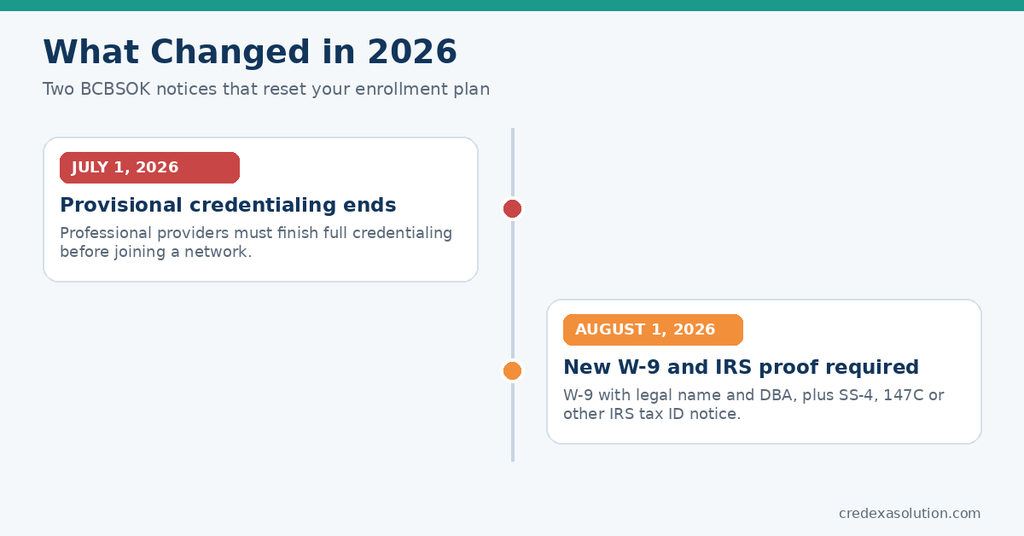
Two official BCBSOK notices matter most for anyone starting an application this year.
Provisional Credentialing Ended July 1, 2026
In a notice dated June 17, 2026, BCBSOK announced that provisional credentialing for professional providers would be discontinued effective July 1, 2026. Under the old approach, certain providers could begin participating after an initial review, before full credentialing finished. Now all professional providers must complete the full credentialing process before joining the networks. BCBSOK says the change is meant to ensure compliance with credentialing standards across its network.
This matters because many older guides, vendor pages, and search summaries still describe the provisional route. If you read anything that promises early participation, check its publication date. A clinic that hired a new nurse practitioner and scheduled a start date around provisional approval will now wait for the full decision instead.
If you were already provisionally approved before the change, the notice does not explain how existing files are handled. Ask your BCBSOK network management representative to confirm where your file stands.
New W-9 and IRS Documentation Rules From August 1, 2026
In a notice dated May 26, 2026, BCBSOK announced a change to the onboarding process for new providers. Starting August 1, 2026, new providers must submit two things with their application:
- A W-9 showing both the legal name and the Doing Business As (DBA) name, if one applies.
- Official IRS documentation of the tax ID, such as an SS-4, a 147C letter, or another official IRS notice of Tax ID assignment.
Current in-network providers do not need to resubmit a W-9 unless something changed, such as a name or TIN. If you need to update a legal name, DBA, or TIN, you submit the new W-9 and IRS documentation through a new onboarding application. Out-of-network providers can submit organizational changes using the Demographic Change Form.
The practical advice is simple: make the name on your W-9 match the name on your IRS letter exactly. A DBA typed into the legal name box, or a small punctuation difference, is the kind of mismatch that sends an application back. If you do not have an IRS letter, the IRS employer identification number page explains how EINs and confirmation notices work.
BCBS Oklahoma Credentialing Requirements
BCBSOK publishes its standards on its How to Join page. The Credentialing Committee can make exceptions to some criteria, but you should plan as if every one applies.
Core Criteria for Every Applicant
- Oklahoma license: current and valid, with no reprimands, restrictions, sanctions, probation, or disciplinary actions (voluntary or mandated) in the past five years.
- Other state licenses: if you were licensed elsewhere, those licenses are held to the same five-year standard, including administrative fines.
- Malpractice history: claims, settlements, and judgments must be submitted with your application.
- Program standing: good standing with Medicare and Medicaid and no state or federal sanctions.
- Integrity: no history of fraud or felony convictions.
- DEA certificate: current, valid, and unrestricted, listing an Oklahoma practice location. Exceptions exist for specialists whose scope does not require a DEA registration.
- Substance use: currently free from substance abuse or illegal drug use and any related discipline. Recommendations from the Oklahoma State Medical Association Health Professionals Program are considered.
- Disciplinary history: a full history of any action by a board, facility, clinic, or professional governing body.
A frequent cause of early failure is outdated location data. A board license that still lists an out-of-state address, or a DEA certificate tied to a previous state, can stop a file before the real review starts. Fix those records first, then apply.
Malpractice Insurance Minimums
BCBSOK sets minimum coverage levels by provider type. Your certificate or face sheet needs to show limits at or above these amounts.
| Provider type | Minimum coverage |
|---|---|
| Individual practitioner | $500,000 per occurrence and $1 million aggregate, or the limits required where admitting privileges are held, whichever is greater |
| Greater coverage requirement | $1 million per occurrence and $3 million aggregate |
| Self-insured group | $1 million for physicians |
| Facilities, ambulatory surgery centers, ground ambulance, dialysis, home health, hospice, home infusion, laboratory, skilled nursing | $1 million per occurrence and $3 million aggregate |
| Air ambulance | $1 million per occurrence and $3 million aggregate, plus at least $50 million in aviation insurance |
| Durable medical equipment | $500,000 per occurrence and $1 million aggregate |
Extra Requirements for Physicians
Primary care physicians and specialists face additional standards:
- Hospital privileges: good standing on the admitting staff of at least one network hospital, with no history of restrictions or suspensions. If you lack privileges, a participating physician in your specialty can supply a Hospital Coverage Letter agreeing to admit and treat your patients. BCBSOK does not require privileges for specialties such as allergy, anesthesiology, dermatology, emergency medicine and urgent care, nuclear medicine, occupational medicine, ophthalmology, pain management, pathology, podiatry, radiology, and radiation oncology.
- Call coverage: 24/7 coverage through a designated covering physician who participates (or is applying) in the same network and specialty. Allergy, dermatology, emergency medicine and urgent care, hospitalists, occupational medicine, pathologists, and radiologists are exempt.
- Board status: certification in your primary specialty through ABMS, the AOA, the American Board of Podiatric Surgery, or the American Board of Podiatric Orthopedics and Primary Podiatric Medicine. Completing an accredited postgraduate training program in your specialty is an alternative, and exceptions can be made based on network adequacy.
Nurse Practitioners and Physician Assistants
Advanced practice nurses follow BCBSOK’s APRN credentialing requirements and attach the Advanced Practice Nurse Prescribing Questionnaire. Physician assistants who prescribe controlled substances file a supplemental questionnaire for prescribing authority, and PAs also file the Supervising Physician and Protocols and Duties questionnaire. If you are building a mixed team of physicians and mid-level providers, expect the PA and NP paperwork to take longer than the physician packet.
Why Credentialing Affects Your Directory Listing
Under the Consolidated Appropriations Act of 2021, contracted providers must be listed in BCBSOK’s provider directory. BCBSOK states that a contracted provider must be credentialed to appear in Provider Finder. Tribal providers are excluded. In other words, you cannot be contracted but invisible: credentialing is also what puts you in front of members searching for a doctor.
Documents to Gather Before You Open the Onboarding Form
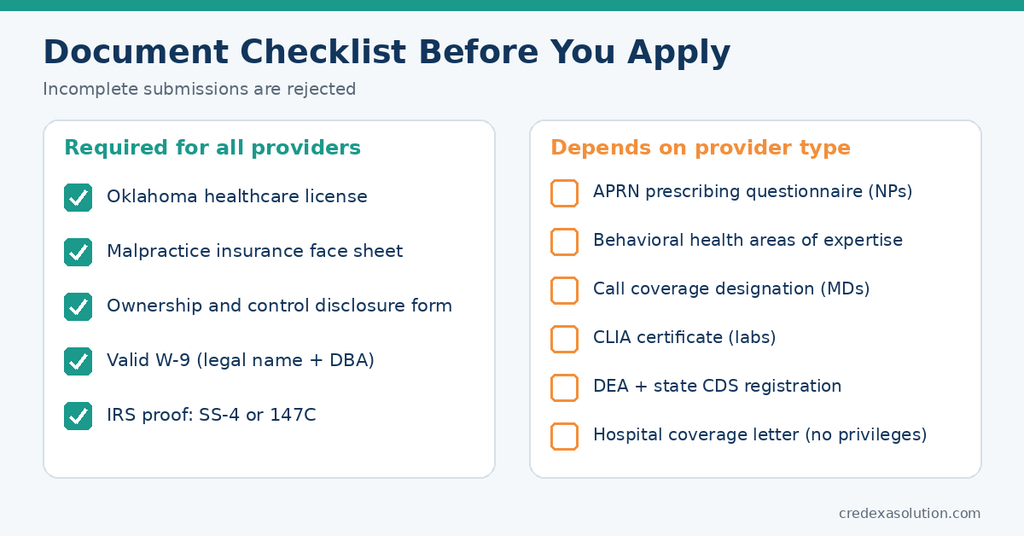
BCBSOK warns that incomplete submissions are rejected, so assembling the packet first saves real time.
Choose the Right Form: Solo or Group
Use the Solo Provider Onboarding path if you are a new solo provider practicing under your own SSN or EIN without a Level 2 organizational NPI. Use the Group/Clinic path if you are joining an existing group with a Level 2 NPI or starting a new group that has one. Solo providers are told to review the federal Machine-Readable File rule when deciding between their SSN and a new Taxpayer Identification Number. That is a decision worth discussing with your accountant before you file.
Ancillary and facility providers use the same Provider Onboarding Form and must also complete every item on BCBSOK’s Ancillary Credentialing Checklist. For a change of ownership, email BCBSOK Network Management at OKNetworkManagement@bcbsok.com before filing. BCBSOK recommends the Chrome browser for the form.
Required for All Providers
| Document | What to check |
|---|---|
| Current Oklahoma healthcare license | Must show an Oklahoma service location where applicable |
| Malpractice liability insurance | Face sheet showing per-occurrence and aggregate limits |
| Provider Disclosure of Ownership and Control Interest Form | BCBSOK’s own form, complete and signed |
| Valid W-9 | Legal name and DBA, if applicable |
| Official IRS documentation | SS-4, 147C, or another IRS notice of TIN assignment |
Required Depending on Provider Type
- Advanced Practice Nurse Prescribing Questionnaire
- Behavioral Health Professional Areas of Expertise
- Call Coverage Designation and Credentialing Contact Information
- Clinical Laboratory Improvement Amendments (CLIA) documentation
- Federal DEA registration and state controlled substance registration (Oklahoma’s registration is issued by the Oklahoma Bureau of Narcotics and Dangerous Drugs Control)
- Hospital Coverage Letter, if you lack admitting privileges at a network hospital
Prepare Your Identifiers
Verify your NPI type and taxonomy in the NPPES NPI Registry before you start. A confusion between Type 1 (individual) and Type 2 (organizational) NPIs, or a taxonomy code that does not match the specialty you are requesting, can stall verification. Your NPI, license numbers, and tax details should read identically across NPPES, CAQH, your W-9, and your IRS letter. Matching one packet across four systems is tedious, but it is the single most effective way to prevent rework.
The Six Steps to Join BCBSOK Networks
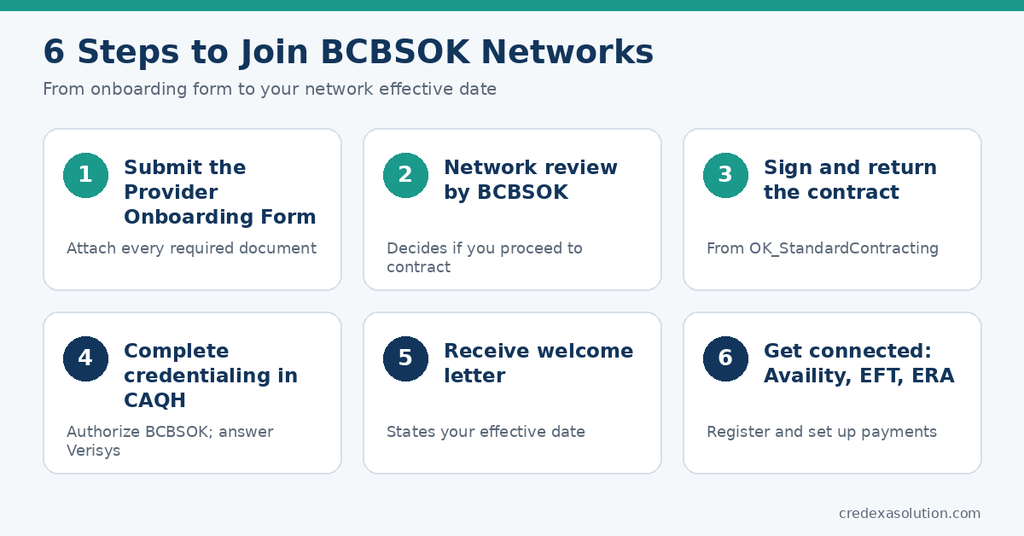
BCBSOK lays out its own process in six steps. Here is what each one means in practice.
Step 1: Submit the Provider Onboarding Form
Start a new application on the BCBSOK form, set up your security questions so you can return to a draft, and attach every document that applies to you. When you submit, you receive a confirmation email containing a case number. Save it. BCBSOK’s status tools and representatives ask for it first.
Step 2: Network Review
A multidisciplinary team at BCBSOK reviews your request. The company says it weighs network needs and its goal of keeping coverage accessible to Oklahomans. After the review, you are told whether you may proceed to contracting.
This is the one stage where better paperwork cannot speed you up. If an area already has enough providers in your specialty, a request may not move forward. That is a network decision, not a mistake in your application.
Step 3: Sign and Return the Contract
If you clear the review, BCBSOK’s Standard Contracting Team sends a contract from OK_StandardContracting@bcbsok.com. You sign and return it to the same address. Add that address to your safe sender list now. A contract sitting in a spam folder halts the entire file, and nobody calls to warn you.
Step 4: Complete Credentialing
All participating providers must be credentialed. BCBSOK follows applicable law and accreditation standards, and data comes from your CAQH profile. Verisys may contact you on BCBSOK’s behalf to ask you to re-attest or to add missing information. If you are not approved, BCBSOK notifies you of the outcome and any appeal rights.
Step 5: Receive the Welcome Letter
Once your signed contract is processed, BCBSOK sends a welcome letter stating your network effective date or dates. This letter is the document that matters most. File it, share it with your billing team, and compare every early claim against it.
Step 6: Get Connected
BCBSOK strongly encourages electronic transactions for claims-related work. Register for Availity Essentials for eligibility, claim status, and related tools, and review BCBSOK’s Electronic Commerce page to set up electronic data interchange. Set up EFT and ERA early so payments and remittances flow correctly from the first claim.
How to Set Up CAQH ProView for BCBSOK
BCBSOK has collected credentialing data through CAQH since May 17, 2010, and all BCBSOK providers need a CAQH Provider ID to begin credentialing. According to BCBSOK, providers can use the CAQH application at no cost. CAQH has also been rebranding its services, so you may see DataSpring branding on some emails, but the ProView login remains the entry point.
If You Are New to CAQH
When you apply for participation, BCBSOK adds you to its roster with CAQH. CAQH then sends your Provider ID and registration instructions. Register, create your username and password, and begin the application.
If You Already Have a CAQH Profile
Log in to ProView, open the Authorize tab, check the box beside BCBSOK (or choose global authorization), and save. This step is easy to forget, and it matters enormously. If BCBSOK is not authorized, it cannot see your profile no matter how complete it is, and credentialing sits idle. This single unchecked box is behind a large share of files that appear to be “stuck.”
Materials to Have Ready
BCBSOK suggests keeping these on hand while you complete the application:
- Previous credentialing application
- List of past and current practice locations
- NPI, Medicare, Medicaid, and other identification numbers
- State licenses and your CV
- DEA and controlled substance certificates
- W-9 forms
- Malpractice face sheet
- Summary of any pending or settled malpractice cases
After finishing the application, you authorize access, review a summary of your data, and submit supporting documents. BCBSOK may still request supplemental documentation beyond what is in CAQH and will notify you if so.
Re-Attestation Every Four Months
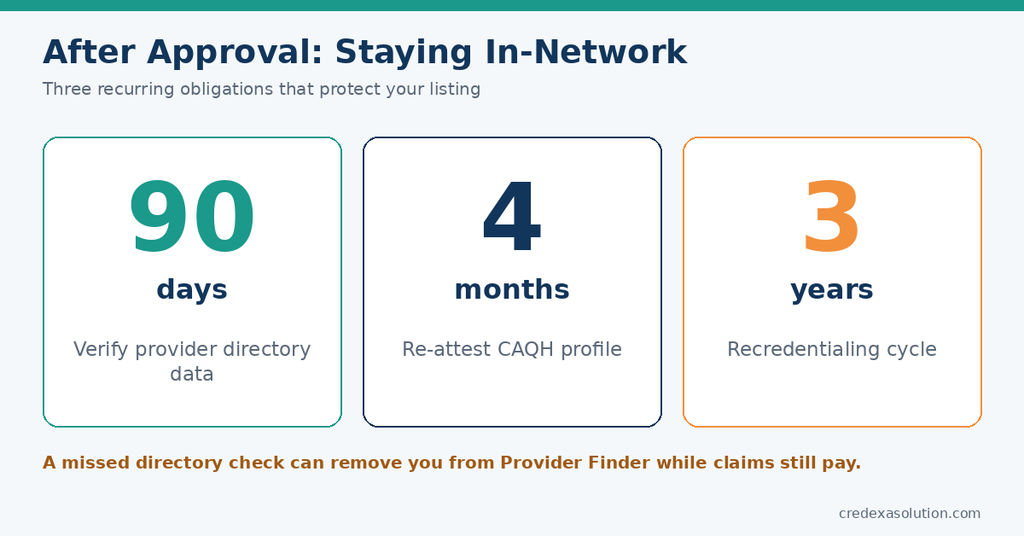
BCBSOK notes that CAQH requires you to review and attest to your data once every four months. Missing a re-attestation leaves BCBSOK looking at stale data. Verisys outreach is another place files stall: front-desk staff sometimes delete verification emails as phishing. Add both CAQH and Verisys senders to your approved list so a legitimate request is never lost.
How Long Does BCBSOK Credentialing Take?
BCBSOK does not publish a guaranteed turnaround time for credentialing, so no one can honestly promise you a specific number of days. What you can control is how clean your submission is. In practice, four problems stretch timelines more than anything else:
- An incomplete onboarding packet that gets rejected.
- A CAQH profile that is not authorized for BCBSOK or has an expired attestation.
- A Verisys request that nobody answered.
- A contract waiting in an unchecked inbox.
Since provisional credentialing is gone, plan your start dates conservatively. Count backward from the day you need to see BCBSOK patients and leave real margin, because the network effective date follows approval and contracting, not your intended hire date.
Your Effective Date Is Not Retroactive
Services provided before the effective date in your welcome letter are processed as out-of-network. Nothing in BCBSOK’s published process suggests you can bill in-network for earlier dates. Tell patients in advance if they are scheduled before your date, because their cost share will differ.
How to Check Your Application Status
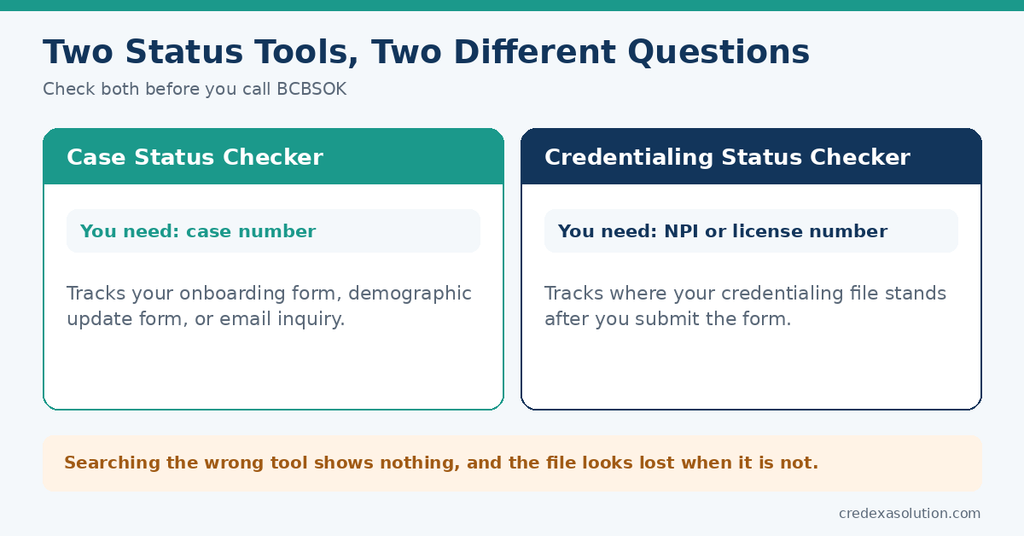
BCBSOK provides two separate tools on its How to Join page, and offices constantly mix them up.
- The Case Status Checker tracks your Provider Onboarding Form, Demographic Update Form, or an email inquiry, using the case number from your confirmation email.
- The Credentialing Status Checker tracks your credentialing, using your NPI or license number.
If you search the wrong tool, you will find nothing and may assume your application disappeared. Check both before calling anyone. For questions, your BCBSOK network representative is the right contact, and the provider contact page lists current phone numbers by topic. Always confirm numbers on the official page rather than relying on a saved copy, since contact details change.
After You Are Approved: Staying In-Network
Enrollment does not end at the welcome letter. A few ongoing obligations catch practices off guard.
Verify Your Directory Information Every 90 Days
Entering data in CAQH does not satisfy the federal directory requirement. The Consolidated Appropriations Act requires certain directory information to be verified every 90 days, even when nothing has changed. BCBSOK recommends that professional providers use the Provider Data Management feature in Availity Essentials to verify information with BCBSOK and other insurers at once, while facilities must use the Demographic Change Form. See BCBSOK’s Verify and Update Your Information page for the exact rules.
If you miss verification, your listing can disappear from Provider Finder while claims continue to pay. That is the worst kind of problem because nothing looks wrong in your billing reports. New patients simply stop finding you.
Keep Your CAQH Profile Current
Keeping your information current is your responsibility. Report practice changes in CAQH within the timeframes that apply under Oklahoma rules. BCBSOK sends automatic reminders to re-attest, and only health plans you have authorized receive your updates.
Recredentialing
When your recredentialing date arrives, BCBSOK sends your name to CAQH. If you have a completed profile that BCBSOK is authorized to view, it can finish recredentialing without contacting you. BCBSOK states that you are considered approved unless notified otherwise, and any decision other than approval is mailed within ten business days. If your profile is not available to BCBSOK, you are added to the roster and must complete the process again.
Billing Basics After Joining
Once you are active, accuracy on every claim protects the revenue you just worked to unlock. Clean diagnosis coding is a large part of that. If your practice treats chronic respiratory conditions, for example, specificity matters for both payment and quality reporting, and our guide to COPD ICD-10 codes for 2026 (J44.0, J44.1, J44.9, J44.81, and J44.89) shows how to choose the right code and avoid avoidable denials. Pair good coding with timely filing, eligibility checks before every visit, and prompt follow-up on unpaid claims.
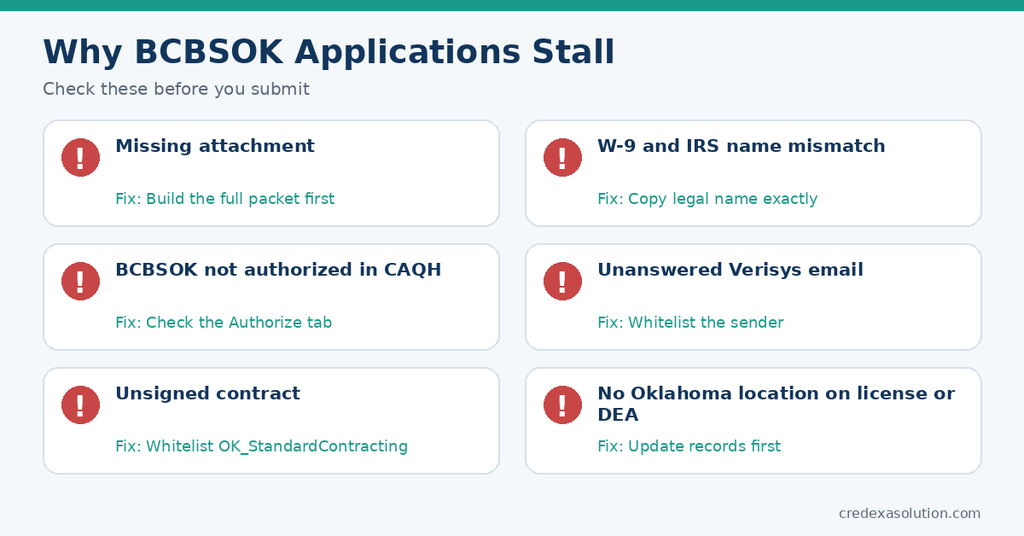
Common Reasons BCBSOK Applications Stall
Patterns repeat across applications. Use this table as a pre-submission checklist.
| Stall point | What happens | How to prevent it |
|---|---|---|
| Missing attachment | BCBSOK rejects the submission | Build the full packet before opening the form |
| W-9 and IRS letter mismatch | File is returned for correction | Copy the legal name from the IRS letter exactly; keep the DBA in its own field |
| Wrong onboarding path | Solo form used with a Level 2 NPI, or the reverse | Confirm NPI type in NPPES first |
| CAQH not authorized for BCBSOK | BCBSOK cannot view your profile | Check the BCBSOK box or choose global authorization |
| Stale CAQH attestation | Data looks outdated | Re-attest every four months |
| Unanswered Verisys request | Verification pauses | Whitelist the sender and reply quickly |
| Unsigned contract | Contracting cannot finish | Whitelist OK_StandardContracting@bcbsok.com |
| No Oklahoma location on license or DEA | Fails credentialing criteria | Update board and DEA records before applying |
| Physician with no hospital privileges | Fails criteria without a coverage letter | Get the Hospital Coverage Letter signed early |
BCBSOK Is Separate From Oklahoma Medicaid
A common assumption is that joining BCBSOK also enrolls you with Oklahoma’s Medicaid program. It does not. SoonerCare, Oklahoma’s Medicaid program, is run by the Oklahoma Health Care Authority, and Medicaid managed care plans have their own credentialing. Each is a separate application with separate requirements. Many Oklahoma practices need both commercial and Medicaid participation, so it usually makes sense to run those applications in parallel instead of waiting for one to finish.
Should You Handle BCBSOK Enrollment Yourself or Outsource It?
Because CAQH is free and BCBSOK’s How to Join page lists no application fee, the main cost of doing it yourself is staff time. A solo provider enrolling with one or two payers, with tidy documents and a free coordinator, can often manage in-house.
Outsourcing becomes attractive when volume or risk rises: several new hires at once, multiple states, a file that already stalled, or a team that cannot afford weeks of follow-up calls. A specialist who handles payer enrollment every day knows which details trip up reviewers, tracks every case number, and keeps CAQH attestations on schedule.
Before you commit to any vendor, ask three questions:
- Is pricing per payer, per provider, or a monthly retainer?
- Who follows up with BCBSOK, and how often?
- Does the fee include EFT and ERA setup and recredentialing tracking?
Two quotes with the same headline price can include very different amounts of work.
At Credexa Solutions, we help medical practices stay organized from enrollment through clean claims, so the time you invest in getting in-network turns into predictable payments.
Frequently Asked Questions About BCBS Oklahoma Provider Enrollment
How do I become a BCBSOK provider?
Submit the Provider Onboarding Form with your Oklahoma license, malpractice coverage, ownership disclosure form, W-9, and IRS tax ID documentation. After a network review, BCBSOK may send a contract. You then complete credentialing through CAQH, and a welcome letter confirms your effective date.
Does BCBSOK still offer provisional credentialing?
No. BCBSOK discontinued provisional credentialing for professional providers effective July 1, 2026. All professional providers must finish the full credentialing process before joining networks.
Does BCBSOK require CAQH?
Yes. BCBSOK collects credentialing and recredentialing data through CAQH, and every provider needs a CAQH Provider ID to begin. Existing users must authorize BCBSOK on the Authorize tab so BCBSOK can view the profile.
What changed for new providers on August 1, 2026?
New providers must submit a W-9 that lists the legal name and DBA (if applicable), plus official IRS documentation such as an SS-4 or 147C letter. Current in-network providers only need to resubmit if their name or TIN changes.
Can I see BCBSOK patients before my effective date?
You can see them, but claims for dates before your effective date are processed as out-of-network. Tell patients ahead of time and schedule new providers around the date in the welcome letter.
What is the difference between the Case Status Checker and the Credentialing Status Checker?
The Case Status Checker tracks your onboarding form, demographic update, or email inquiry using your case number. The Credentialing Status Checker tracks your credentialing progress using your NPI or license number.
How often must I verify my information?
CAQH requires re-attestation about every four months, and federal rules require certain directory information to be verified every 90 days. These are separate obligations, so keeping one current does not satisfy the other.
Is BCBSOK enrollment the same as BCBS Texas or Illinois?
No. Each is a separate division of HCSC with its own enrollment, contracts, and networks. Approval with one does not make you participating with another.
Does BCBSOK enrollment cover Oklahoma Medicaid?
No. Oklahoma Medicaid (SoonerCare) and its managed care plans require separate applications.
Final Thoughts: Build a Complete Packet and Move Fast
BCBS Oklahoma provider enrollment in 2026 rewards preparation. With provisional credentialing gone, there is no shortcut between your hire date and your effective date. The practices that get in-network fastest build the full document packet first, match every name and number across NPPES, CAQH, the W-9, and the IRS letter, authorize BCBSOK in CAQH, and watch their inboxes for the contract and Verisys requests.
Treat the welcome letter as the finish line, then protect what you have earned: verify your directory data every 90 days, re-attest in CAQH every four months, and submit clean, accurate claims. If you would rather hand the process to a team that does it daily, contact Credexa Solutions to talk through your enrollment and billing needs.
This article is for general information and reflects BCBSOK’s published requirements as of October 2026. Payer rules change, so confirm details on BCBSOK’s official provider site before submitting an application.
Sources
- BCBSOK: How to Join
- BCBSOK: Provisional Credentialing To Be Discontinued, Effective July 1, 2026
- BCBSOK: Change in Onboarding Process for New Providers, Effective Aug. 1, 2026
- BCBSOK: Verify and Update Your Information
- NPPES NPI Registry
- CAQH ProView
- Availity Essentials
- IRS: Employer ID Numbers
- Oklahoma Health Care Authority