Wound care is one of the most technically demanding areas of outpatient billing. A single visit can include an E/M service, debridement of two wounds at different depths, a compression wrap and a skin substitute application. Each of those services follows its own rules for measurement, bundling, frequency and coverage. Get one detail wrong and the claim is either denied or, worse, paid for less than you earned without any warning.
2026 raised the stakes. CMS changed how skin substitutes are paid, the coverage policies everyone expected to arrive on January 1 were withdrawn at the last minute, and the CY 2027 Physician Fee Schedule proposals already point to more change ahead. Practices that still bill wound care the way they did in 2024 are leaving money on the table or building audit exposure.
This guide explains how to code and bill wound care correctly in 2026: how to choose between the debridement code families, how skin substitute billing works now, which modifiers protect your claims, how home visits are billed and what a clean claim workflow looks like.
Quick Answer: Wound Care Billing in 2026
- Surgical debridement (CPT 11042–11047) is chosen by the deepest tissue actually removed. Active wound care management (CPT 97597, 97598, 97602) is chosen by technique and surface area.
- Skin substitutes are now paid by Medicare as incident-to supplies at a single national rate of roughly $127 per square centimeter, billed alongside application codes 15271–15278.
- The 2026 skin substitute LCDs were withdrawn on December 24, 2025, so coverage depends on your MAC and on general “reasonable and necessary” standards.
- Wound measurements, tissue depth and failed conservative care are the documentation elements auditors look for first.
Why Wound Care Claims Get Denied (and Underpaid)
Wound care combines procedure coding, diagnosis specificity, product billing and strict medical necessity rules. Common failure points include codes chosen from the procedure title instead of the clinical note, missing add-on units, diagnosis codes without site or depth, same-day services that NCCI edits bundle, and no documented trial of standard care before advanced therapy.
The most expensive of these is underpayment. If a biller omits an add-on code, the claim still pays, just at a lower amount. Nobody sends a denial letter for revenue you never asked for, which is why wound care needs periodic coding audits and not only denial tracking.
CMS is also watching this specialty closely. According to CMS, its Fraud Defense Operations Center stopped nearly $185 million in improper skin substitute payments in 2025. Documentation quality is now a financial safeguard, not just a clerical task.
The Main Wound Care CPT Code Families
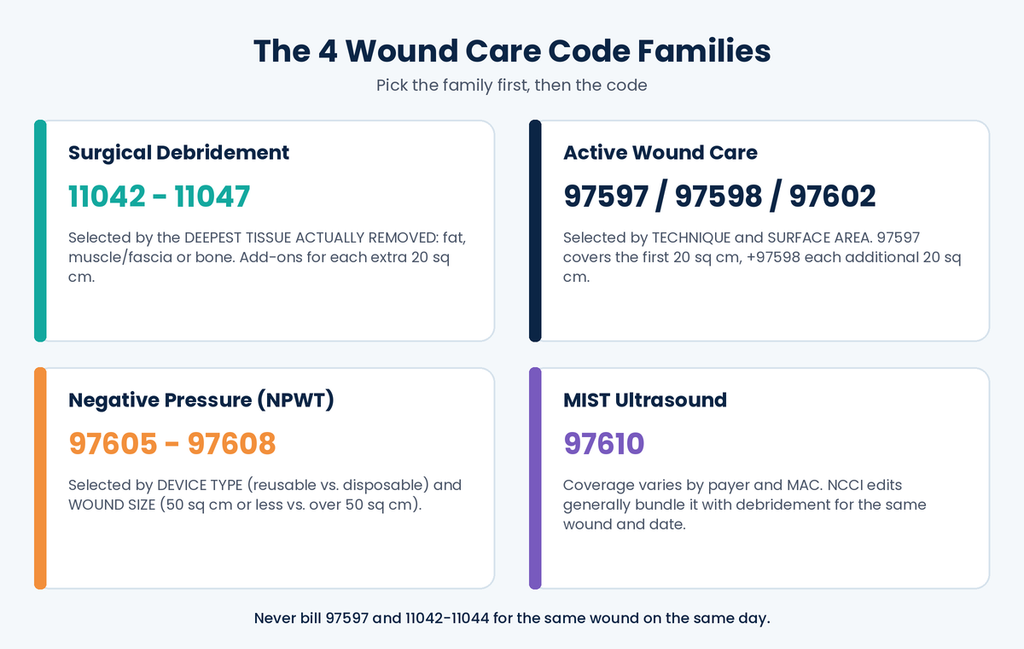
Wound care codes fall into a few families. The most important skill is knowing which family a service belongs to before choosing a code within it.
Surgical Debridement: CPT 11042–11047
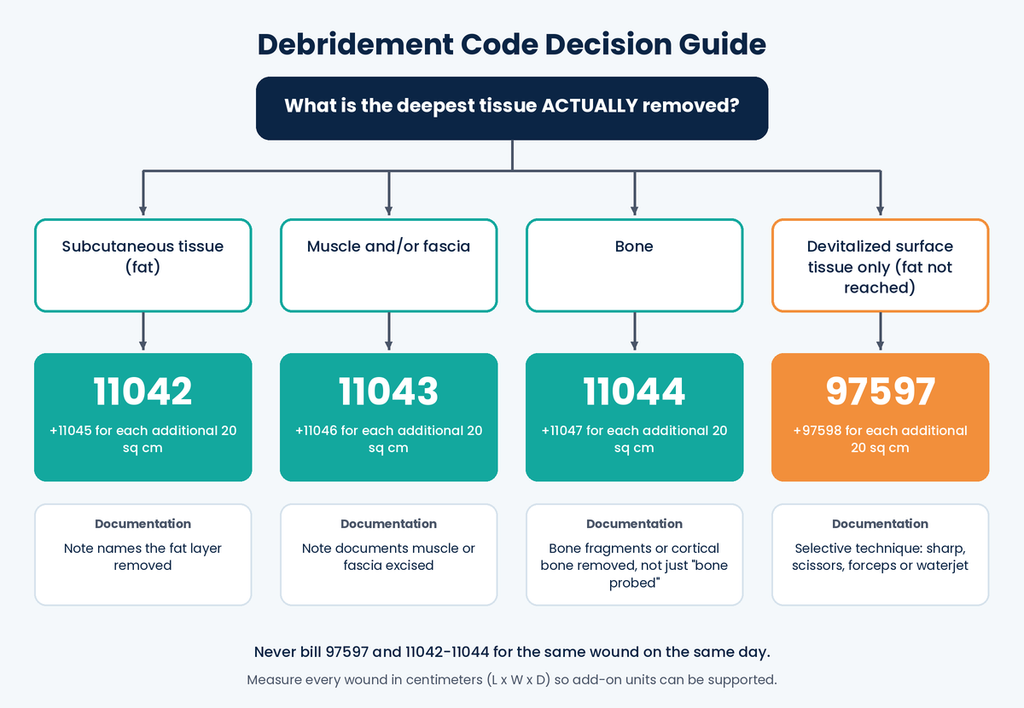
Surgical debridement codes are selected by the deepest layer of tissue actually removed, not by how deep the wound looks and not by what the instrument touched.
| Code | Tissue removed | Add-on for each additional 20 sq cm |
|---|---|---|
| 11042 | Subcutaneous tissue | +11045 |
| 11043 | Muscle and/or fascia | +11046 |
| 11044 | Bone | +11047 |
Key points for accurate billing:
- Report the first 20 sq cm with the primary code and each additional 20 sq cm (or part thereof) with the add-on.
- When multiple wounds are treated in one session, group them by depth and total the surface area for each depth level, following CPT guidance.
- Bone debridement requires documentation of bone actually removed, such as cortical bone or fragments. “Bone visible” or “bone probed” does not support 11044.
- These codes carry a 0-day global period, so an E/M on the same day needs its own justification (see the modifier section).
Active Wound Care Management: CPT 97597, 97598 and 97602
These codes describe removal of devitalized tissue where the selection depends on technique and surface area rather than depth.
- 97597 covers selective debridement (sharp instrument, scissors, forceps or high-pressure waterjet) for the first 20 sq cm.
- +97598 is the add-on for each additional 20 sq cm. It is one of the most commonly missed codes in wound care.
- 97602 covers non-selective debridement such as wet-to-dry dressings, enzymatic or autolytic methods. Medicare generally treats it as a bundled service, so check payer policy before you expect payment.
The practical rule: if the note documents removal of tissue to the level of subcutaneous fat or deeper, evaluate the 11042–11047 family. If it documents removal of devitalized tissue from the wound surface, the 97597 family fits. Do not report both for the same wound on the same day.
Negative Pressure Wound Therapy: CPT 97605–97608
NPWT codes are divided by device type and wound size:
- 97605 / 97606: durable (reusable) equipment, wound area up to 50 sq cm / over 50 sq cm
- 97607 / 97608: disposable, non-DME equipment, up to 50 sq cm / over 50 sq cm
Documentation should include wound dimensions, pressure settings, dressing type, exudate description and the clinical reason NPWT was selected. When a reusable pump is supplied, the pump and supplies are typically billed by the DME supplier, while the clinician bills the professional service.
MIST and Other Ultrasound Therapy: CPT 97610
CPT 97610 describes low-frequency, non-contact, non-thermal ultrasound. Three cautions apply:
- Coverage varies widely. Many payers and MACs limit or exclude this service, so verify policy before treating.
- Bundling is strict. NCCI edits generally prevent 97610 from being paid with debridement or other active wound care codes for the same wound on the same date. Check the current edits rather than relying on last year’s list.
- Documentation must be specific. Record the treatment time, device, wound dimensions and clinical rationale.
Compression and Casting: CPT 29580, 29581 and Related Codes
Unna boot application (29580) and multilayer compression systems (29581) are used mainly for venous ulcers and require documentation that supports the venous indication. Watch for same-extremity conflicts when compression is applied alongside debridement, and confirm your charge master matches current CPT descriptors each January.
E/M Services in Wound Care
New and established patient visits (99202–99215) are reportable on the same day as a procedure only with modifier 25, and only when the E/M is significant and separately identifiable. A routine pre-procedure wound check does not qualify; new cellulitis requiring antibiotics or management of an unrelated comorbidity does.
Documentation That Protects Every Wound Care Claim
Wound care denials and audit findings tend to trace back to the same handful of missing elements. Build them into your templates so they cannot be skipped.
Required in every visit note:
- Measurements in centimeters (length × width × depth) for every wound. Words like “small” or “large” do not count. Measurements drive add-on units and, for grafts, payment.
- Exact location and laterality, for example “left plantar first metatarsal head,” not “foot wound.”
- Wound bed description: tissue types, exposed structures, undermining, tunneling, exudate and periwound condition.
- Tissue removed and technique used for any debridement, written so the note independently supports the billed code.
- Progress against baseline. State the measured change since the last visit, not just “improving.”
- Medical necessity for the chosen therapy and why alternatives were not enough.
Required before advanced therapy:
- A documented period of standard wound care (offloading, compression, debridement, infection control) with measurements showing inadequate progress
- Vascular and diabetic control assessment where relevant
- Prior authorization confirmation when required
- Dated photographs, which are among the strongest tools in an ADR response
Conservative-care requirements differ by MAC and payer, so confirm the local standard in the Medicare Coverage Database.
ICD-10 Coding for Chronic Wounds and Diabetic Ulcers
Diagnosis specificity is what connects the procedure to medical necessity. Vague codes are a common reason claims fail LCD logic or payer edits.
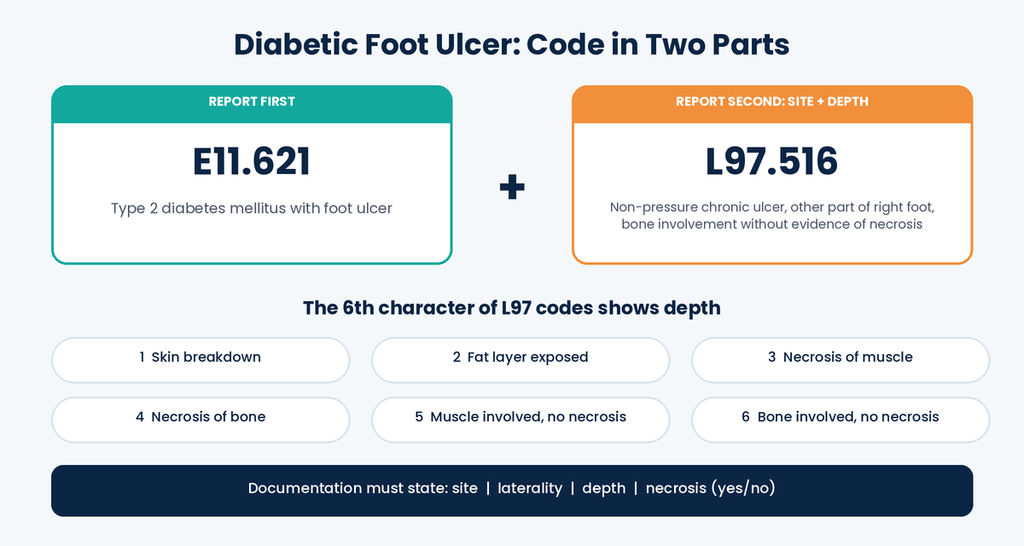
For a diabetic foot ulcer, report the diabetes code with ulcer first and the ulcer site and depth code second. For example:
- E11.621: Type 2 diabetes mellitus with foot ulcer
- L97.516: Non-pressure chronic ulcer of other part of right foot with bone involvement without evidence of necrosis
The L97 category is built by site, laterality and severity, so a note that says “foot ulcer” without depth cannot be coded to full specificity. Prompt clinicians to document depth (skin breakdown, fat layer exposed, muscle involvement, bone involvement) and whether necrosis is present. Also code documented conditions that affect healing, such as peripheral arterial disease or neuropathy.
Skin Substitute Billing in 2026
No area of wound care changed more in 2026 than skin substitutes, also called cellular and tissue-based products (CTPs).
What Changed
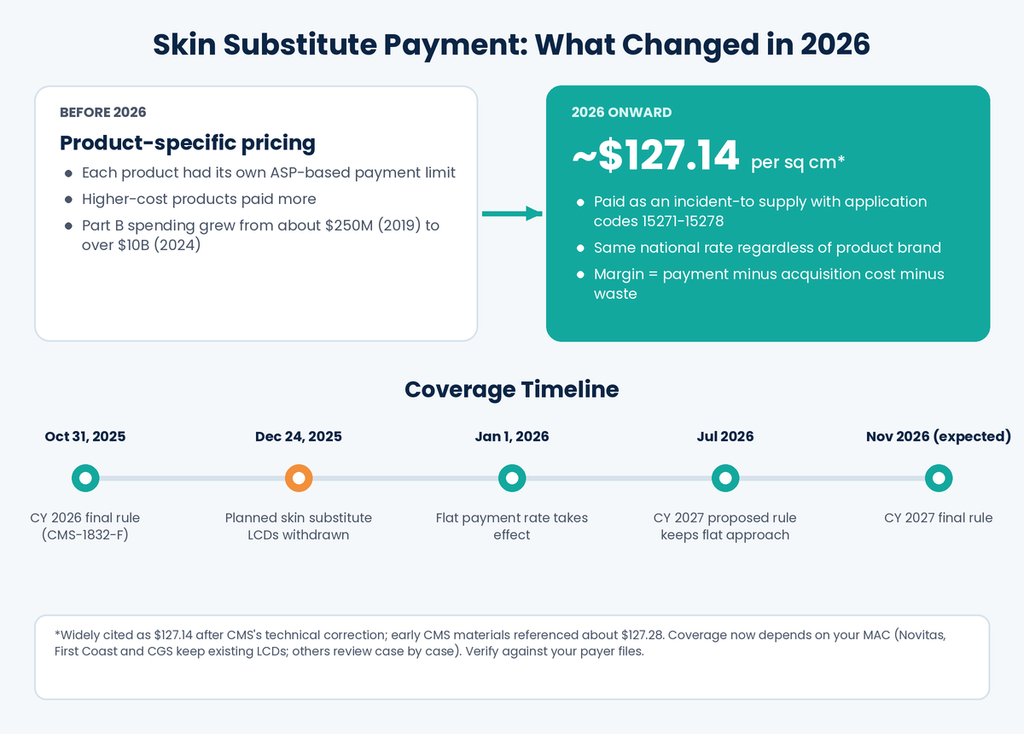
Under the CY 2026 Physician Fee Schedule final rule (CMS-1832-F), CMS finalized payment for skin substitutes as incident-to supplies used with a covered application procedure, in both the physician office and the hospital outpatient department. Instead of product-specific pricing, Medicare now applies one national rate to most products. That rate is widely cited as $127.14 per square centimeter following CMS’s technical correction (early materials referenced about $127.28), so confirm the current figure in your payer files.
CMS acted because spending had exploded: it reported Part B skin substitute spending growing from roughly $250 million in 2019 to more than $10 billion in 2024, under a model that paid more for more expensive products.
What This Means for Your Margin
Reimbursement no longer depends on which product you use. It depends on how many square centimeters you accurately document and apply, so acquisition cost now determines margin. A product that costs more per square centimeter than the payment rate loses money on every Medicare application. Review your formulary against the flat rate and factor in waste.
How to Bill the Application
- Application codes: 15271–15278, selected by body area and wound size
- 15271 / +15272: trunk, arms, legs, first 25 sq cm / each additional 25 sq cm
- 15273 / +15274: trunk, arms, legs, first 100 sq cm or 1% of body area in children / each additional 100 sq cm
- 15275–15278: the same size structure for the face, scalp, eyelids, mouth, neck, ears, orbits, genitalia, hands, feet and digits
- Product reporting: report the specific product with its HCPCS code and the correct number of units in square centimeters.
- Applied versus discarded product: document exactly how much was applied and how much was wasted. CMS and auditors expect this level of detail.
- FDA category: CMS now groups skin substitutes by regulatory pathway (361 HCT/Ps, 510(k) devices and PMA products), so product classification matters more than before.
The LCD Withdrawal: Coverage Is Not What You May Have Heard
Before January 1, 2026, the seven Part B MACs planned to implement uniform LCDs for diabetic foot ulcers and venous leg ulcers that would have named 18 covered products and 158 non-covered products. Many blogs still repeat that list. On December 24, 2025, however, CMS withdrew those LCDs before they took effect.
The result is a patchwork:
- Novitas, First Coast and CGS keep their existing skin substitute LCDs.
- Other MACs generally rely on “reasonable and necessary” case-by-case review.
- The flat payment rate applies regardless.
If someone tells you “only 18 products are covered,” treat it as outdated. Confirm coverage with your own MAC, and read commercial and Medicare Advantage policies separately, because many require prior authorization.
Protecting Skin Substitute Claims
- Document failed standard care with dated measurements before the first application
- Confirm diagnosis eligibility (most policies focus on diabetic foot ulcers and venous leg ulcers)
- Follow your MAC’s frequency limits and append required modifiers when they are exceeded
- Keep product records, including lot numbers and waste
Modifiers That Matter in Wound Care
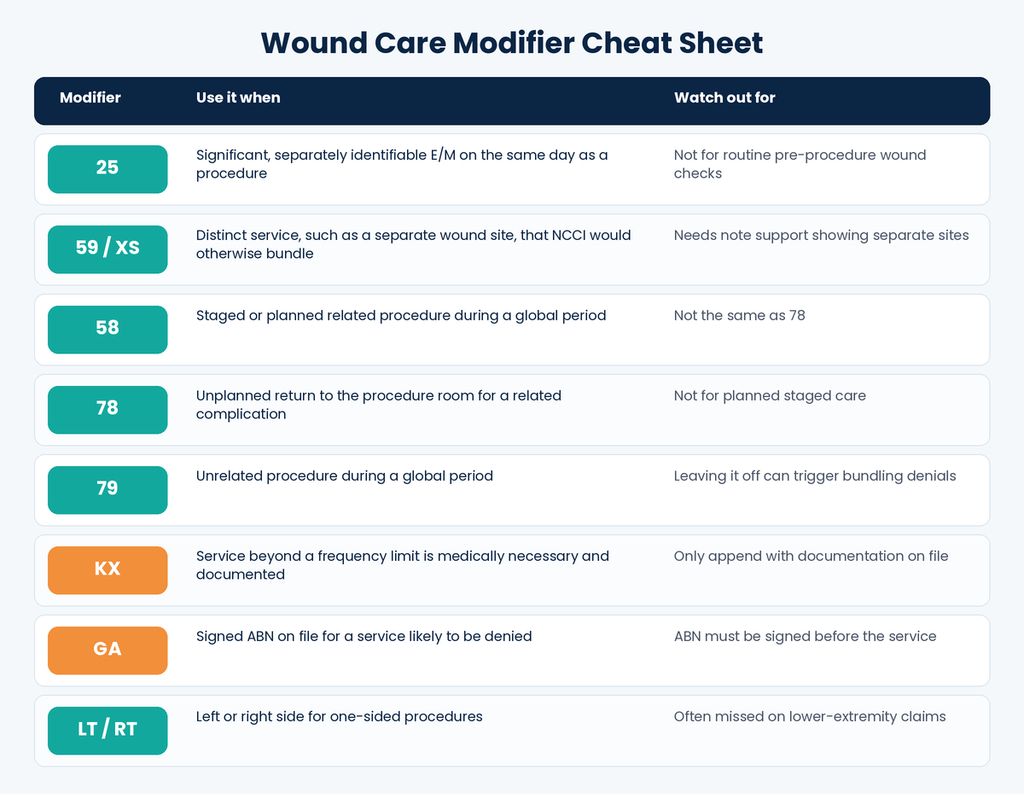
| Modifier | Use in wound care | Common mistake |
|---|---|---|
| 25 | Significant, separately identifiable E/M on the same day as a procedure | Adding it to every visit, including routine pre-procedure checks |
| 59 / XS | Distinct procedural service, such as a separate wound site, when NCCI bundles the pair | Using it without note support showing separate sites |
| 58 | Staged or planned related procedure during a global period | Confusing it with 78 |
| 78 | Unplanned return to the operating or procedure room for a related complication | Using it for planned staged care |
| 79 | Unrelated procedure during a global period | Omitting it, causing a global-period bundling denial |
| KX | Attests that a service exceeding a frequency or coverage limit is medically necessary and documented | Appending it without the documentation on file |
| GA | Signed ABN on file for a service likely to be denied as not reasonable and necessary | Getting the ABN after the service |
| LT / RT | Laterality on procedures performed on one side | Missing it on lower-extremity claims |
Global periods can change how same-day and later services are reported. Our general surgery CPT codes guide explains modifiers 58, 78 and 79 and global period rules in more depth, and the same logic applies to wound procedures that carry 0-day or 10-day globals. If you want to see how modifier 25 and 59 decisions work in another procedure-heavy specialty, our ophthalmology CPT codes guide is a useful companion.
Billing Wound Care in the Patient’s Home
Mobile and house-call wound care is growing, and it comes with its own set of rules.
Physician and NPP Home Visits
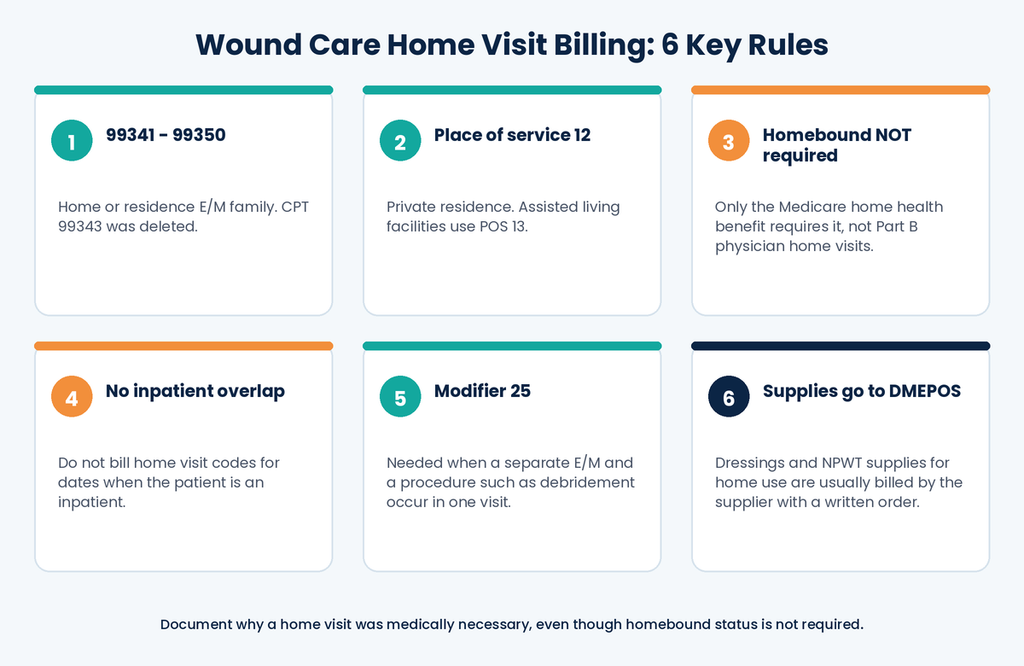
Clinicians who see patients at home bill the Home or Residence Services E/M family, CPT 99341–99350 (99343 was deleted). Key rules:
- Use place of service 12 for a private residence. Assisted living facilities use POS 13. Review the current CMS place of service code list for other settings.
- Homebound status is not required for Part B physician home visits. It is a requirement of the Medicare home health benefit, not of the physician service. The note should still explain why a home visit was medically necessary.
- Code selection can be based on medical decision making or total time on the date of the encounter. Prolonged services follow CPT and Medicare rules (Medicare uses G0318 for prolonged home or residence services).
- Home visit codes cannot be billed for dates when the patient is an inpatient.
- Some commercial payers require separate credentialing for home-based services, so confirm before the first claim.
When a clinician evaluates a new problem and also debrides a wound during one home visit, modifier 25 rules still apply, and the note should clearly show two distinct components.
Home Health Agency Patients
For patients under a Medicare home health plan of care, agency wound care services fall under the agency’s bundled payment and consolidated billing, while physician professional services remain billable under Part B. Rules for disposable NPWT under home health changed in 2024, so verify current billing instructions with your MAC or the agency before submitting.
Dressings and NPWT supplies for home use are generally billed by DMEPOS suppliers with a valid written order, so confirm who is billing supplies to avoid duplicates.
A Practical Wound Care Claim Workflow
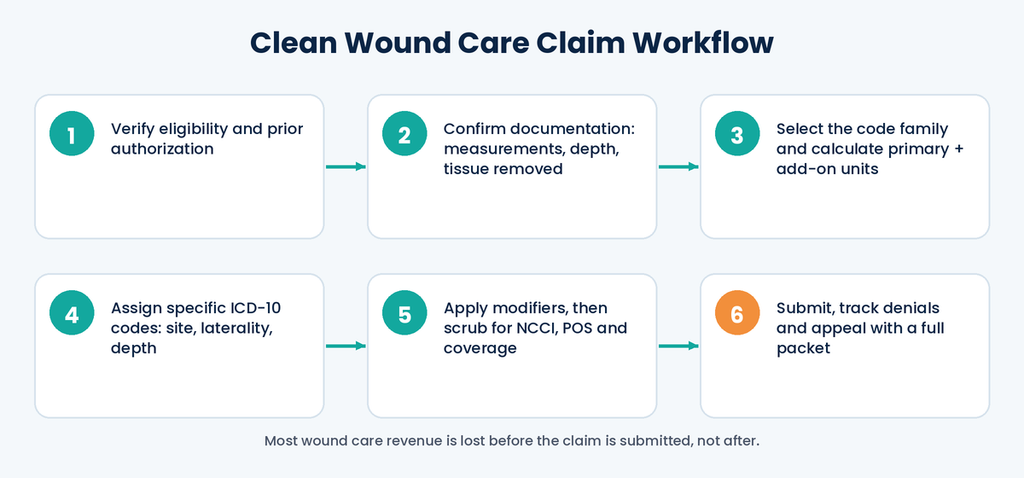
- Verify eligibility and authorization before the visit, especially for skin substitutes, NPWT and Medicare Advantage patients.
- Confirm documentation is complete before coding: measurements, depth, tissue removed and technique.
- Select the code family based on what was done, then calculate primary and add-on units.
- Assign specific ICD-10 codes with site, laterality and depth, linked to the right procedure lines.
- Apply modifiers only where documentation supports them, then scrub for NCCI conflicts and place of service.
- Submit promptly, track denials by reason and payer, and appeal with notes, measurements, photographs and policy language.
Top Wound Care Denial Reasons and How to Prevent Them
- Debridement depth mismatch: train providers to document the deepest tissue removed and have a coder review any 11043 or 11044.
- Missing add-on units: run a monthly report comparing documented wound area against billed units.
- Non-specific diagnosis codes: build ICD-10 prompts for site and depth into the template.
- No conservative care history: add a required standard-care section before any advanced therapy order.
- NCCI bundling and global period errors: scrub 97610 and same-day combinations, and review modifier 58, 78 and 79 use.
Denial prevention in wound care follows the same principle as in other high-scrutiny specialties. Our lithotripsy CPT codes guide shows how medical necessity documentation, prior authorization and payer-specific rules combine to protect reimbursement in another area where claims are frequently reviewed.
Compliance and Audit Readiness
Wound care claims are a recurring focus of payer audits and government oversight. Keep procedure notes specific enough to support the code on their own, avoid cloned notes that describe identical wounds across visits, audit debridement depth, add-on units and modifier 25 use periodically, retain product and waste records, and train staff each January and after every major CMS rule.
Coding guidance from the AMA CPT program, NCCI edits from CMS and enforcement priorities from the HHS Office of Inspector General should all inform your compliance plan.
What Could Change in 2027
CMS released the CY 2027 Physician Fee Schedule proposed rule in July 2026, and the comment period closed in September. A final rule is expected in the fall. Items worth watching for wound care include:
- Skin substitute rate: CMS is proposing to keep the flat approach for now.
- Non-sheet products: CMS proposes paying non-sheet skin substitutes reported under HCPCS G0681–G0684 at the same per-square-centimeter rate as sheet products.
- E/M with procedures: CMS proposes reducing payment for the lower-valued service when a separately identifiable E/M is billed with a procedure using modifier 25, which could affect many wound care visits.
None of these are final, so plan scenarios rather than changing workflows until the final rule is published.
How Credexa Solutions Helps Wound Care Practices Get Paid Accurately
Wound care rewards precision and punishes guesswork. Between depth-based debridement codes, add-on units, skin substitute reporting, modifier decisions and shifting coverage policies, even experienced in-house teams struggle to keep every claim clean. That is where a specialist billing partner makes a measurable difference.

Credexa Solutions supports wound care and surgical practices with end-to-end revenue cycle support built around the issues covered in this guide:
- Coding accuracy review: claims checked against the clinical note for debridement depth, technique, surface area and add-on units before submission
- Skin substitute billing support: correct application code and product reporting, unit calculation and documentation checks under the 2026 payment model
- Modifier and NCCI management: proper use of 25, 59, 58, 78, 79, KX and GA, with bundling conflicts caught up front
- Insurance verification and prior authorization: eligibility, coverage and authorization confirmed before advanced therapies are delivered
- Denial management and appeals: root-cause tracking by payer and code, with organized appeal packets for denied claims
- Home visit and mobile practice billing: correct place of service, E/M level and payer requirements for house-call and facility-based services
- Provider credentialing and enrollment: clean payer enrollment so new clinicians and locations can bill without delays
Instead of reacting to denials after the fact, your practice gets a team that reviews documentation, codes accurately and follows every claim through payment, so your clinicians can focus on healing wounds.
Ready to find out where your wound care revenue is leaking? Contact Credexa Solutions for a review of your current billing workflow and a plan to reduce denials, capture missed add-on units and stay compliant.
Frequently Asked Questions
What is the difference between CPT 97597 and CPT 11042? CPT 97597 reports selective debridement of devitalized tissue by technique and surface area. CPT 11042 reports surgical debridement that reaches subcutaneous tissue. Choose 11042 when subcutaneous tissue is actually removed and documented, and 97597 when the removal is limited to devitalized surface tissue. Do not bill both for the same wound on the same day.
Can I bill MIST therapy (97610) with debridement? NCCI edits generally bundle 97610 with debridement and other active wound care codes for the same wound on the same date. Different wounds treated with different services may be reportable with proper modifiers and documentation. Always check current edits and payer coverage first.
How are skin substitutes paid in 2026? Medicare pays most skin substitutes as incident-to supplies at a single national per-square-centimeter rate when used with a covered application code such as 15271–15278. The rate does not vary by product, so accurate measurement and product cost management are essential.
Are only 18 skin substitutes covered by Medicare? No. That list came from LCDs scheduled for January 1, 2026, which CMS withdrew on December 24, 2025. Coverage now depends on the MAC’s existing policy or case-by-case reasonable and necessary review.
Do I need modifier 25 to bill an E/M with a wound procedure? Yes, when the E/M is significant and separately identifiable from the procedure. Routine pre-procedure wound assessment does not qualify, and the note should clearly document the separate problem addressed.
This article is for educational purposes only and is not legal, compliance or coding advice. Payment rates, coverage policies and code edits vary by payer, MAC and locality, and may change. Verify requirements with current CMS, MAC and payer sources before billing.