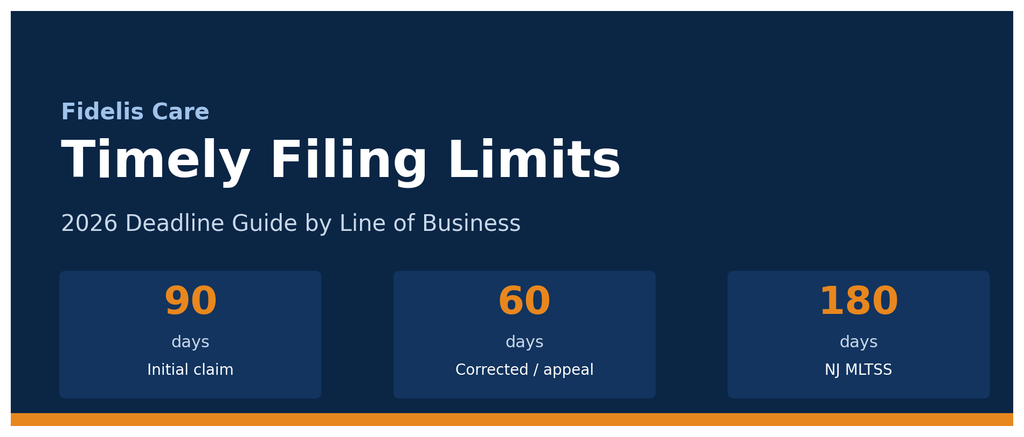
The Fidelis timely filing limit is 90 days from the date of service for New York claims, and corrected claims and appeals are due within 60 days of the remittance. Fidelis Care New Jersey MLTSS runs on a longer window of 180 days. Miss the window that applies to your claim and you’ll see a CO-29 denial, and the balance lands on your write-off report instead of in your bank account. Fidelis CareFidelis Care
Timely filing is one of the most preventable denials in medical billing. It keeps draining revenue because practices apply one number to every Fidelis claim. Fidelis Care runs several lines of business: Medicaid Managed Care, Child Health Plus, the Essential Plan, Ambetter from Fidelis Care, and Wellcare by Fidelis Care Medicare products. A single claim can be running on more than one clock at once.
This guide puts every deadline in one place and explains when each clock starts. It shows how to submit a corrected claim so it isn’t returned, and what proof holds up in a dispute. You’ll also get worked date examples, an internal-deadline system, and prevention tips for surgical, eye care, and urology practices. Always confirm against your signed Provider Participation Agreement, because your contract controls.
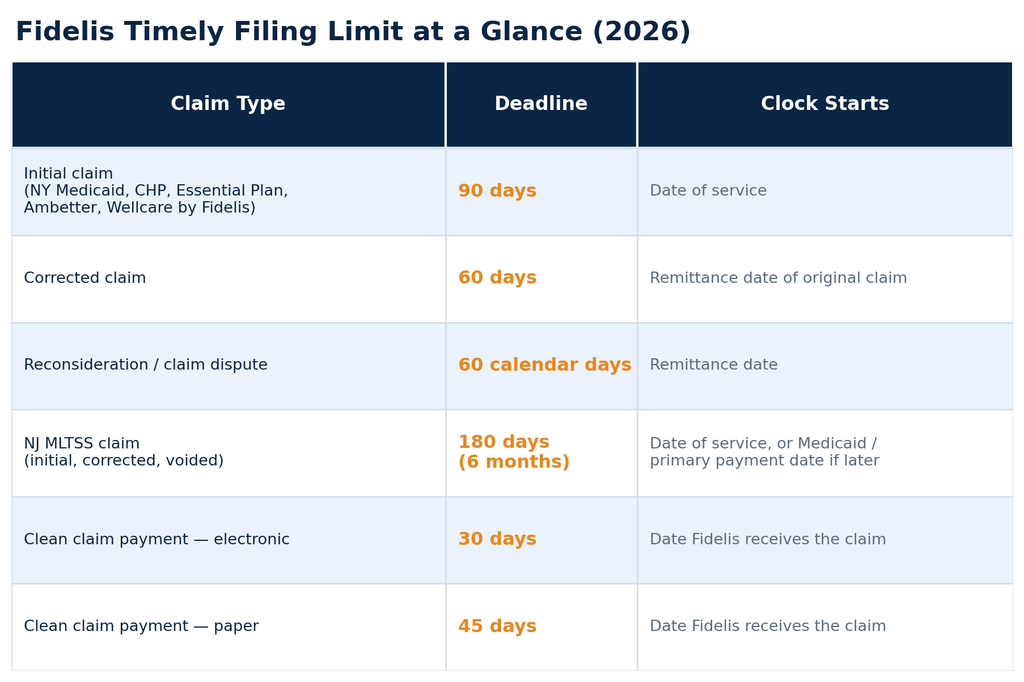
Fidelis Timely Filing Limit at a Glance (2026)
| Claim type | Deadline | Clock starts |
|---|---|---|
| Initial claim (NY Medicaid, Child Health Plus, Essential Plan, Ambetter, Wellcare by Fidelis) | 90 days | Date of service |
| Corrected claim | 60 days | Remittance date of the original claim |
| Reconsideration / claim dispute | 60 calendar days | Remittance date |
| NJ MLTSS claim (initial, corrected, voided) | 180 days or 6 months | Date of service, or Medicaid/primary payment date if later |
| Clean claim payment, electronic | 30 days | Date Fidelis receives the claim |
| Clean claim payment, paper | 45 days | Date Fidelis receives the claim |
| EDI payer ID (New York) | 11315 | n/a |
Fidelis publishes 30-day processing for clean electronic claims and 45 days for clean paper claims, so a claim that hasn’t moved after those windows deserves a status check, not more waiting. Fidelis Care
Why There Is No Single Fidelis Timely Filing Limit
New York and New Jersey are separate operations. Fidelis Care New York works from fideliscare.org, and Fidelis Care New Jersey works from fideliscarenj.com. Search results blend them constantly, which is why you’ll find “90 days” on one page and “180 days” on another. Both are right, for different states. On the New Jersey MLTSS claims page, initial, corrected and voided claims are due within six months or 180 days from the Medicaid or primary insurance payment date, whichever is later, unless the Provider Participation Agreement says otherwise. Fideliscarenj
Your contract overrides the published number. Fidelis billing guidance says claims must be submitted within the timeframes in your provider contract, with 90 days as the standard for enrollee services. Some practices bill Fidelis for years without opening the agreement. Pull it, find the claims submission article, and write the number beside each plan you’re contracted for. It takes about 20 minutes, and it becomes your source of truth. StudyLib
Don’t borrow deadlines from another plan. Other Centene and Wellcare products publish their own windows. For a Fidelis claim, use the plan-specific Fidelis tip sheet or the Fidelis Care provider manuals, not a general Medicare Advantage manual or a third-party payer database.
Fidelis Timely Filing Limit by Plan
NY Medicaid Managed Care and Child Health Plus
Both lines follow the 90-day rule. A Fidelis Medicaid claim is a managed care claim, so it’s governed by your Fidelis agreement and provider manual rather than by eMedNY fee-for-service rules. That distinction matters most when you’re arguing for an exception (more on that below).
Essential Plan and Ambetter from Fidelis Care
For Ambetter from Fidelis Care, claims are generally due within 90 days of service, corrected claims within 60 days of the remittance advice, and the manual lists certain late-filing exceptions that require proof or an explanation. Hospital UB-04 claims can be measured differently, for example from discharge, so check the QHP and Essential Plan manual before counting an inpatient stay from admission. Clark Street Health
Wellcare by Fidelis Care Medicare Advantage and Dual Advantage
The Medicare Advantage/Dual Advantage tip sheet requires claims within 90 days of the date of service, and reconsiderations within 60 calendar days of the remittance advice. Dual-eligible members add a billing-order wrinkle, covered in the secondary claims section below. Fidelis Care
Fidelis Care New Jersey MLTSS
New Jersey MLTSS has the longest window at 180 days, and it treats initial, corrected, and voided claims under the same rule. Fidelis Care NJ also states that HIPAA-compliant electronic clean claims process within 15 calendar days and manual clean claims within 30. If you bill both states, keep the two rule sets on separate rows of your deadline sheet. Fideliscarenj
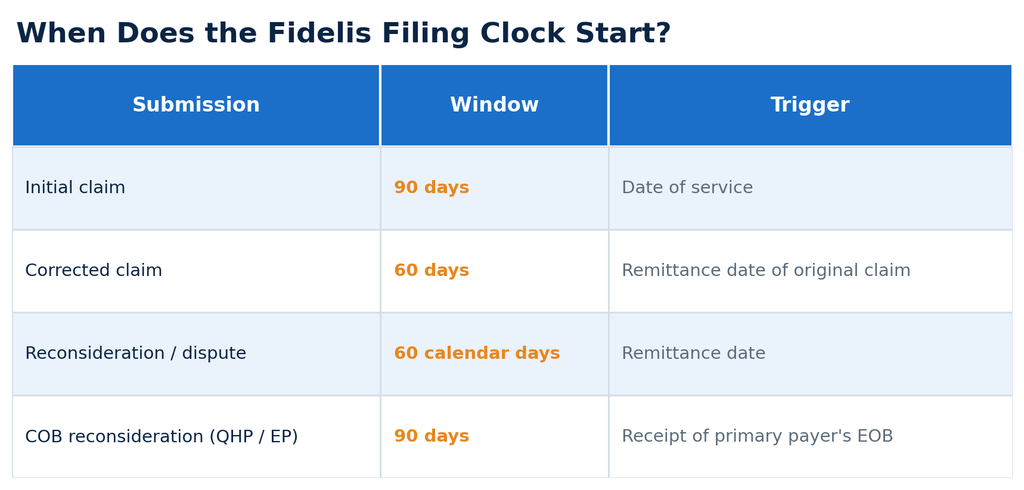
When Does the Fidelis Filing Clock Start?
Fidelis runs separate clocks for separate submissions, and each has its own trigger.
| Submission | Window | Trigger |
|---|---|---|
| Initial claim | 90 days | Date of service |
| Corrected claim | 60 days | Remittance date of the original claim |
| Reconsideration / dispute | 60 calendar days | Remittance date |
| COB reconsideration (QHP/Essential Plan) | 90 days | Receipt of the primary payer’s EOB |
Three rules keep the counting honest:
- Count from the remittance, not the letter. Corrected claims and reconsiderations start on the remittance date. Billers who count from the day they opened the denial give away days they were entitled to.
- “Filed” means received. The clock stops when Fidelis receives a clean claim, not when your biller clicks submit or your clearinghouse sends the file. Paper adds mail time.
- Don’t assume a weekend rollover. We couldn’t find a published weekend or holiday rollover rule for Fidelis New York lines. If day 90 lands on a Saturday, treat Friday as the deadline.
Fidelis Corrected Claim Timely Filing Limit: The 60-Day Rule
Fidelis requires corrected claims within 60 days of the remittance, a claim frequency code of 7 for a replacement, and the original Fidelis claim number on the submission. The Fidelis corrected claim protocol gives the electronic requirements: Fidelis Care
- Loop 2300, CLM05-3 set to 7 (replacement of prior claim)
- Loop 2300, REF segment with REF01 = F8 and REF02 = the original Fidelis claim number
- Full retraction: use the void/cancel frequency code (8), not a fresh initial claim
- Volume: Fidelis guidance limits submissions to one correction per original claim number per day
Paper corrections carry their own fields. On the UB-04, the type of bill (FL 4) must end in 7 and the Document Control Number (FL 64) must carry the original claim number. On the CMS-1500, Box 22 needs resubmission code 7 with the original reference number.
What closes the window. Fidelis states that corrected claims should not be sent through the Provider Appeals Form or the portal’s claim dispute feature. Misrouted corrections get returned rather than denied, so you receive no remittance and no dated proof that you tried, while the 60-day clock keeps running. Mailing a correction to the initial claims box has the same effect, because it can process as a duplicate instead of a correction.
Most corrected claims trace back to coding and modifier mistakes that could have been caught before the first submission. That’s where specialty accuracy pays off. Surgical practices can start with our general surgery CPT codes 2026 billing, modifier and global period guide, since a missed modifier on a global-period claim is a classic reason for a correction.
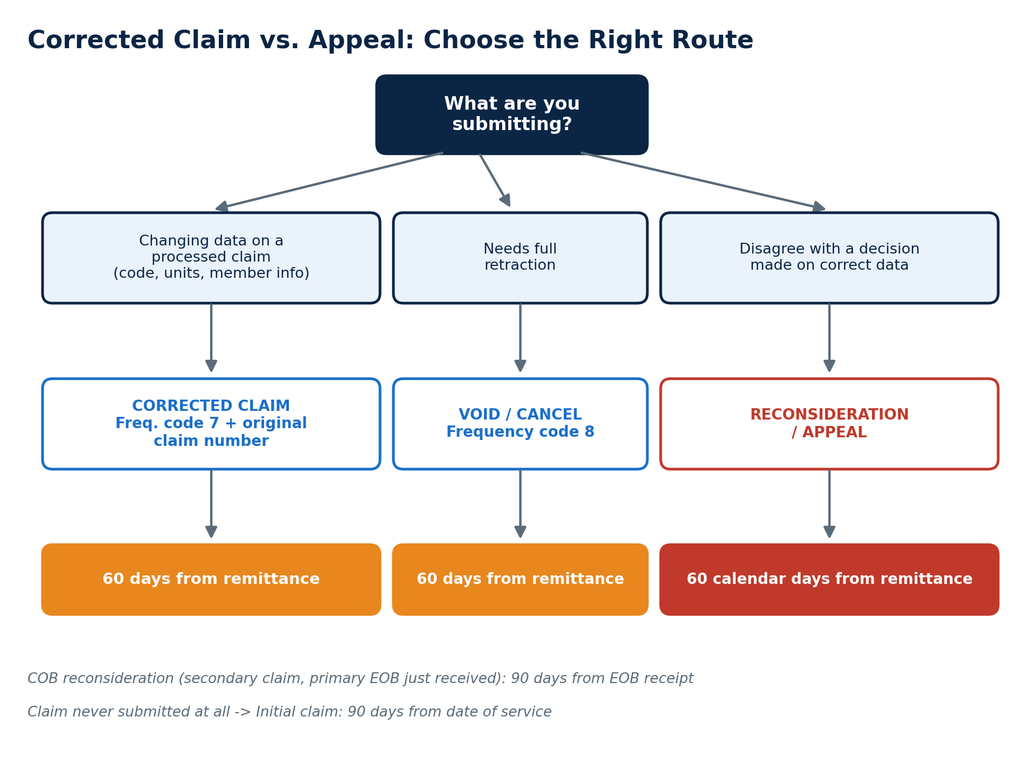
Corrected Claim vs. Appeal: Choose the Right Route
A corrected claim changes data on a claim Fidelis already processed. An appeal asks Fidelis to review a decision. Both run 60 days from the remittance, but they are not interchangeable.
| Situation | Route | Clock |
|---|---|---|
| Wrong code, units, or member data | Corrected claim | 60 days from remittance |
| Claim needs full retraction | Void (frequency code 8) | 60 days from remittance |
| You disagree with a denial on correct data | Reconsideration or appeal | 60 calendar days from remittance |
| Secondary claim, primary EOB just arrived | COB reconsideration | 90 days from EOB receipt |
| Claim never submitted | Initial claim | 90 days from service |
Picking the wrong route doesn’t pause the clock. The submission bounces, the days keep burning, and you rebuild the file at day 50. A simple test: if you’re changing claim data, it’s a correction. If you’re challenging a decision made on accurate data, it’s an appeal.
What Happens If You Miss the Fidelis Timely Filing Deadline
Late claims come back with CO-29, the claim adjustment reason code for an expired filing limit, maintained in the X12 claim adjustment reason code list. The CO group code assigns the loss to the provider, and where your contract prohibits balance billing, the patient can’t be billed either. Depending on your system, it may display as CO29, CO-29, or CO 29, so search all three spellings when you pull denial reports or you’ll undercount the problem.
A CO-29 isn’t always the end of the road. Whether it can be disputed depends on your plan, your contract, and your evidence. You’d typically argue one of three things: the claim was filed on time and Fidelis has the wrong receipt date, a different clock applied, or a recognized exception covers the delay. Pick one argument and document it. Submitting all three at once signals that you don’t know what actually happened.
What Counts as Proof of Timely Filing?
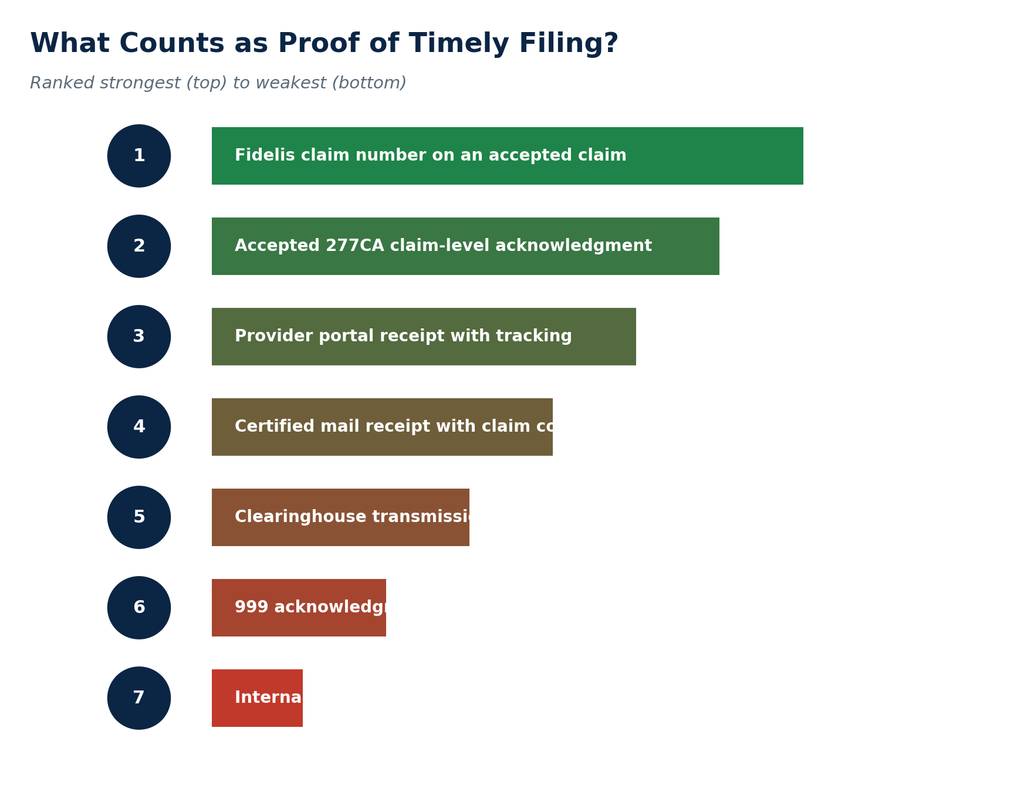
Fidelis points to electronic acceptance reports as proof of timely submission. Evidence isn’t equal, though. Ranked from strongest to weakest: Fidelis Care
- A Fidelis claim number on an accepted claim
- An accepted 277CA claim-level acknowledgment
- A provider portal receipt with tracking
- Certified mail receipt with a copy of the claim
- Clearinghouse transmission report
- A 999 acknowledgment (file-level only)
- Internal notes or screenshots
Everything above the clearinghouse line shows what the payer received. Everything below it shows what your office did, and disputes built on internal notes alone rarely survive review. Fidelis describes electronic acceptance reports on its electronic transactions page.
The distinction that decides most disputes is rejected vs. denied. A rejected claim never entered adjudication, so the filing clock never stopped. If your practice management system shows “submitted” but Fidelis has no record, you had a rejection, and the deadline kept running the whole time. A claim isn’t done when it transmits. It’s done when a Fidelis claim number exists.
Timely Filing Exceptions and Late Claim Reasons
Exceptions are narrow and need documentation. Ambetter/QHP manuals list reasons such as litigation, primary insurance delays, retroactive eligibility, and an original claim rejected for a reason unrelated to timeliness, and they expect proof or an explanatory letter. Staff turnover, a software migration, or a backlog of unbilled charges are not on any list we’ve seen.
The New York Medicaid framework explains why 90 days is so common in the state. 18 NYCRR 540.6 requires Medicaid claims within 90 days of service unless the delay was outside the provider’s control, and late submissions must follow within 30 days of the point when submission came back within the provider’s control. The eMedNY general billing manual and the eMedNY delay reason code guidance apply to fee-for-service. Because Fidelis is a managed care organization, confirm with Provider Relations whether a delay reason code will be accepted before you build a workflow around one.
Secondary and Coordination of Benefits Claims
For Ambetter and Essential Plan secondary claims, the COB reconsideration window runs 90 days from receipt of the primary payer’s EOB, not from the date of service. That means a service from ten months ago can still be inside its secondary window if the primary only just adjudicated. Work the EOB the day it arrives, because it looks like old paper and sits in queues.
For dual-eligible members, bill Medicare first when the service is covered, then bill Medicaid or the managed care plan for the balance. Getting the order wrong burns days on both claims. 42 CFR 447.45 is the federal foundation for Medicaid being the payer of last resort, and verifying coverage before the visit is far cheaper than reconstructing it months later.
Fidelis Payer ID and Where to Send Claims
The Fidelis Care payer ID is 11315 and is used for all electronic submissions. Eligibility and remittance also route through your clearinghouse, and you can check status on Provider Access Online. Professional and institutional claims go to different destinations, and corrected claims and appeals go somewhere else again. Because PO boxes change more often than filing rules, verify every paper address on the official Fidelis provider site before mailing. For questions, the provider call center is 1-888-FIDELIS (1-888-343-3547). StudyLib
How to Calculate Your Fidelis Filing Deadline
Count calendar days forward, treating day 1 as the day after the trigger date. Worked examples for 2026:
| Date of service | 90-day deadline | Remittance date | 60-day corrected/appeal deadline |
|---|---|---|---|
| June 10, 2026 | September 8, 2026 | August 20, 2026 | October 19, 2026 |
| August 3, 2026 | November 1, 2026 (Sunday: file by Friday, Oct 30) | September 10, 2026 | November 9, 2026 |
| September 1, 2026 | November 30, 2026 | September 22, 2026 | November 21, 2026 (Saturday: file by Friday, Nov 20) |
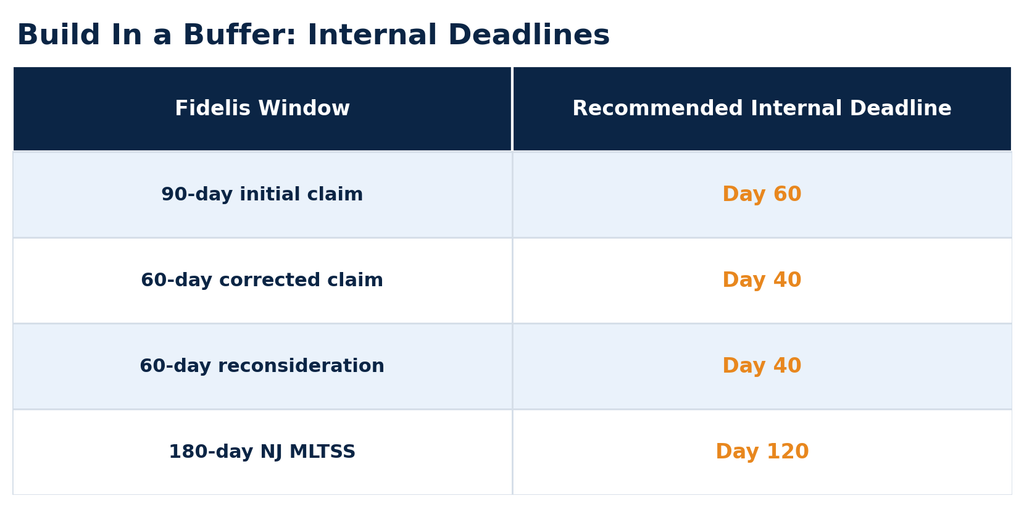
Notice how often the raw deadline lands on a weekend. That’s why your internal deadline should sit well ahead of the payer’s.
| Fidelis window | Recommended internal deadline |
|---|---|
| 90-day initial claim | Day 60 |
| 60-day corrected claim | Day 40 |
| 60-day reconsideration | Day 40 |
| 180-day NJ MLTSS | Day 120 |
A 30-day buffer absorbs one rejection cycle and one round of records retrieval. Practices submitting at day 85 have room for neither. Also, work the aging report by deadline proximity, not dollar amount: a $180 claim at day 84 is more urgent than a $2,400 claim at day 30, because only one of them is about to become unrecoverable.
How to Prevent Fidelis Timely Filing Denials
Practices that lose claims almost always knew the limit. The failure is workflow. Six habits close the gap:
- Bill within 48 hours of the encounter. Claims rarely miss 90 days because 90 wasn’t enough. They miss because charges sat unbilled for three weeks and a rejection ate another two.
- Confirm acceptance, not transmission. Build a check for a Fidelis claim number into the workflow.
- Separate rejection and denial queues. A rejection means the clock never stopped, so it’s more urgent.
- Keep a payer deadline matrix by line of business, with initial, corrected, appeal, and COB windows.
- Reconcile unbilled encounters weekly. Aging reports only show claims that exist, so unbilled encounters are invisible in the report managers rely on.
- Fix coding before submission. Every avoidable correction spends days from a 60-day window.
That last habit is highly specialty-specific. High-dollar procedures with modifiers, laterality, and authorization requirements generate the most corrections:
- Eye care practices: Exam codes, diagnostic testing, surgical codes, and laterality modifiers interact in ways that trigger edits. Our ophthalmology CPT codes 2026 guide to eye exam, diagnostic, surgery and modifier codes covers how to code these correctly the first time.
- Urology and stone treatment centers: Procedures like lithotripsy involve authorizations, facility and professional components, and denial-prone documentation. See our lithotripsy CPT codes 2026 billing, reimbursement and denial prevention guide.
- Surgical practices: Global periods and modifiers are the most common source of surgical corrections. Review the general surgery CPT codes 2026 modifier and global period guide before your next Fidelis submission.
How Credexa Solutions Helps Protect Your Fidelis Claims
Knowing the Fidelis timely filing limit is half the job. The other half is a billing process that submits clean claims fast, confirms acceptance, and works every aging claim before its deadline. That’s the work Credexa Solutions does for medical practices, as a partner that handles the operational side of medical billing so your team isn’t tracking deadlines by memory.
Here’s how Credexa Solutions helps with medical billing on payer accounts like Fidelis:
- Payer-specific deadline tracking. Each Fidelis line of business gets its own initial, corrected, and appeal windows instead of one number for everything.
- Eligibility and benefit verification. Coverage and payer order are confirmed before the visit, which prevents COB mistakes that burn the filing window.
- Coding review and clean claim submission. Modifier, laterality, and global-period errors are caught before the claim leaves, so fewer claims need corrections.
- Acceptance confirmation. Claims are tracked until a payer claim number exists, so rejections don’t sit unnoticed.
- Denial management. When a CO-29 or other denial arrives, the root cause is investigated and disputed with evidence rather than resubmitted blindly.
- Accounts receivable follow-up prioritized by deadline. Claims nearest their limit are worked first, not the ones with the largest balance.
- Credentialing and payer enrollment. Claims can’t be billed cleanly while enrollment is pending, and the 90-day window doesn’t pause for paperwork, so timely credentialing protects your revenue.
If Fidelis balances are aging and nobody owns the deadline, that’s a workflow gap, and it’s fixable. Visit Credexa Solutions to talk with a billing specialist about your denials and aging AR.
Fidelis Timely Filing Limit FAQs
What is the Fidelis timely filing limit?
Fidelis Care generally requires initial claims within 90 days of the date of service across its New York lines of business. Fidelis Care New Jersey MLTSS allows 180 days. Your Provider Participation Agreement governs if it states a different window.
What is the Fidelis corrected claim timely filing limit?
Corrected claims are due within 60 days of the remittance date of the original claim, with frequency code 7 and the original claim number included.
What is the Fidelis appeal or reconsideration deadline?
Requests for reconsideration or claim disputes must be received within 60 calendar days of the remittance advice. Allow mail time for paper submissions, since the date that counts is the date Fidelis receives it.
Does Fidelis count calendar days or business days?
Treat every Fidelis window as calendar days unless a plan document specifically says business days. Weekends and holidays count, and no weekend rollover is published for New York lines.
Can a Fidelis timely filing denial be overturned?
Sometimes. It depends on your plan, your contract, and your proof. Strong evidence includes an accepted 277CA, a Fidelis claim number, or a portal receipt showing timely submission.
What is the Fidelis payer ID?
The New York payer ID is 11315. Fidelis Care New Jersey has its own portal and payer details, so confirm them on the New Jersey provider site.
How can Credexa Solutions help with Fidelis claims?
Credexa Solutions supports the full billing workflow: eligibility verification, coding review, clean claim submission, denial management, AR follow-up by deadline, and credentialing. The goal is fewer late claims and more recovered revenue.
Final Thoughts
The Fidelis timely filing limit isn’t hard to learn. It’s hard to enforce when claims are moving through rejections, corrections, and COB delays. Build a deadline matrix, set internal deadlines at day 60 and day 40, and confirm acceptance instead of assuming it. Sending clean claims the first time protects you more than any appeal will.
Want help putting that process in place? Credexa Solutions can take deadline tracking, denial follow-up, and billing off your team’s plate.
Related guides from Credexa Solutions: