If you bill for Aetna and you’ve ever watched a clean, medically necessary claim get denied for one reason and one reason only you already know how frustrating a CO-29 timely filing denial can be. There’s no coding error to fix, no missing documentation to chase down. The service was legitimate, the patient was eligible, and the claim was accurate. It was simply submitted too late.
For physicians, billing managers, and revenue cycle teams, the Aetna timely filing limit 2026 is one of the most unforgiving rules in the entire reimbursement process. Miss it by even a single day, and that claim is gone permanently, in most cases. There’s no negotiating with a payer’s system once the window closes.
This guide breaks down everything a provider or billing team needs to know about Aetna’s filing deadlines in 2026: how they differ by plan type, how they differ by claim type (initial, corrected, secondary, and appealed claims), what triggers a CO-29 denial, and most importantly how to build a workflow that makes missed deadlines a thing of the past.
Why This Matters More in 2026 Than Ever Before
Payer scrutiny on submission timelines has tightened considerably over the past few years, and Aetna is part of that broader industry trend. More claims are now processed through automated adjudication engines that flag late submissions instantly and without human review which means there’s less room for the kind of informal leniency billing teams may have relied on in the past. At the same time, non-participating providers are increasingly seeing shorter windows than they once had, and payers across the industry are trending toward tighter, more uniform submission periods rather than the more generous, provider-friendly timelines of a decade ago.
For physicians and practice administrators, this means the margin for error on the Aetna timely filing limit 2026 is smaller than it’s ever been. A single overlooked deadline on a high-dollar claim a surgical case, a multi-visit treatment course, or a bundle of related services can represent thousands of dollars in unrecoverable revenue. Multiply that across a full patient panel, and timely filing compliance becomes a genuine line item in a practice’s financial health, not just a back-office administrative detail.
This is also why so many practices choose to bring in a dedicated medical billing partner rather than manage payer-specific deadlines internally. It isn’t just about submitting claims it’s about maintaining a system disciplined enough to catch every deadline across every payer, every plan type, and every claim status, all at once.
What Does “Timely Filing” Actually Mean?
Timely filing is the maximum number of days a healthcare provider has to submit a claim to an insurance payer after the date a service was rendered. Every commercial and government payer sets its own version of this rule, and Aetna is no exception.
The logic behind timely filing limits is straightforward from the payer’s perspective: insurers need predictable data to close out claims periods, calculate reserves, and manage risk. From a provider’s perspective, though, these deadlines are a constant operational hazard especially in practices juggling multiple payers, each with a different clock.
Once a claim passes its timely filing deadline, Aetna is contractually and legally permitted to deny it outright, regardless of whether the service was medically necessary, whether the patient was eligible, or whether the claim was otherwise “clean.” This is why timely filing denials are considered some of the most preventable and most frustrating revenue losses in medical billing.
Aetna Timely Filing Limit 2026: Quick-Reference Table
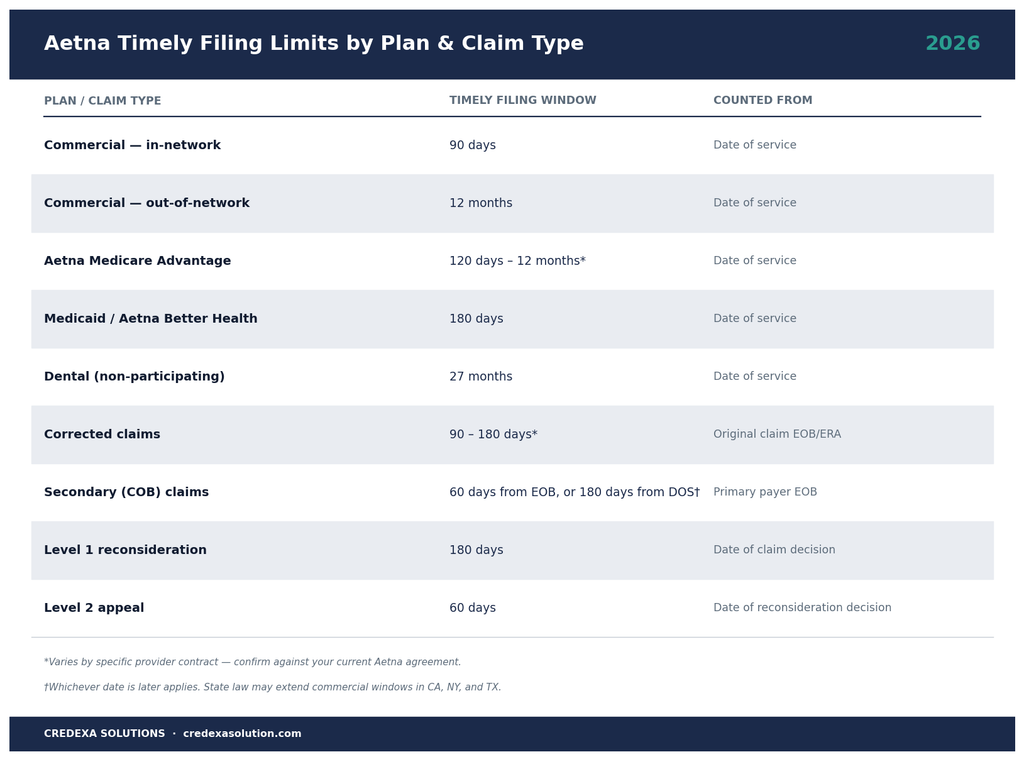
Because Aetna’s deadlines vary by network status, product line, and state, there is no single universal number. Below is the general framework billing teams work from in 2026. Always confirm the specific figure against the provider’s own contract and the current Aetna Provider Manual, since individual agreements can extend or shorten these defaults.
| Plan / Claim Type | Typical Timely Filing Limit | Counted From |
|---|---|---|
| Commercial, in-network (participating) | 90 days | Date of service |
| Commercial, out-of-network (non-participating) | 12 months (365 days) | Date of service |
| Aetna Medicare Advantage | 120 days to 12 months, depending on contract | Date of service |
| Aetna Medicaid / Aetna Better Health (managed Medicaid) | 180 days | Date of service |
| Dental plans, non-participating | 27 months | Date of service |
| Corrected claims | 90–180 days, depending on plan | Original claim’s ERA/EOB or date of service |
| Secondary claims (COB) | Whichever is later: 60 days from primary EOB, or 180 days from date of service | Primary payer’s EOB date |
| Level 1 reconsideration | 180 days | Date of the claim decision |
| Level 2 appeal | 60 days | Date of the reconsideration decision |
A few important caveats sit underneath this table, and skipping them is exactly how practices end up with avoidable denials.
1. Commercial In-Network Claims: 90 Days Is the Working Standard
For most participating commercial providers, 90 days from the date of service is the number your billing team should build workflows around. This is tighter than several other major national payers, some of which allow 120 days or more, so Aetna claims deserve a shorter internal follow-up cycle than payers with looser windows.
2. Out-of-Network Claims: 12 Months, But Don’t Get Comfortable
Non-participating providers get considerably more breathing room generally 12 months from the date of service, a standard that has been in place since Aetna widened the non-par window from a much shorter legacy period. That said, a 12-month runway is not an excuse to deprioritize out-of-network claims. Longer deadlines tend to produce more lost claims, not fewer, simply because staff assume there’s no urgency.
3. Medicare Advantage: Where the Confusion Really Starts
Aetna Medicare Advantage timely filing is where most billing teams get tripped up, because the number quoted depends entirely on the source. Some Aetna product materials and contracted-provider agreements reference a 120-day window; others point to a 12-month standard tied to the federal floor that governs Medicare Advantage organizations. The safest approach is to treat 120 days as your internal deadline unless your specific provider agreement or current Aetna claims correspondence states otherwise filing early costs you nothing, while assuming a longer window and being wrong costs you the entire claim.
It’s also worth understanding what a Medicare Advantage timely filing limit is not. The federal regulation prompt-payment rule at 42 CFR § 422.520 governs how quickly a Medicare Advantage organization must pay a clean claim once received it does not set a floor for how long a provider has to submit that claim in the first place. Don’t let a vendor or billing reference conflate the two; they answer completely different questions.
4. Medicaid Managed Care (Aetna Better Health)
Aetna’s managed Medicaid plans, operating under the Aetna Better Health brand in various states, generally use a 180-day timely filing standard for both initial and corrected claims. However, because Medicaid managed care is regulated at the state level, the actual number can shift depending on which state program you’re billing. Always check the state-specific Aetna Better Health provider manual before assuming the 180-day default applies.
5. State Law Can Override Aetna’s Standard Windows
This is one of the most overlooked pieces of the puzzle. Aetna itself acknowledges that state insurance regulations can supersede its standard timely filing periods in states with longer statutory requirements. California, New York, and Texas are frequently cited examples where state-mandated minimums extend beyond Aetna’s baseline commercial window. Self-funded ERISA plans are typically exempt from these state mandates, which means two patients with “Aetna coverage” in the same state can technically be operating under two different filing clocks depending on whether their employer’s plan is fully insured or self-funded ERISA. When in doubt, check the plan type on file, not just the payer name.
How to Calculate Your Aetna Filing Deadline Correctly
A surprising number of timely filing denials come down to one simple error: counting from the wrong starting date. Follow this sequence to calculate a deadline correctly every time:
- Confirm the plan type first. Pull the patient’s eligibility record and identify whether the coverage is commercial (participating or non-participating), Medicare Advantage, or Medicaid managed care. This single step determines which row of the table above applies.
- Identify the correct “clock start” date. For an initial claim, this is the date of service. For a corrected claim, it’s typically the date of the original remittance advice or EOB. For a secondary claim, it’s the date the primary payer issued its EOB.
- Check for a state override. If the practice is located in or the plan is issued in a state with a longer statutory minimum (such as California, New York, or Texas), confirm whether that state rule applies before defaulting to Aetna’s standard window.
- Check whether the plan is self-funded ERISA. Self-funded ERISA plans are generally not subject to state timely filing overrides, even within states that otherwise extend the deadline, so this detail changes which rule actually governs the claim.
- Build in an internal buffer. Don’t file to the deadline file well ahead of it. A 10-to-15-day internal buffer protects against clearinghouse rejections, payer system downtime, or last-minute documentation issues that could otherwise push a claim past the true deadline.
Aetna Timely Filing Limit vs. Other Major Payers
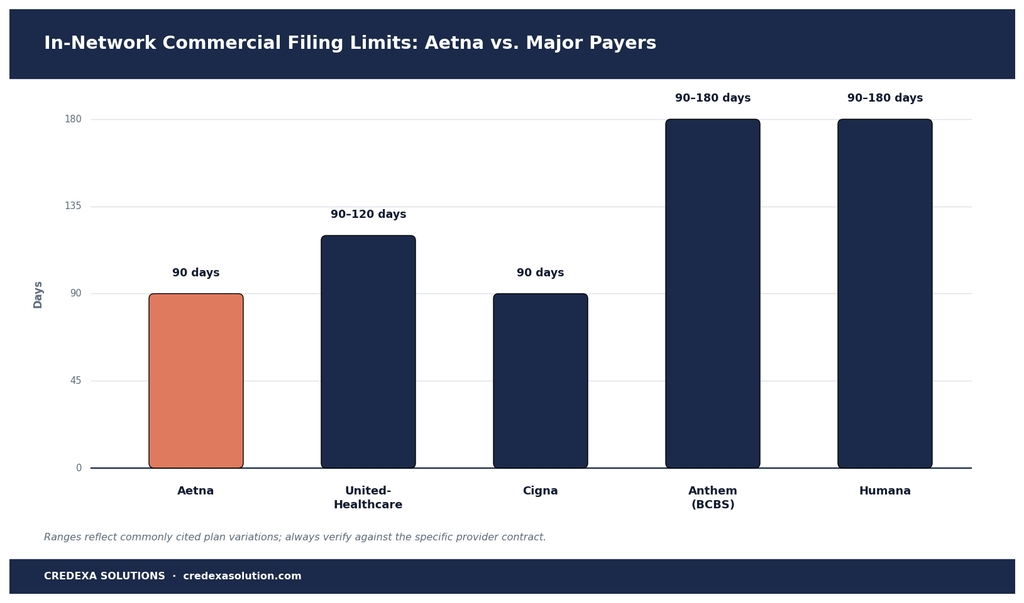
Context helps here, because billing teams working across multiple payers often default to whichever number they see most often which is a risky habit. Aetna’s 90-day commercial standard is noticeably tighter than several other national carriers:
| Payer | Typical In-Network Commercial Filing Limit |
|---|---|
| Aetna | 90 days |
| UnitedHealthcare | 90–120 days, depending on the plan |
| Cigna | 90 days |
| Anthem/Elevance (BCBS) | 90–180 days, depending on the state plan |
| Humana | 90–180 days, depending on the plan |
The takeaway isn’t that Aetna is unusually strict it’s that no two payers run on the same clock, and any billing workflow built around a single “standard” number across all payers is going to generate avoidable denials somewhere in the mix. Aetna claims specifically deserve their own dedicated tracking rule given how short the 90-day commercial window is relative to some competitors.
Timely Filing by Claim Type: Initial, Corrected, Secondary, and Appealed Claims
Providers often assume “timely filing” is a single deadline attached to a patient encounter. In reality, Aetna runs several parallel clocks depending on what kind of submission you’re making.
Initial Claims
This is the baseline deadline discussed above the window between the date of service and the first submission of that claim to Aetna. It’s the easiest deadline to track and the one most revenue cycle software is built to monitor by default.
Corrected Claims
A corrected claim is not a new claim it’s a resubmission that fixes an error in a claim you already sent (wrong modifier, incorrect units, a missing NDC, a diagnosis code correction, etc.). Corrected claims typically must be submitted using the correct claim frequency code (commonly Frequency Code 7 for a replacement of a prior claim) and within their own separate window often 90 to 180 days, depending on whether the plan is commercial or Medicare Advantage, and measured from the original claim’s ERA/EOB date rather than the original date of service.
A common and costly mistake is submitting a “corrected” claim as a brand-new claim without the proper frequency code. This typically triggers a duplicate claim denial instead of processing as a correction, burning valuable days off your original filing window while the error gets sorted out.
Secondary Claims (Coordination of Benefits)
When Aetna is the secondary payer, the timely filing rule shifts again. The standard approach is: the claim is timely if it’s submitted within 60 days of the primary payer’s EOB, or within 180 days of the date of service whichever is later. This dual-trigger structure exists specifically to account for delays in receiving the primary payer’s determination. One of the most frequent causes of an erroneous COB denial is billing teams counting only from the date of service and ignoring the 60-day EOB trigger, which can actually extend the deadline in the provider’s favor if used correctly.
Reconsiderations and Appeals
Once a claim is denied, an entirely new set of clocks starts running:
- Level 1 Reconsideration: Generally must be filed within 180 calendar days of the claim decision. This is the standard first step for disputing a denial whether it’s a payment amount, a coding decision, or (relevantly) a timely filing denial itself.
- Level 2 Appeal: If the reconsideration is denied, providers generally have 60 calendar days from that decision to escalate to a formal appeal.
- Medicare Advantage appeals follow a different structure entirely the CMS five-level Medicare Advantage appeal ladder under 42 CFR Part 422, Subpart M rather than Aetna’s standard commercial appeals process. Non-contracted providers appealing a Medicare Advantage denial should be aware their appeal window can be considerably shorter than the commercial 180-day standard.
What Triggers a CO-29 Denial (and What It Means)
CO-29 is the Claim Adjustment Reason Code Aetna (and most payers) use to flag a claim that was denied specifically for missing the timely filing window. When you see CO-29 on a remittance advice, it means the payer has determined the claim arrived after its allowed deadline — full stop. It doesn’t matter whether the diagnosis was correct, whether prior authorization was obtained, or whether the patient was fully eligible on the date of service.
The good news: CO-29 denials are administrative, not clinical. They don’t require a medical necessity argument they require proof. Specifically, they require documentation showing the claim actually was submitted on time, even if Aetna’s system shows otherwise. This is why maintaining airtight submission records matters as much as hitting the deadline in the first place.
How to Appeal a Timely Filing Denial
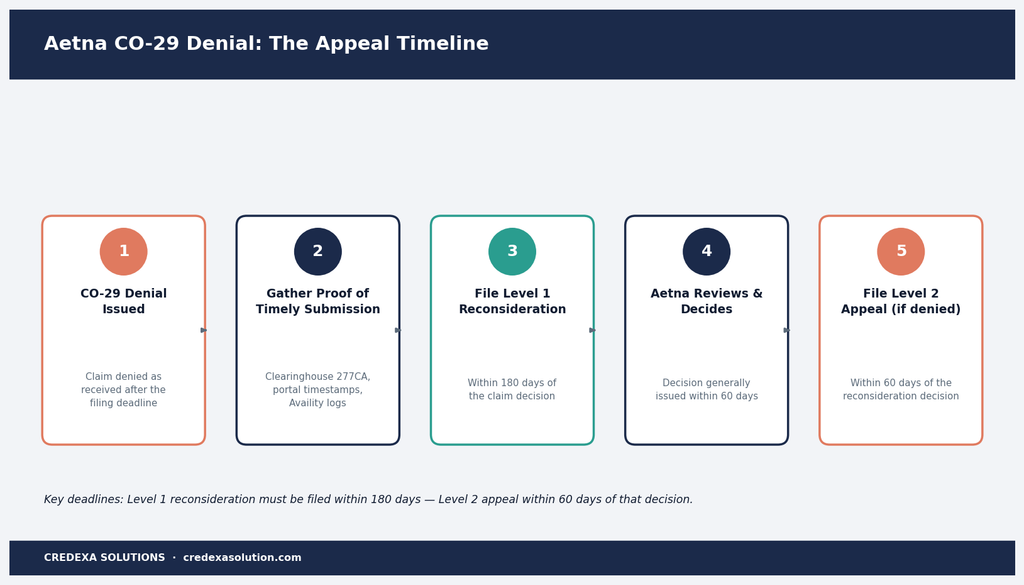
If you believe a CO-29 denial was issued in error a common scenario when a clearinghouse accepted the claim on time but a downstream transmission delay pushed the payer’s received date later here’s the general path:
- Pull your proof of timely submission. This includes clearinghouse acceptance reports, 277CA transaction confirmations, or portal (e.g., Availity) submission timestamps showing the claim left your system before the deadline.
- File a Level 1 reconsideration within 180 days of the denial, referencing CARC code 29 directly, stating the actual submission date, and attaching your proof of timely transmission.
- Explain any valid exception, if applicable documented system outages, natural disasters, or other circumstances beyond your control that Aetna recognizes as valid reasons for a late submission.
- Escalate to a Level 2 appeal within 60 days if the reconsideration is denied, making sure the appeal package includes the original claim, the denial notice, your reconsideration letter, and all supporting documentation in a single, organized submission.
- Track the decision timeline. Aetna generally has 60 days to issue a decision on post-service claim reconsiderations follow up if that window passes without a response.
Timely filing denials are, by nature, the most preventable form of denial in the revenue cycle but only if the appeal is filed promptly and backed by clear documentation. Missing the 180-day reconsideration window on a CO-29 denial closes the door permanently.
Best Practices to Avoid Aetna Timely Filing Denials
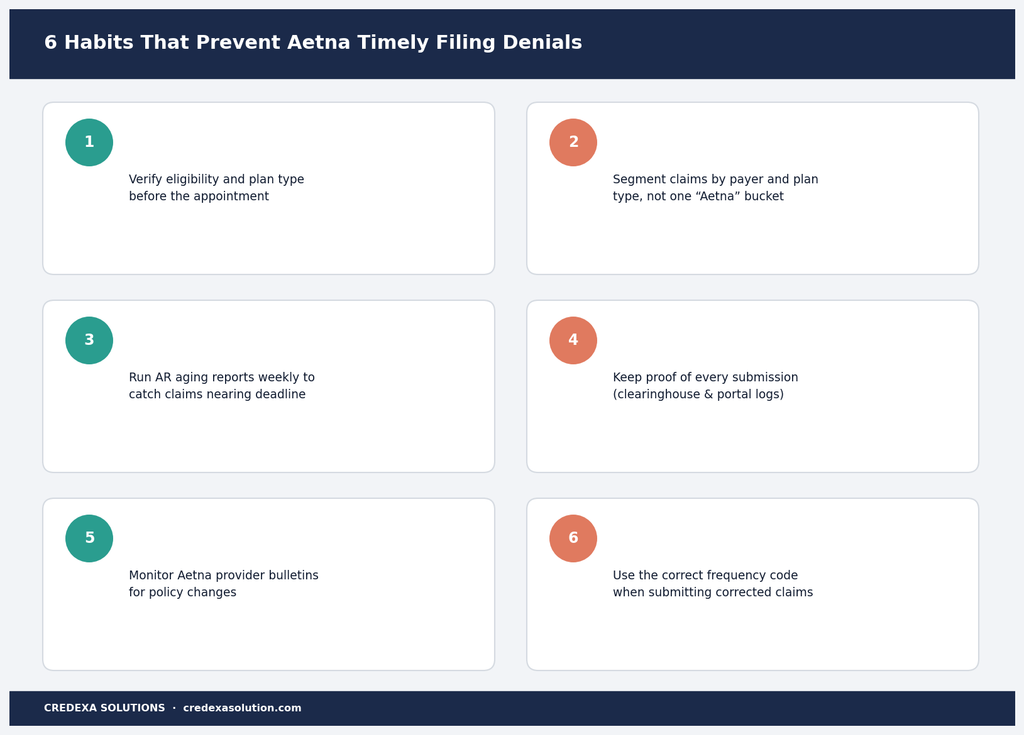
Because Aetna runs several deadlines simultaneously 90 days here, 12 months there, 60-day COB triggers, 180-day appeal periods relying on staff memory alone is not a sustainable system for any practice processing meaningful claim volume. A few operational habits make a significant difference:
- Verify eligibility and plan type before the appointment, not after. Knowing upfront whether a patient is on a commercial, Medicare Advantage, or Medicaid managed care plan tells you exactly which filing clock applies from day one.
- Segment your claims queue by payer and plan type. A single “Aetna” bucket isn’t specific enough commercial, Medicare Advantage, and Medicaid claims need separate deadline tracking.
- Run accounts receivable aging reports frequently weekly if possible, but no less than every two weeks so claims approaching their deadline surface before they lapse.
- Keep documented proof of every submission, including clearinghouse acceptance confirmations and portal timestamps, so a wrongful CO-29 denial can be challenged with evidence rather than argument.
- Assign someone to monitor Aetna’s provider bulletins. Aetna’s filing rules and product-specific requirements can change with little advance notice, and being caught off guard by a policy update is an avoidable risk.
- Use the correct claim frequency code for corrections. This alone prevents a large share of duplicate-claim denials that eat into your original filing window.
- Build payer-specific rules into your practice management or clearinghouse software so claims approaching the Aetna deadline are flagged automatically rather than relying on manual review.
Common Mistakes That Cause Preventable Timely Filing Denials
- Treating “Aetna” as a single payer with a single deadline, instead of a family of products (commercial, Medicare Advantage, Medicaid) with different clocks.
- Counting a COB secondary claim only from the date of service and missing the 60-day-from-EOB trigger.
- Resubmitting a corrected claim without the proper frequency code, causing it to be treated as a duplicate.
- Assuming a longer out-of-network or Medicare Advantage window applies without confirming it against the current contract.
- Letting reconsideration and appeal deadlines lapse while gathering documentation instead of filing first and supplementing after.
- Ignoring state-specific overrides in states like California, New York, and Texas where statutory minimums may extend Aetna’s standard commercial window.
Frequently Asked Questions About the Aetna Timely Filing Limit 2026
What is the Aetna timely filing limit for commercial in-network claims in 2026? Generally 90 days from the date of service for participating providers, though the specific figure should always be confirmed against the individual provider contract.
What is the Aetna timely filing limit for out-of-network providers? Typically 12 months (365 days) from the date of service for non-participating commercial claims.
What is the Aetna Medicare Advantage timely filing limit? This varies by source and contract commonly cited figures range from 120 days to 12 months. Providers should confirm the applicable window in their specific Medicare Advantage agreement rather than relying on a single universal number.
How long do I have to submit a corrected claim to Aetna? Typically 90 to 180 days, depending on the plan type, measured from the original claim’s EOB/ERA rather than the original date of service. Always use the correct claim frequency code when resubmitting.
What is the deadline for Aetna secondary (COB) claims? Whichever comes later: 60 days from the primary payer’s EOB, or 180 days from the date of service.
How long do I have to appeal an Aetna timely filing denial? Generally 180 days for a Level 1 reconsideration from the date of the claim decision, and 60 days for a Level 2 appeal from the reconsideration decision.
Does Aetna’s timely filing limit change by state? Yes. State insurance regulations can extend Aetna’s standard commercial windows in states with longer statutory minimums, including California, New York, and Texas. Self-funded ERISA plans are generally not subject to these state overrides.
What does a CO-29 denial code mean? CO-29 indicates the claim was denied specifically because it was received after the applicable timely filing deadline, independent of medical necessity or eligibility.
Can a timely filing denial be reversed? Yes, if you can provide documented proof that the claim was actually submitted within the deadline — such as clearinghouse acceptance records or portal timestamps and you file the reconsideration within Aetna’s appeal window.
How Credexa Solutions Helps Providers Stay Ahead of Aetna’s Deadlines
Tracking a payer with as many overlapping deadlines as Aetna 90 days for commercial claims, a variable window for Medicare Advantage, 180 days for Medicaid managed care, separate clocks for corrected claims, COB claims, and multi-level appeals is not something most practices can manage reliably with spreadsheets and staff memory alone.
At Credexa Solutions, this is exactly the kind of operational risk our revenue cycle management team is built to eliminate. Our billing specialists:
- Segment and track every Aetna claim by plan type and network status, so the correct filing clock is applied automatically from the moment a claim is created.
- Run frequent accounts receivable aging reviews to catch claims approaching their Aetna deadline before they lapse into a CO-29 denial.
- Maintain organized proof-of-submission records for every claim filed, so that if a wrongful timely filing denial does occur, the appeal is backed by documentation from day one.
- Monitor payer bulletins and policy updates across Aetna and every other major payer, so your practice is never caught off guard by a mid-year rule change.
- Handle the full reconsideration and appeal process end-to-end when a denial does occur, tracking every Level 1 and Level 2 deadline so revenue that’s rightfully yours doesn’t disappear over a missed date.
Timely filing denials are almost entirely preventable with the right workflow in place and preventing them is far less costly than trying to recover from them after the fact. If your practice is losing revenue to Aetna timely filing denials, or if your team simply doesn’t have the bandwidth to track every plan-specific deadline, Credexa Solutions can take that burden off your billing staff entirely.
Related Reading
For a deeper look at two other high-impact areas of the revenue cycle that directly affect how quickly and cleanly your Aetna claims get paid, see:
- CPT Codes in Medical Billing: The Complete 2026 Guide for Healthcare Providers — accurate CPT coding is the first line of defense against denials of every kind, including the coding errors that often lead to corrected claims and their own separate filing deadlines.
- Denial Management Process in Medical Billing: A Complete 2026 Guide to Preventing, Tracking, and Overturning Claim Denials — a full framework for building the kind of denial-tracking system that catches CO-29 and other denial codes before they become permanent revenue loss.
External References
- Centers for Medicare & Medicaid Services (CMS.gov) — federal guidance on Medicare claims processing timelines.
- 42 CFR § 424.44 — Time limits for filing Medicare claims — the federal regulation governing the 12-month Original Medicare filing deadline.
- Aetna Health Care Professionals Resource Center — the payer’s official provider manual, forms, and current claims submission policies.
Final Takeaway
The Aetna timely filing limit 2026 isn’t a single number it’s a set of overlapping deadlines that shift based on network status, product line, claim type, and even the state the patient is covered in. The practices that consistently protect their revenue aren’t the ones with the best clinical documentation alone; they’re the ones with a billing workflow disciplined enough to track every one of these clocks at once.
Verify eligibility early, segment your claims by plan type, document every submission, and treat reconsideration and appeal deadlines with the same urgency as the original filing window. Do that consistently, and CO-29 becomes a denial code you rarely see instead of one that quietly drains your practice’s revenue every month.
Need help auditing your current Aetna denial rate or building a bulletproof timely filing tracking system? Contact Credexa Solutions to see how much revenue a dedicated billing team can recover.