Every healthcare practice runs on two things: good patient care and a billing process that actually gets paid for it. Yet most providers only think about their medical billing process when something goes wrong a spike in denials, a cash flow crunch, or a payer audit that exposes gaps nobody noticed until it was too late.
The truth is that the medical billing process is not a back-office afterthought. It is the financial engine of the practice. A patient visit only becomes revenue after it has passed through registration, insurance verification, coding, charge entry, claim submission, payment posting, and when something slips denial management. Break any one link in that chain, and reimbursement slows down or disappears entirely.
This guide walks through the complete healthcare medical billing process step by step, explains the different types of medical billing, unpacks the most common challenges providers face in 2026, and shows what a well-run revenue cycle should look like. Whether you run a solo practice, a multi-specialty group, or a growing clinic, understanding this process is the first step toward protecting the revenue you have already earned.
What Is the Medical Billing Process?
The medical billing process is the system by which a clinical encounter an office visit, a procedure, a lab test is converted into a claim, submitted to a payer, and turned into actual payment. It sits at the center of what the industry calls revenue cycle management (RCM): the end-to-end cycle that begins the moment a patient schedules an appointment and ends only when every dollar owed for that visit has been collected and reconciled.
At a high level, the healthcare medical billing process includes:
- Collecting and verifying patient demographic and insurance information
- Confirming insurance eligibility and benefits before service is rendered
- Translating the physician’s documentation into standardized codes (CPT, ICD-10, HCPCS)
- Entering charges and generating a clean claim
- Submitting that claim electronically or on paper to the correct payer
- Monitoring the claim through adjudication
- Posting payments and adjustments once the payer responds
- Billing the patient for any remaining balance
- Identifying, correcting, and appealing denied or rejected claims
Every one of these stages depends on the one before it. A wrong policy number at registration can trigger a rejection weeks later. A missed prior authorization can turn a clean claim into a hard denial. That is why practices that treat billing as a single continuous process rather than a series of disconnected tasks consistently collect more, and faster, than those that don’t.
Medical Billing vs. Medical Coding: Why the Distinction Matters
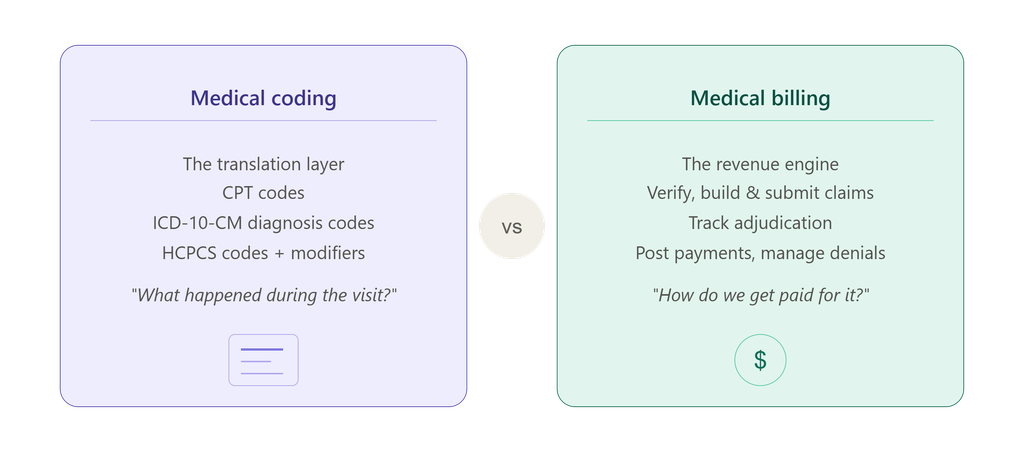
Providers often use “billing” and “coding” interchangeably, but they are two different disciplines that happen to sit next to each other in the same workflow.
Medical coding is the translation layer. A certified coder reviews the provider’s documentation and assigns the correct CPT, ICD-10-CM, and HCPCS codes that describe what was done and why. Coding accuracy is the foundation everything else is built on if the codes are wrong, the claim built on top of them will be wrong too, no matter how efficient the rest of the billing process is. If you want a deeper breakdown of how procedure coding actually works and where practices lose money on it, our guide to CPT codes in medical billing covers the code sets, modifiers, and documentation rules in detail.
Medical billing is everything that happens around that code: verifying the patient is covered, building the claim, submitting it, tracking it, posting the payment, and chasing down anything that doesn’t get paid the first time. Coding answers “what happened during the visit.” Billing answers “how do we get paid for it, and what do we do if we don’t.”
Practices that separate these functions or outsource both to a team that understands how tightly they’re linked tend to see fewer denials and faster turnaround, because errors get caught before a claim ever leaves the building.
Types of Medical Billing
Not all billing looks the same, and the types of medical billing a practice uses depends on where care is delivered and who is billing for it.
Professional Billing
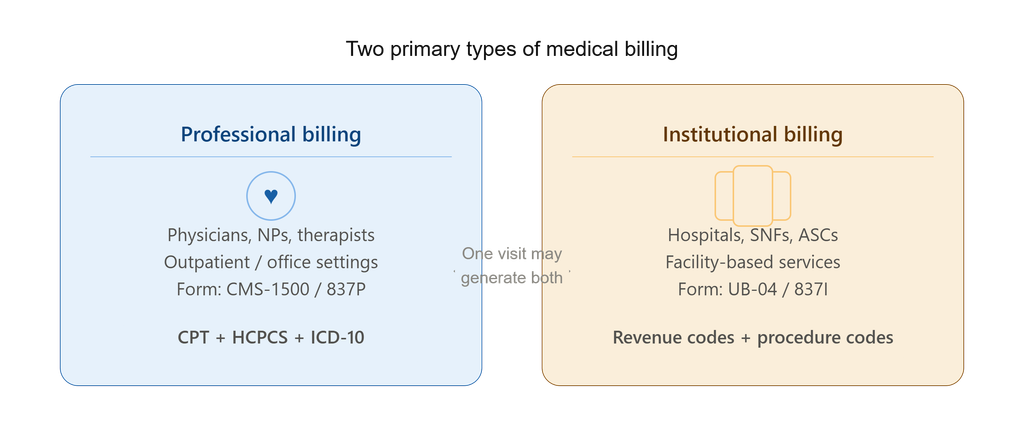
Professional billing covers services performed by individual providers physicians, nurse practitioners, physician assistants, therapists typically in an outpatient or office setting. These claims are submitted on the CMS-1500 form (or its electronic equivalent, the 837P) and are built around CPT and HCPCS procedure codes paired with ICD-10 diagnosis codes.
Institutional Billing
Institutional billing applies to facility-based claims: hospitals, skilled nursing facilities, ambulatory surgical centers, and other institutions billing for the use of their facility, equipment, and staff. These claims use the UB-04 form (electronically, the 837I) and rely on revenue codes in addition to procedure and diagnosis codes.
Understanding the difference matters operationally
A single patient encounter at a hospital-owned practice can actually generate both a professional claim (for the physician’s work) and an institutional claim (for the facility). Mixing up which form, code set, or payer rule applies to which claim type is one of the most common and most preventable sources of denials. Choosing the right billing type and format up front speeds up acceptance and reduces the risk of costly rework later in the cycle.
The Steps in Medical Billing Process, Explained
This is the part of the medical billing process that determines whether a practice gets paid in two weeks or two months. Each step below builds directly on the one before it.
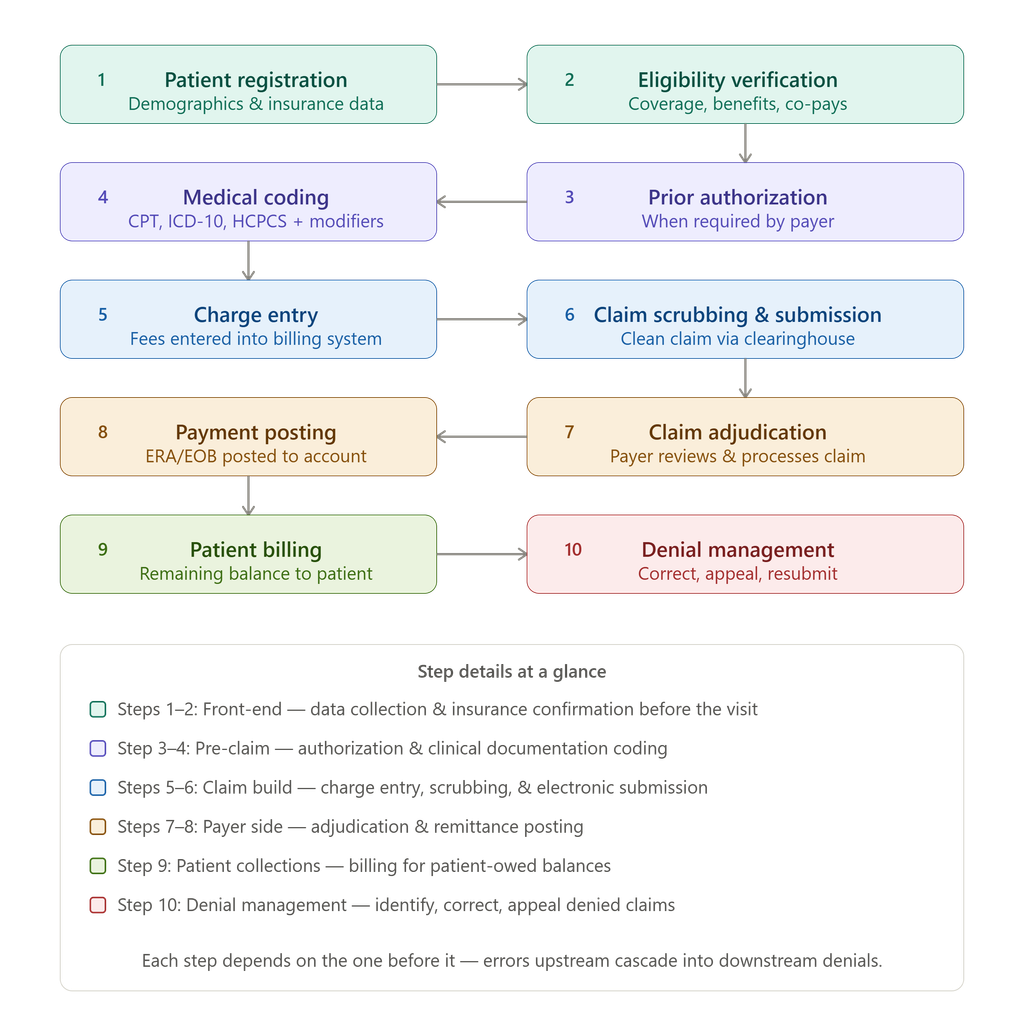
Step 1: Patient Registration and Data Collection
The billing process technically starts before the patient is even seen. Front-desk staff collect the patient’s legal name, date of birth, address, contact information, insurance card details, and the reason for the visit. Any typo here a transposed policy number, a misspelled last name can cause a claim to be rejected weeks later, long after the visit is over and the error is harder to trace. Accuracy at registration is the cheapest error to prevent and one of the most expensive to fix retroactively.
Step 2: Insurance Eligibility and Benefits Verification
Before the appointment, staff confirm that the patient’s insurance is active and that the planned services are covered. This step identifies co-pays, deductibles, coinsurance responsibility, and whether a referral or prior authorization is required. Skipping or rushing this step is one of the single biggest drivers of preventable denials payers routinely reject claims for services that were never confirmed as covered in the first place.
Step 3: Prior Authorization (When Required)
Many procedures, imaging studies, and specialty medications require the payer’s approval before the service is rendered. Obtaining prior authorization is time-consuming, but skipping it when required almost guarantees a denial, and that denial is typically the provider’s financial responsibility, not the patient’s. Tracking authorization requirements by payer and by CPT code is now a core part of front-end billing operations.
Step 4: Medical Coding
Once the visit is complete, the provider’s documentation is translated into ICD-10-CM diagnosis codes and CPT or HCPCS procedure codes. Modifiers are applied where needed to reflect exactly what was performed. This step requires both clinical understanding and coding certification coders need to know not just what code exists, but which one a specific payer will accept for a specific diagnosis-procedure combination.
Step 5: Charge Entry
The coded services, along with their associated fees, are entered into the practice management or billing system. This creates the financial record that the claim will be built from. Charge entry errors a missing charge, a duplicate entry, an incorrect units field flow directly into the claim and can either underbill the practice or trigger a denial for inconsistency.
Step 6: Claim Scrubbing and Submission
Before a claim goes out, it should be run through a “scrubber” software (or a trained biller) that checks for missing information, invalid code combinations, and payer-specific formatting requirements. Clean claims are then submitted electronically through a clearinghouse, which routes them to the correct payer. Electronic submission is faster, cheaper, and far less error-prone than paper claims, and most payers now expect it as the default.
Step 7: Claim Adjudication
Once received, the payer reviews the claim against the patient’s coverage, medical necessity rules, and its own internal edits. The claim is either accepted and paid, partially paid, or denied. This stage is largely out of the provider’s hands, but a clean claim built correctly in Steps 1–6 dramatically increases the odds of a first-pass approval.
Step 8: Payment Posting
When the payer responds through an Electronic Remittance Advice (ERA) or paper Explanation of Benefits (EOB) the payment, adjustment, and any remaining patient responsibility are posted to the account. Accurate payment posting is what allows a practice to actually see, in real numbers, how much of its billed revenue it is collecting.
Step 9: Patient Billing and Collections
Whatever the payer doesn’t cover co-pays, deductibles, coinsurance becomes the patient’s responsibility. Clear, timely patient statements (and, ideally, transparent estimates given before the visit) reduce confusion and speed up collection on the patient-owed portion of the bill.
Step 10: Denial Management and Follow-Up
No matter how clean the process is upstream, some claims will still be denied or underpaid. This step is about identifying why a claim was denied, correcting the underlying issue, and resubmitting or appealing within the payer’s filing window. Left unmanaged, denials are the single largest source of quiet revenue loss in a practice money that was earned but never collected simply because no one followed up in time. We’ve written a full breakdown of how to build a denial management workflow, including how to categorize denials and track appeal deadlines, in our guide to denial management in medical billing.
Common Challenges in the Medical Billing Process
Even a well-documented process runs into friction. The most common challenges providers report include:
- Data entry errors at registration or charge entry, which cascade into downstream rejections
- Incomplete or outdated insurance verification, leading to claims for services that were never actually covered
- Coding errors or mismatched modifiers, especially as payers update code sets and local coverage determinations
- Missed timely filing deadlines, which can make an otherwise valid claim permanently uncollectible
- Denials that are never worked, simply because staff don’t have the bandwidth to appeal every rejected claim
- Inconsistent follow-up on aging accounts receivable, letting claims sit past 60 or 90 days without action
- Staff turnover and training gaps, which are especially disruptive in smaller practices that rely on one or two billing staff to know the entire process
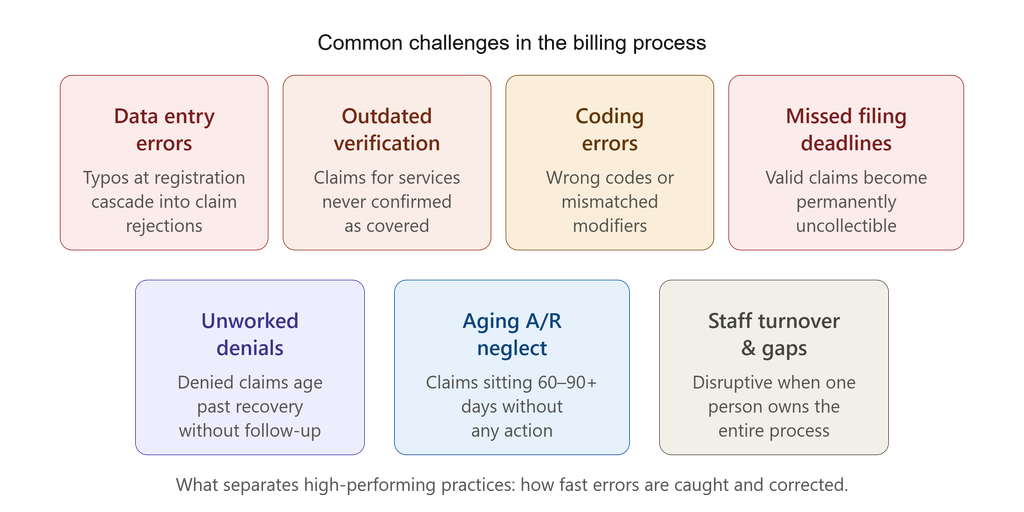
None of these challenges are unusual they show up in some form in almost every practice. What separates high-performing practices from the rest is not the absence of errors, but how quickly those errors are caught and corrected.
It’s worth calling out two of these in more detail, because they tend to cause the most financial damage while being the easiest to overlook day to day.
Timely filing deadlines vary by payer commercial insurers often allow 90 to 180 days from the date of service, while some government programs and specific plans allow far less. Once that window closes, even a completely valid, medically necessary claim becomes uncollectible with almost no recourse. Practices that don’t actively track filing deadlines by payer are, in effect, giving themselves a shrinking window to catch and fix every error upstream and once that window closes, the revenue is simply gone.
Unworked denials are the quieter version of the same problem. A denied claim doesn’t disappear from the books, but it also doesn’t get collected unless someone actively investigates why it was denied, fixes the issue, and resubmits or appeals it — often within a payer-specific window that can be as short as 30 days. In practices without a dedicated denial workflow, denied claims tend to sit in a queue behind higher-priority tasks until they age past the point of recovery. Multiplied across dozens or hundreds of claims a month, this is frequently where practices lose the most money without ever seeing it show up as a single obvious failure.
The Role of Technology in Modern Medical Billing
Billing software and integrated EHR systems have taken over much of the manual work that used to slow this process down: real-time eligibility checks, automated claim scrubbing, coding assistance, and analytics dashboards that flag denial trends before they become a pattern. Technology reduces human error and speeds up the cycle from visit to payment, but it does not replace the judgment needed to interpret a denial reason, negotiate a payer policy, or catch an edge case a rules engine wasn’t built to see. The most effective billing operations combine automation for routine, repeatable work with experienced staff for the exceptions because in medical billing, the exceptions are where the revenue is won or lost.
Compliance Still Comes First
Every step of the billing process happens inside a compliance framework most importantly HIPAA’s rules around the privacy and security of patient health information, and payer-specific billing and documentation requirements. Claims that are technically “clean” but built on inaccurate documentation, upcoded services, or mishandled patient data create risk that goes well beyond a single denied claim. Practices and their billing partners need processes that are fast, but never at the expense of accuracy or compliance.
Benefits of a Well-Managed Medical Billing Process
When the healthcare medical billing process runs the way it should, the results show up directly on the practice’s bottom line:
- Fewer claim rejections and denials, because errors are caught before submission rather than after
- Faster reimbursement, since clean claims are paid on the first pass instead of cycling through correction and resubmission
- Stronger compliance posture, with accurate coding and documentation reducing audit risk
- Lower administrative burden on clinical staff, who can focus on patients instead of paperwork
- Clearer, more transparent patient billing, which improves the patient experience and speeds up patient-owed collections
- Better visibility into practice financials, since accurate posting and reporting show exactly where revenue is and isn’t coming in
Why Providers Outsource the Medical Billing Process
Running an in-house billing department well requires certified coders, trained billers, up-to-date software, and constant attention to payer rule changes a level of overhead that is hard to justify for small and mid-sized practices. Outsourcing the medical billing process for providers to a dedicated RCM partner lets clinical staff focus entirely on patient care while a specialized team handles verification, coding, claim submission, payment posting, and critically the denial follow-up that most practices don’t have the bandwidth to do consistently.
At Credexa Solutions, this is the entire focus of our work: taking on the full revenue cycle from the first eligibility check to the last appealed denial so that providers stop losing revenue to process gaps they never had time to fix. If you want a closer look at how denials specifically get tracked and overturned, or how CPT coding decisions affect what you’re ultimately paid, both of those breakdowns are linked above and worth reading alongside this guide.
A well-run outsourced billing relationship isn’t about handing over control it’s about adding a layer of specialized attention to a process that’s often stretched too thin across staff who are also handling scheduling, patient calls, and clinical support. The best partnerships are transparent: the practice can see claim status, denial trends, and collection rates at any time, rather than finding out about a problem only when revenue has already slowed down. That visibility is what turns outsourced billing from a black box into a genuine extension of the practice’s own operations.
Building a Billing Process That Scales With the Practice
A process that works for a two-provider practice rarely works unchanged for a ten-provider group, and the reverse is just as true over-engineering a small practice’s workflow with enterprise-level systems can slow things down without adding real benefit. As a practice grows, the medical billing process needs to scale in a few specific ways: verification and prior authorization tracking need to move from manual checks to system-driven workflows, coding needs dedicated specialists rather than shared responsibility among general staff, and denial management needs to shift from reactive (fixing problems as they’re noticed) to proactive (tracking patterns by payer and by denial reason so the same mistake doesn’t repeat across dozens of future claims).
The practices that scale most smoothly are usually the ones that treat billing infrastructure as seriously as they treat clinical staffing reviewing it regularly, rather than only revisiting it after a cash flow problem forces the issue.
Key Metrics That Show Whether Your Billing Process Is Actually Working
Most practices can describe their billing process in general terms, but far fewer track the numbers that actually reveal whether it’s working. A handful of metrics matter more than the rest:
- Days in Accounts Receivable (A/R): the average number of days it takes to collect payment after a claim is submitted. Lower is better; anything trending upward is an early warning sign that follow-up is slipping.
- First-pass claim acceptance rate: the percentage of claims that are accepted and paid on the first submission, without correction or resubmission. This is one of the clearest signals of front-end process quality registration, verification, and coding all feed into it.
- Denial rate: the share of submitted claims that come back denied. Industry benchmarks generally put a healthy denial rate in the low single digits; practices well above that are losing time and revenue to preventable errors.
- Net collection rate: how much of the revenue the practice is actually entitled to collect (after contractual adjustments) is being collected. This is a better indicator of financial health than gross collections, which can look healthy even while a practice is writing off avoidable losses.
- Clean claim rate: the percentage of claims that pass through scrubbing without needing correction before submission.
Tracking these numbers monthly not just glancing at total collections is what allows a practice or its billing partner to catch a slipping process before it turns into a real cash flow problem.
In-House Billing vs. Outsourced Billing: How to Decide
There’s no universal right answer here, but a few questions tend to clarify the decision quickly.
How much billing volume does the practice generate? A high-volume, multi-provider practice may have enough scale to justify a well-staffed in-house billing team with dedicated coders, billers, and a denial specialist. A solo or small-group practice often can’t support that level of specialization internally without the cost outweighing the benefit.
Does the practice have certified coding expertise on staff? Coding errors are one of the most common and most expensive sources of denials. If the practice doesn’t have a certified coder reviewing claims before submission, that gap alone can justify bringing in outside expertise.
Is anyone consistently working denials past the first follow-up? This is the question most practices answer honestly only when pressed. It’s common for a practice to submit claims reliably but let denials pile up because no one has the bandwidth to appeal them within payer deadlines. If that’s the case, the practice is likely already losing more revenue than an outsourced RCM partner would cost.
How much payer-rule change can staff realistically keep up with? Payer policies, prior authorization requirements, and code sets change frequently. Practices without dedicated billing staff often fall behind on these changes simply because billing isn’t anyone’s full-time job it’s one more responsibility layered onto front-desk or clinical staff.
For practices answering “no” to more than one of these questions, outsourcing the medical billing process in whole or in part usually pays for itself through recovered denials and faster reimbursement alone, before even accounting for the staff time it frees up.
Payer-Specific Considerations That Complicate the Process
One reason the medical billing process is harder in practice than it looks on paper is that no two payers apply the same rules the same way. Medicare, Medicaid, and commercial payers each have their own timely filing windows, prior authorization lists, documentation requirements, and claim edit logic. A modifier that satisfies one payer’s rules can trigger a denial with another. A service that doesn’t require authorization under one plan might require it under a different plan from the same insurer.
This is why a billing process built around general best practices still needs payer-specific knowledge layered on top. Practices or their billing partners that track these differences by payer, and update their claim scrubbing rules accordingly, consistently see higher first-pass acceptance rates than those relying on a one-size-fits-all workflow.
Frequently Asked Questions
What is the medical billing process? The medical billing process is the sequence of steps healthcare providers use to convert clinical services into submitted insurance claims and, ultimately, into collected payment. It spans patient registration, insurance verification, coding, claim submission, payment posting, and denial management.
What are the main steps in the medical billing process? The core steps are patient registration, insurance verification, medical coding, charge entry, claim submission, claim adjudication, payment posting, patient billing, and denial management and follow-up.
What’s the difference between medical billing and medical coding? Coding translates clinical documentation into standardized codes (CPT, ICD-10, HCPCS). Billing uses those codes to build, submit, and follow up on claims until they’re paid. Coding answers what happened; billing answers how the practice gets paid for it.
What are the types of medical billing? The two primary types are professional billing (individual provider services, billed on the CMS-1500/837P) and institutional billing (facility-based services, billed on the UB-04/837I). Some encounters generate both.
Why do claims get denied, and how can providers reduce denials? Common denial causes include eligibility issues, missing prior authorizations, coding errors, and missed filing deadlines. Reducing denials starts with accurate front-end data collection and verification, and requires a consistent process for tracking and appealing the denials that still occur.
Should a practice outsource its medical billing process? It depends on the practice’s size, staff bandwidth, and in-house billing expertise. Practices that struggle with denial follow-up, aging accounts receivable, or keeping up with payer rule changes typically see the clearest financial benefit from outsourcing to a dedicated RCM partner.
Conclusion
The medical billing process is not a single task it’s a chain of interdependent steps, and the strength of a practice’s revenue depends on how well each link in that chain holds up. Registration errors become claim rejections. Skipped verification becomes a denied service. Unworked denials become revenue that was earned but never collected. Getting this process right, end to end, is what separates practices that collect what they’ve earned from practices that are quietly leaving money on the table every month.
Whether you handle billing in-house or through a partner, understanding each step and where it typically breaks is the first step toward a healthier revenue cycle. For more on the pieces that plug directly into this process, see our guides on CPT codes in medical billing and denial management in medical billing.
For general background on U.S. medical billing terminology, AAPC’s overview of medical billing is a useful reference, and providers researching official Medicare claims requirements can consult CMS.gov directly.