North Dakota Medicaid provider enrollment is the process of registering with North Dakota Health and Human Services (ND HHS) so you can bill, order, refer, or prescribe for ND Medicaid members. You complete an application online in the ND Health Enterprise MMIS Web Portal, then send your supporting documents to Noridian Healthcare Solutions with a Provider Enrollment Coversheet. When ND approves you, you receive a seven-digit ND Medicaid ID.
That sounds simple, and the application itself is. The trouble starts afterward. Practices finish enrollment and then watch clean-looking claims bounce because the taxonomy code doesn’t match the enrollment record, the ordering provider was never enrolled, or the claim reached the state after the filing window closed. Enrollment and coding are two halves of the same revenue problem, and this guide treats them that way.
Below you’ll find who has to enroll, how the three organizations involved divide the work, what to gather before you start, the four-step application, how effective dates and timely filing interact, what’s different for Medicaid Expansion through Blue Cross Blue Shield of North Dakota (BCBSND), the 2026 moratoria and revalidation sweep, and how to keep enrollment data aligned with accurate claim coding so denials stay low. Rules cited here come from ND HHS, Noridian, BCBSND, and federal regulations, and we link to each so you can verify before you act.
Quick note on accuracy: State Medicaid policies change often. Confirm dates, forms, and phone numbers against the ND HHS pages linked in this article before you submit anything.
ND Medicaid Provider Enrollment at a Glance
| Topic | What to know |
|---|---|
| Who runs Medicaid | North Dakota Health and Human Services (ND HHS), Medical Services Division |
| Who processes applications | Noridian Healthcare Solutions (all provider types except Qualified Service Providers) |
| Where you apply | ND Health Enterprise MMIS Web Portal, online only |
| How documents are submitted | Email, fax, or mail to Noridian with the coversheet; the portal does not accept attachments |
| Your approval ID | Seven-digit ND Medicaid ID, mailed after approval |
| Standard processing time | Not published by ND; review begins only when the online application and all documents are in |
| Provider agreement | SFN 615, Medicaid Program Provider Agreement |
| Retroactive effective date | Up to 90 days before ND receives your complete packet (emergency care has a longer window) |
| Timely filing | Original claims due within 180 days of the date of service |
| Expansion adults (19 to 64) | Covered through BCBSND; enroll with the state first, then BCBSND |
| Revalidation | At least every five years (DME suppliers every three) |
| Federal application fee | $750 in 2026 for institutional providers; individual practitioners exempt |
Who Has to Enroll in ND Medicaid?
You need to enroll if you bill ND Medicaid, appear as the servicing provider on a claim, or order, refer, or prescribe services for an ND Medicaid member. North Dakota pays a claim only when both the billing NPI and the servicing NPI were enrolled on the date of service.
Billing, Rendering, and Ordering Providers
Each eligible clinician enrolls and bills under their own National Provider Identifier (NPI). You can’t bill under a supervisor’s or colleague’s NPI if you’re eligible to enroll yourself. Locum tenens providers enroll as well, and the claim has to name them.
Ordering, referring, and prescribing (ORP) providers must also be enrolled, even if they never submit a claim. The federal requirement sits in 42 CFR Part 455, Subpart E, and North Dakota enforces it at the claim level.
Supervised Clinicians, Trainees, and Students
Whether a limited-license clinician must enroll depends on the provider type. Where ND doesn’t require enrollment, services can be billed under the supervising provider’s NPI. Behavioral health rehabilitative roles are the notable exception. These roles cannot bill under a supervisor’s NPI:
- Behavior modification specialists
- Licensed associate professional counselors (LAPCs)
- Licensed master social workers (LMSWs), added in January 2026
- Licensed baccalaureate social workers (LBSWs)
- Mental health technicians
- Registered nurses (RNs)
Trainees who are registered with a licensing board but not yet licensed can’t enroll or bill. Student services may be billed by the supervisor when supervision is direct and continuous, no more than six students work under one supervisor, and a contract or school policy covers the arrangement.
Separate Processes and Closed Categories
Qualified Service Providers (QSPs) follow ND HHS’s own QSP enrollment process rather than Noridian’s. Individual 1915(i) providers can’t be approved without an affiliation to an approved 1915(i) group, so the group must finish first.
Some categories are closed outright. Since June 11, 2026, ND has not accepted new NEMT agencies statewide, nor new QSP and developmental disability agencies in Cass and Burleigh counties. More on that in the 2026 changes section below.
ND HHS, Noridian, and the MMIS Portal: Who Does What
Three names show up in every ND Medicaid enrollment conversation, and mixing them up wastes days.
ND HHS sets Medicaid policy and pays claims. Older forms may still say “ND DHS,” because the former Department of Human Services is now part of ND HHS. It’s the same agency, portal, and process.
Noridian Healthcare Solutions is the contractor that screens applications, revalidations, and record changes for ND Medicaid. Noridian also serves as a Medicare contractor, but Medicare enrollment runs through PECOS and is a separate application with a separate ID. Don’t assume one covers the other.
The MMIS (Medicaid Management Information System) is the web portal where you apply, submit claims, view remittance advice, and track applications. It has two doors: Provider Enrollment for new applicants through the ND MMIS enrollment portal, and Provider Login for enrolled providers with web access. Billing agents and clearinghouses that send electronic transactions enroll separately as trading partners.
What Is an MMIS Number?
Your MMIS number is the seven-digit ND Medicaid ID assigned at approval, sometimes called the Medicaid provider number. It is not your 10-digit NPI. Every individual and every group gets its own ID, and the group application asks for each rendering provider’s ID, so individual approvals come first. You’ll use your ID plus your SSN (individual) or EIN (group) to register for portal access.
What to Gather Before You Start the Application
There is no single paper form for ND Medicaid enrollment. You complete the online application, then add the forms and attestations your provider type requires. Having these ready prevents most mid-application stalls:
- IRS letter: CP 575 (the EIN assignment letter) or 147C if the original is lost
- Exact legal business name as the IRS shows it, including “LLC” or “Inc.”
- NPI and taxonomy code: ND keeps separate taxonomy sets for individuals and groups
- License, certification, or registration valid where you render services, plus any DEA, NCPDP, or CLIA details
- Ownership details: anyone with 5% or more ownership, with name, date of birth, SSN, and effective date
- Managing employees: administrators, directors, and anyone with operational control
- Exclusion and sanction history, checked against the OIG exclusion list
- Clearinghouse or trading partner information
- Group affiliation details: each rendering provider’s ND Medicaid ID, NPI, and affiliation date
Why Name Mismatches Cost the Most Time
Say the IRS letter reads “Northern Plains Therapy LLC” and the application says “Northern Plains Therapy.” Noridian now sees two names for one business, and the file waits while someone sorts it out. ND specifically warns that exclusion or sanction discrepancies can lead to denial or resubmission, and its screening checks providers, owners, and managing employees against federal databases every month, so an old sanction left off the form won’t stay hidden.
Is There an Application Fee?
ND’s enrollment policy lists no separate state fee. The federal fee does apply to institutional providers, set at $750 for 2026 under the CY 2026 fee notice. Under 42 CFR 455.460, individual physicians and nonphysician practitioners are exempt, as are providers who already paid the fee to Medicare or another state’s Medicaid or CHIP program.
The Four-Step ND Medicaid Enrollment Process
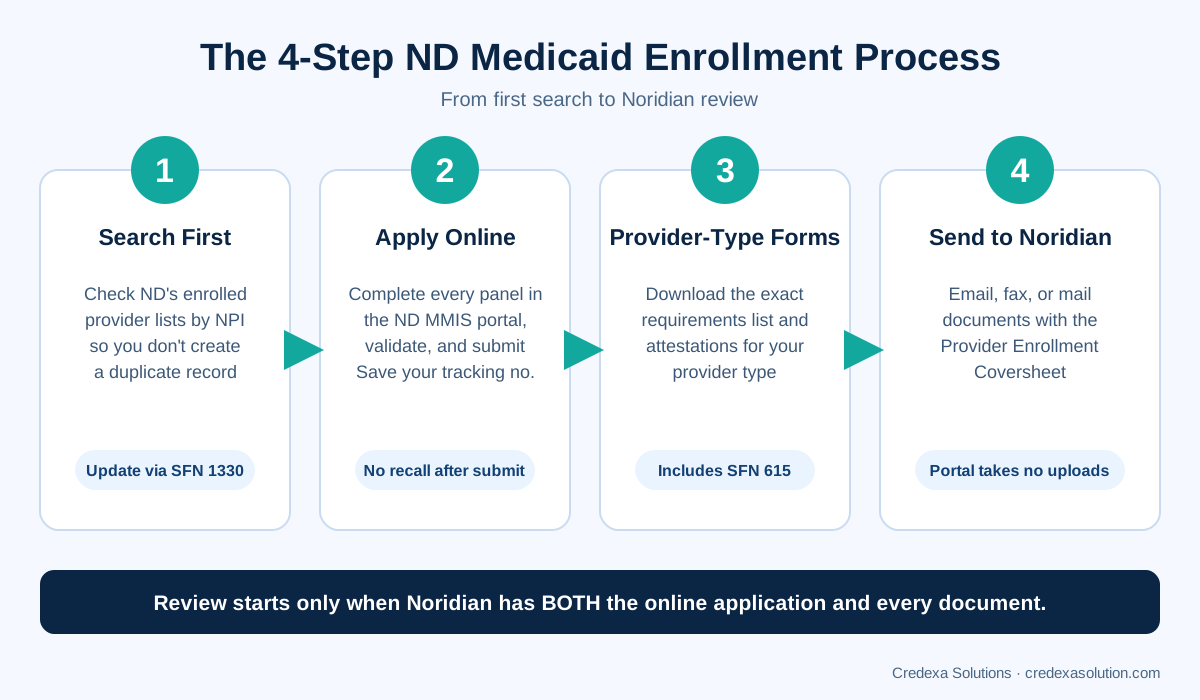
ND HHS lays out enrollment in four steps on its provider enrollment page. Here is what each one looks like in practice.
Step 1: Confirm You’re Not Already Enrolled
Search ND’s enrolled provider lists by NPI, or use the portal’s name search. If you already have a record, update it or add an affiliation with SFN 1330 instead of filing again. Duplicate records usually begin with a job change: a therapist joins a new Fargo group and submits a fresh application, and now two records need untangling before the group can bill her visits.
Step 2: Complete the Online Application
Choose individual enrollment if you report income under your SSN with no EIN. Groups, and individuals who have incorporated, enroll under an EIN. In the portal you will:
- Read the instructions and accept the online provider agreement.
- Complete each panel: identifying information, licensure, provider identifiers, service location, group affiliation, electronic transactions, ownership, and exclusion history.
- Decide on web access and name a web access administrator.
- Run Validate Application and fix every flagged error.
- Add another provider type or location if needed.
- Enter your Requested Claim Submission Effective Date.
- Click Confirm Submit and write down your application tracking number.
Save as you go, because anything unsaved is lost when you exit. ND’s MMIS help page for individual enrollment also notes that a submitted application can’t be recalled for changes, so review every panel before confirming.
Step 3: Complete Provider-Type Requirements
ND publishes a separate requirements list, and often an attestation, for each provider type, covering individuals such as LAPCs, behavior analysts, and physical therapists, and groups from ABA and dental to hospitals, hospice, and pharmacies. Download the list for your exact type. An LAPC who follows the general individual list and skips the LAPC attestation hands Noridian an incomplete file, and review can’t finish. SFN 615, the provider agreement, is a condition of enrollment for everyone.
Step 4: Send Documents to Noridian
The portal can’t take attachments. Send your documents with the coversheet by email, fax, or mail. Noridian doesn’t begin processing until it has both the submitted online application and every required document, so a fast online submission paired with slow paperwork gains nothing.
The Provider Enrollment Coversheet and Where to Send It
| Method | Destination |
|---|---|
| NDMedicaidenrollment@noridian.com | |
| Fax | (701) 433-5956, ATTN: NDM Provider Enrollment |
| Noridian Healthcare Solutions, Attn: ND Medicaid Provider Enrollment, PO Box 6055, Fargo, ND 58108-6055 |
ND asks you to flatten filled PDF forms before sending so typed entries don’t shift or vanish when Noridian opens the file. Most PDF tools can do this with a print-to-PDF step.
Use the same provider name and NPI on the coversheet as on the online application, and remember the clock: if a group submits online on a Monday and emails documents two weeks later, review starts on the later date.
Effective Dates, Backdating, and the 180-Day Timely Filing Trap
Your Requested Claim Submission Effective Date determines which dates of service ND will pay. ND’s provider enrollment policy sets the limits:
- The date can reach back up to 90 days before ND receives your complete packet.
- It can’t precede your NPI’s enumeration date.
- Leave it blank and enrollment starts on the date ND received your application.
- Future effective dates can’t be more than 60 days before service.
- For emergency care, ND may go back up to 365 days from the date of service with a written explanation and medical notes.
- Out-of-state providers can request a retroactive date covering the date of service.
- The 1915(i) program doesn’t allow retroactive enrollment.
A Worked Example
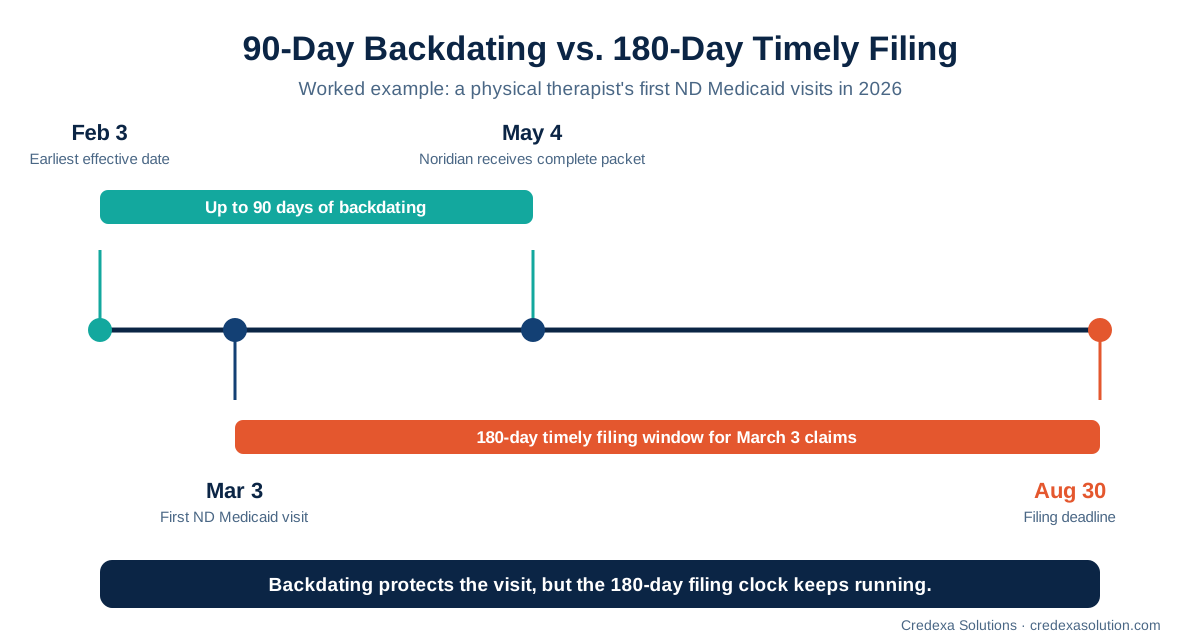
A physical therapist starts seeing ND Medicaid patients on March 3, 2026. Noridian receives her complete packet on May 4, 2026, so the earliest effective date she can request is February 3, 2026, which comfortably covers her March 3 visits.
The trap is the second clock. ND must receive an original claim within 180 days of the date of service, so her March 3 claims expire on August 30, 2026. If approval arrives after that, she’s depending on a timely filing exception, and exceptions are not a plan. The practical rule: submit the complete packet within 90 days of the first visit, and track every held claim against its own 180-day date.
How Long Does Approval Take?
ND doesn’t publish a standard processing time, so be skeptical of any fixed day count that doesn’t cite the state. Four things stretch the timeline: requests for missing or mismatched information, group affiliations waiting on individual approvals, site visits for moderate- and high-risk provider types (including 1915(i) from October 1, 2026), and moratorium categories where applications are denied rather than queued.
Checking Status and What Happens After Approval
Enter your application tracking number in the MMIS portal, or call Noridian. ND also mails letters when an application is pending, approved, denied, or terminated, so watch the mailing address on file. After approval, you’ll get a letter with your seven-digit ID, and if you completed the security section, your login details.
Before the first claim goes out, set up:
- SFN 661 for electronic funds transfer (EFT)
- SFN 583 for electronic remittance advice (ERA)
- Trading partner enrollment for your clearinghouse through the MMIS portal
A practice can be fully approved and still see claims go nowhere because the clearinghouse never enrolled. Check that the same week you submit your own application.
Do You Also Need BCBSND? Fee-for-Service vs. Medicaid Expansion
Traditional ND Medicaid pays on a fee-for-service basis, so state enrollment is the whole job. ND ended its Primary Care Case Management program effective on or after January 1, 2024, per its public notice, so guides that still mention PCP roster setup are outdated.
Medicaid Expansion adds a second layer. Adults ages 19 to 64 in Expansion are covered through BCBSND, and the BCBSND Medicaid Expansion page requires enrollment with both the State and BCBSND. State enrollment comes first, because BCBSND can’t enroll or retain a provider the state hasn’t approved.
Already in BCBSND’s commercial network? Request a Medicaid Expansion addendum at providercontracting@bcbsnd.com. New providers apply to the network after state approval, and that application functions as the credentialing step for Expansion members. Retail outpatient pharmacy for Expansion members stays with the state.
In short: traditional Medicaid needs enrollment only; Expansion needs enrollment plus BCBSND credentialing. If you hold a CAQH profile, keep it attested, since BCBSND credentialing may lean on it, but note that ND’s fee-for-service enrollment itself runs through the MMIS and Noridian, not CAQH.
ND Medicaid Requirements by Provider Type
| Provider type | What’s different |
|---|---|
| Physicians, NPs, PAs | Enroll individually under their own NPI; exempt from the federal fee |
| Group practices | Enroll under the group EIN; every rendering provider must already be enrolled; add affiliations later with SFN 1330 |
| Behavioral health (LAC, LAPC, LBSW) | Separate requirement lists and attestations; rehab roles can’t bill under a supervisor |
| ABA agencies | Analysts and technicians enroll individually and affiliate to the agency; services need authorization |
| 1915(i) HCBS | Group first, then individuals; moderate risk from October 1, 2026; no retroactive enrollment |
| NEMT | New agencies under moratorium; drivers need NPIs and agency affiliation |
| QSPs | ND HHS process, not Noridian; agency employees need NPIs from January 1, 2027 |
| DME suppliers | Revalidate every three years |
| Pharmacies | Pharmacy agreement (SFN 1169); Expansion retail pharmacy stays with the state |
| FQHC, RHC, IHS, hospitals, SNFs, hospice | Own group requirement lists; the $750 federal fee applies to institutions unless exempt |
For most groups the order is simple: individuals first, group second. The 1915(i) program reverses it, as the 1915(i) process overview explains.
Out-of-State and Telehealth Providers: The 50-Mile Rule
ND treats a provider as out-of-state only when it’s located more than 50 miles from a North Dakota border. A clinic in Moorhead or East Grand Forks, Minnesota, sits inside that line and isn’t considered out-of-state, but it still must complete ND Medicaid enrollment to get paid for ND members.
Providers beyond the 50-mile line submit SFN 509 and generally need a service authorization (SFN 769) except in emergencies. ND’s out-of-state services policy calls for a written second opinion from an in-state board-certified specialist and assurance that the service isn’t available in North Dakota.
Telehealth delivered to members located in North Dakota isn’t treated as out-of-state care, so the authorization rule doesn’t apply. Out-of-state telehealth providers still complete their provider-type requirements, submit the telehealth attestation, and meet licensing rules.
What Changed in 2026
| Date | Change | Who it affects |
|---|---|---|
| June 11, 2026 | Moratoria on new enrollments | NEMT agencies statewide; QSP and DD agencies in Cass and Burleigh counties |
| July to October 2026 | Off-cycle revalidation | NEMT providers |
| October 1, 2026 | Moderate risk, site visits, annual competency statements | 1915(i) providers |
| October 2026 to May 2027 | Off-cycle revalidation | 1915(i) providers |
| January 1, 2027 | Agency employees need NPIs, individual enrollment, and affiliation (pending a rule change) | QSP agencies and employees |
| January 1, 2027 | Work requirements begin | Some Expansion members, ages 19 to 64 |
| January 2027 to June 2028 | Off-cycle revalidation | QSP agencies and individual QSPs |
The Moratoria
The moratoria notice covers new enrollments only. Providers already enrolled keep billing, and applications that had reached final approval by June 11 continue. Each moratorium lasts six months and may be extended in six-month increments under 42 CFR 455.470. A new QSP agency in Fargo or Bismarck that applies today should expect a denial letter.
The Two-Year Revalidation Sweep
ND’s revalidation strategy targets QSP, NEMT, and 1915(i) providers through June 2028, after which they move to a three-year cycle. Most physician practices sit outside the sweep, because ND relies on Medicare’s screening for Medicare-enrolled provider types.
Revalidation and Keeping Your Enrollment Active
ND requires revalidation at least every five years, and every three for DME suppliers. Your due date appears in the MMIS portal, and ND emails the addresses on file. If you hold an active Medicare enrollment and your data matches, you take a shortcut: individuals send SFN 615 and the coversheet, groups add SFN 1168. “Matches” means the same name, NPI, and SSN for individuals, and the same legal name, TIN, location, and ownership for groups. If your PECOS record is off, fix it first.
Approval doesn’t end the paperwork. ND warns that outdated enrollment information can lead to claim denial, recoupment, or termination. Report these changes on schedule:
| Change | Rule | Form |
|---|---|---|
| Ownership of 5% or more | Report within 35 days | SFN 1168 |
| New Tax ID | Notify at least 30 days ahead, then file a new application | New application |
| Group address | Send update to Provider Enrollment | SFN 1299 |
| Taxonomy | Add or change before billing under it | SFN 1302 |
| New affiliation | Add provider to a group | SFN 1330 |
| Bank account | Notify ND in advance | SFN 661 |
To end an enrollment, give ND 30 days’ written notice with your name, NPI, Medicaid number, and termination date (SFN 1331). Keep records for at least seven years after the last claim was paid or denied.
How Enrollment Errors Turn Into Claim Denials (and Where Accurate Coding Fits)
Approval is the starting line. What happens next is where revenue is won or lost, because a Medicaid claim has to be right on two separate axes at once: the provider data must match the enrollment record, and the procedure and diagnosis coding must be accurate and supported by documentation.
The enrollment side produces a predictable set of denials:
- The servicing or billing NPI wasn’t enrolled on the date of service
- The taxonomy code on the claim doesn’t match the enrollment record
- The ordering, referring, or prescribing provider isn’t enrolled
- Behavioral health rehab services were billed under a supervisor’s NPI
- An out-of-state service went out without authorization
- The claim arrived after the 180-day limit
The coding side produces its own: invalid or outdated CPT and HCPCS codes, missing or misapplied modifiers, diagnosis codes that don’t support medical necessity, bundling conflicts, and units that don’t match the documentation. Many practices lump all of these together as “denials,” but they need different fixes, and treating them the same is why the same denials keep coming back.
Resubmitting an enrollment-driven denial before correcting the enrollment record earns the same denial again, so fix the root cause first and resubmit second.
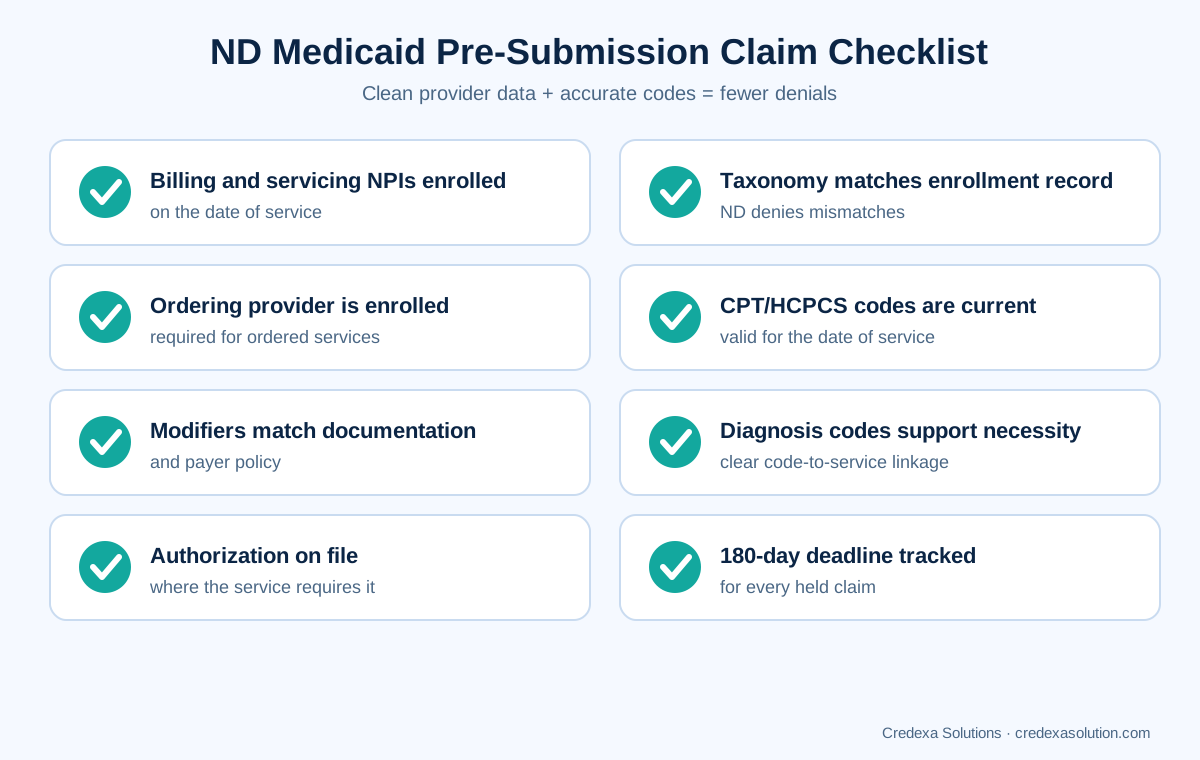
A Pre-Submission Checklist for ND Medicaid Claims
| Check | Why it matters |
|---|---|
| Billing and servicing NPIs enrolled on date of service | Prevents “provider not enrolled” denials |
| Taxonomy code matches the enrollment record | ND denies mismatched taxonomy |
| Ordering/referring provider is enrolled | Required for ordered services |
| CPT/HCPCS codes are current for the date of service | Retired or invalid codes reject at the front end |
| Modifiers match documentation and payer policy | Wrong modifiers cause underpayment or denial |
| Diagnosis codes support medical necessity | Weak linkage invites medical-necessity denials |
| Authorization on file where required | Missing authorization is a leading preventable denial |
| 180-day filing date tracked for held claims | Late claims are rarely recoverable |
Coding accuracy varies enormously by specialty. If your practice bills procedure-heavy services, our specialty references can help your team keep codes current: see our guides to ophthalmology CPT codes for 2026, lithotripsy CPT codes for 2026, and general surgery CPT codes for 2026.
How Credexa Solutions Helps You Manage Denials With Accurate Codes
Enrolling correctly gets you into the Medicaid program. Keeping claims clean once you’re in it is the day-to-day work, and that’s where Credexa Solutions supports practices.
Coding review before submission. Claims are checked for code validity, modifier use, and diagnosis linkage against documentation before they leave your office, which catches many errors at the cheapest point to fix them.
Enrollment-to-claim alignment. Credexa’s team compares the details on your claims, including NPIs, taxonomy codes, and dates of service, against your enrollment records so mismatches are caught before a payer rejects them.
Denial analysis, not just denial rework. Every denial is traced to its cause, whether that’s coding, eligibility, authorization, enrollment, or timely filing, so the same error stops repeating. Reporting by denial reason shows where your process leaks revenue.
Appeals with supporting documentation. When a denial is worth fighting, appeals are prepared with the correct codes, records, and payer-specific requirements rather than a generic resubmission.
Deadline discipline. Held claims and appeal windows are tracked against payer deadlines, including the 180-day limit that applies to ND Medicaid.
The goal isn’t to work denials faster. It’s to see fewer of them, because accurate coding and clean provider data go out the door together. If you’d like a second set of eyes on your ND Medicaid claims or your current denial patterns, visit credexasolution.com to connect with the Credexa team.
ND Medicaid Provider Enrollment FAQs
How do I enroll as a provider in North Dakota Medicaid?
Search ND’s enrolled provider lists, complete the online application in the MMIS portal, finish your provider-type requirements, and send your documents to Noridian with a Provider Enrollment Coversheet. Keep your application tracking number for status checks.
Can I treat ND Medicaid patients before approval?
You can, but ND pays only for dates of service on or after your effective date, which can reach back up to 90 days before Noridian receives your complete packet. You must meet eligibility requirements on each date of service and keep documentation. Watch the 180-day filing limit on held claims.
What is the phone number for ND Medicaid provider enrollment?
Noridian’s enrollment line is (877) 328-7098 or (701) 328-7098, option 1, from 8 a.m. to 5 p.m. Central, Monday through Friday. The EDI Help Desk for electronic transactions is (844) 848-0844. Confirm current numbers on the ND Medicaid provider information page.
Final Thoughts
ND Medicaid provider enrollment comes down to data accuracy: matching names, NPIs, and taxonomy codes, with complete documents delivered together. After approval, accurate coding, aligned provider data, and disciplined denial management decide how much of what you bill you actually collect. To keep your Medicaid claims clean, Credexa Solutions can help you build that process.
Sources: ND HHS Medicaid provider enrollment, ND revalidation strategy, BCBSND Medicaid Expansion, CMS NPPES, eCFR 42 CFR Part 455. Credexa Solutions is not affiliated with ND HHS, Noridian Healthcare Solutions, or BCBSND. ND Medicaid makes all enrollment decisions.