Getting enrolled with MassHealth is only half the job. The other half the part almost every guide skips is what happens to your claims after approval, when a single missed field, an unlinked group NPI, or a lapsed revalidation quietly turns clean visits into unbillable ones. This guide walks through the full 2026 process: which enrollment track fits your practice, what MassHealth actually requires on paper, how long each phase realistically takes, and critically how enrollment mistakes show up later as denials that look like coding problems but aren’t.
If you bill Massachusetts Medicaid in any capacity, whether as a solo practitioner, a group, a facility, or a provider who only orders and refers, this is the reference to bookmark.
What MassHealth Provider Enrollment Actually Is
MassHealth provider enrollment is the credentialing and registration process that the Massachusetts Executive Office of Health and Human Services requires before a clinician or organization can either bill MassHealth directly, or legally order, refer, or prescribe for a MassHealth member. The function is run by MassHealth Provider Enrollment and Credentialing (PEC), which Massachusetts contracts out to Maximus.
Three numbers drive nearly every operational decision a practice makes around this process:
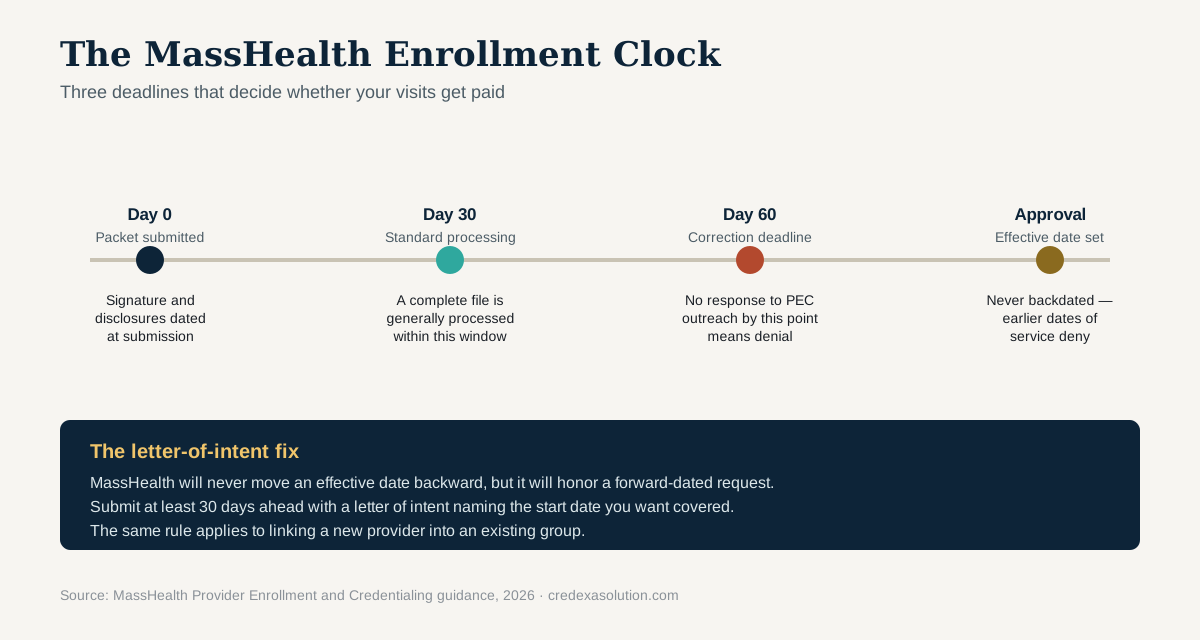
- A complete application is generally processed within 30 days.
- Once MassHealth flags an error, the provider has up to 60 days to fix it before the file is denied outright.
- MassHealth does not backdate an enrollment effective date, under any circumstance.
That third point is where most of the financial damage happens. A practice that starts scheduling MassHealth patients before its effective date is locked in isn’t looking at delayed revenue it’s looking at services that can never be billed, no matter how clean the claim is or how accurately it’s coded.
Provider Enrollment vs. Member Enrollment: Don’t Confuse the Two
These get conflated constantly because they share a phone number and both get shorthand-labeled “MassHealth enrollment.”
Member enrollment is how a Massachusetts resident gets health coverage, applied for through the Health Connector or a MassHealth Enrollment Center. Standard decisions land within 45 days; disability-based applications can take up to 90 because of the additional evaluation step.
Provider enrollment is how a clinician, group, or facility registers with the state to bill for treating those members, or to order/refer/prescribe on their behalf. It runs through the Provider Application Request Form on Provider Self-Service not through any Enrollment Center and moves on a 30-day clock for complete files.
If someone quotes you a 45- or 90-day timeline for “enrollment,” they’re almost certainly describing member eligibility, not the provider process.
Choosing the Right Enrollment Track
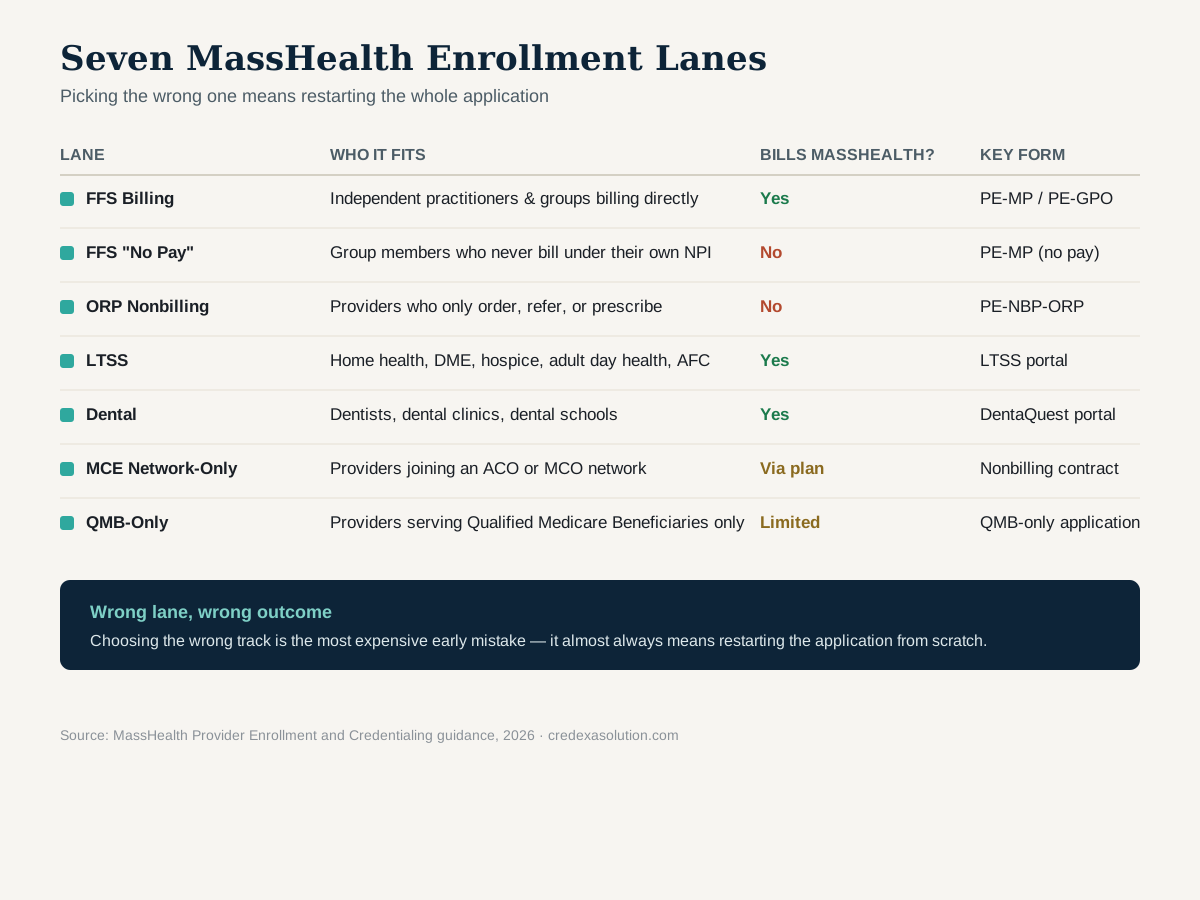
MassHealth doesn’t run one enrollment pathway — it runs several, and picking the wrong one is the single most expensive early mistake a practice can make, since a track correction usually means starting over.
Fee-for-service billing is the standard route for independent practitioners and groups who submit claims under their own NPI. FFS “no pay” applies to practitioners inside a group who never bill individually this track skips the EFT setup, the Data Collection Form, and the Trading Partner Agreement, which lightens the paperwork considerably. ORP non billing covers providers who exist in the system purely to order, refer, or prescribe; in Massachusetts, several license types are legally required to hold this enrollment even if they never see a MassHealth patient directly. LTSS (home health, DME, hospice, adult day health, adult foster care) runs through its own dedicated portal rather than the general track. Dental enrollment now flows through a different vendor entirely (more on that below). MCE network-only providers still need a separate state contract in addition to their plan credentialing, because federal rules require it. And QMB-only enrollment exists for providers whose entire MassHealth exposure is dual-eligible crossover claims.
Confirming your track before submitting anything is worth the extra day it takes. Restarting an application in the wrong lane doesn’t just cost time it resets your position in the queue.
The Paperwork MassHealth Actually Wants
Generic advice tells you to gather a license, an NPI, and a W-9. That’s necessary but incomplete. The real packet is form-specific:
The core application is either PE-MP (individual practitioners), PE-GPO (group practices), or PE-NBP-ORP (non billing ORP providers). Every applicant signs the GEN-15 provider contract at the time of submission not weeks earlier, since an aged signature is a documented reason for rejection. Ownership disclosures go on PE-FRD-IN for individuals or PE-FRD-E for entities, and every section needs an answer; leaving a box blank is treated differently than checking “no.” The POSC-DC-PE Data Collection Form establishes your Primary User account. Payment setup runs through EFT-1 and ERA-1, tax identification through the Massachusetts Substitute W-9, and electronic transactions through a Trading Partner Agreement. Certain higher-risk provider types also file a CORI Request Form.
MassHealth began issuing updated application versions in January 2026 with new provider-directory fields attached, and expects requested packets to be submitted within 90 days so an outdated version doesn’t get filed. It’s worth checking the current form revisions on the official MassHealth provider forms library before printing anything.
On the supporting-document side, gather an active, unrestricted Massachusetts license; a Type 1 and Type 2 NPI that matches NPPES exactly; a taxonomy code that matches your NPI registry entry; a TIN or EIN with IRS documentation; proof of active malpractice coverage; DEA and Massachusetts Controlled Substances registration where applicable; and a CAQH profile attested within the last 120 days. If your CAQH file has gone stale, that alone can stall an otherwise complete application.
Electronic signatures through Adobe or DocuSign are accepted. A typed name in a cursive font is not a signature MassHealth recognizes, and applications with one get sent back.
The Seven-Step Enrollment Process
Step one is checking whether an application already exists for this provider, using the “Check Provider Enrollment Status” and “Check the Provider Application Status” tools on Provider Self-Service. MassHealth has specifically flagged duplicate submissions from third-party billing vendors as a cause of processing delays.
Step two is requesting the application itself through the Provider Application Request Form not through the POSC, because a brand-new provider has no PID/SL and no Primary User account yet, so POSC login simply isn’t available.
Step three is completing the application for your track and signing the GEN-15 contract at submission time, not in advance.
Step four is the Federally Required Disclosures ownership and control information that has to be filled out completely, with “no” boxes explicitly checked rather than left blank.
Step five is submission by mail to MassHealth Provider Enrollment, P.O. Box 278, Quincy, MA 02171, by fax to (617) 988-8974, or via POSC upload if you’re an already-enrolled organization adding a provider. Email submission isn’t accepted, for data-security reasons.
Step six is responding to outreach during the 60-day correction window. If MassHealth finds a problem, PEC contacts the provider by phone, email, and mail to the Doing-Business-As address on file. No response within five days triggers a second attempt, then repeating two-day cycles until day 60, when the file is denied outright.
Step seven is registering a Primary User on the POSC once approved, via the Data Collection Form. That typically takes seven business days, with credentials delivered through the Virtual Gateway. ORP providers skip this step entirely since they never get POSC access.
What Enrollment Costs in 2026
The federal Medicaid application fee for calendar year 2026 is $750, up from $730 in 2025 but only six institutional provider types actually owe it: acute, chronic, psychiatric, and semi-acute inpatient hospitals; ICF-MR state schools; and skilled nursing facilities that don’t participate in Medicare. Individual practitioners, group practices, and most other provider types are exempt outright, and organizations that already paid the fee to Medicare or another state Medicaid program don’t pay it again.
Where the fee does apply, it has to be paid through the state’s secure payment portal (no paper checks accepted), and it’s non-refundable meaning a denial for missing documentation doesn’t return the money, and reapplying means paying a second time.
Realistic Timelines, Stage by Stage
Confusion around “how long enrollment takes” usually comes from people measuring different stages. A complete application generally clears PEC review in 30 days. The correction window runs up to 60 days before denial. Applications with a pending license or DEA registration can sit for up to six months. POSC registration after approval takes about seven business days, with EFT and ERA activation following a week or two after that. If you also need ACO or MCO network credentialing, budget an additional 60 to 120 days on a completely separate track, since state enrollment and plan credentialing don’t run in parallel unless someone deliberately coordinates them.
The three most common causes of delay are mismatches between the application, the NPI registry, and the license; a contract signature that aged before MassHealth received the packet; and silence during PEC outreach, which is the one failure mode that guarantees denial.
The No-Backdating Rule and Why It’s the Costliest Detail in This Whole Process
MassHealth will not backdate an effective date on any application, and it won’t backdate a group link either. Your effective date is set the day PEC finishes credentialing and enters the provider into the system which can land well after the packet arrived and every claim with a date of service before that day denies permanently. No appeal reverses it, because the provider genuinely wasn’t enrolled yet.
The workaround is simple and free: submit the application at least 30 days before the date you want coverage to begin, and attach a letter of intent naming that target date. MassHealth will honor a forward-dated request; it will never move backward.
The same logic applies to adding a provider to an existing group send a letter of intent naming both PID/SL numbers and the intended link date. A clinician who starts seeing MassHealth patients before that link posts generates weeks of visits that have nowhere to route on a claim, regardless of how accurately those visits are coded.
Checking Enrollment and Application Status
Two different tools answer two different questions. An Application Tracking Number (ATN), issued when you first request the application, or your NPI, will show you where a pending application sits on Provider Self-Service no login required. Whether a provider is already enrolled is a separate question, answered through the POSC provider search, which returns an active-status flag but notably does not surface managed care network providers. A clean search there doesn’t confirm someone isn’t already in an MCO network.
Provider Self-Service, POSC, and CWP Aren’t the Same System
This trips up more new providers than almost anything else. Provider Self-Service is where enrollment starts, applications are tracked by ATN, and provider file information gets updated it’s open for status checks. The Provider Online Service Center (POSC) is where enrolled providers submit claims, verify eligibility, manage authorizations, and view remittances but it requires an assigned PID/SL and Primary User account, meaning a brand-new provider literally cannot log in yet. The Customer Web Portal (CWP) is a third, entirely separate account system with its own registration.
Your PID/SL a 10-character identifier (nine digits plus a service-location letter, e.g., 123456789A) is used for POSC login, eligibility checks, and remittances. Your NPI is what actually goes on claims and standard transactions. Mixing the two up produces rejections that look mysterious until someone traces which identifier landed in which field.
One structural rule worth flagging: entities and group practices must enroll at every physical location where members are seen, including nonbilling satellite locations billing through a main site. Administrative-only offices can’t be enrolled, and skipping a real service location means it won’t appear in the MassHealth provider directory.
The Application Errors MassHealth Flags Most Often
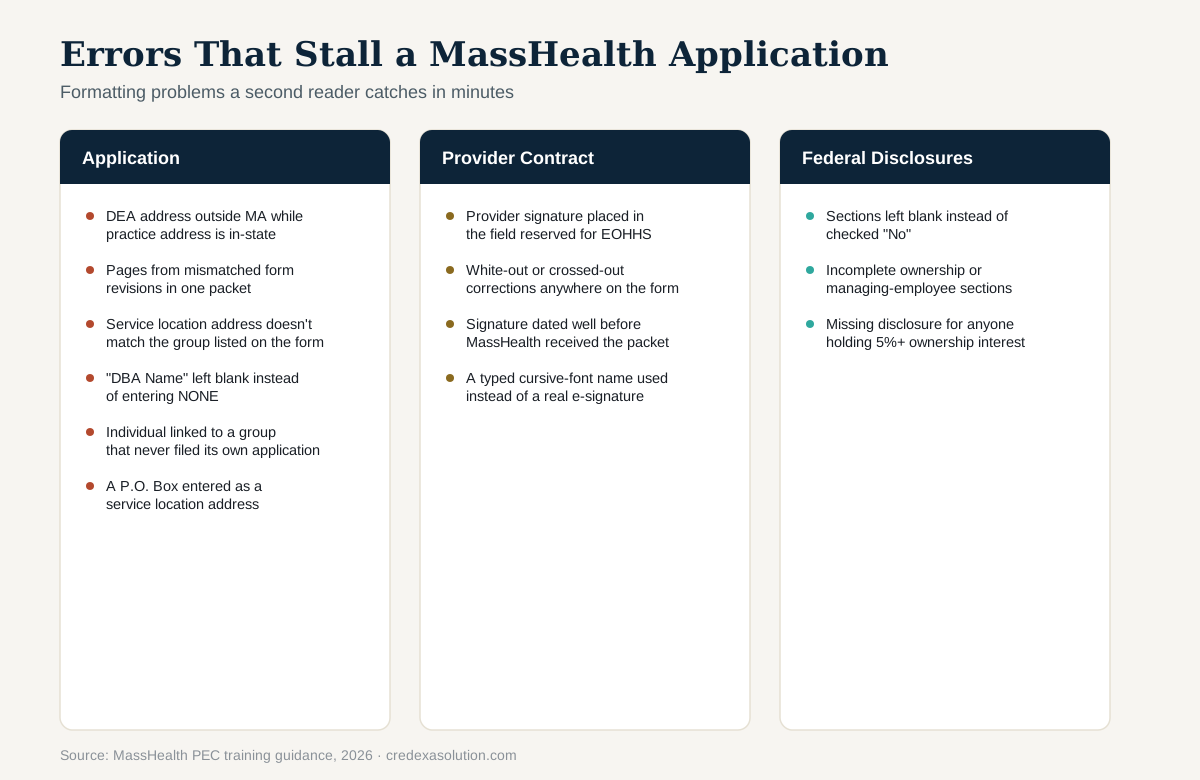
MassHealth’s own training materials for PEC staff list a remarkably specific set of recurring mistakes nearly all of them formatting or consistency issues rather than judgment calls:
A DEA address that falls outside Massachusetts while the practice address on the application is in-state. Pages from mismatched form revisions submitted together. A service-location address that doesn’t match the group listed elsewhere on the same form. A blank “DBA Name” field where “NONE” was the correct entry. An individual application listing a group that never filed its own group application. A P.O. Box entered as a service location, which isn’t accepted.
On the contract side: a provider signature placed in the field reserved for the state, white-out or crossed-out corrections anywhere on the document, a signature dated well before MassHealth received the file, and typed cursive-font names used in place of genuine electronic signatures.
And in the disclosures: blank sections instead of checked “No” boxes, incomplete ownership or managing-employee fields, and missing disclosures for anyone holding a 5% or greater ownership interest a requirement rooted in federal disclosure rules under 42 CFR 455.104.
Ordering, Referring, and Prescribing Providers Still Have to Enroll
Providers who only order, refer, or prescribe for MassHealth members never billing directly still have to enroll, at minimum on the non billing ORP track. For several Massachusetts license types, this isn’t optional; it’s a condition of obtaining and keeping a state license, regardless of whether that provider ever treats a Massachusetts resident.
This matters well beyond the ORP provider’s own paperwork. When a referring provider isn’t actively enrolled, claims submitted by the lab, imaging center, or pharmacy acting on their order deny even though that downstream entity did everything correctly. MassHealth requires an authorized, enrolled ORP NPI on the claim, and dates of service on or after September 1, 2023 are held to that standard. One unenrolled referring physician can generate denials across every entity billing off their orders, which is exactly why auditing your referring-provider roster against MassHealth enrollment status before claims go out matters more than most billing teams realize.
Why Enrollment Gaps Get Mistaken for Coding Errors
This is the part that costs practices the most money without ever announcing itself as an enrollment problem. When a claim denies for “provider not certified or eligible,” billing staff often start troubleshooting the CPT or diagnosis codes first because that’s where denials usually originate. But an enrollment-driven denial has nothing to do with code accuracy. It traces back to one of three causes: the effective date landed after the service date, a group link was never established, or the provider’s enrollment lapsed at revalidation without anyone noticing.
No amount of corrected coding fixes any of those. Resubmitting the same clean, accurately coded claim just produces the same denial with less time left on the filing clock because timely filing keeps running while enrollment processes. A provider who becomes effective 90 days after their actual start date has already burned 90 days of filing window on every encounter in that stretch.
This is precisely where accurate, disciplined coding and a structured denial-management process work together rather than in isolation. Getting the CPT and modifier selection right on a claim the kind of specificity covered in our guides to ophthalmology CPT codes for 2026, lithotripsy CPT coding, and general surgery CPT codes — only pays off if the claim is also hitting a payer where the provider is genuinely, currently enrolled. A practice can have flawless coding and still bleed revenue if enrollment status isn’t tracked with the same discipline.
This is exactly the gap Credexa Solutions is built to close. Rather than treating enrollment and coding as two separate problems handled by two separate teams, Credexa tracks provider enrollment status, effective dates, and revalidation deadlines alongside claim-level coding accuracy so a denial gets routed to its actual root cause instead of triggering a reflexive recode. When the issue is enrollment, we fix the enrollment. When it’s a code or modifier, our credentialed coding team corrects it against current CPT and payer-specific rules before resubmission. That root-cause sorting is what actually reduces repeat denials, instead of just resubmitting the same claim and hoping.
Dental Enrollment Moved to a New Vendor in 2026
If your practice or billing vendor is still routing MassHealth dental enrollment paperwork to Bene Care, it’s going to the wrong place. Denta Quest took over dental credentialing, recredentialing, claims, and prior authorizations on February 1, 2026. Every dentist has to enroll as an ORP non billing provider (or already be enrolled as a billing provider) before getting an initial license or renewing an existing one a requirement in place since November 2017 regardless of where the dentist actually practices.
Two Provider Types Can’t Enroll Right Now
MassHealth has two active CMS-approved enrollment moratoria in 2026. Adult Day Health providers are under a temporary six-month hold effective May 19, 2026, with MassHealth citing sufficient existing access with more than 151 active providers. Adult Foster Care has been under an extended moratorium, including a CMS-approved extension effective January 17, 2026, tied to program-integrity concerns in a network that had grown past 180 providers. Neither moratorium blocks state licensure a program can still get licensed and staffed while it waits but both get extended past their stated timelines more often than not, so checking current status on the MassHealth moratoria page before spending money on an application is worth the five minutes.
Enrollment Doesn’t Automatically Cover ACO and MCO Networks
State enrollment covers fee-for-service, the Primary Care Clinician Plan, and Primary Care ACO plans full stop. It does not cover Partnership Plans or MCOs, which require separate plan-level applications running 60 to 120 days on their own review track. Federal rules still require managed care network providers to hold a MassHealth state contract in addition to the plan agreement, so these providers carry two active relationships simultaneously; letting either lapse can trigger network termination even while the other stays technically active.
Plan naming has also shifted enough to trip up otherwise-correct applications: the Tufts Health Together MCO was discontinued January 1, 2026 (the accountable care partnership plans under similar names are separate and still active), Boston Medical Center HealthNet Plan is now WellSense Health Plan, and Neighborhood Health Plan is now Mass General Brigham Health Plan. Pulling the current MassHealth ACO and MCO list directly before filing avoids using a retired plan name.
Revalidation: The Quiet Termination Risk
MassHealth providers must revalidate at least every five years under federal Section 6401 and 42 CFR 455.414. MassHealth initiates the notice providers don’t request it and once that email lands, there’s a 45-day window to complete it. Correspondence goes to whichever primary and secondary contacts are on file, so if that person left the practice months ago, nobody may notice until the deadline has already passed.
Starting July 1, 2026, revalidation also requires reviewing and submitting current information for the MassHealth Fee-for-Service Provider Directory, tied to federal CMS guidance under the Consolidated Appropriations Act. Missing revalidation entirely results in termination from the program, can affect license renewal, and because other providers may be ordering, referring, or prescribing off a terminated provider’s NPI the damage isn’t contained to that one provider’s own claims.
What Has to Happen After Approval
Approval isn’t the finish line. MassHealth issues no paper checks, so EFT setup via the EFT-1 form is required for every pay-status provider (the “no pay” track is the one exception). ERA-1 enrolls the practice for electronic remittance advices, and skipping it means manual payment posting a slow, quiet source of missed contractual variances. Any change to service location, banking details, ownership, or group affiliation has to reach MassHealth at least 14 days in advance, per 130 CMR 450.223(B); a banking change that arrives late means EFT payments landing in a closed account, which can take weeks to untangle.
Handling Enrollment In-House vs. Bringing in a Partner
Some practices manage this well internally. Most underestimate the actual hours involved: gathering documentation, sitting on hold for weekly payer follow-up, correcting errors inside a 60-day clock, and tracking a five-year revalidation cycle that nobody puts on a calendar until it’s overdue. The real cost shows up in accounts receivable, not on an invoice a single clinician generating meaningful weekly billable revenue who sits unenrolled for two months over a preventable denial represents a five- or six-figure gap that never gets recovered.
What a credentialing and billing partner should actually deliver is judgment on the failure points covered throughout this guide: choosing the correct enrollment lane the first time, using current form versions, watching the 60-day PEC outreach window closely enough to respond before day 60, timing the letter of intent so the effective date lands exactly where the practice needs it, and tracking revalidation deadlines so a notification email never dies in a departed employee’s inbox.
Credexa Solutions builds enrollment support around that exact judgment, paired with coding and denial-management work that catches the difference between a coding error and an enrollment-driven denial before a claim gets stuck in an endless resubmission loop. Instead of treating credentialing as a one-time task and coding accuracy as a separate downstream function, our team tracks both together so when a MassHealth claim denies, it gets diagnosed correctly the first time, whether that means correcting a CPT or modifier against current payer rules or fixing an enrollment or effective-date issue at the root. That combined approach is what actually shortens the distance between “service rendered” and “clean payment posted.”

Frequently Asked Questions
How do I enroll as a MassHealth provider? Submit a Provider Application Request Form through MassHealth Provider Self-Service new enrollment does not begin on the POSC, since a new provider has no PID/SL yet. Complete the application for your track, sign the GEN-15 contract and disclosures at submission, and mail or fax the packet to Quincy.
How long does MassHealth provider enrollment take? Around 30 days for a complete application, plus about seven business days for POSC registration afterward. Incomplete files can extend well past that, and unanswered outreach results in denial at day 60.
Can MassHealth backdate my effective date? No, never on applications or group links. Submitting at least 30 days ahead with a letter of intent naming your desired start date is the only reliable workaround.
Does enrollment cost anything? A $750 federal fee applies in 2026, but only to six institutional provider types. Most individual practitioners and group practices are exempt entirely.
Can I bill while enrollment is pending? Claims can be submitted, but they’ll deny until an effective date covering that service date exists. Meanwhile, the timely filing clock keeps running regardless.
How often do I need to revalidate? At least every five years, with a 45-day window to respond once MassHealth sends notice missing it results in termination from the program.
Do ACOs and MCOs require separate enrollment? Yes, for Partnership Plans and MCOs specifically. State enrollment only covers fee-for-service, the Primary Care Clinician Plan, and Primary Care ACO plans.