OB-GYN coding has always been dense. In 2026, it’s also unstable. A restructure of the maternity care code set takes effect on January 1, 2027, and it doesn’t behave like a typical annual CPT update where a handful of codes get tweaked. It splits a single, decades-old global code into four separate billing phases and practices that haven’t already adjusted their antepartum billing are quietly building a denial backlog that will surface the moment claims start hitting payer systems under the new structure.
This guide walks through every OB-GYN CPT code category your practice bills today the global maternity package, itemized OB billing, obstetric ultrasounds, pregnancy loss codes, well-woman exams, and common gynecologic procedures along with the modifiers that determine whether those codes actually get paid. It also covers exactly what changes in 2027, what to bill right now during the transition, and where OB-GYN claims are denied most often.
Quick-Reference Table: OB-GYN CPT Codes at a Glance
| Code | Description | Status |
|---|---|---|
| 59400 | Global OB package — antepartum, vaginal delivery, postpartum | Active through Dec 31, 2026 |
| 59425 / 59426 | Itemized antepartum care, 4-6 visits / 7+ visits | Active |
| 59409 / 59410 | Vaginal delivery only / delivery + postpartum | Active through 2026 |
| 59431 | Vaginal delivery only | New, effective 2027 |
| 59432 | Vaginal delivery after prior cesarean | New, effective 2027 |
| 59502 / 59503 | Primary / repeat cesarean delivery | New, effective 2027 |
| 76801 / 76805 | Complete OB ultrasound, under 14 weeks / 14 weeks and beyond | Active |
| 76811 | Detailed fetal anatomy survey | Active |
| 76815 / 76816 / 76817 | Limited / follow-up / transvaginal ultrasound | Active |
| 59812 / 59820 / 59821 | Incomplete abortion / missed abortion (1st trimester) / missed abortion (2nd trimester) | Active |
| 99384-99397 | Preventive visit codes by age band, new and established | Active |
| Q0091 / G0101 | Medicare Pap collection / pelvic & breast exam | Active |
| 99459 | Add-on: practice expense for pelvic exam | Active since 2024 |
| 57452-57456 | Colposcopy variations (biopsy, curettage, combined) | Active |
| Modifier TH | Flags obstetric E/M billing during the 2026-2027 transition | Active now |
Use this table as a jump point, then go deeper into the section that applies to the claim in front of you.
The 2027 Maternity Code Overhaul: What’s Actually Changing
For more than thirty years, a single global code has represented an entire pregnancy from the first prenatal visit through the six-week postpartum check. That model made sense when one OB-GYN saw a patient start to finish. It stopped making sense once care fragmented: patients see multiple providers across a single pregnancy, rural patients get transferred to higher-acuity centers mid-pregnancy, and antepartum visit schedules increasingly flex around telehealth rather than following the traditional thirteen-visit pattern the global code assumed.
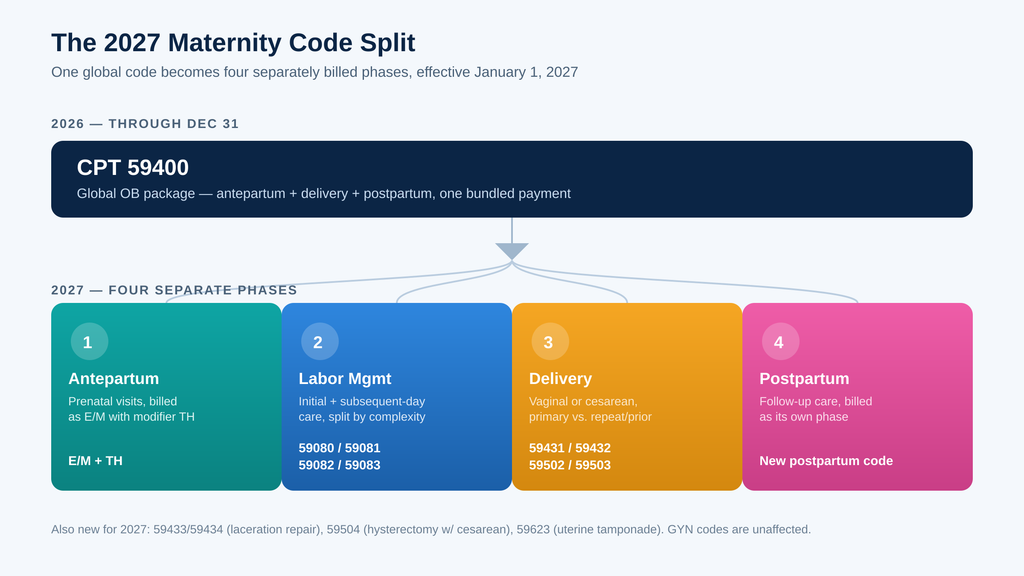
The AMA’s CPT Editorial Panel approved a full restructuring of maternity codes in April 2026 after roughly two years of work alongside the American College of Obstetricians and Gynecologists (ACOG). Instead of one bundled code, maternity care splits into four separately billed phases starting January 1, 2027: antepartum care, labor management, delivery, and postpartum care.
In total, 35 codes are affected 17 deleted, 12 added, and 6 revised. A few of the additions are worth memorizing now rather than in December:
- 59080 / 59081 — initial-day labor management, split by complexity
- 59082 / 59083 — subsequent-day labor management, same complexity split
- 59431 / 59432 — vaginal delivery, with 59432 used when a prior cesarean is on record
- 59502 / 59503 — cesarean delivery, primary versus repeat
- 59433 / 59434 — third- and fourth-degree laceration repair, now billed separately from the delivery code
- 59504 — hysterectomy performed during the same session as a cesarean
- 59623 — a new procedure code for uterine tamponade to manage postpartum hemorrhage; it does not cover pharmacologic hemorrhage management
Gynecology codes are untouched by this restructure. Colposcopy, hysterectomy, IUD management, and every other GYN procedure code in this guide stays exactly as-is the overhaul is scoped to maternity care only. For the full code-by-code mapping, the AMA publishes the complete 2027 maternity coding guidelines directly.
What to Bill Right Now, During the Transition
ACOG’s guidance calls for antepartum visits to move to standard E/M codes with modifier TH attached, and set September 1, 2026 as the target start date a date that has already passed. Practices that made the switch on schedule are billing clean claims today. Practices that haven’t are accumulating antepartum claims that will need correction before the calendar turns, on top of whatever new denial patterns the 2027 codes introduce.
The trickiest scenario isn’t a pregnancy that starts and ends entirely in one year it’s the one that spans the boundary. A patient who begins antepartum care in 2026 and delivers in 2027 needs two different billing approaches inside a single pregnancy: current rules for the early visits, the new four-phase structure for the delivery and everything after. That seam is exactly where the first wave of 2027 denials is going to show up, and it will show up months before January 1 does. ACOG has published its full obstetric coding guidance covering the modifier TH transition in detail.
The Global OB Package: What’s In, What’s Out
Through the end of 2026, four global codes 59400, 59510, 59610, and 59618 still carry the bulk of routine OB billing. Each bundles three phases of pregnancy care into one payment, made once, to one provider or group.
Included in the global package: routine antepartum visits, uncomplicated labor management, the delivery itself, first- or second-degree laceration repair, and routine postpartum care within the standard window.
Excluded from the global package, and billed separately: ultrasounds, amniocentesis, non-stress tests, external cephalic version, and any care for a condition unrelated to the pregnancy a sinus infection treated during a prenatal visit, for example.
The global code depends on a single condition holding for the entire pregnancy: one provider or group, under one tax ID, delivering all three phases to one payer. The moment that condition breaks a mid-pregnancy transfer, a different provider handling delivery, care ending before the postpartum visit the claim moves out of the global package entirely and into itemized billing.
When the Global Code Doesn’t Apply: Itemized OB Billing
| Situation | Code to Bill |
|---|---|
| Patient transferred to your practice after 4-6 prenatal visits elsewhere | 59425 |
| Patient transferred after 7+ prenatal visits elsewhere | 59426 |
| You delivered, another provider handles postpartum care | 59409 |
| You delivered and will also handle the postpartum visit | 59410 |
| Your practice saw the patient for only 1-3 antepartum visits before transfer | Standard E/M codes not 59425/59426 |
| You handled only the postpartum visit, with no antepartum or delivery care | 59430 |
The last two rows cause more denials than they should. Code 59425 requires a documented minimum of four antepartum visits. Bill it for a patient seen only three times before transferring, and the claim denies in a way that rarely survives an appeal, because the visit count itself not the clinical picture is what the payer is checking against.
Obstetric Ultrasound Codes: Picking the Right One
Ultrasound codes generate more lookup traffic and more coding errors than almost any other OB-GYN category.
76801 vs. 76805: CPT 76801 covers a complete transabdominal ultrasound performed before 14 weeks 0 days of pregnancy. CPT 76805 takes over at 14 weeks 0 days and continues through the rest of the pregnancy. Gestational age at the time of the scan not the date the visit was scheduled decides which code applies.
76811 vs. 76805: CPT 76811 is a higher tier of 76805: a detailed anatomy survey ordered only when a specific medical indication exists, such as a suspected fetal anomaly. It’s reserved for that indication, not routine second-trimester screening, and is typically performed or supervised by maternal-fetal medicine.
76815, 76816, 76817: CPT 76815 is a limited scan usable in any trimester to answer one narrow clinical question confirming a heartbeat or checking placental location, for example. It also serves as the correct fallback when a first-trimester scan intended to be complete under 76801 couldn’t visualize a required element. CPT 76816 covers a follow-up or repeat scan later in the same pregnancy. CPT 76817 is the transvaginal approach, used when a transabdominal view alone doesn’t answer the clinical question.
Billing more than one on the same date: several of these pairs can be billed together, but only with separate, documented medical necessity for each. A transabdominal scan followed by a transvaginal scan because the first view was insufficient supports billing both. The same pairing without a documented reason for the second scan invites a bundling denial or a multiple-procedure reduction.
Pregnancy Loss and Miscarriage Codes
CPT 59812 and CPT 59820 get confused often enough that the mix-up shows up repeatedly on appeal. CPT 59812 covers an incomplete abortion the miscarriage has already started and some tissue has passed and applies in any trimester. CPT 59820 covers a missed abortion, where the pregnancy has stopped developing but nothing has passed, and it’s restricted to the first trimester. CPT 59821 is the second-trimester version of that same clinical picture, a distinction several billing references skip entirely.
CPT 59840 and 59841 split by method rather than clinical status: 59840 reports an induced abortion by dilation and curettage, while 59841 reports dilation and evacuation, typically used further into a pregnancy once suction alone can’t complete the procedure.
The single question that resolves this category correctly: has tissue already passed, and which trimester applies? That’s what the chart note needs to answer clearly well before the general term “miscarriage” enters the documentation.
Well-Woman and Preventive Exam Codes
Preventive visit codes, 99384-99397: new patients use 99384 through 99387; established patients use 99394 through 99397. Both ranges split into the same four age bands 12-17, 18-39, 40-64, and 65 and older. A patient counts as established if any physician in the same specialty and group has seen her face-to-face within the past three years. Miss that window by even a day and the visit reverts to a new-patient code.
Modifier 25 causes more denials in this category than any other single error. When a scheduled well-woman exam turns up a separate, significant problem the physician also addresses, the problem-oriented E/M code carries modifier 25 the preventive code does not. Reversing that pairing bundles the entire claim.
Medicare-specific codes, Q0091 and G0101: Original Medicare doesn’t pay for the standard 99384-99397 codes, so two HCPCS codes fill the gap. Q0091 covers obtaining, preparing, and conveying a screening Pap smear to the lab. G0101 covers the pelvic and clinical breast exam. Medicare pays for both every two years for average-risk patients, and annually for high-risk patients or those with an abnormal Pap in the past three years. CMS lays out the full frequency rules in its Medicare wellness visit coverage guidance.
Add-on code 99459, introduced in 2024, covers the practice expense of a pelvic exam performed alongside an eligible visit — staff time, a speculum, supply costs separate from the physician’s own work. It requires a primary code from a specific eligible list; G0101 and Q0091 don’t qualify, since those HCPCS codes already build practice expense into their own valuation.
Common Gynecologic Procedure Codes
Colposcopy splits into four codes based on exactly what accompanies the exam: CPT 57452 covers the exam alone, 57454 adds both a cervical biopsy and endocervical curettage, 57455 adds a biopsy only, and 57456 adds curettage only. Confusing these four is one of the fastest ways to undercode or overcode a routine colposcopy visit.
CPT 58100 covers an endometrial biopsy. CPT 58120 covers dilation and curettage for a non-obstetric indication worth keeping mentally separate from the pregnancy-loss codes above, since payers treat them as distinct clinical events entirely. CPT 58558 covers hysteroscopy with biopsy or polypectomy, and 58300/58301 cover IUD insertion and removal.
Hysterectomy coding depends on surgical approach: 58150 for total abdominal, the 58260 range for vaginal, and the 58570 range for laparoscopic, where uterine weight above or below 250 grams changes which specific code applies.
The most common denial in this whole category comes from billing a colposcopy and an E/M visit on the same date without documenting a distinct, separately identifiable reason for the E/M payers bundle the two automatically when that documentation is missing.
Modifiers That Determine Whether These Codes Get Paid
| Modifier | Trigger | OB-GYN Example |
|---|---|---|
| 25 | Separate, significant E/M same day as a procedure or preventive visit | Problem visit billed alongside a scheduled well-woman exam |
| 59 / X-modifiers | Two normally bundled services performed as separate and distinct | Cervical biopsy and endocervical curettage at separate sites |
| 51 | Multiple procedures, one session | Hysterectomy plus a separate, distinct procedure |
| 22 | Unusually difficult delivery or procedure | Cesarean complicated by dense adhesions, operative report attached |
| 24 | Unrelated E/M during a global period | Sinus infection treated during the postpartum global window |
| TH | Obstetric E/M during the 2026-2027 transition | Antepartum visit billed after September 1, 2026 |
Modifier 59 and its more specific alternatives XE, XS, XP, XU flag services that would normally bundle as separate and distinct, with payers generally preferring the specific X modifier over the general 59 whenever one applies. CMS documents the underlying bundling logic in its own National Correct Coding Initiative Policy Manual. Modifier 22 needs an operative report attached every time it’s used; without it, a payer has no way to evaluate why the case took more work than usual. Modifier 24 belongs on the E/M code for unrelated care during a global period not on the original procedure code and getting that backward is a common, avoidable source of denied postpartum visits.
Where OB-GYN Claims Actually Get Denied
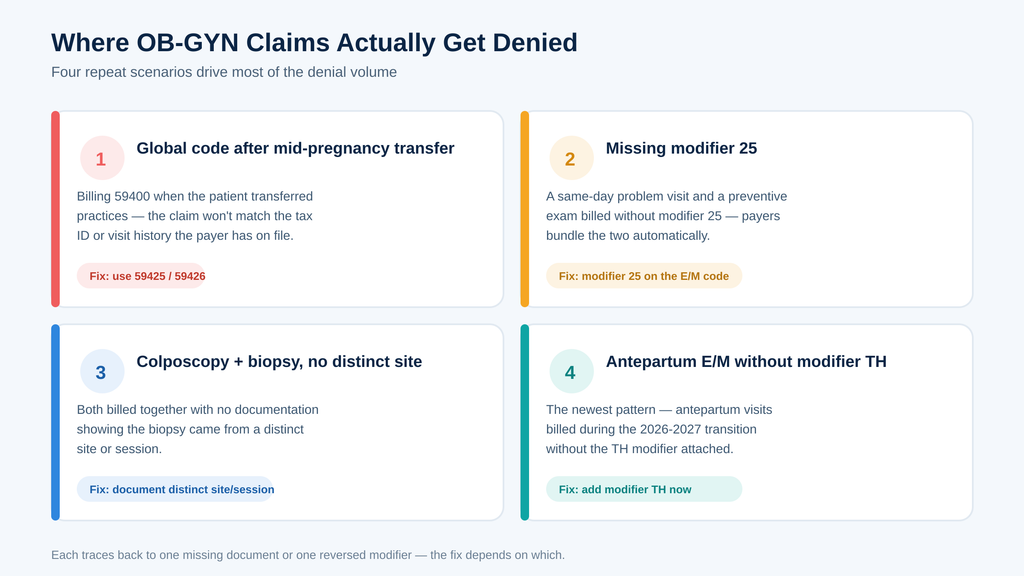
Most OB-GYN denials trace back to four repeat scenarios, not forty different problems:
- A global OB code billed when the patient transferred practices mid-pregnancy, and the claim doesn’t match the tax ID or visit history the payer already has on file.
- A same-day E/M and preventive visit billed without modifier 25, bundled automatically without manual review.
- A colposcopy and biopsy billed together with no documentation showing the biopsy came from a distinct site or session.
- An antepartum E/M claim billed during the current transition period without modifier TH a denial pattern that’s brand new to this specific window and will only get more common as 2027 approaches.
Each of these traces back to one missing piece of documentation or one reversed modifier. That distinction matters because it changes the fix: a coding error needs a corrected code, but a documentation gap needs a different chart note next time — and if nobody is tracking which denials fall into which bucket, the same mistake keeps repeating month after month.
Documentation Habits That Prevent These Denials Before They Start
Coding correctly and documenting correctly are two different disciplines, and OB-GYN denials usually trace back to a gap in the second one even when the first was done right. A few habits catch most of the recurring problems above before a claim ever leaves the building:
- Log visit counts explicitly, not just clinically. A chart that says “patient established, multiple prior visits” doesn’t tell a coder whether 59425 or standard E/M codes apply it needs an actual number.
- Document medical necessity separately for stacked ultrasounds. If a transvaginal scan follows a transabdominal one on the same date, the note needs its own sentence explaining why the first view wasn’t sufficient, not just a repeated diagnosis code.
- Attach the operative report every time modifier 22 is used. A claim with modifier 22 and no supporting narrative reads, to a payer, exactly like a claim without the modifier at all.
- Flag transfer-of-care pregnancies at intake, not at billing. If a patient discloses a mid-pregnancy transfer during registration, that detail needs to reach the coding team before the claim is built, not after a denial forces a rework.
- Track modifier TH compliance weekly through the rest of 2026, since it’s the newest rule in this guide and the one most likely to slip through an established workflow that hasn’t been updated yet.
None of these habits require new software or a new EHR field they require someone whose job is specifically to watch for them, which is usually the difference between a practice that denies the same claim type repeatedly and one that fixes it once.
How Credexa Solutions Helps OB-GYN Practices Stop Repeat Denials
Everything above is learnable by any billing team willing to sit with the code books. The harder question is whether that team has the bandwidth to apply it consistently across every payer, every modifier rule, and every code change while also keeping up with a maternity coding overhaul that touches 35 codes in a single year.
This is exactly where Credexa Solutions fits into an OB-GYN practice’s revenue cycle. Rather than treating each denial as an isolated claim to rework, Credexa’s coding and denial management team builds a root-cause process around it:
- Specialty-specific coding accuracy. Credexa’s coders track the OB-GYN code set the way this guide does global package rules, itemized billing triggers, modifier TH, and the incoming 2027 phase structure instead of applying general medical billing knowledge to a specialty that punishes generic coding.
- Root-cause denial review, not just resubmission. When a claim comes back denied, Credexa’s team categorizes the denial, corrects the claim in front of them, and traces the pattern back to its source a missing modifier, an undocumented visit count, a transfer-of-care gap so the same denial stops showing up on next month’s report instead of quietly repeating.
- Modifier and bundling audits before claims go out, catching a missing modifier 25, a misapplied modifier 59, or a colposcopy-and-E/M pairing without separate documentation while the claim is still in queue, rather than after a payer has already denied it.
- Credentialing and enrollment support that keeps pace with billing, so a delayed payer enrollment isn’t the hidden reason clean claims are stuck behind it.
For an OB-GYN practice navigating the 2027 maternity restructure on top of routine denial management, that combination accurate, specialty-specific coding paired with a denial process that fixes the workflow rather than just the claim is what keeps collections from stalling while the code set underneath the practice is changing. See how Credexa Solutions supports OB-GYN billing and coding accuracy.
Frequently Asked Questions
What are the OB-GYN CPT codes for 2026? The active procedure code ranges run from roughly 56405 through 59899, alongside the standard evaluation and management ranges for office visits. Add-on code 99459, covering pelvic exam practice expense, is one of the more recent additions billing teams need to track. Everything in this range stays active through December 31, 2026, before the maternity restructure takes effect.
What’s changing in OB-GYN coding for 2027? Thirty-five maternity codes change 17 deleted, 12 added, 6 revised. The global maternity package splits into four separately billed phases: antepartum, labor management, delivery, and postpartum. Gynecologic procedure codes are unaffected.
What does CPT 59400 include? Routine antepartum visits, uncomplicated labor management, the vaginal delivery, first- or second-degree laceration repair, and routine postpartum care, all under one payment to one provider or group. It excludes ultrasounds, amniocentesis, non-stress tests, external cephalic version, and care unrelated to the pregnancy.
What’s the difference between CPT 76801 and 76815? 76801 is a complete transabdominal ultrasound performed before 14 weeks 0 days. 76815 is a limited scan usable in any trimester, meant to answer one narrow clinical question rather than complete a full standard survey.
What’s the CPT code for a D&C? It depends on the clinical picture. CPT 58120 covers a non-obstetric D&C, used for conditions like abnormal bleeding. CPT 59812 and 59820 cover the same procedure performed for a pregnancy loss, split by whether tissue has already passed.
What’s the difference between CPT 59812 and 59820? 59812 treats an incomplete abortion the miscarriage has started and some tissue has passed in any trimester. 59820 treats a missed abortion the pregnancy has stopped developing, nothing has passed restricted to the first trimester.
What’s the CPT code for a GYN office visit? A visit addressing a specific problem uses standard office visit codes: 99202-99205 for a new patient, 99212-99215 for an established one. An annual well-woman exam uses the separate, age-banded preventive codes covered above mixing the two up is a frequent, avoidable source of denials.
The Bottom Line
2026 codes stay active through December 31 of this year, the 2027 restructure replaces the global maternity package phase by phase, and the modifier TH transition is already underway. If your practice hasn’t confirmed exactly where it stands on any of those three fronts, that gap is worth closing before the next denial arrives rather than after. Talk to Credexa Solutions about OB-GYN coding and denial management.
Related Coding Guides from Credexa Solutions
- Ophthalmology CPT Codes 2026 Guide
- Lithotripsy CPT Codes 2026 Guide
- General Surgery CPT Codes 2026 Guide
External Sources Referenced
- American Medical Association — CPT code resources and 2027 maternity coding guidelines
- ACOG — obstetric coding and payment guidance
- CMS — Medicare preventive and wellness visit coverage rules