Meta description: A complete 2026 guide to urgent care CPT and HCPCS codes E/M level selection, S9083 vs itemized billing, POS 20, modifier 25, CLIA-waived testing, telehealth, and the denial codes that cost urgent care centers the most.
Urgent care occupies a strange middle ground in medical billing. It isn’t a scheduled primary care visit, and it isn’t an emergency department encounter, yet it borrows billing rules from both worlds and then adds a few rules that exist nowhere else like a HCPCS code that replaces the entire visit with one flat fee. Get the code set wrong, or bill the wrong format to the wrong payer, and the claim doesn’t just get delayed. It often gets denied in a way no amount of appeal can fix, because the error was baked in at the coding stage.
This guide breaks down every CPT and HCPCS code family an urgent care center bills in 2026, explains how to choose an E/M level correctly, clarifies when a payer contract requires the S9083 global fee instead of itemized billing, and walks through the modifier and place-of-service rules that generate the most denials in this specialty. If you run billing for an urgent care center or you’re evaluating whether to keep it in-house or hand it to a revenue cycle partner this is the reference to bookmark.
What Makes Urgent Care Billing Different
Urgent care bills unscheduled, walk-in encounters for problems that need same-day attention but aren’t life-threatening. That single fact changes almost everything downstream in the billing process.
There’s no pre-visit scheduling window to verify insurance days in advance. There’s no fixed panel of established patients, so a meaningful share of every day’s volume is new-patient billing. And because urgent care performs minor procedures laceration repair, splinting, abscess drainage on top of the visit itself, nearly every encounter touches more than one CPT code family at once.
A single laceration visit, for example, typically generates four separate billing lines: an evaluation and management (E/M) code for the visit, a repair code for the procedure, a tetanus toxoid product code, and an administration code for giving it. All four have to be coded correctly, sequenced correctly, and depending on the payer modified correctly, or the claim comes back.
The five code families urgent care relies on
- Evaluation and management (E/M) codes the visit itself
- Procedure codes what the clinician physically did (repairs, splints, incision and drainage, foreign body removal)
- Diagnostic and lab codes point-of-care testing and imaging
- Injection and immunization codes the drug and its administration, billed as two separate lines
- HCPCS S-codes urgent care-specific codes that some payers require instead of, or in addition to, standard E/M billing
The Full Urgent Care CPT and HCPCS Code List for 2026
Evaluation and management codes
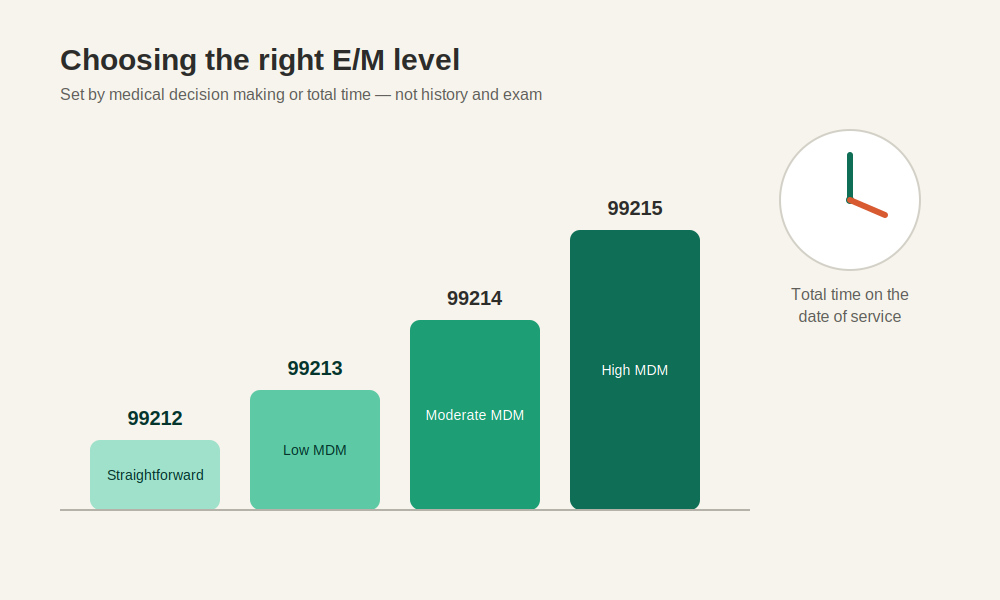
E/M level selection has been based on medical decision making (MDM) or total time since January 1, 2021 history and physical exam are no longer the deciding factor, though they should still be documented as clinically appropriate.
| CPT Code | Patient Type | Typical Total Time | MDM Level | Notes |
|---|---|---|---|---|
| 99202 | New | 15–29 min | Straightforward | Entry-level new patient code |
| 99203 | New | 30–44 min | Low | The most frequently billed new-patient level in walk-in settings |
| 99204 | New | 45–59 min | Moderate | Supported by workup on an undiagnosed problem |
| 99205 | New | 60–74 min | High | Uncommon; this acuity usually gets transferred out of urgent care |
| 99211 | Established | Under 10 min | N/A | No physician or NP/PA presence required |
| 99212 | Established | 10–19 min | Straightforward | One minor, self-limited problem |
| 99213 | Established | 20–29 min | Low | The default urgent care code, and the most commonly under-billed one |
| 99214 | Established | 30–39 min | Moderate | Prescription drug management alone can support this level |
| 99215 | Established | 40–54 min | High | Requires a documented threat to life or bodily function |
Procedure codes
| CPT Code | Description | Key Distinction |
|---|---|---|
| 12001–12007 | Simple repair, scalp/neck/axillae/trunk/extremities | Selected by total repair length in cm; combine lengths within the same group |
| 12011–12018 | Simple repair, face/ears/eyelids/nose/lips | A separate anatomic group — never combine lengths with 12001–12007 |
| 10060 / 10061 | Incision & drainage of abscess, simple / complicated or multiple | 10061 requires documented complexity |
| 10120 / 10121 | Foreign body removal, subcutaneous | 10121 requires documented depth/dissection |
| 26010 | Drainage of finger abscess, simple | Often needs a digit modifier (F1–F9) |
| 29125 / 29130 | Short arm splint / finger splint | Application only — not billable alongside separate fracture care |
| 29515 / 29540 | Short leg splint / ankle-foot strapping | Supplies often billed separately under Q4049 |
| 69210 | Cerumen removal requiring instrumentation | Impaction plus instrumentation both required |
| 30300 | Nasal foreign body removal | High-frequency pediatric urgent care code |
| 65205 | Superficial conjunctival foreign body removal | External eye only; corneal FB uses 65222 |
| 11730 | Nail plate avulsion, single | 11732 for each additional nail |
Diagnostic and laboratory codes
Point-of-care testing is what makes the urgent care business model work financially. Most tests are CLIA-waived, and Medicare requires modifier QW on some but not all of them (more on that below).
| CPT Code | Description | QW Required for Medicare? |
|---|---|---|
| 71046 | Chest X-ray, 2 views | No |
| 73030 | Shoulder X-ray, 2+ views | No |
| 73130 | Hand X-ray, 3+ views | No |
| 73562 | Knee X-ray, 3 views | No |
| 93000 | ECG with interpretation and report | No |
| 87880 | Strep A, immunoassay, direct optical observation | Yes |
| 87804 | Influenza A/B, immunoassay, direct optical observation | Yes |
| 81002 | Urinalysis, dipstick, non-automated | No — inherently waived |
| 81003 | Urinalysis, dipstick, automated | Yes |
| 82962 | Glucose, home-use-cleared device | No — inherently waived |
| 36415 | Venipuncture (the draw, not the test) | No |
Injection and immunization codes
Administration and product always bill on separate lines.
| CPT Code | Description | Note |
|---|---|---|
| 96372 | Therapeutic/prophylactic/diagnostic injection, IM or SQ | Drug bills separately under a J-code |
| 96374 / 96375 | IV push, initial / each additional | Push, not infusion |
| 90471 / 90472 | Immunization administration, first / each additional vaccine | 90472 never stands alone |
| 20552 / 20553 | Trigger point injection, 1–2 muscles / 3+ muscles | Counted by muscle, not by needle stick |
| 20610 / 20611 | Arthrocentesis, major joint, without / with ultrasound guidance | Knee, shoulder, hip |
HCPCS S-codes and related codes
| Code | Set | Description | Medicare Status |
|---|---|---|---|
| S9083 | HCPCS II | Global per-visit fee for the entire urgent care encounter | Not recognized |
| S9088 | HCPCS II | Add-on for services in an urgent care setting; billed alongside an E/M code | Not recognized |
| G0463 | HCPCS II | Hospital outpatient clinic visit (facility claims only) | Institutional claims only |
| G2211 | HCPCS II | Visit complexity add-on for a longitudinal patient relationship | Rarely appropriate in urgent care |
The ten highest-volume urgent care codes
If you only audit ten codes a quarter, audit these: 99213, 99203, 99214, 96372, 87880, 71046, 12001, 10060, 29540, and 90471. Together they represent the bulk of volume and the bulk of denial risk — for most centers.
If your practice also handles imaging-heavy visits, our complete guide to radiology CPT codes and modifiers covers the imaging billing rules that apply anytime a chest X-ray or extremity film gets ordered on-site.
Choosing the Right E/M Level: MDM or Time, Not History and Exam
Since 2021, level selection runs on one of two tracks, and the coder picks whichever supports the higher, defensible level:
- Medical decision making based on the number and complexity of problems addressed, the amount and complexity of data reviewed, and the risk of complications or morbidity from the encounter.
- Total time on the date of the encounter everything the billing provider personally does that day: chart review, the exam itself, ordering tests, documenting, and coordinating care. Time logged by clinical staff doesn’t count toward the provider’s total.
A patient is considered “new” when no physician of the same specialty and subspecialty in the same group has seen them face-to-face in the prior three years. Because urgent care sees a constant stream of walk-in traffic rather than a fixed patient panel, that three-year rule gets misapplied more often here than in almost any other specialty and every misapplication changes the reimbursement on that claim.
Undercoding is the quieter problem
Overcoding draws audits. Undercoding drains revenue silently, and it’s the more common failure mode in high-volume urgent care. When staff feel pressure to move quickly, 99213 becomes the default answer even on encounters that clearly meet 99214 criteria moderate MDM, prescription drug management, or a documented workup on an undiagnosed problem. Run a level-distribution report by provider every quarter and compare it against your own historical baseline first, then against specialty benchmarks. A level distribution that never moves is usually a documentation habit, not an accurate reflection of acuity.
S9083 vs. E/M Billing: Why the Payer Contract Not the Coder Decides
This is the single most urgent-care-specific billing decision in the entire specialty, and it trips up centers that otherwise code cleanly.
S9083 is a HCPCS Level II code with the CMS descriptor “global fee, urgent care centers.” It pays one flat rate for the entire visit regardless of what happened during it a sore throat and a complex laceration with imaging and splinting are reimbursed identically. When a contract requires S9083, the center generally does not also submit a separate E/M or procedure code for that date of service.
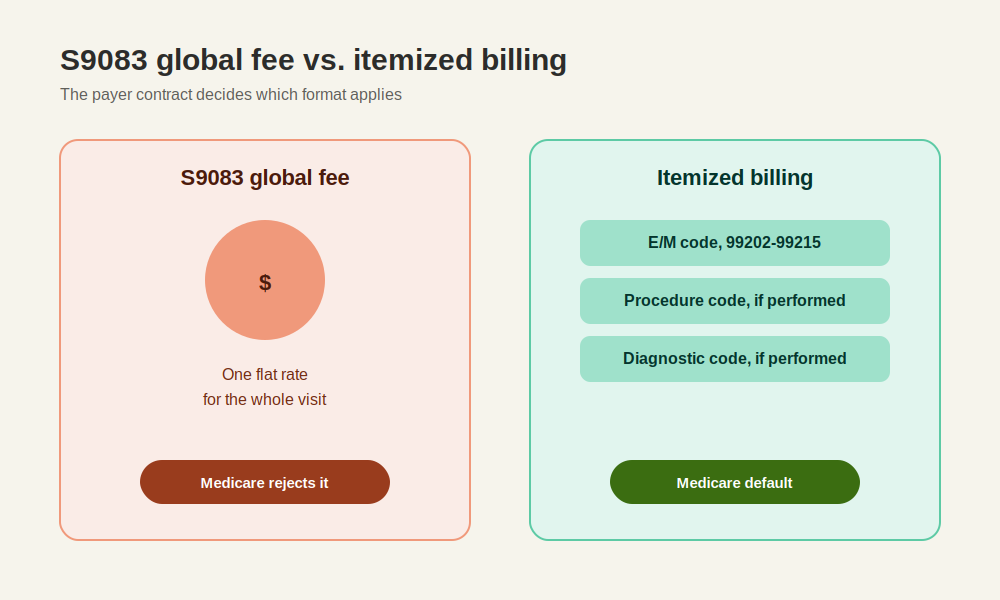
S9088 is different. It’s an add-on code “services provided in an urgent care center, listed in addition to the code for service” that has to accompany a standard E/M code rather than replace it. It exists to recognize that urgent care carries higher overhead than a routine scheduled office visit. Not every payer recognizes it, and some that do treat it as informational only, paying nothing on the line even though it appears “accepted.”
Medicare recognizes neither one. S-codes sit entirely outside the Medicare Physician Fee Schedule; a traditional Medicare claim carrying S9083 gets rejected outright rather than denied. That distinction matters operationally a rejected claim never enters an appeals workflow, so if your practice management system auto-populates S9083 on every visit, Medicare claims need to be routed around that default or they fail silently with no remittance to chase.
Which format wins financially
Because S9083 pays a flat case rate, centers with a heavy procedure mix lots of laceration repairs, splinting, imaging typically collect less under a global fee than they would billing itemized E/M plus procedure codes. Centers with mostly low-acuity visits sometimes come out ahead under a case rate. The only way to know for certain is to model your own procedure mix against both formats before accepting a contract term, because the answer isn’t the same for every practice.
Build a payer-by-payer billing grid
Because the correct format is a contract decision, not a coding decision, the practical fix is a maintained reference one row per payer — answering:
- Does this contract require S9083, or does it want itemized E/M?
- Is S9088 recognized and actually paid, or informational only?
- What place of service does this payer expect loaded on the claim?
- Does this payer apply its own reduction to the E/M line even with modifier 25 attached?
- What’s the filing deadline, and what’s the appeal deadline if that’s missed?
Submitting the wrong format to a payer that has a firm contractual preference is a fully preventable denial but it’s preventable only at the contracting and front-office level, since no coder reviewing a chart after the fact can infer which format a specific payer contract requires.
Place of Service: POS 20 and Why “Facility” in the Name Is Misleading
CMS defines POS 20 as a location distinct from a hospital emergency room, physician office, or clinic, whose purpose is treating unscheduled ambulatory patients who need immediate attention. Despite the word “facility” appearing in its formal name Urgent Care Facility POS 20 is paid using non-facility rate logic on the Medicare fee schedule, the same payment logic used for a standard physician office visit. That naming mismatch causes real confusion for billing teams accustomed to assuming “facility” means facility-rate reimbursement.
| POS Code | Setting | When Urgent Care Uses It |
|---|---|---|
| POS 11 | Physician office | When a payer contract has the practice loaded as an office rather than urgent care |
| POS 19 | Off-campus outpatient hospital department | Hospital-owned urgent care not on the main campus |
| POS 20 | Urgent care facility | Independent, freestanding urgent care the default setting |
| POS 22 | On-campus outpatient hospital department | Hospital-owned urgent care located on the hospital campus |
| POS 23 | Hospital emergency room | Never appropriate for freestanding urgent care |
| POS 02 / POS 10 | Telehealth, not in patient’s home / in patient’s home | Virtual urgent care visits |
POS goes in Box 24B on a CMS-1500 paper claim, or in the SV105 data element of Loop 2400 on an 837P electronic claim — and it’s entered per service line, so a single claim can carry different POS codes on different lines if needed.
Modifier 25: The Most Consequential Modifier in Urgent Care, and Where 2026 Scrutiny Is Landing
Urgent care performs a minor procedure alongside an E/M visit constantly a wound check that turns into a repair, a sprain evaluation that turns into a splint. Modifier 25 is what allows the E/M to be billed separately from that same-day procedure, and it’s also one of the most scrutinized modifiers in outpatient billing heading into the back half of 2026.
When it applies: the E/M must come from the same clinician, on the same day as another billable procedure, for the same patient, and it must represent a significant, separately identifiable service work that goes beyond the usual pre- and post-procedure work already bundled into the procedure code itself.
A persistent misconception worth correcting: modifier 25 does not require a different diagnosis code on the E/M line than on the procedure line. CMS guidance is explicit that the same diagnosis can support both lines, as long as the documentation shows the evaluation stood on its own clinically a patient who came in for a laceration but was also evaluated and treated for an unrelated cough is one example, but a single-problem visit where the workup clearly exceeded the procedure’s built-in evaluation is equally valid.
Placement matters: modifier 25 goes on the E/M code, never on the procedure code. Reversing the two produces a claim that either bundles incorrectly or gets returned for correction rather than paid.
Why 2026 raises the stakes: federal oversight has specifically flagged the pattern of E/M services billed alongside minor procedures with modifier 25 either missing when it should be present, or present without documentation to support it. The exposure genuinely runs in both directions over-applying the modifier without support draws outlier scrutiny, but omitting it when it’s warranted just quietly bundles the E/M into the procedure and the revenue disappears without any denial to flag it. The only real defense is a periodic internal review comparing modifier-25 usage rates against documentation, done before a payer or contractor runs that same review unprompted.
CLIA-Waived Testing and the QW Modifier
On-site rapid testing strep, flu, urinalysis, glucose, pregnancy — is core to how urgent care operates as a business, and it comes with its own modifier rule that trips up billing teams constantly.
Modifier QW tells a payer that a specific test was run under CLIA-waived status. Most Medicare Administrative Contractors deny the line without it on codes that require it 87880 (strep), 87804 (flu), and 81003 (automated urinalysis) among them. But a short list of tests is inherently waived and needs no QW at all, including 81002 (manual urinalysis), 82962 (home-use glucose meters), and 85013 (spun microhematocrit). Appending QW to codes that don’t need it is a surprisingly common charge-master error worth auditing out.
The practical takeaway: QW isn’t a blanket “this is a waived test” flag it applies line by line, code by code, and the list of which codes need it changes periodically as CMS adds newly waived tests.
Telehealth for Virtual Urgent Care in 2026
A permanent telemedicine CPT code family (98000–98016) replaced the older telephone-only codes effective January 1, 2025. It splits into synchronous audio-video codes, synchronous audio-only codes, and a brief check-in code (98016) for five-to-ten-minute virtual touchpoints with an established patient.
Here’s the catch that trips practices up: Medicare assigns most of that new code family an invalid payment status only 98016 is actually payable under the physician fee schedule. For Medicare patients, virtual urgent care still bills the familiar 99202–99215 E/M codes with a telehealth place of service (POS 02 or POS 10) rather than the new code family. Commercial and Medicaid payer adoption of the newer codes varies by plan, so it’s worth confirming before building a virtual-visit workflow around them.
Telehealth flexibilities that expanded access during recent years have been extended through the end of 2027 under current law, with a scheduled return of geographic and originating-site restrictions afterward (permanently exempting behavioral health). Any virtual urgent care program built on current flexibility is operating on a timeline, and it’s worth modeling now rather than reacting when the rules shift.
Can Urgent Care Bill G2211? Almost Never
G2211 is a HCPCS add-on code meant to recognize the added complexity of an ongoing, longitudinal relationship between a clinician and patient the kind of relationship a primary care provider builds over years, not the kind a walk-in encounter typically represents. CMS’s own guidance names simple virus treatment, seasonal allergy counseling, and fracture care as examples where the add-on is not appropriate a description that covers most of an average urgent care day.
There’s also a direct structural conflict: G2211 is denied whenever the accompanying E/M carries modifier 25 for the same patient and date, and urgent care bills modifier 25 constantly given how often a same-day procedure accompanies the visit. The narrow exception is a center that genuinely functions as a patient’s ongoing source of care common in some rural or underserved markets but that requires an affirmative, documented rationale, not a default EHR setting applied to every encounter.
What Changed for Urgent Care Payment in 2026
A few structural shifts are worth tracking on your own reimbursement dashboards this year:
- Two Medicare conversion factors exist for the first time. Practitioners in a qualifying Advanced Alternative Payment Model are paid at a higher rate than everyone else billing the identical code in the identical locality a genuinely new wrinkle in fee schedule math.
- A negative efficiency adjustment applies to non-time-based work RVUs. Because it specifically excludes time-based codes which covers E/M services urgent care absorbs less of this cut than procedure-heavy specialties, since procedure and diagnostic lines carry more of the reduction than the visit line does.
- The Medicare Part B deductible increased for 2026, pushing more early-year encounters fully onto patient responsibility before Medicare coverage kicks in. In a walk-in setting with no scheduled follow-up to fall back on, that makes point-of-service collection in January and February meaningfully more important than later in the year.
For a broader view of how these annual payment shifts flow through an entire practice’s cash position not just urgent care specifically see our complete guide to revenue cycle management for healthcare providers.
Why Urgent Care Claims Get Denied — and Where the Pattern Actually Sits
Industry benchmarking has consistently placed average initial claim denial rates above 11% across hospitals and physician practices in recent years, and urgent care’s walk-in structure creates a few denial patterns that are more concentrated here than in scheduled specialties.
Eligibility denials dominate. With no pre-visit scheduling window, there’s no opportunity to verify coverage days in advance the only chance is at check-in, in real time, on a day when the waiting room is already full. Skipping that step even occasionally is where “expenses incurred after coverage terminated” denials come from, and it’s a workflow fix, not a training fix: real-time eligibility, every patient, every visit, no exceptions for familiar faces.
Bundling denials cluster around modifier 25. An E/M billed without modifier 25 alongside a same-day procedure or a 99211 billed alongside an injection administration code that already includes the nursing work are the two most common triggers.
Missing-modifier denials show up on the lab and E/M lines. A waived test line missing QW, or a same-day E/M missing modifier 25, both produce a “procedure inconsistent with modifier, or modifier missing” denial that requires a corrected claim rather than an appeal.
Medical necessity denials trace to documentation depth, not code choice. A level-four visit supported by a level-two note reads as unsupported to a reviewer regardless of whether the code itself was technically correct.
Because filing deadlines vary meaningfully by payer and because a missed deadline forecloses the claim entirely regardless of whether the underlying denial was fixable it’s worth keeping your timely filing windows next to your denial tracker. Medicare’s own filing rule, along with how to recover a claim that slips past it, is covered in our Medicare timely filing limit guide, and payer-specific windows are broken down in our BCBS timely filing limit guide by plan and state.
Denials in urgent care don’t scatter evenly across dozens of causes they cluster tightly around two or three recurring codes per center. Working each denial individually fixes one claim at a time; identifying the two or three root causes behind most of them stops the next quarter’s worth before they’re ever filed.
Front-End Eligibility: Where Urgent Care Revenue Actually Gets Won or Lost
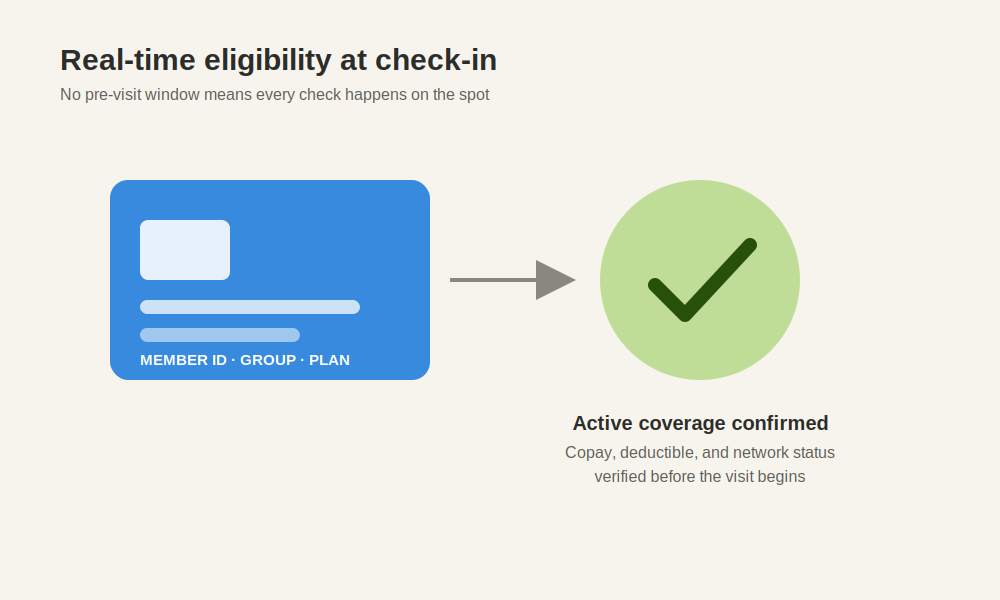
Eligibility verification and benefit verification answer two different questions, and urgent care needs both.
Eligibility verification confirms the plan is active. Benefit verification confirms what the visit type actually costs the patient deductible remaining, the specific copay for an urgent care encounter (which is frequently different from a standard office-visit copay on the same plan), coinsurance, and in-network status for that exact plan and provider.
That last point matters more than it sounds: a provider can be in-network for one plan and out-of-network for a different plan from the same insurance company. That single gap causes more balance-billing disputes at urgent care front desks than coding errors do.
Because there’s no scheduled return visit to fall back on if a balance goes uncollected at the time of service, urgent care has a narrower window than almost any other specialty to estimate and collect patient responsibility ideally at check-in, not at checkout, and never left to a mailed statement weeks later.
Urgent Care Billing FAQs
What CPT codes does urgent care bill most often? Office and outpatient E/M codes (99202–99205 new, 99211–99215 established) carry the majority of claims, supported by procedure codes like 12001 for simple laceration repair, diagnostic codes like 71046 and 87880, and administration codes like 96372 and 90471. Some payer contracts replace the E/M code entirely with HCPCS S9083.
Is S9083 a CPT code? No it’s a HCPCS Level II code, despite frequently being searched as a “CPT code.” Medicare does not recognize S-codes at all, so a Medicare claim carrying S9083 is rejected rather than denied.
What’s the difference between S9083 and S9088? S9083 replaces the E/M code with a single flat global fee for the entire visit. S9088 is an add-on that has to accompany a standard E/M code it can’t stand alone, and it isn’t recognized or paid by every payer that technically accepts it on a claim.
Do I need modifier QW on every CLIA-waived test? No. Most waived tests need QW to be recognized by Medicare including 87880 and 87804 but a short list of tests are inherently waived and shouldn’t carry QW at all, including 81002, 82962, and 85013.
Can urgent care bill emergency department codes (99281–99285)? No. CMS is explicit that emergency department E/M coding is inappropriate outside an actual emergency department setting. Freestanding urgent care bills office and outpatient E/M with POS 20 instead, regardless of acuity.
Does modifier 25 require a different diagnosis code? No this is one of the most persistent misconceptions in outpatient coding. What’s required is that the E/M represent a significant, separately identifiable service beyond the procedure’s built-in evaluation work, not a different ICD-10 code.
What place of service code does freestanding urgent care use? POS 20. It’s paid at the non-facility rate despite the word “facility” appearing in its official CMS name a naming quirk that causes genuine confusion for billing staff.
A Working Checklist for Getting Urgent Care Claims Paid
- Build a payer-by-payer grid documenting whether each contract requires S9083, recognizes S9088, and what POS and modifier-25 policies apply.
- Confirm no Medicare claims are auto-populating S9083 by default in your practice management system.
- Pull a modifier-25 usage rate by provider and compare it against your own historical baseline quarterly.
- Audit your QW modifier usage confirm it’s applied where required and removed where a test is inherently waived.
- Sort last quarter’s denials by reason code and identify your top three root causes rather than working each claim in isolation.
- Move eligibility and benefit verification to real time at check-in, with no exceptions for returning patients.
Urgent care is one of the only outpatient settings where a single visit could correctly be billed three different ways a flat global fee, an itemized E/M encounter, or an institutional clinic visit depending entirely on the contract sitting in a file most billing staff have never read closely. Getting that one decision right, before the claim goes out, prevents more denials than any downstream fix ever will.
Credexa Solutions provides medical billing, credentialing, denial management, and AR follow-up services for physician practices and urgent care centers. If your team is spending more time chasing denials than seeing patients, get in touch for a claims and payer-contract review.