
By Credexa Solutions | Revenue Cycle Management for Healthcare Providers
Imaging is one of the highest-volume, highest-denial-risk service lines in healthcare billing. A single missed contrast detail, a dropped laterality modifier, or an outdated code range pulled from an old cheat sheet can turn a clean claim into a denial. At Credexa Solutions, we manage radiology billing and coding for practices that can’t afford that kind of revenue leakage so this guide reflects exactly how our coding and denial-management teams work these claims every day.
Below is the complete, corrected 2026 radiology CPT code list, organized by modality, along with the contrast rules, modifier logic, and denial patterns that determine whether a radiology claim gets paid the first time.
Table of Contents
- What Are Radiology CPT Codes?
- Radiology CPT Code Ranges: The 2026 Breakdown
- What Actually Determines a Radiology Code
- Radiology CPT Codes List by Modality (2026)
- Contrast Billing Rules: Without, With, and Without-and-With
- Modifier 26 vs. Modifier TC Explained
- Other Radiology Modifiers to Know
- What’s New in Radiology CPT Codes for 2026
- Codes That Were Retired — Stop Billing These
- Prior Authorization Rules for Imaging
- Top Radiology Denial Reasons and How to Prevent Them
- How Credexa Solutions Supports Radiology Billing
- FAQs
<a name=”what-are-radiology-cpt-codes”></a>
What Are Radiology CPT Codes?
Radiology CPT codes are the five-digit procedure codes, maintained by the American Medical Association, that report diagnostic imaging, image-guided procedures, and radiation therapy on a healthcare claim. They fall inside the 70010–79999 range of the CPT code set, and they tell the payer exactly which imaging service was performed and how.
Every radiology claim actually depends on two coding systems working together: ICD-10-CM explains the clinical reason imaging was ordered, and CPT explains what was actually done. If the two don’t logically support each other, the claim is a denial risk regardless of how accurately either code was selected on its own.
This isn’t limited to radiology groups and imaging centers. Cardiology, orthopedics, urology, oncology, and emergency medicine practices that read their own films also bill directly from this code range which means radiology coding accuracy affects far more specialties than most billing teams assume.
<a name=”radiology-cpt-code-ranges”></a>
Radiology CPT Code Ranges: The 2026 Breakdown
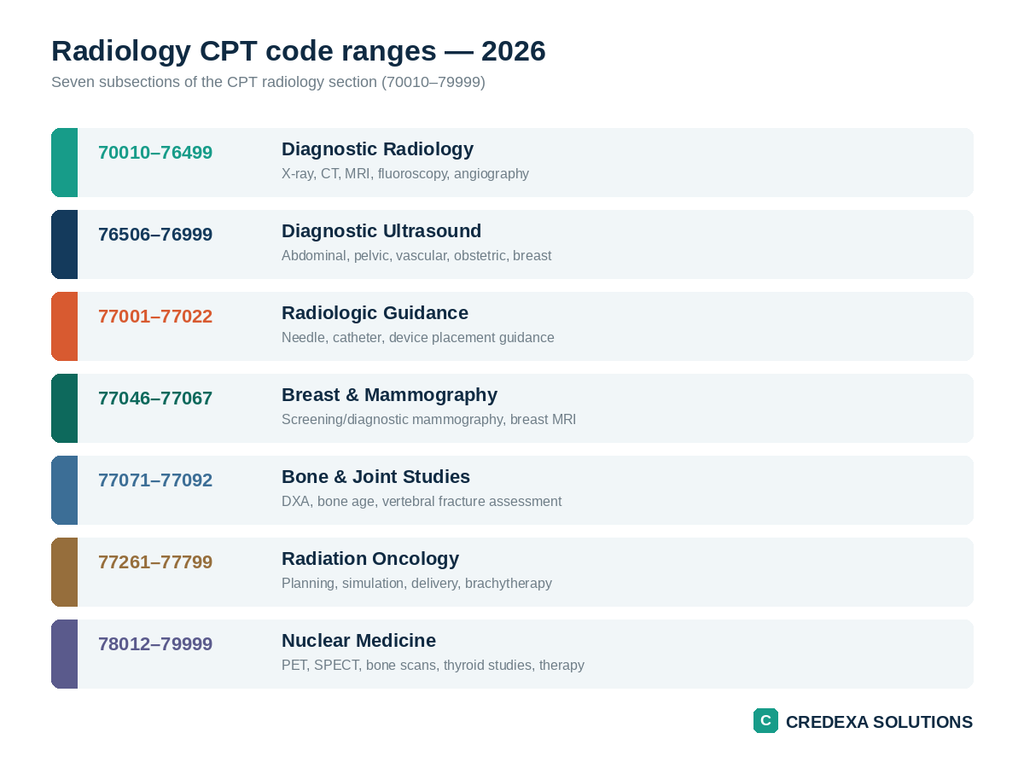
The CPT radiology section is divided into seven subsections. A surprising number of billing references online still list two of these ranges incorrectly, which is worth flagging before we go further.
| Range | Subsection | Covers |
|---|---|---|
| 70010–76499 | Diagnostic Radiology | X-ray, CT, MRI, fluoroscopy, angiography |
| 76506–76999 | Diagnostic Ultrasound | Abdominal, pelvic, vascular, obstetric, breast |
| 77001–77022 | Radiologic Guidance | Needle, catheter, and device placement guidance |
| 77046–77067 | Breast & Mammography | Screening/diagnostic mammography, breast MRI |
| 77071–77092 | Bone & Joint Studies | DXA, bone age, vertebral fracture assessment |
| 77261–77799 | Radiation Oncology | Planning, simulation, delivery, brachytherapy |
| 78012–79999 | Nuclear Medicine | PET, SPECT, bone scans, thyroid studies, therapy |
Two corrections worth making now: Radiologic guidance does not extend to 77032 that range was retired back in 2014 and folded into the breast biopsy and localization codes (19081–19086, 19281–19288). And nuclear medicine does not begin at 78000 those codes were consolidated into 78012–78014 more than a decade ago. If either range still appears on your internal templates, it’s inherited from an outdated source, and it will fail against a current payer edit.
<a name=”five-variables”></a>
What Actually Determines a Radiology Code
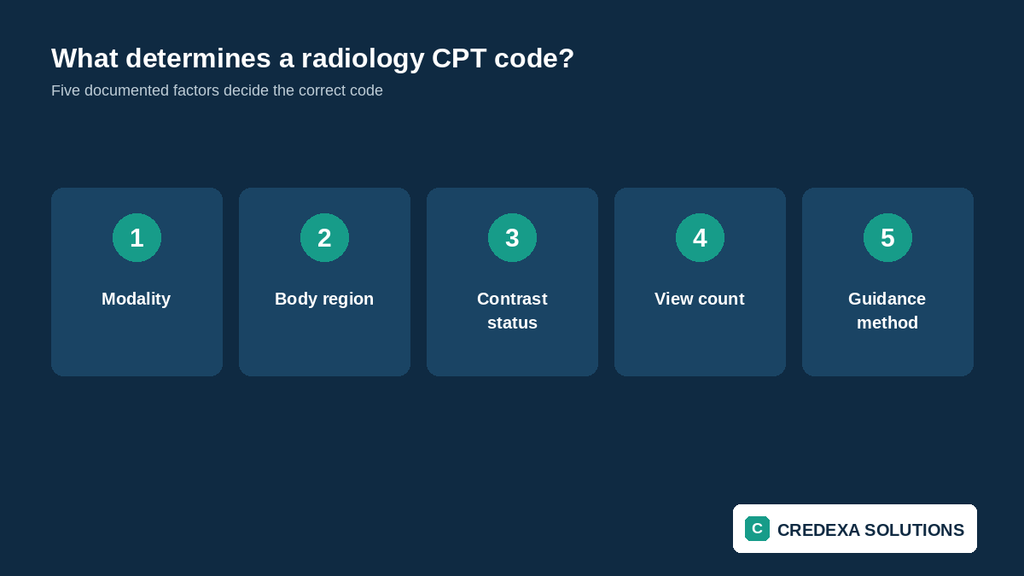
Five documented factors decide which radiology CPT code applies to a given study:
- Modality — X-ray, CT, MRI, ultrasound, nuclear medicine, or fluoroscopy
- Body region — head, chest, spine, abdomen, pelvis, extremity, etc.
- Contrast status — without, with, or without-then-with
- View count — for plain film studies specifically
- Guidance method — fluoroscopic, CT, MRI, or ultrasound guidance, many of which bundle into the primary code
The single most important rule in radiology coding: the radiologist’s report governs code selection, not the order. If the order says non-contrast and the final report documents contrast administration, the code follows the report every time. Coders who work from the order alone routinely miss this, and it’s one of the most common root causes behind coding-related denials that Credexa Solutions identifies during claim audits.
<a name=”codes-by-modality”></a>
Radiology CPT Codes List by Modality (2026)
Common X-Ray CPT Codes
| Code | Study |
|---|---|
| 71045 | Chest X-ray, single view |
| 71046 | Chest X-ray, 2 views |
| 71047 | Chest X-ray, 3 views |
| 71048 | Chest X-ray, 4+ views |
| 72040 | Cervical spine, 2–3 views |
| 72100 | Lumbar spine, 2–3 views |
| 73030 | Shoulder, complete, min. 2 views |
| 73130 | Hand, min. 3 views |
| 73562 | Knee, 3 views |
| 73630 | Foot, complete, min. 3 views |
Unilateral extremity X-rays require the LT or RT modifier Medicare and most commercial payers reject these claims without one.
CT CPT Codes by Contrast Status
| Body Region | Without | With | Without & With |
|---|---|---|---|
| Head/brain | 70450 | 70460 | 70470 |
| Soft tissue neck | 70490 | 70491 | 70492 |
| Chest | 71250 | 71260 | 71270 |
| Cervical spine | 72125 | 72126 | 72127 |
| Abdomen & pelvis | 74176 | 74177 | 74178 |
| CTA head & neck, combined (new 2026) | — | 70471 | — |
| CT cerebral perfusion (new 2026) | — | 70472 / 70473 | — |
MRI CPT Codes by Contrast Status
| Body Region | Without | With | Without & With |
|---|---|---|---|
| Brain | 70551 | 70552 | 70553 |
| Cervical spine | 72141 | 72142 | 72156 |
| Lumbar spine | 72148 | 72149 | 72158 |
| Pelvis | 72195 | 72196 | 72197 |
| Abdomen | 74181 | 74182 | 74183 |
| Breast, unilateral | 77046 | — | 77048 |
Note that 74183 (MRI abdomen, without/with contrast) is frequently confused with the CT abdomen/pelvis contrast codes (74176–74178). They are different modalities with different reimbursement mixing them up is a recurring audit finding.
Common Ultrasound CPT Codes
| Code | Study |
|---|---|
| 76700 | Abdomen, complete |
| 76705 | Abdomen, limited or follow-up |
| 76856 | Pelvic, non-obstetric, complete |
| 76857 | Pelvic, non-obstetric, limited |
| 76641 | Breast ultrasound, unilateral, complete |
| 76642 | Breast ultrasound, unilateral, limited |
A “complete” abdominal ultrasound (76700) requires documented imaging of the liver, gallbladder, common bile duct, pancreas, spleen, both kidneys, upper abdominal aorta, and inferior vena cava. Missing even one element downgrades the study to 76705 bowel gas obscuring a structure doesn’t change that rule.
Mammography & Breast Imaging CPT Codes
| Code | Study |
|---|---|
| 77067 | Screening mammography, bilateral, with CAD |
| 77065 | Diagnostic mammography, unilateral |
| 77066 | Diagnostic mammography, bilateral |
| 77061/77062 | Diagnostic tomosynthesis, unilateral/bilateral |
| 77046–77049 | Breast MRI, unilateral & bilateral |
When a screening mammogram converts to diagnostic on the same day, append modifier GG to the diagnostic code Medicare pays both, but the report must document the specific finding that prompted the conversion.
Nuclear Medicine & PET CPT Codes
| Code | Study |
|---|---|
| 78012–78014 | Thyroid uptake and imaging |
| 78300/78305/78306 | Bone/joint imaging — limited/multiple/whole body |
| 78451/78452 | Myocardial perfusion SPECT |
| 78815/78816 | PET with CT |
Remember: the radiopharmaceutical bills separately under its own HCPCS code. A claim that omits it walks away from the cost of an isotope the practice already purchased and administered.
<a name=”contrast-rules”></a>
Contrast Billing Rules: Without, With, and Without-and-With
Contrast misclassification is one of the most frequent sources of radiology denials and payer audit findings. Three rules apply consistently:
- Only intravenous contrast counts. Oral or rectal contrast does not qualify a study for a “with contrast” code.
- The final report governs, not the original order if they disagree, the report wins.
- Contrast ordered but not administered (due to allergy or renal concerns) bills as the without-contrast code, regardless of original intent.
<a name=”modifier-26-vs-tc”></a>
Modifier 26 vs. Modifier TC Explained
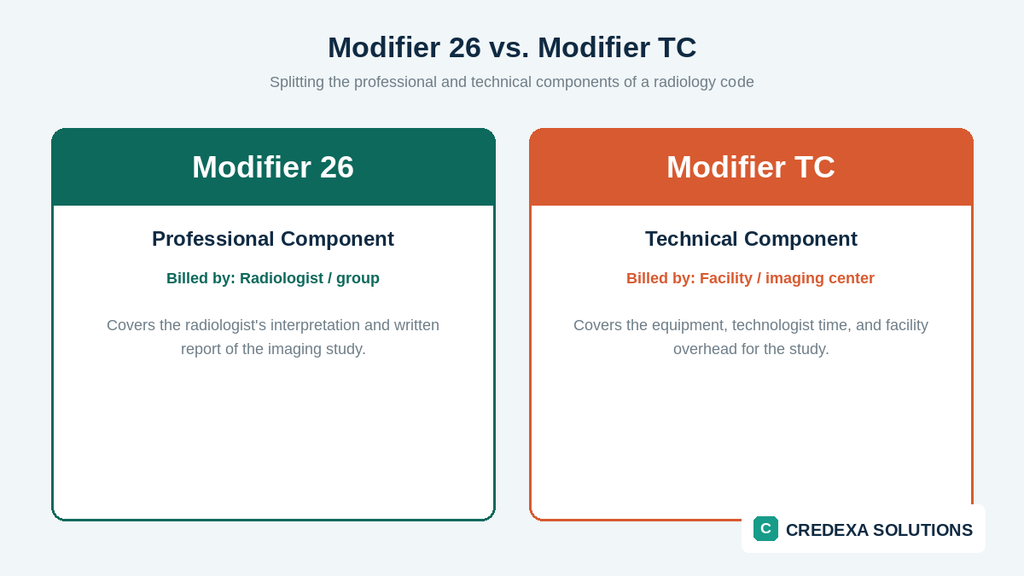
Most radiology CPT codes split into a technical component (equipment, technologist time, facility overhead) and a professional component (the radiologist’s interpretation and written report).
| Scenario | Modifier | Who Bills |
|---|---|---|
| One entity owns equipment and interprets | None — bill globally | The practice |
| Radiologist interprets only, facility owns equipment | 26 | Radiologist/group |
| Facility owns equipment, outside radiologist reads | TC | Facility/imaging center |
Appending 26 or TC to a global claim (when one entity performs both parts) reduces payment to a fraction of what the study is worth. Always check the PC/TC indicator on the Medicare Physician Fee Schedule before splitting not every code supports a split, and appending a modifier to one that doesn’t just generates a rejection.
<a name=”other-modifiers”></a>
Other Radiology Modifiers to Know
| Modifier | Meaning | Use Case |
|---|---|---|
| 50 | Bilateral procedure | Same study, both sides, same session |
| 59 / XE, XP, XS, XU | Distinct procedural service | Separate anatomic study, same date |
| 76 / 77 | Repeat procedure | Same or different physician, same day |
| LT / RT | Laterality | Required on unilateral extremity studies |
| GG | Screening to diagnostic conversion | Same-day mammography upgrade |
Where an X modifier (XE, XP, XS, XU) applies with equal accuracy to modifier 59, it holds up better on payer review because it names the specific reason two services are distinct rather than leaving the payer to infer it.
<a name=”2026-changes”></a>
What’s New in Radiology CPT Codes for 2026
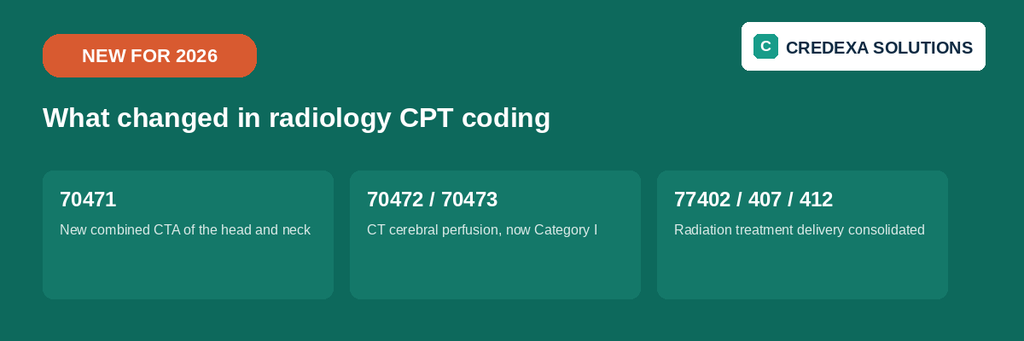
The 2026 CPT code set introduced hundreds of editorial changes, and radiology and interventional radiology absorbed a significant share of them:
- 70471 — new combined CTA of the head and neck
- 70472 / 70473 — CT cerebral perfusion, moved from Category III to Category I
- 37254–37299 — lower extremity revascularization rebuilt from 16 codes into 46, organized by vascular territory and lesion complexity
- 77402, 77407, 77412 — radiation treatment delivery consolidated into three complexity levels, with image guidance bundled in
- 77436–77439 — new surface radiation therapy family
- 47384 / 55877 — irreversible electroporation (liver/prostate) moved from Category III to Category I
CMS also applied a 2.5% efficiency adjustment to work RVUs on non-time-based codes for 2026, and radiology falls inside that group — a factor that affects reimbursement math independent of coding accuracy.
<a name=”deleted-codes”></a>
Codes That Were Retired Stop Billing These
Claims submitted with deleted codes deny automatically, regardless of documentation quality.
| Deleted Code | Replaced By | Invalid Since |
|---|---|---|
| 37220–37235 | 37254–37299 | Jan 1, 2026 |
| 77385, 77386 | 77402, 77407, 77412 | Jan 1, 2026 |
| 77058, 77059 | 77046–77049 | Jan 1, 2019 |
| 77055, 77056, 77057 | 77065, 77066, 77067 | Jan 1, 2017 |
| 76645 | 76641 / 76642 | Jan 1, 2015 |
| 78000–78011 | 78012, 78013, 78014 | Jan 1, 2013 |
A chargemaster and order-set audit against the current code set catches these before a payer does and it’s one of the fastest denial-prevention wins available to any imaging practice.
<a name=”prior-auth”></a>
Prior Authorization Rules for Imaging
Most commercial payers route advanced imaging through a radiology benefit manager with its own authorization code list, separate from the CPT calendar.
| Service | Typically Requires Auth? |
|---|---|
| Plain film X-ray | Rarely |
| Ultrasound | Rarely |
| CT / MRI, outpatient | Usually |
| PET | Nearly always |
| Interventional radiology | Nearly always |
Authorization must be active on the date of service. An approval that expired between scheduling and the visit denies the same as if no authorization existed at all and by that point, the claim has no coding fix available. This is exactly why authorization tracking belongs at scheduling, not billing.
<a name=”denials”></a>
Top Radiology Denial Reasons and How to Prevent Them
| Denial Cause | Root-Cause Fix |
|---|---|
| Wrong contrast code billed | Pull contrast status from the final report, not the order |
| Missing component modifier | Set modifier rules by billing entity + place of service |
| Duplicate global billing | Written component agreement between facility and reading group |
| Guidance code unbundled | Check the current-quarter NCCI edit file before submission |
| Missing laterality | Flag unilateral extremity codes lacking LT/RT pre-submission |
| Diagnosis doesn’t support the study | Work with ordering providers on documentation specificity |
| No active prior authorization | Verify at scheduling; track expiration through the date of service |
| Deleted code submitted | Annual chargemaster audit against the current CPT set |
Fixing one denied claim solves one claim. Categorizing denials by root cause and routing the fix to whoever can prevent the repeat the front desk, the coder, or the ordering provider is what actually moves a practice’s denial rate.
<a name=”credexa-support”></a>
How Credexa Solutions Supports Radiology Billing

Radiology billing carries more moving parts than almost any other specialty: component splits between facilities and reading groups, contrast-driven code selection, quarterly NCCI edit updates, and payer-specific prior authorization rules that change independently of the CPT calendar.
At Credexa Solutions, our team handles the full radiology revenue cycle so imaging groups, hospital outpatient departments, and ordering specialties don’t have to track all of it in-house:
- Eligibility verification and benefit checks before the study is performed
- Prior authorization tracking, including expiration monitoring against the date of service
- Coding review built from the radiologist’s final report, not the original order
- Claim scrubbing against the current-quarter NCCI edit set before submission
- Payment posting and reconciliation
- Root-cause denial management, not just claim-by-claim appeals
- Monthly reporting by payer and denial category
If you want to see how these principles apply across the entire billing cycle not just radiology our companion guide on Revenue Cycle Management (RCM): Complete Guide for Healthcare Providers walks through every stage from scheduling to final collection.
Ready to see where your radiology claims are leaking revenue? Get in touch with the Credexa Solutions team for a claims review.
<a name=”faqs”></a>
FAQs
What is the CPT code range for radiology services? Radiology CPT codes run from 70010 to 79999, divided into seven subsections: diagnostic radiology, diagnostic ultrasound, radiologic guidance, breast and mammography, bone and joint studies, radiation oncology, and nuclear medicine.
What is the difference between modifier 26 and modifier TC? Modifier 26 reports the professional component the radiologist’s interpretation and report. Modifier TC reports the technical component equipment, technologist time, and facility overhead. When one entity performs and bills both, the code is billed globally with no modifier.
Do radiology CPT codes change every year? Yes. The AMA releases an updated CPT code set every January 1. Deleted codes deny automatically starting with the first claim of the new year, so chargemasters and order sets need an annual review.
Does radiology imaging always require prior authorization? It depends on the modality and payer. CT, MRI, PET, and nuclear cardiology usually require authorization through a radiology benefit manager. Plain film X-ray and most ultrasound studies rarely do.
What are the most commonly billed radiology CPT codes? High-volume codes include 71046 (chest X-ray, 2 views), 74177 (CT abdomen/pelvis with contrast), 70553 (MRI brain without and with contrast), and 76700 (complete abdominal ultrasound).
Credexa Solutions specializes in end-to-end revenue cycle management for healthcare providers, including radiology and imaging billing. Visit credexasolution.com to learn how our team keeps radiology claims moving from eligibility verification through final payment posting.
Sources & further reading: American Medical Association, Centers for Medicare & Medicaid Services (CMS), AAPC.