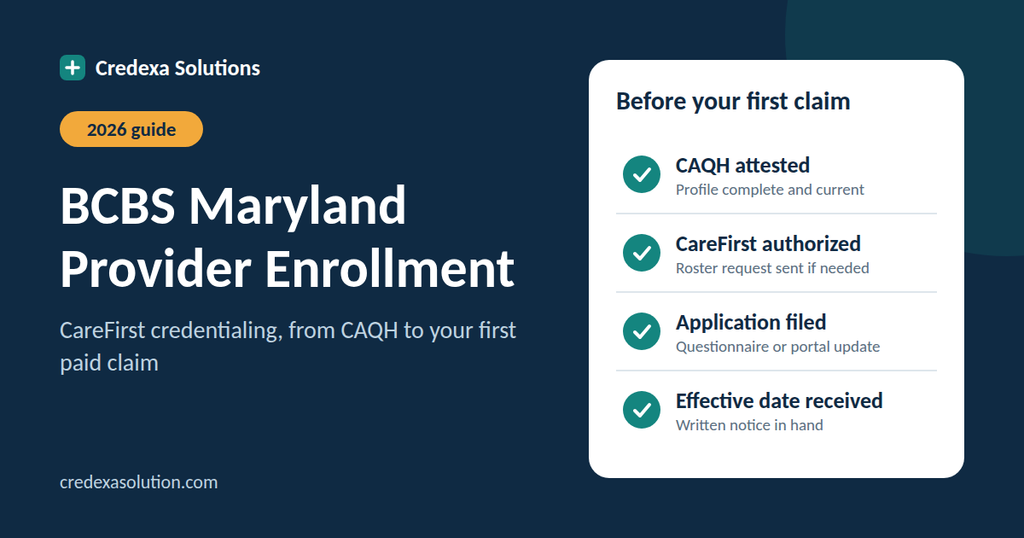
If you want to see Blue Cross patients in Maryland, you will deal with one company: CareFirst BlueCross BlueShield. BCBS Maryland provider enrollment is CareFirst enrollment, and the process has more moving parts in 2026 than it used to. There are separate applications for commercial plans, Medicare Advantage, Medicaid, dental, and facilities. Maryland’s Medicaid portal is changing. A new state law will tighten carrier deadlines in 2027.
This guide walks you through the whole process, from your first CAQH login to your first paid claim. It also covers the part most enrollment guides skip. Many “claim denials” are enrollment mistakes in disguise, and many others come from coding mistakes. We show how both get fixed before they cost you revenue.
BCBS Maryland Provider Enrollment at a Glance
| Question | Short answer |
|---|---|
| Who is BCBS in Maryland? | CareFirst BlueCross BlueShield, which also covers Washington, D.C., and Northern Virginia |
| How do professionals apply? | Attest your CAQH ProView (DataSpring) profile, then submit the CareFirst Questionnaire for your provider type |
| How do I add a clinician to an existing group? | Use Provider Updates and Attestation in the CareFirst Direct portal |
| Credentialing phone numbers | 877-269-9593 or 410-872-3500 |
| Current Maryland decision timeline | Notice within 30 days of a complete application, then a decision within 120 days |
| Timeline from January 1, 2027 | 15 days for notice and 60 days for the decision, with the application fee repealed |
| Recredentialing | Every 3 years; a current CAQH profile covers it |
| Directory updates | Every 90 days |
Confirm these details with CareFirst before you file.
Is BCBS of Maryland the Same as CareFirst?
Yes. CareFirst is an independent, nonprofit licensee of the Blue Cross and Blue Shield Association. It holds the Blue license for Maryland, Washington, D.C., and Northern Virginia. There is no second “Maryland Blue” company, so searches for “Blue Cross Blue Shield of Maryland provider enrollment” all lead to CareFirst.
You will see several legal entity names on contracts and remittances. CareFirst BlueCross BlueShield is the shared business name of CareFirst of Maryland, Inc. and Group Hospitalization and Medical Services, Inc. (GHMSI). Other entities include CareFirst BlueChoice, Inc., Medicare Advantage entities, and a Medicaid plan called CareFirst Community Health Plan Maryland (CHPMD). Your billing team should match the entity on the patient’s card to the right payer ID and claim rules. Posting payments or appealing denials against the wrong entity is a common source of delays.
Where CareFirst Ends and Anthem Begins
CareFirst’s Virginia territory is limited to Northern Virginia. That includes Arlington County, the cities of Alexandria and Fairfax, the Town of Vienna, and parts of Fairfax and Prince William counties. The rest of Virginia belongs to Anthem Blue Cross and Blue Shield. Anthem does not hold the Blue license in Maryland, so there is no Anthem BCBS Maryland commercial network to join. (Elevance Health, Anthem’s parent, does operate in Maryland Medicaid under a different brand.)
If your practice crosses state lines, plan separate enrollments for each Blue plan. Each Blue company credentials on its own, and participation with one does not carry over to another. The Blue Cross Blue Shield Association’s member company directory can help you find the right plan for each state.
Which CareFirst Network Should You Join?
Professionals can join BlueChoice, the Regional Participating Preferred Network (RPN), or both. A commercial approval does not cover Medicare Advantage, Medicaid, dental, or facility networks. Each uses its own application.
| You are | You want to bill | How you apply |
|---|---|---|
| Solo practitioner or new group | Commercial (BlueChoice, RPN, or both) | CAQH, then the CareFirst Questionnaire |
| Practitioner joining an existing CareFirst group | Same networks as the group | Provider Updates and Attestation in CareFirst Direct |
| Medicare-enrolled practitioner | CareFirst Medicare Advantage | Separate agreement or network addendum |
| Practitioner seeing HealthChoice members | Medicaid (CHPMD) | Maryland Medicaid enrollment first, then CAQH and the CHPMD questionnaire |
| Dentist | CareFirst dental networks | CAQH or the Dental Provider Application |
| Facility or ancillary provider | Institutional networks | Request for Information Application plus a Facility Data Sheet per location |
The Same-Network Rule for Groups
CareFirst requires all providers in the same practice to participate in the same networks. You cannot put one physician in BlueChoice and a partner only in RPN. If CareFirst terminates one practitioner, the group’s participation can be affected too.
The practical lesson: start a new hire’s application before their first day. If they see CareFirst members before the effective date, those claims can process out of network or deny.
Blue Members From Other States and FEP
Patients with Blue coverage from other states reach you through the BlueCard program, with CareFirst acting as your local plan. Being in network with CareFirst puts you in network for those patients. Federal Employee Program (FEP) members are also served through the local Blue plan. Always submit the patient’s full ID including the three-character prefix, because CareFirst uses it to route the claim to the member’s home plan.
How BCBS Maryland Provider Enrollment Works, Step by Step
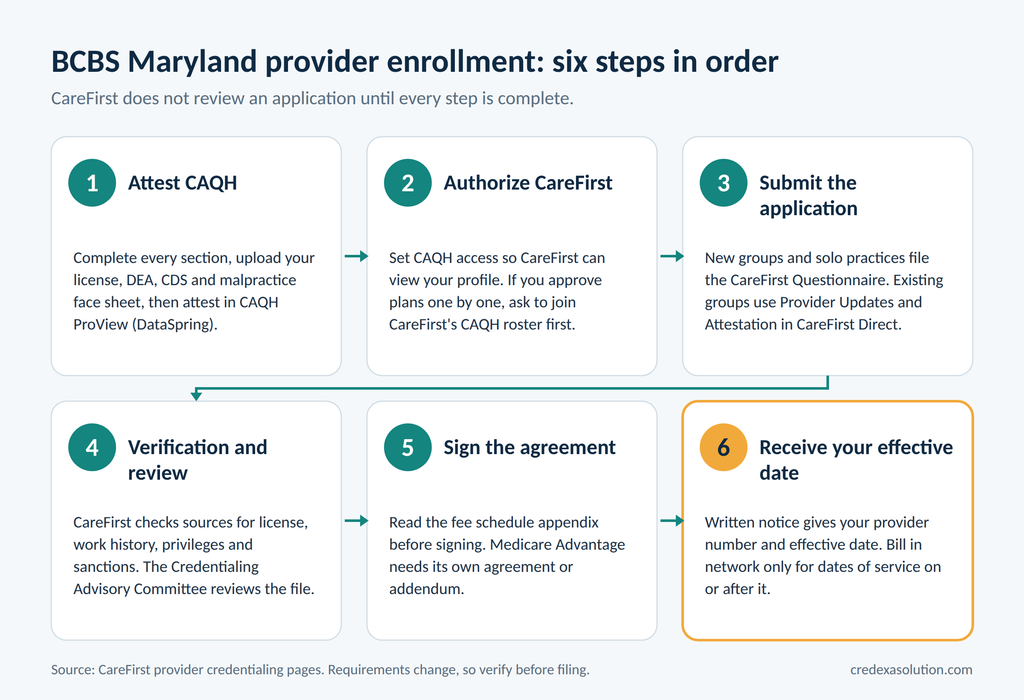
CareFirst will not review an application until every step is complete, so do the steps in order.
Step 1: Build and Attest Your CAQH ProView (DataSpring) Profile
CareFirst enrollment starts in CAQH, which now operates as DataSpring. The login is still proview.caqh.org, and CareFirst’s pages still say “CAQH ProView.” Complete every section and upload your license, malpractice face sheet, DEA, and Maryland controlled dangerous substances (CDS) registration. Then attest. Keep your CAQH ID handy, because the CareFirst Questionnaire asks for it.
CareFirst expects re-attestation about every 120 days and updates whenever your information changes. For a refresher on every profile section, read the CAQH attestation resources at CAQH.
Step 2: Authorize CareFirst
Set your CAQH authorization so CareFirst can view your profile. Some practices configure CAQH to approve each health plan request individually. If that is your setup, CareFirst’s How to Apply page instructs you to email the credentialing status mailbox to request addition to CareFirst’s CAQH roster before you submit. Skip this, and CareFirst may be unable to open a profile you have already finished. That is one of the most common reasons an application sits idle for weeks.
Step 3: Submit the CareFirst Questionnaire or Add the Practitioner
New groups and solo practices submit the CareFirst Questionnaire for their provider type. Ambulance, laboratory, and urgent care providers have their own versions. Have these ready: group Tax ID, billing NPIs, a W-9 (for new groups or solo practices), and electronic copies of licenses and insurance.
Existing groups adding a clinician use a different route. Log in to CareFirst Direct and choose Provider Updates and Attestation. The clinician’s CAQH profile must already list the new practice affiliation. New practices do not apply through the portal.
Step 4: Primary Source Verification and Committee Review
CareFirst verifies your license, DEA and CDS, education, board certification (if applicable), work history, hospital privileges, malpractice history, and sanctions. If the file meets criteria, the Medical Director refers it to the Credentialing Advisory Committee for a recommendation. Answer any CareFirst questions the same day, because a request that sits unanswered adds time to your timeline.
Step 5: Review and Sign the Participation Agreement
Credentialing approval and contracting are separate. Read the fee schedule appendix before signing. That is where your CareFirst rates live, and a missing high-volume code can cost you for years. Medicare Advantage networks need their own agreement or addendum.
Step 6: Receive Your Provider Number and Effective Date
CareFirst sends written notice of acceptance with your provider number and effective date. Save it where your billing team can find it. Do not bill in network for any date of service before that effective date.
Documents and Data to Have Ready
There is no single BCBS Maryland provider enrollment form for professionals. You apply online through CAQH and the questionnaire. PDFs exist for specific tracks, such as the group credentialing application for CHPMD and the Medicare Advantage HMO-SNP, and the facility and dental applications.
Gather these before you start:
- NPIs: a Type 1 NPI for each practitioner and a Type 2 billing NPI for the group
- Tax ID and W-9: for new groups and solo practices
- State license: valid, current, and unrestricted
- DEA and CDS registrations: for prescribers
- Malpractice face sheet: meeting CareFirst’s minimums
- CAQH ID: from your attested profile
- Board certification or training records
- Practitioner roster: each clinician’s CAQH ID or rendering NPI (for groups)
The CHPMD and Medicare Advantage HMO-SNP group form adds more. It asks for a CAQH attestation within the last 120 days, a Model of Care training attestation, five years of work history (with documentation for gaps over six months), hospital privileges for MDs, DOs, and PCPs, and Medicare and Medicaid numbers that are not “pending.”
Malpractice Insurance Minimums
CareFirst’s malpractice requirements depend on practice size and provider type. Smaller practices commonly see $1M/$3M thresholds, larger groups may need higher limits or an excess layer, and mid-level behavioral health and therapy providers have their own tiers. The authoritative source is Chapter 3 of the CareFirst provider manual, so check it rather than relying on a number you saw in a search snippet. On the CHPMD and Medicare Advantage group form, the malpractice face sheet cannot be dated within 45 days of the application date. If your policy renews soon, wait for the renewal face sheet before you submit.
Who Can Apply
CareFirst contracts with a range of licensed practitioners. These include physicians, nurse practitioners, nurse midwives, therapists, psychologists, licensed clinical social workers, and several others. Physician assistants are handled under a separate payment policy rather than the standard credentialing list, so review CareFirst’s policy on limited license providers before you plan PA billing.
Supervised clinicians, such as certain graduate-level behavioral health license types, can join only if their supervisor is independently licensed and actively credentialed with CareFirst.
Criteria That Catch Offices Off Guard
- A minimum number of weekly office hours to see patients
- Active admitting privileges at a participating hospital, unless CareFirst agrees otherwise
- An acceptable malpractice and sanctions record
- A separate application for locum tenens coverage, limited in duration
How Long Does CareFirst Credentialing Take?
CareFirst does not publish a standard turnaround, so Maryland law sets the outer limit.
Maryland’s Clock Today
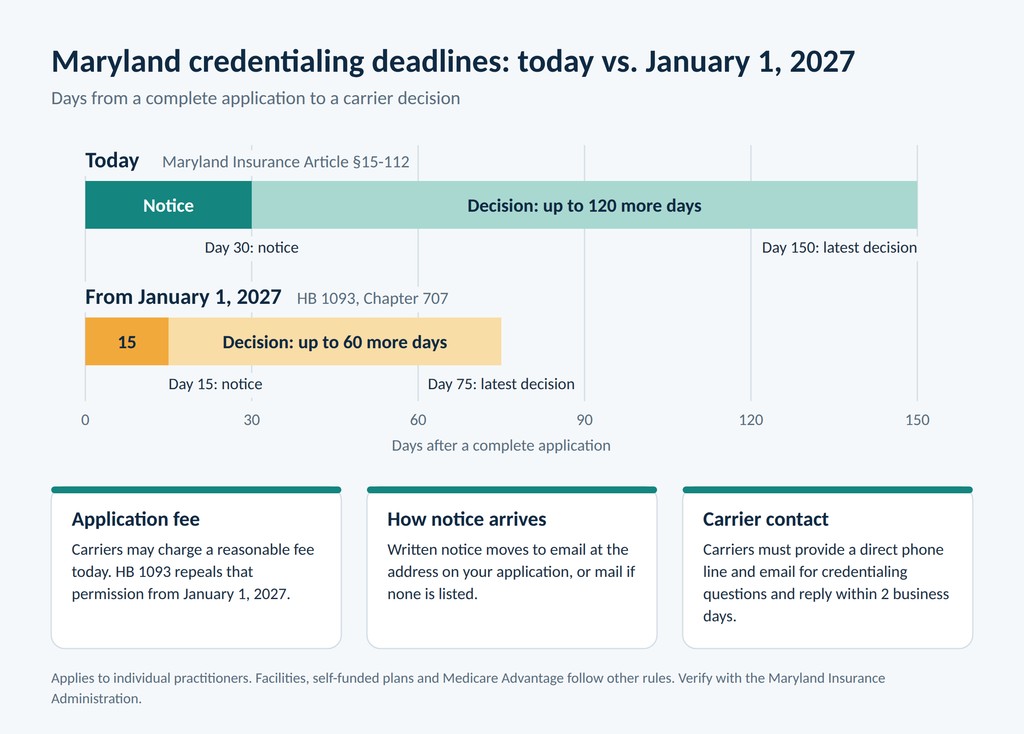
Under Maryland Insurance Article §15-112, a carrier has 30 days after receiving a complete application to send written notice that it will continue processing or is rejecting the provider. If processing continues, the carrier has 120 days from that notice to decide. An incomplete application is returned within 10 days, and the clock does not start until the file is complete. Penalties can apply to carriers that miss deadlines.
The statute protects individual practitioners. Facilities, self-funded employer plans, and Medicare Advantage follow different rules, and your Washington, D.C. and Virginia locations answer to those jurisdictions.
What Changes on January 1, 2027
Maryland’s HB 1093 (and its Senate companion) takes effect January 1, 2027. According to the legislation, the notice window shrinks from 30 to 15 days and the decision window from 120 to 60 days. That means about 75 days from a complete application to a decision. Notices go to the email address on your application. The “reasonable” credentialing application fee that carriers may charge today is repealed. Carriers must also provide a direct phone line and email for credentialing questions, with replies within two business days. You can read the bill on the Maryland General Assembly website.
DataSpring and Maryland’s Shared Credentialing System
The Maryland Insurance Administration issued Bulletin 26-20 giving DataSpring provisional designation as the state’s uniform credentialing application and shared directory system. Carriers regulated in Maryland must accept directory updates through DataSpring or directly. CareFirst still asks providers to update directly every 90 days, so do both until CareFirst says otherwise.
How to Check CareFirst Credentialing Status
Call CareFirst Provider Information and Credentialing at 877-269-9593 or 410-872-3500. Before you call, confirm that your CAQH profile is attested and that CareFirst is authorized to see it. If CareFirst says it has no file, authorization is the first thing to check.
Have four details in front of you: the practitioner’s NPI, the group Tax ID, the CAQH ID, and your submission date. Record the representative’s name and a call reference number. We could not find a public online status checker, so the phone line is your tool. After approval, search CareFirst’s provider directory to confirm your listing is live.
Other CareFirst Provider Numbers
| Purpose | Contact |
|---|---|
| Commercial provider services (BlueChoice and others) | 800-842-5975 |
| CHPMD provider line | 410-779-9359 or 800-730-8543 |
| Medicare Advantage (individual PPO) | 833-536-2001 |
| Medicare Advantage (group PPO) | 833-320-2664 |
| BlueCard eligibility | 800-676-2583 |
| Portal help desk | 877-526-8390 |
Treat third-party phone-number lists with caution. Some lists show an FEP precertification line as a general provider services number. For a member’s own customer service, use the number on the back of their ID card. Reverify all numbers on CareFirst’s provider site.
CareFirst Direct: The CareFirst Provider Portal
CareFirst Direct (provider.carefirst.com) is where practices check eligibility, track claims, submit prior authorizations, view panel rosters, and attest directory data. To register, you need your Tax ID, billing NPI, and a valid email address. Then request “Demographic Information” access from your practice’s Portal Administrator. If you don’t have one, call the help desk. If your Portal Administrator leaves, name a replacement immediately. Otherwise no one can approve new users.
Keep in mind that the eligibility screen is a starting point. Remaining deductibles, referral rules, and behavioral health carve-outs may still need a phone call or a separate benefit verification.
CareFirst Community Health Plan Maryland (CHPMD) and the MPRIME Switch
Joining CHPMD takes two enrollments: Maryland Medicaid first, then credentialing with the plan. Maryland is replacing its ePREP portal with MPRIME (Maryland Provider Registration and Information Management Enterprise), with go-live scheduled for October 2026. Application holds started in July and August 2026, depending on provider risk category.
The Maryland Department of Health MPRIME page has current instructions. Per the source material, new providers who submit a complete MPRIME application by December 31, 2026 may receive a backdated effective date. Confirm the current rule with MDH.
Why This Matters for Claims
CareFirst has stated that the billing NPI on a claim must match what CareFirst, NPPES, and (for CHPMD providers) the state system have on file, with MPRIME included starting in October 2026. A mismatch in any one record can stop a claim. Reconcile all three before go-live, and ask CareFirst which Medicaid ID to enter on forms that still reference ePREP.
When a hold lifts, months of held claims can arrive at once. A disciplined accounts receivable team should work that backlog before filing limits close.
Joining CareFirst Medicare Advantage Networks
Medicare Advantage participation starts with traditional Medicare. Providers must be Medicare-eligible and participating. Providers who have opted out or been excluded are not eligible. CareFirst’s Medicare Advantage products include individual PPO plans, a group PPO, and a dual-eligible HMO special needs plan. The group PPO requires a separate signed agreement, and the HMO network requires its own addendum.
Complete your Medicare enrollment in CMS’s PECOS system and keep your NPPES record current before you approach CareFirst about Medicare Advantage.
After Approval: Set Up Billing Before Your First CareFirst Claim
Approval is not the finish line. Before your first claim:
- Match your billing NPI across CareFirst, NPPES, and, for Medicaid, the state system.
- Confirm the payer ID. CareFirst uses separate payer codes for professional and institutional claims, and clearinghouse directories sometimes disagree. Confirm with your clearinghouse and match against the company printed on the member’s card.
- Set up ERA and EFT. For commercial claims, setup routes through your clearinghouse. Some CareFirst plans pay through Zelis, which has its own enrollment process.
- Note the timely filing limit. According to the source article, CareFirst’s commercial limit is 365 days from the date of service, while Medicaid and Medicare Advantage have their own limits. Verify each in the current provider manual.
Why CareFirst Applications Stall and Claims Deny
This section is where enrollment and revenue connect. A clean enrollment gets you in the network. A clean claim gets you paid. Both fail in predictable ways.
Seven Enrollment Mistakes That Delay Approval or Trigger Denials
| Mistake | What happens | Fix |
|---|---|---|
| CAQH not re-attested on schedule | CareFirst cannot use your data | Set a reminder at day 100 |
| CAQH set to approve each plan, no roster request | CareFirst cannot see your profile | Request roster addition before submitting |
| Billing before the effective date | Claims deny or process out of network | Hold claims until the notice arrives |
| New hire sees patients before being added | Group participation is put at risk | Start the update before day one |
| Billing NPI mismatch | Claims reject or post to the wrong record | Reconcile CareFirst, NPPES, and MPRIME |
| Malpractice below minimums or expiring soon | Packet is returned | Check requirements and renewal date |
| Directory not attested every 90 days | Administrative fee risk | Attest on schedule |
How Enrollment Errors Show Up as Denial Codes
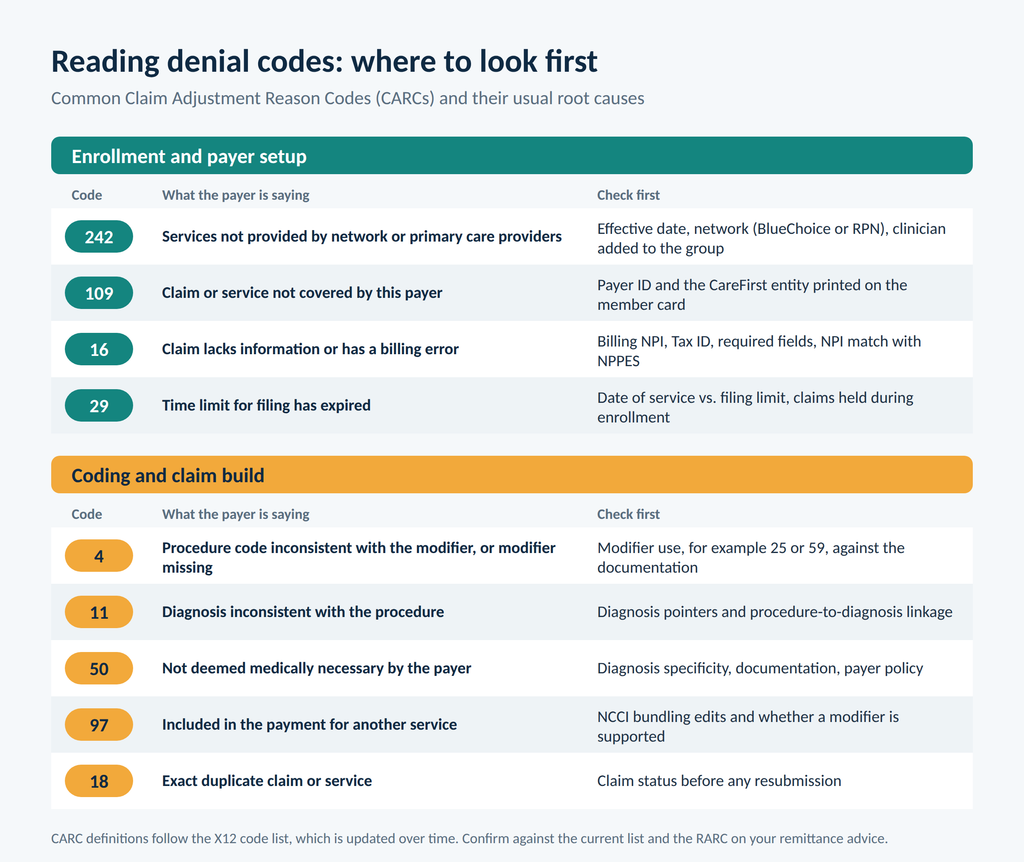
When an enrollment problem reaches a claim, the explanation on the remittance usually appears as a Claim Adjustment Reason Code (CARC). Common examples include:
- CARC 242: services not provided by network or primary care providers, which often points to an effective-date or network-status issue
- CARC 109: the claim is not covered by this payer, which can indicate the wrong payer ID or entity
- CARC 16: the claim lacks information needed for adjudication, often tied to missing or mismatched identifiers
- CARC 29: the time limit for filing has expired
Reading the code tells you where to look. But finding the root cause matters more than resubmitting. A denial caused by a credentialing gap will keep happening until the enrollment record is fixed.
The Coding Side: Where Even Perfectly Enrolled Practices Lose Money
Even with perfect enrollment, coding errors drive a large share of denials. Frequent patterns include:
- Modifier errors: a missing or incorrect modifier (for example, modifier 25 on a same-day evaluation and procedure) can trigger CARC 4 or a bundling denial.
- Diagnosis and procedure mismatches: when the diagnosis does not support the procedure, the claim can deny for medical necessity (CARC 50) or inconsistency (CARC 11).
- Bundling and NCCI edits: billing separately for services that payers consider included in another service can deny as CARC 97.
- Duplicate submissions: resubmitting without checking status can deny as CARC 18.
- Unspecified diagnosis codes: vague codes invite payer scrutiny and downcoding.
Accurate coding means selecting the code the documentation supports, linking each procedure to the right diagnosis, applying modifiers correctly, and following the payer’s policies. It protects revenue, and it also protects you in audits.
This is why we publish specialty coding guides. If you want to see how detailed code selection prevents denials, start with our guides on ophthalmology CPT codes, lithotripsy CPT codes, and general surgery CPT codes.
How Credexa Solutions Helps You Manage Denials With Accurate Codes
Credexa Solutions approaches denials as a process, not a pile of rejected claims. For CareFirst practices, that means working both sides of the problem:
- Root-cause review: each denial is traced to its source, whether an enrollment record, a payer ID, a registration error, or a coding issue, so the fix is made once instead of repeated per claim.
- Coding accuracy checks: claims are reviewed for correct CPT and ICD-10 selection, diagnosis linkage, and modifier use before submission, which reduces avoidable front-end denials.
- Payer-specific rule tracking: CareFirst’s policies, filing limits, and edits are applied claim by claim.
- Timely appeals: denials that are worth appealing are appealed with the supporting documentation, inside the payer’s deadline.
- Trend reporting: recurring denial reasons are reported back so your front desk, providers, and billing staff can fix the underlying habit.
If your CareFirst denials are piling up, a review of your last 90 days of remittances will usually show whether the cause is enrollment, registration, or coding. Contact Credexa Solutions to start with a denial review.
Can You See CareFirst Patients Before Approval?
You can treat members before approval, but as an out-of-network provider. Tell patients up front that you are out of network until your effective date and let them decide whether to proceed or wait. For urgent situations, ask CareFirst about a single case agreement. Never bill one provider’s service under another provider’s NPI to bridge a gap. That misrepresents who rendered the care and creates compliance risk.
How to Keep Your CareFirst Enrollment Active
| Task | How often |
|---|---|
| Directory attestation with CareFirst | Every 90 days |
| CAQH re-attestation | Every 120 days, with updates when data changes |
| NPPES updates | Whenever practice data changes |
| Recredentialing | Every 3 years (automatic if CAQH is current) |
| PCP panel closure notice (BlueChoice) | At least 60 days in advance |
Federal law (42 U.S.C. §300gg-115) requires plans to verify provider directory information at least every 90 days, which is why CareFirst keeps asking. Put these dates on a shared practice calendar that survives staff turnover.
Should You Handle CareFirst Credentialing In-House or Outsource It?
The real cost of credentialing is staff time and delayed revenue more than application fees. The question is who owns CAQH upkeep, roster requests, payer follow-up calls, and billing setup. When you compare vendors, look for:
- Transparent, written pricing
- A committed submission timeline
- Regular payer follow-up until a decision
- CAQH and DataSpring upkeep included
- Knowledge of CareFirst’s roster rule, MPRIME, and Maryland’s 2027 deadlines
- Billing setup handled: payer IDs, NPI matching, EFT, and ERA
- A team that connects enrollment with billing, so gaps are caught at the claim
BCBS Maryland Provider Enrollment FAQs
Is provider enrollment the same as credentialing with CareFirst?
No. Credentialing verifies the practitioner’s qualifications. Enrollment and contracting add the participation agreement, provider number, and effective date. You need both before billing in network.
Does joining one CareFirst network enroll me in the others?
No. Commercial, Medicare Advantage, Medicaid, dental, and facility networks each require their own application or addendum. Track each effective date separately.
Does CareFirst charge a credentialing application fee?
Its How to Apply page does not list one. Maryland law currently allows carriers to charge a reasonable fee, and HB 1093 repeals that permission on January 1, 2027. If you are asked for a fee, request it in writing.
What happens if CareFirst denies my application?
You will receive written notice. The source article states that practitioners can appeal in writing within 30 days. Confirm the current appeal process in CareFirst’s provider manual, and use the window to fix the underlying gap.
Can I start the application before my license is issued?
You can build your CAQH profile at any time, but CareFirst requires a valid, current license, so submit the questionnaire once the license is active.
Does my credentialing carry over if I join a new group?
Your CAQH data goes with you, but the new group must add you through Provider Updates and Attestation. You can bill in network for that group only after you receive CareFirst’s written notice.
I’m in another Blue plan. Do I still need to join CareFirst?
Yes. Each Blue company credentials separately.
Can one company handle credentialing and billing?
Yes, and doing so helps catch enrollment gaps, NPI mismatches, and wrong payer IDs at the claim stage.
Final Thoughts
BCBS Maryland provider enrollment is manageable when you treat it as a sequence: build a clean CAQH profile, authorize CareFirst, submit the right application for each network, wait for the written effective date, and set up billing correctly before your first claim. The practices that struggle are usually the ones that treat enrollment, registration, and coding as separate problems.
If you want help getting in network or cleaning up CareFirst denials, Credexa Solutions supports practices with medical billing, credentialing support, and denial management built on accurate coding. Contact Credexa Solutions to review your enrollment status and your denial trends.
Sources and Further Reading
- CareFirst Provider Site
- CareFirst Professional Credentialing Overview
- CareFirst How to Apply
- CareFirst CHPMD Become In-Network Provider
- CAQH
- Maryland Insurance Administration Bulletin 26-20
- Maryland HB 1093 (2026)
- Maryland Department of Health MPRIME
- CMS PECOS and NPPES
- 42 U.S.C. §300gg-115
Disclaimer: Credexa Solutions is not affiliated with CareFirst BlueCross BlueShield, the Maryland Insurance Administration, or the Maryland Department of Health. Requirements change, so verify each detail with CareFirst and the relevant agency before you file. This article is for education and is not legal advice.